Archive for ‘migrant workers’

05/02/2019

Across China: Migrant workers find easier way home at Spring Festival

GUANGZHOU, Feb. 4 (Xinhua) — Migrant worker Liao Guiren was more than excited to take a bullet train on his Spring Festival journey back home, the first time for the middle-aged man.

Each year during the past two decades, the 45-year-old had to endure an exhausting eight-hour bus ride from his workplace in south China’s Guangdong Province to his hometown in the city of Guigang in Guangxi Zhuang Autonomous Region, for a large annual family gathering.

But this year, the bullet train cut his travel time to less than three and a half hours.

“The traffic jams on the roads during the holiday must be worse,” Liao said when having his ticket checked at the railway station in Guangdong’s Zhongshan. “The expressways back home must be more crowded than the railway station.”

Liao said it was no easy job to buy the bus ticket back home during the festival. “I used to line up for hours at the station for tickets, and the prices often ticked up due to high demand.”

However, it took Liao a couple of minutes to buy the train ticket back home on his smartphone this year.

Liao is among a growing number of Chinese travelers who have benefited from a more convenient and efficient way to return home during the Spring Festival travel rush in recent years.

It is estimated that the annual travel rush that lasts 40 days will see 413 million railway trips across the country, up 8.3 percent from the previous year.

To meet the growing demand, China has been expanding its railway network at an unprecedented pace for decades, with the total operational length of high-speed railways reaching 29,000 km by the end of last year.

One of the country’s major newly-built railways is the Guangzhou-Shenzhen-Hong Kong Express Rail Link, which started service last year and links Hong Kong with more than 40 cities on the Chinese mainland via direct rail services.

“The railway makes it more convenient for those working in Hong Kong to return to the mainland for family gatherings,” said Siu Kin-Po, head of the Guangzhou center of the Hong Kong Federation of Trade Unions.

SMARTER TRAVEL

Liao has taken trains several times, but it was his first time to use a self-service machine to check in at the railway station.

Liao followed the instructions on the machine that explicitly explains what to do.

He put both his ticket and ID card onto the slot of the machine and waited for the facial recognition system to identify his face before the gate opened to let him pass. The whole process took less than 10 seconds.

A total of 595 self-service check-in machines have been deployed at the railway stations in Guangdong, Hunan and Hainan to streamline the check-in process, according to China Railway Guangzhou Group Co. Ltd.

Other smart technologies such as virtual reality and smart navigation machines have also been used in Chinese railway stations to help travelers ease the pressure during the travel rush.

“Smart technologies have made the rail services more fun and convenient,” Liao said. “I want to take bullet train again next year when I go home.”

Source: Xinhua
01/05/2017

Journey to the Rest: China’s Migrant Workers Top 280 Million – China Real Time Report – WSJ

Over the past two decades, Guo Wenli has traveled throughout China, everywhere except Tibet.

The 40-year-old has camped in the Gobi Desert in the north and at the foot of snow-capped mountains in the southwestern province of Yunnan.Mr. Guo isn’t a backpacker. He is one of China’s migrant workers—rural laborers who left the farm to work in factories and construction. According to an official survey, they numbered 281 million in 2016, slightly more than the previous year.

More than 65% of the country’s migrant workforce is male, 39 years old on average, and earns a monthly salary of 3,275 yuan ($475), the National Bureau of Statistics said in an annual report released Friday. More than half either work in factories (30.5%) or at construction sites (19.7%), the report said.

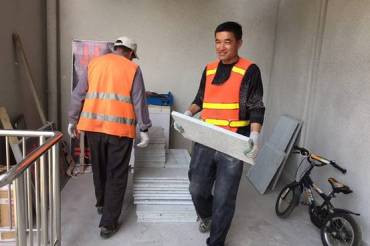
“Young people in our village with some education all find jobs at factories. Nobody wants us old folks,” said Mr. Guo, wearing an orange vest while paving sidewalks in a Beijing neighborhood known for its late-night restaurants.

This latest survey shows the migrant workforce is aging rapidly. More than 19% of migrant workers in 2016 were older than 50, compared with 14% five years ago.

More are choosing to work closer to home, especially women, who now make up 34.5% of the migrant labor force, up from 33.6% in 2015.  More migrants are also heading to western China, where the government is trying to direct investment and promote development. The migrant labor force in the west rose 5.3% from a year earlier, the survey said. In the better-off east, which has drawn a large share of foreign and private investment for years, the migrant workforce shrank marginally, by 0.3%, but the majority—56.7%—still work in those areas.

The statistics bureau carries out door-to-door visits to nearly a quarter of a million rural households every quarter for the survey.

A native of Xinxiang in the central province of Henan, Mr. Guo still keeps his farm, where he grows wheat and corn. His wife and two sons remain there, and he returns three times a year—planting season, harvesting season, and for the Lunar New Year holiday, altogether about three months. The crops bring his family an extra 3,000 to 4,000 yuan each year.

Mr. Guo said he earns about 5,000 to 6,000 yuan every month, depending on the construction job. The biggest project he worked on was the 60-story Fortune Financial Center, a landmark office tower in Beijing’s financial hub. He said he spent more than a year installing windows and other glass. He’s seen the completed building on TV, but he’s never visited it himself.

Mr. Guo, who lives in a room in a prefab hut he shares with five other coworkers, typically gets up at 5 a.m., works wherever he is sent by his boss—a contractor with the city government—and returns about 7 p.m. That’s longer than the average of 8.5 hours a day, based on the findings of the government survey.

He said he doesn’t have the time, energy or the money to go to check out the tourist sites in Beijing. His jobs usually last a few months, but he estimates, adding up the stints, he’s spent years of his life working in the capital.

Mr. Guo thinks his life is improving, because he’s earning more than in the past and isn’t living in a tent, as he has done on many jobs. While wages have been rising, the pace has slowed in recent years. Wages rose 6.6% on average last year, down from 7.2% in 2015, the official survey showed.

But he doesn’t want his two sons to follow in his footsteps; he wants them to live like city dwellers and have an easier life.

Nearly 18% of the migrant workers have purchased property in the cities in 2016, higher than the 17.3% in 2015, said the statistics bureau.

For Mr. Guo, buying an apartment Beijing, which typically cost millions of yuan, isn’t part of his dream. He wants to start his own business, growing and selling garlic, if he can get a small bank loan.

Unlike some of his fellow villagers who managed to receive zero-interest loans, he said he doesn’t have connections at the local government or at the bank to get one.

“Without a loan, I can’t do anything. I guess I’ll keep working in cities until the day I can’t move.”

Source: Journey to the Rest: China’s Migrant Workers Top 280 Million – China Real Time Report – WSJ

Law of Unintended Consequences

continuously updated blog about China & India

ChiaHou's Book Reviews

continuously updated blog about China & India

What's wrong with the world; and its economy

continuously updated blog about China & India