Archive for ‘ethnic minorities’

13/05/2020

Xinhua Headlines-Xi Focus: Xi stresses achieving moderately prosperous society in all respects

Chinese President Xi Jinping, also general secretary of the Communist Party of China Central Committee and chairman of the Central Military Commission, learns about poverty alleviation efforts at an organic daylily farm in Yunzhou District of Datong City, north China’s Shanxi Province, May 11, 2020. (Xinhua/Li Xueren)

— Xi stressed addressing the difficulties faced by enterprises in resuming production and operation.

— Xi underscored lifting the remaining poor population out of poverty.

— Xi required implementing pro-employment policies.

TAIYUAN, May 12 (Xinhua) — Chinese President Xi Jinping has stressed efforts to complete building a moderately prosperous society in all respects, and ride on the momentum to write a new chapter in socialism with Chinese characteristics for a new era.

Xi, also general secretary of the Communist Party of China (CPC) Central Committee and chairman of the Central Military Commission, made the remarks during an inspection tour in north China’s Shanxi Province.

Xi called for efforts to overcome the adverse impacts of the COVID-19 epidemic and make greater strides in high-quality transformation and development to ensure that the target of poverty eradication is reached and the building of a moderately prosperous society in all respects is completed.

During the tour from Monday to Tuesday, Xi inspected work on coordinating the regular epidemic response with economic and social development, and on consolidating the poverty eradication results.

While visiting an organic daylily farm in Yunzhou, Datong City, on Monday, Xi said what he cares about the most after poverty eradication is how to consolidate the achievements, prevent people from falling back into poverty, and make sure rural people’s incomes rise steadily.

He said an important benchmark to evaluate an official’s job performance is to see the amount of good and concrete services he or she has delivered to the people.

When visiting a community of relocated villagers, Xi said relocation is not only about better living conditions but also about chances to get rich. He called for follow-up support to residents with tailor-made rural business projects to ensure sustainable development.

Highlighting that whether the people can benefit shall be a top concern, Xi demanded more supporting policies be put in place in terms of industrial development, financing, agricultural insurance, among others.

Xi applauded the strenuous efforts made by primary-level officials on helping people fight poverty.

At the home of villager Bai Gaoshan, Xi chatted with Bai’s family as they sat on a “kang” — a bed-stove made out of clay or bricks in north China.

Chinese President Xi Jinping, also general secretary of the Communist Party of China Central Committee and chairman of the Central Military Commission, learns about poverty alleviation efforts in a village of Xiping Township in Datong City, north China’s Shanxi Province, May 11, 2020. (Xinhua/Xie Huanchi)

Xi said the CPC wholeheartedly seeks happiness for the Chinese people, having stopped collecting agricultural taxes and fees, helping the impoverished rural residents with housing and medical service, training them with skills, and finding ways for them to live a prosperous life.

“I believe our villagers will enjoy better days ahead,” Xi said.

On top of that, he called for consolidating achievements in poverty alleviation, and then focusing on rural vitalization to ensure a better life for rural residents.

He then went on to visit the 1,500-year Yungang Grottoes, a “treasure house” of artifacts featuring elements blending Chinese and foreign cultures, as well as cultures of China’s ethnic minorities and the Central Plains.

Xi stressed that historical and cultural heritages are irreplaceable precious resources, and protecting them should always be put in the first place in tourism development.

Noting that tourism should not be over-commercialized, Xi said tourism should become a way for the Chinese to understand and appreciate the culture of the nation and enhance their cultural confidence.

The historical implications of communication and integration behind the Yungang Grottoes should be further explored to enhance the sense of community for the Chinese nation, said Xi.

During a research tour in a stainless steel manufacturer in the provincial capital Taiyuan on Tuesday morning, Xi said products and technology are the lifeline of businesses, calling for more efforts in technological innovation to make a greater contribution to the development of advanced manufacturing.

He also called on businesses to strictly implement epidemic prevention and control measures to ensure the safety and health of their workers, while promoting the resumption of work and production to make up for the time lost.

Chinese President Xi Jinping, also general secretary of the Communist Party of China Central Committee and chairman of the Central Military Commission, waves to workers during a research tour in a stainless steel manufacturer in Taiyuan, capital city of north China’s Shanxi Province, May 12, 2020. (Xinhua/Li Xueren)

Later on, Xi went to check the ecological protection work of the Fenhe River in the city, and urged the incorporation of environment protection, energy revolution, green development, and economic transformation.

After hearing the work reports of the CPC Shanxi Provincial Committee and the provincial government on Tuesday afternoon, Xi stressed that no relaxation is allowed in epidemic prevention and control, noting that efforts should be made to guard against both imported infections and domestic rebounds, improve regular prevention and control mechanism, and prevent new outbreaks.

Xi called for efforts on more promptly and effectively addressing the difficulties faced by enterprises in resuming production and operation, on solid implementation of all the policies and measures for expanding domestic demand, and on strengthening the competitiveness and quality of the real economy, especially the manufacturing industry.

Chinese President Xi Jinping, also general secretary of the Communist Party of China Central Committee and chairman of the Central Military Commission, speaks with workers during a research tour in a stainless steel manufacturer in Taiyuan, capital city of north China’s Shanxi Province, May 12, 2020. (Xinhua/Xie Huanchi)

Continuous efforts should be made to promote the adjustment and optimization of China’s industrial structure, and scientific and technological innovations should be greatly enhanced to continue achieving breakthroughs in new infrastructures, technologies, materials, equipment as well as new products and business models, Xi said.

He stressed overcoming the difficulties and obstacles facing reforms in key areas, including state-owned enterprises and assets, the fiscal, tax, and financial system, business environment, the private sector, domestic demand expansion, and urban-rural integration.

Xi also highlighted efforts to improve the country’s system and mechanism for opening-up.

China will uphold the concept that lucid waters and lush mountains are invaluable assets, and steadily implement the national strategy for ecological protection and high-quality development of the Yellow River basin, he said.

More should be done to accelerate institutional innovation and strengthen the implementation of institutions to help form a green way of production and living, he said.

Efforts should be made to solidify the foundation for the development of agriculture and rural areas, beef up policy support for grain production and lift the remaining poor population out of poverty, Xi said.

Authorities should adhere to the people-centered development philosophy and ensure the bottom line of people’s livelihood, Xi said. He added that efforts should be made to implement pro-employment policies and facilitate the employment of key groups such as college graduates, veterans, rural migrant workers and urban people facing difficulties.

Efforts should be expedited to improve the weak areas in the public health system exposed by the epidemic and shift the focus of social governance to the primary levels, Xi said.

The rich and colorful local history and culture as well as revolutionary cultural resources should be fully drawn on and used to promote cultural advancement, Xi said.

He stressed consistent efforts to promote core socialist values to guide Party cadres as well as the public to enhance morality, cultivate good ethics and strengthen cultural confidence.

Xi also called for efforts to improve the Party’s political ecosystem, strictly observe the Party’s political discipline and rules and fight against corruption and undesirable conduct.

Source: Xinhua
31/08/2019

Assam NRC: What next for 1.9 million ‘stateless’ Indians?

Final Draft of National Register of Citizens of India (NRC) released on July 30, 2018Image copyright GETTY IMAGES
Image caption Four million people were stripped of their citizenship in the draft list last July

India has published the final version of a list which effectively strips about 1.9 million people in the north-eastern state of Assam of their citizenship.

The National Register of Citizens (NRC) is a list of people who can prove they came to the state by 24 March 1971, the day before neighbouring Bangladesh declared independence from Pakistan.

People left off the list will have 120 days to appeal against their exclusion.

It is unclear what happens next.

India says the process is needed to identify illegal Bangladeshi migrants.

It has already detained thousands of people suspected of being foreigners in temporary camps which are housed in the state’s prisons, but deportation is currently not an option for the country.

The process has also sparked criticism of “witch hunts” against Assam’s ethnic minorities.

A draft version of the list published last year had four million people excluded.

What is the registry of citizens?

The NRC was created in 1951 to determine who was born in Assam and is therefore Indian, and who might be a migrant from neighbouring Bangladesh.

The register has been updated for the first time.

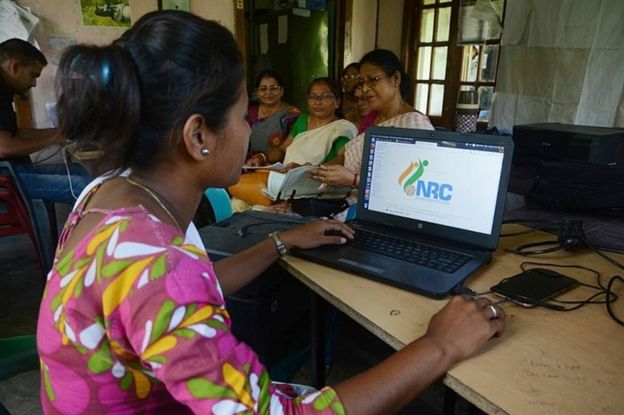
Indian worker of National Register of Citizens (NRC) office checks different documents which were submitted by people for NRC ahead of the release of the final draft of NRC in Guwahati, Assam, India, 26 August 2019.Image copyright EPA
Image caption The NRC was created in 1951 to determine who was born in the state and is Indian

Families in the state have been required to provide documentation to show their lineage, with those who cannot prove their citizenship deemed illegal foreigners.

Prime Minister Narendra Modi’s Hindu nationalist Bharatiya Janata Party (BJP) has long railed against illegal immigration in India but has made the NRC a priority in recent years.

Presentational grey line

An anxious wait

By Rajini Vaidyanathan, BBC News, Assam

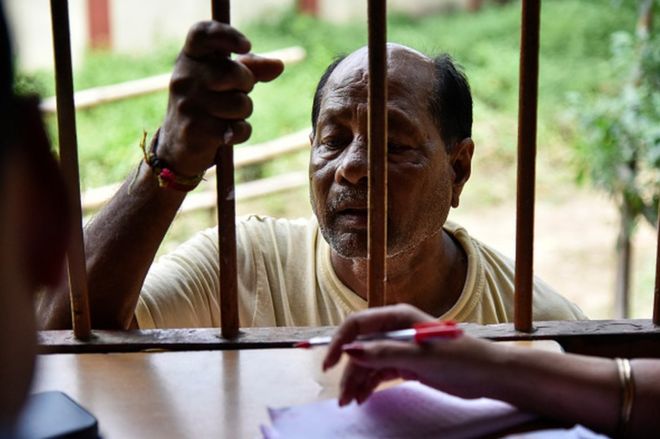
A small community centre in the village of Katajhar is being guarded by two members of the Indian army. Outside, a line of people wait. Some are clutching plastic bags containing documents.

As they enter one of two rooms, an official runs his eyes down a print-out to see if their names or photos are on it. This list – the National Register of Citizens – is one with huge consequences. And so there’s fear and trepidation as people here find out whether they’ve been included.

Many here who haven’t made it tell me it’s a mistake as they show me paperwork they say proves they belong in this country.

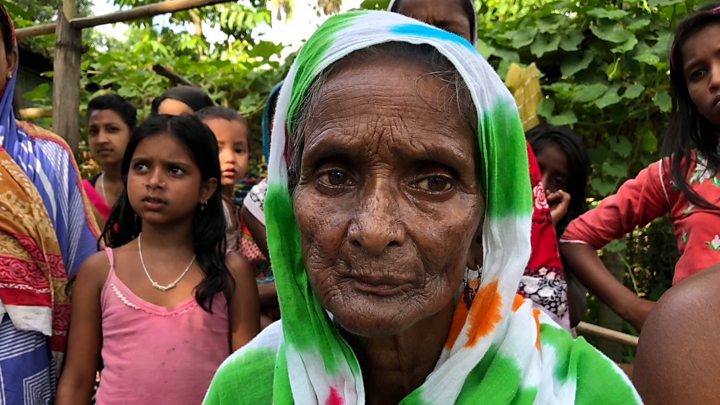
None of Asia Khatun’s family of nine made the list. They now have the chance to appeal but there’s real fear about what might come next. “I’d rather die than go to a detention centre,” she tells me. People here are angry but they’re also scared.

Presentational grey line

Why is the registry happening in Assam?

Assam is one India’s most multi-ethnic states. Questions of identity and citizenship have long vexed a vast number of people living there.

Among its residents are Bengali and Assamese-speaking Hindus, as well as a medley of tribespeople.

A third of the state’s 32 million residents are Muslims, the second-highest number after Indian-administered Kashmir. Many of them are descendants of immigrants who settled there under British rule.

But illegal migration from neighbouring Bangladesh, which shares a 4,000-km long border with India, has been a concern there for decades now. The government said in 2016 that an estimated 20 million illegal immigrants were living in India.

So have 1.9 million people effectively become stateless?

Not quite. Residents excluded from the list can appeal to the specially formed courts called Foreigners Tribunals, as well as the high court and Supreme Court.

However, a potentially long and exhaustive appeals process will mean that India’s already overburdened courts will be further clogged, and poor people left off the list will struggle to raise money to fight their cases.

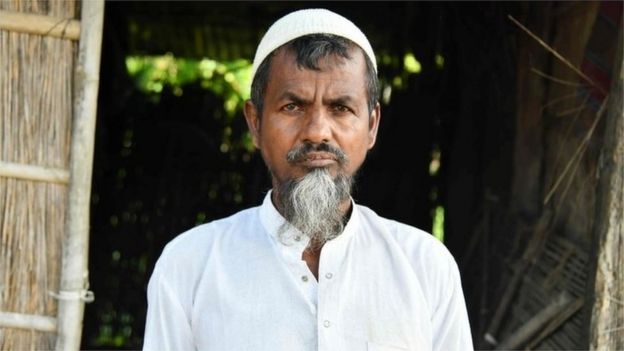
In this photo taken on August 29, 2019, Saheb Ali, 55, poses for a photograph at his home in Khutamari village in Goalpara district, some 160km from Guwahati, the capital city of India's north-eastern state of AssamImage copyright AFP
Image caption Saheb Ali, 55, from Goalpara district, has not been included in the list

If people lose their appeals in higher courts, they could be detained indefinitely.

Some 1,000 people declared as foreigners earlier are already lodged in six detention centres located in prisons. Mr Modi’s government is also building an exclusive detention centre, which can hold 3,000 detainees.

“People whose names are not on the final list are really anxious about what lies ahead. One of the reasons is that the Foreigners Tribunal does not have a good reputation, and many people are worried that they will have to go through this process,” Sangeeta Barooah Pisharoty, author of Assam: The Accord, The Discord, told the BBC.

Why have been the courts so controversial?

The special courts were first set up in 1964, and since then they have declared more than 100,000 people foreigners. They regularly identify “doubtful voters” or “illegal infiltrators” as foreigners to be deported.

But the workings of the specially formed Foreigners Tribunals, which have been hearing the contested cases, have been mired in controversy.

There are more than 200 such courts in Assam today, and their numbers are expected to go up to 1,000 by October. The majority of these tribunals were set up after the BJP came to power in 2014.

The courts have been accused of bias and their workings have often been opaque and riddled with inconsistencies.

Media caption Living in limbo: Assam’s four million unwanted

For one thing, the burden of proof is on the accused or the alleged foreigner.

For another, many families are unable to produce documents due to poor record-keeping, illiteracy or because they lack the money to file a legal claim.

People have been declared foreigners by the courts because of differences in spellings of names or ages in voter rolls, and problems in getting identity documents certified by authorities. Amnesty International has described the work by the special courts as “shoddy and lackadaisical”.

Journalist Rohini Mohan analysed more than 500 judgements by these courtsin one district and found 82% of the people on trial had been declared foreigners. She also found more Muslims had been declared foreigners, and 78% of the orders were delivered without the accused being ever heard – the police said they were “absconding”, but Mohan found many of them living in their villages and unaware they had been declared foreigners.

“The Foreigners Tribunal,” she says, “must be made more transparent and accountable.”

A decorated Indian army veteran, Mohammed Sanaullah spent 11 days in a detention camp in June after being declared a “foreigner”, prompting national outrage.

Both the citizen’s register and the tribunals have also sparked fears of a witch hunt against Assam’s ethnic minorities.

Have the minorities been targeted?

Many say the list has nothing to do with religion, but activists see it as targeting the state’s Bengali community, a large portion of whom are Muslims.

They also point to the plight of Rohingya Muslims in neighbouring Bangladesh.

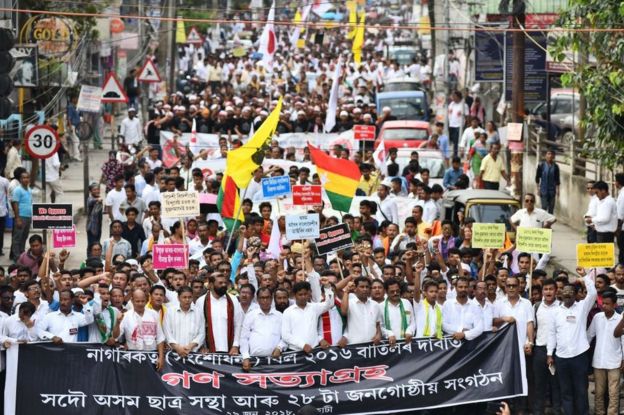
Activists in Assam take part in a protest against the a bill that seeks to give Hindu migrants more rights.Image copyright GETTY IMAGES
Image caption The move to make millions of people stateless will probably spark protests

However significant numbers of Bengali-speaking Hindus have also been left off the citizenship list, underscoring the communal and ethnic tensions in the state

“One of the communities worst affected by the list are the Bengali Hindus. There are as many of them in detention camps as Muslims. This is also the reason just days before NRC is to be published the BJP has changed tack, from taking credit for it to calling it error-ridden. That is because the Bengali Hindus are a strong voter base of the BJP,” says Barooah Pisharoty.

The human tragedy

Fearing possible loss of citizenship and detention after exclusion from the list, scores of Bengali Hindus and Muslims have killed themselves since the process to update the citizen register started in 2015, activists say.

And in an echo of US President Donald Trump’s policy to separate undocumented parents and children, families have been similarly broken up in Assam.

Detainees have complained of poor living conditions and overcrowding in the detention centres.

Bhaben Das' family get ready to perform his final ritesImage copyright CITIZENS FOR JUSTICE AND PEACE
Image caption A father and son killed themselves 30 years apart because of citizenship doubts (photo shows funeral)

One detainee told a rights group after his release he had been taken to a room which had a capacity for 40 people, but was filled with around 120 people. People who have been declared foreigners as well as many inmates have been suffering from depression. Children have also been detained with their parents.

Human rights activist Harsh Mander, who visited two detention centres, has spoken about a situation of “grave and extensive human distress and suffering”.

What happens to people who are declared foreigners?

The BJP which rules the state, has insisted in the past that illegal Muslim immigrants will be deported. But neighbouring Bangladesh will definitely not accede to such a request.

Many believe that India will end up creating the newest cohort of stateless people, raising the spectre of a homegrown crisis that will echo that of the Rohingya people who fled Myanmar for Bangladesh.

It is not clear whether the people stripped of their Indian citizenship will be able to access welfare or own property.

One possibility is that once they are released, they will be given work permits with some basic rights, but will not be allowed to vote.

Source: The BBC

22/04/2019

China lifts 3 ethnic minorities out of poverty

KUNMING, April 21 (Xinhua) — China has lifted three ethnic minority groups out of poverty in the southwestern province of Yunnan as it steps toward delivering the goal of completely eliminating poverty by 2020.

The ethnic minority groups of Dulong, Deang and Jino had a total population of more than 50,000, according to the last national population census in 2010.

The proportion of residents living in poverty has been reduced from 24.25 percent a few years ago to 2.42 percent, well below the required 3 percent that removes them from the poverty list in western China.

The ethnic minority groups of Dulong, Deang and Jino live in the mountainous regions in the northwestern, western and southern parts of Yunnan, respectively.

Huang Yunbo, head of the provincial office of poverty alleviation and development, said a total of seven ethnic minority groups will be removed from the poverty list this year.

The number of such ethnic groups who are lifted out of poverty will reach 11 by 2020, Huang said.

The battle against poverty is one of the “three tough battles” that the country must win to build a moderately prosperous society in all respects by 2020. To achieve the goal, China needs to lift around 30 million poor rural residents out of poverty between 2018 and 2020.

Source: Xinhua

Law of Unintended Consequences

continuously updated blog about China & India

ChiaHou's Book Reviews

continuously updated blog about China & India

What's wrong with the world; and its economy

continuously updated blog about China & India