Archive for ‘Europe’

21/02/2019

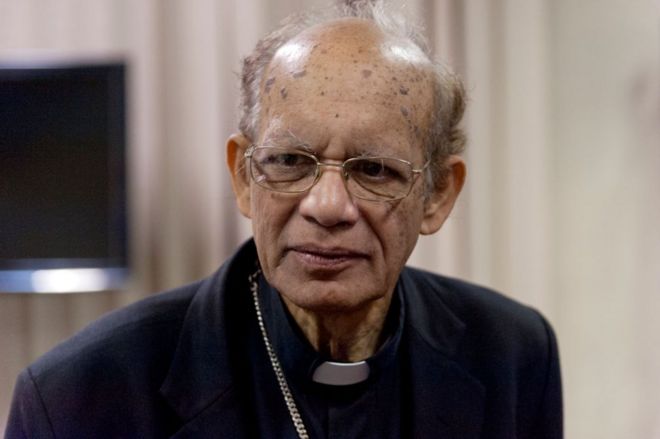
India Catholic Cardinal Oswald Gracias ‘failed abuse victims’

Cardinal Oswald Gracias, Archbishop of Bombay, during the launch of the bishops' declaration on climate justice on 26 October 2018 in Rome, Italy.Image copyrightGETTY IMAGES
Image captionCardinal Oswald Gracias told the BBC it pained him to hear accusations that he had neglected victims of alleged abuse

One of the Catholic Church’s most senior cardinals has admitted that he could have better handled sexual abuse allegations that were brought to him.

Oswald Gracias, the Archbishop of Mumbai is one of four men organising a major Vatican conference on child abuse this week.

We found two separate cases where the cardinal, who is tipped by some to possibly become the next Pope, is claimed to have failed to respond quickly or offer support to the victims.

Victims and those who supported them allege that Cardinal Gracias did not take allegations of abuse seriously when they were reported to him.

India’s Catholics say there is a culture of fear and silence in the Catholic Church about sexual abuse by priests. Those who have dared to speak out say it has been an ordeal.

‘My heart was hurt’

The first case dates back to 2015 in Mumbai.

A woman’s life changed when her son returned from Mass at the church and told her that the parish priest had raped him.

“I could not understand what should I do?” she said. She did not know this yet, but this event would put her on a collision course with the Catholic Church in India.

Media captionWhy is India’s Catholic church silent about sexual abuse?

The man she reached out to for help was and remains one of the most senior representatives of the Church.

It was nearly 72 hours after the alleged rape that the family briefly met Cardinal Gracias, then president of the Catholic Bishop’s Conference of India and Federation of Asian Bishops’ Conferences.

The issue of sexual abuse within the Church is being called the Vatican’s biggest crisis in modern times, and the integrity of the Catholic Church is said to ride on the outcome of this conference.

Pope Francis, flanked by Archbishop of Bombay Cardinal Oswald Gracias (L) and other bishops, arrives at Synod Hall in Vatican City on 24 October 2015Image copyrightGETTY IMAGES
Image captionPope Francis with Cardinal Oswald Gracias (fourth from left)

Over the past year, the Catholic Church has been reeling under multiple allegations of sexual abuse around the world.

But while abuse claims have made headlines in North and South America, Europe and Australia, very little is known about the problems in Asian countries. In countries such as India there is a social stigma about reporting abuse.

Among Christians, who are a minority of nearly 28 million people, a culture of fear and silence makes it impossible to gauge the true scale of the problem.

Cardinal Blase Cupich of Chicago – a colleague of Cardinal Gracias on the four-member organising committee – has promised that decisive action in Rome and in dioceses worldwide will follow after the meeting so as to safeguard children and bring justice to the victims.

Cardinal Gracias will open the second day of the summit with a conversation about accountability in the Church.

Media captionBrigitte, a survivor of child sex abuse by a chaplain, explains why she is ready to speak now

This vital role given to him during this crucial conference has made some in India unhappy.

They say his track record in protecting children and women from abusers is questionable. Those we have spoken to who have taken cases to him say they received little support from him.

The mother of the abused boy said: “I told the cardinal about what the priest had done to my child, that my child was in a lot of pain. So he prayed for us and told us he had to go to Rome…my heart was hurt in that moment.

“As a mother, I had gone to him with great expectations that he would think about my son, give me justice, but he said he had no time, he only cared about going to Rome.”

The family say they requested medical help but were offered none.

The cardinal told us it pained him to hear this, and that he was not aware that the boy needed medical help – and if he had been asked, he would have immediately offered it.

The Archbishop's house in Mumbai

The cardinal admits he left for Rome that night without alerting the authorities.

By failing to call the police, Cardinal Gracias may have violated India’s Protection of Children from Sexual Offences Act, 2012 (POCSO).

The provisions of this law state that if the head of any company or institution fails to report the commission of an offence in respect of a subordinate under his control, they shall be punished with imprisonment for a term which may extend to one year, and with a fine.

The cardinal told us he had telephoned his bishop the next day, who told him the family had subsequently informed the police themselves.

Asked if he regretted not calling the police personally at the time, he said: “You know I’m being honest, I’m not 100% sure… but I must reflect on that. I admit whether immediately, the police should have got involved, sure.”

He says he was under a duty to evaluate the credibility of accusations by speaking to the accused man.

Emerging from that meeting, the family decided to go to a doctor.

“He took one look at my boy and said that something has happened to him. This is a police case. Either you report it or I will… so we went to the police that night,” the mother said.

A police medical examination found that the child had been sexually assaulted.

Indian Catholics pray during Friday afternoon service at the Holy Name Cathedral in Mumbai on 15 March 2013.Image copyrightGETTY IMAGES
Image captionIndia is home to about 19 million Catholics

A current priest who spoke to us on the condition of anonymity said this was not the first time allegations about this priest had been brought to the cardinal’s attention.

“I met him some years before this [alleged] incident,” the priest told us.

“There were strong rumours about [the accused priest] in the diocese, and like these are about abuse that is taking place. And yet he seems to be moving from one place to another, one parish to another. The cardinal told me directly that he is not aware directly of all these things.”

The cardinal says he cannot recall the conversation. He says he did not recollect any “cloud of suspicion” over the man.

‘A lonely battle’

As part of our investigation, we wanted to see if there were other allegations of the cardinal being slow to act.

We found an instance dating back almost a decade, brought to his attention just a couple of years after becoming archbishop of Mumbai.

Virginia Saldanha.
Image captionCatholic activist Virginia Saldanha says three legal notices were sent to the cardinal, threatening court action unless took action about the claims of abuse

In March 2009, a woman approached him with accusations of sexual abuse by another priest who conducted retreats.

She says that he took no action against the priest so she reached out to a group of female Catholic activists, who say they forced the cardinal to act.

Under pressure, he finally set up an enquiry committee in December 2011. Six months after the enquiry, there was still no action and the accused priest continued working in his parish.

“We had to send the cardinal three legal notices to act, threaten to take the matter to the courts if he did not act,” said Virginia Saldanha, a devout Catholic who has worked on the women’s desk of multiple Church-affiliated positions for over two decades.

When the cardinal replied, he said: “The priest is not listening to me.”

Blurred image of family
Image captionThe family says they have been ostracised from the church and isolated within their communities since reporting the sexual assault

During the time, Saldanha said she had to leave the church because “I could not bear to see that man giving Mass in the church. I did not feel like going there.”

The priest was eventually removed from his parish, but the reasons for his departure were never made public.

The punishment, decided by the cardinal personally in October 2011, was a “guided retreat and therapeutic counselling”.

When we pressed him about the speed of process and punishment, the cardinal said it was a “complicated case”.

After a stay in the seminary, the accused priest was briefly given a parish again and still conducts retreats.

Meanwhile, the family of the allegedly raped minor feel abandoned by the institution that they had built their lives around.

“It has been a lonely battle,” the mother concedes. They say they have been ostracised from the church and isolated within their communities.

“After complaining to the police, when we would go into church, people would refuse to talk to us, to sit next to us during Mass. If I went to sit next to someone… they would get up and leave,” she said.

The hostility she encountered eventually “made us leave the church. But it got so difficult for us that we eventually had to change our home as well. We left it all behind”.

Church members say that it is this hostility that makes it harder for victims and their families to speak up.

Caught between an apparently unsupportive clergy and hostile social network, many find their voices faltering.

Source: The BBC
17/02/2019

China-Europe great example of cultural dialogue, engagement: senior Chinese official

MUNICH, Germany, Feb. 16 (Xinhua) — People-to-people and cultural exchanges are thriving, making China and Europe a great example of cultural dialogue and engagement, a senior Chinese official said here Saturday.

Yang Jiechi, a member of the Political Bureau of the Communist Party of China (CPC) Central Committee, said this in his keynote speech themed “Working for a Community with a Shared Future for Mankind by Promoting International Cooperation and Multilateralism” at the 55th Munich Security Conference.

Fifteen years since the establishment of the China-EU comprehensive strategic partnership, the two sides have developed an all-dimensional and multi-tiered framework of exchanges and cooperation covering wide-ranging areas, said Yang, who is also director of the Office of the Foreign Affairs Commission of the CPC Central Committee.

Efforts to build China-EU partnerships for peace, growth, reform and civilization have made substantial progress, Yang noted.

“It is essential that our two sides continue to draw on each other’s strengths, focus on shared interests, remove obstacles and work together to seize the opportunities presented by the Fourth Industrial Revolution and meet our people’s aspirations for a better life,” said the official.

This year marks the 70th anniversary of the founding of the People’s Republic of China. Under the leadership of the Communist Party of China, Yang said, the country has embarked on the right path, one that is suited to its national conditions and follows the trend of the times.

The Chinese economy has entered a new phase of transitioning from high-speed growth to high quality development, operating within a proper range and maintaining overall stability and continued progress, he added.

“Facing lackluster new drivers and mounting downward pressure in the global economic context, China has enough resilience and huge potential to keep the economy on a sound track for a long time to come,” Yang said.

The enormous effective demand being generated by the 1.4 billion Chinese people who are moving up the income ladder will provide the world with even more opportunities in terms of market, investment and cooperation, he reassured.

Source: Xinhua

17/02/2019

China says no to Germany’s call for arms control deal with US and Russia

  • German Chancellor Angela Merkel makes appeal to Beijing at Munich Security Conference as Washington prepares to leave INF treaty
  • But China’s top diplomat Yang Jiechi says nation’s missiles are defensive, do not pose a threat
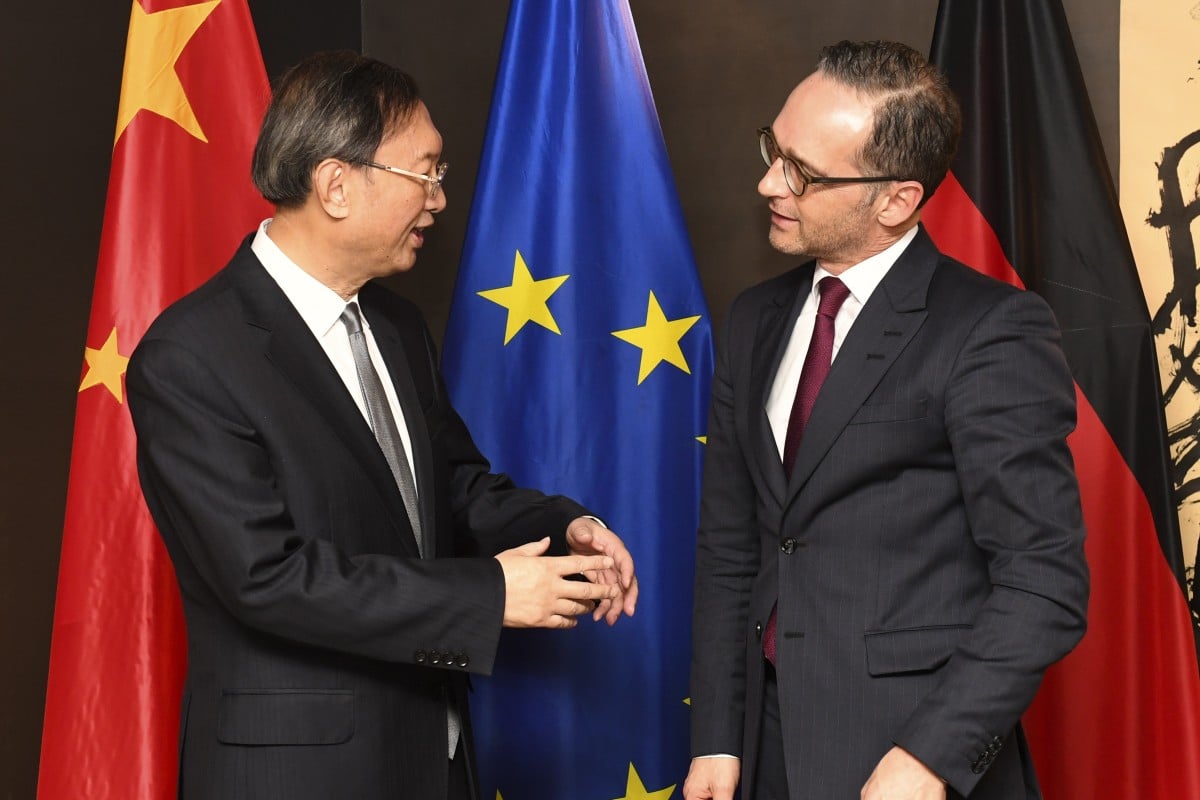
Chinea’s top envoy Yang Jiechi chats to German Foreign Minister Heiko Maas at the Munich Security Conference. Photo: AP

China on Saturday rejected German Chancellor Angela Merkel’s appeal to join a cold war-era arms control treaty that the United States accuses Russia of breaching, saying it would place unfair limits on its military.

Fearing a nuclear arms race between China, Russia and the US after the collapse of the Intermediate-Range Nuclear Forces (INF) treaty, which the US is withdrawing from, Merkel made her call for a global treaty.

“Disarmament is something that concerns us all and we would of course be glad if such talks were held not just between the United States, Europe and Russia but also with China,” she told the Munich Security Conference.

Is China about to abandon its ‘no first use’ nuclear weapons policy?

Russia and the United States are the signatories to the 1987 INF treaty that bans land-based missiles with a range between 500km (310 miles) and 5,500km, and which US President Donald Trump started the six-month withdrawal from this month, blaming Russian violations.

Moscow denies any wrongdoing, but the US and its Nato allies want Russia to destroy its 9M729 nuclear-capable cruise missile system, which Washington says could allow Russia to strike Europe with almost no warning.

Merkel’s suggestion of involving China in a negotiation is seen by European Nato diplomats as a potential way out of the impasse because a new treaty could address American concerns about a growing military threat from China and Russia.

“China develops its capabilities strictly according to its defensive needs and doesn’t pose a threat to anybody else. So we are opposed to the multilateralisation of the INF,” he said.

China’s stated ambition is to modernise its People’s Liberation Army by 2035, improve its air force and push into new technologies including very high speed cruise missiles and artificial intelligence.

Its defence budget grew nearly 6 per cent between 2017 and 2018, according to the London-based International Institute for Security Studies.

Chinese scientists make progress on nuclear submarine communication

Retired Chinese general Yao Yunzhu told delegates a new arms control agreement would only work if it included sea- and air-launched missiles, as well as land, because most of China’s military technology was ground-based and the country would not want to put itself at a disadvantage.

Cheaper to build, more mobile and easier to hide, ground-based rocket launchers are an attractive option for China as it develops its armed forces, experts said, whereas the United States operates more costly sea-based systems to comply with the INF.

“China is traditionally a land power and the Chinese military is a ground force,” Yao said.

“If China is to enter into these kinds of negotiations, I think it ought to be more comprehensive to include not only land-based but also air and sea-based strike capabilities … and that would be hugely complicated,” she said.

Source: SCMP

07/01/2019

More freight trains travel between Chongqing, Europe in 2018

CHONGQING, Jan. 6 (Xinhua) — A total of 1,442 freight trains traveled between Chongqing and European countries last year, an increase of 117 percent compared with the previous year, the YUXINOU (Chongqing) Logistics Co., Ltd announced on Saturday.

The number of trains traveling from Europe back to Chongqing reached 728, surpassing the number of outbound trains for the first time, according to the company.

Chongqing launched more cargo train routes last year, connecting the city with Belarus, Vietnam and Iran, said Qi Dan, general manager of the company.

Currently, the outbound train reaches over 30 European countries, and the goods brought back can be transferred to other Chinese cities and Southeast Asia, Qi said.

In May 2011, a rail route was opened between Chongqing and Duisburg in Germany, marking the start of the China-Europe cargo train service.

The varieties of goods transported via the trains have expanded to electronic products, cars, mechanical products, coffee beans and clothes, Qi added.

14/12/2018

World stocks tumble on weak economic data from China and Europe

LONDON (Reuters) – Stocks worldwide tumbled on Friday after weak economic data from China and Europe fanned concerns of a global economic slowdown and left investors fretting over the wider impact of a still-unresolved Sino-U.S. trade dispute.

The MSCI All-Country World Index .MIWD00000PUS, which tracks stocks across 47 countries, was down half a percent.

Euro zone business ended the year on a weak note, expanding at the slowest pace in over four years as new order growth all but dried up, hurt by trade tensions and violent protests in France, a survey showed.

Another survey showed French business activity plunged unexpectedly into contraction this month, retreating at the fastest pace in over four years in the face of violent anti-government protests.

Germany’s private sector expansion slowed to a four-year low, meanwhile, suggesting growth in Europe’s largest economy may be weak in the final quarter.

The data out of Europe added to weak readings from China, where November retail sales grew at the weakest pace since 2003 and industrial output rose the least in nearly three years, underlining risks to the economy as Beijing works to defuse a trade dispute with the United States.

Stock markets in Europe opened sharply lower, with Germany’s DAX index .GDAXIfalling 1-1/2 percent. The pan-European STOXX 600 index was down 1.3 percent. [.EU]

“The data this morning out of France really hasn’t helped the mood. You look at China data, you look at the flash PMIs out of France and Germany and they’ve really sort of reinforced concerns that the global economy is slowing down,” said Michael Hewson, chief markets analyst at CMC Markets in London.

“Ultimately, I think it rather questions the wisdom of the ECB ending its asset purchase programme at the end of this month. You’ve got Mario Draghi basically tightening into a downturn.”

MSCI’s broadest index of Asia-Pacific shares outside Japan .MIAPJ0000PUS fell 1.5 percent. Japan’s Nikkei .N225, also dragged down by the country’s weak tankan sentiment index, dropped 2.0 percent.

China’s benchmark Shanghai Composite .SSEC and the blue-chip CSI 300 .CSI300closed down 1.5 percent and 1.7 percent, respectively, and Hong Kong’s Hang Seng .HSI was off 1.5 percent.

A Chinese statistics bureau spokesman said the November data showed downward pressure on the economy is increasing.

The data “means that the worst is yet to come and policymakers will be very worried, particularly with consumption growth falling off a cliff,” said Sue Trinh, head of Asia FX strategy at RBC Capital Markets in Hong Kong.

“So I expect further support measures including rate cuts will come in coming weeks, although these data would indicate measures to date aren’t really working.”

The Chinese yuan weakened 0.4 percent to 6.9063 per dollar CNH=D4 in offshore trade following the data.

“Although hopes of progress in U.S.-China talks and cheap valuations are supporting the market for now, we have lots of potential pitfalls,” said Nobuhiko Kuramochi, chief strategist at Mizuho Securities.

“If U.S. shares fall below their triple bottoms hit recently, that would be a very weak technical sign.”

Overnight on Wall Street, the S&P 500 .SPX ticked down 0.02 percent to 2,650, not far from its 6-1/2-month closing low of 2,633 touched on Nov. 23, while the Nasdaq Composite .IXIC dropped 0.39 percent.

U.S. corporate earnings due next month could throw a spotlight on the impact from the U.S. tariffs on imports from China, while there is risk of a government shutdown and further political stalemate in a divided U.S. congress, Kuramochi added.

In the currency market, the euro was down 0.7 percent after the weak PMIs, last changing hands at $1.1293.[FRX/]

Sterling’s rally fizzled as signs that the British parliament was headed towards a deadlock over Brexit prompted traders to take profits from its gains made after Prime Minister Theresa May had survived a no-confidence vote.

The European Union has said the agreed Brexit deal is not open for renegotiation even though its leaders on Thursday gave May assurances that they would seek to agree a new pact with Britain by 2021 so that the contentious Irish “backstop” is never triggered.

The pound fell 0.6 percent to $1.2615 GBP=D3, on track to post its fifth consecutive week of losses. It was down 0.9 percent so far this week.

The dollar stood at 113.48 yen JPY=, down 0.1 percent on the day but above this week’s low of 112.245 set on Monday.

Oil prices gave up some of their Thursday’s gains following inventory declines in the United States and expectations that the global oil market could have a deficit sooner than they had previously thought.

U.S. crude futures CLc1 edged down 0.5 percent to $52.32 per barrel and Brent crude LCOc1 slipped 0.6 percent to $61.09, after both gained more than 2.5 percent on Thursday.

Cryptocurrency Bitcoin BTC=BTSP fell as low as $3,200, a fresh 15-month low.

A rash of bomb threats were emailed on Thursday to hundreds of businesses, public offices and schools across the United States and Canada demanding payment in cryptocurrency, but none of the threats appeared credible, law enforcement officials said.

14/12/2018

Trips made by China-Europe freight trains surge in 2018

CHINA-EUROPE-FREIGHT TRAINS TRIPS-SURGING

Staff unload containers from the freight train X8044 after the train from Hamburg of Germany arrived at Wujiashan railway container center station in Wuhan, central China’s Hubei Province, Aug. 26, 2018. China-Europe freight trains made 5,611 trips in the first 11 months of 2018, surging 72 percent compared with the same period last year, according to a meeting held in southwest China’s Sichuan Province. In 2017, more than 3,000 trips were made via the China-Europe freight trains between cities on the two continents. The number is expected to reach 6,000 in 2018, according to the meeting held by the Transport

Photo taken on May 21, 2018 shows a cross-border e-commerce freight train from Hamburg of Germany arriving in Xi’an, northwest China’s Shaanxi Province. China-Europe freight trains made 5,611 trips in the first 11 months of 2018, surging 72 percent compared with the same period last year, according to a meeting held in southwest China’s Sichuan Province. In 2017, more than 3,000 trips were made via the China-Europe freight trains between cities on the two continents. The number is expected to reach 6,000 in 2018, according to the meeting held by the Transport Coordinating Committee of China Railway Corporation’s China-Europe project. As of November, the trains connect 56 Chinese cities with 49 European cities in 15 European countries. The number of trips from Europe to China has increased and accounted for 71 percent of the trips to Europe, according to the committee. In late August, the trains marked their 10,000th trip since beginning operations in March 2011. The China-Europe freight rail services have pushed forward China’s opening-up and boosted economic and trade cooperation with countries along the Belt and Road, the China Railway Corporation said in a statement. This year marks the fifth anniversary of the Belt and Road Initiative, a transnational network connecting Asia with Europe, Africa and beyond. Over the past five years, China’s trade in goods with countries along the Belt and Road exceeded 5.5 trillion U.S. dollars. Chinese direct investment in the non-financial sectors of these countries reached 80 billion dollars during the same period. (Xinhua/Li Yibo)

CHENGDU, Dec. 13 (Xinhua) — China-Europe freight trains made 5,611 trips in the first 11 months of 2018, surging 72 percent compared with the same period last year, according to a meeting held in southwest China’s Sichuan Province.

In 2017, more than 3,000 trips were made via the China-Europe freight trains between cities on the two continents. The number is expected to reach 6,000 in 2018, according to the meeting held by the Transport Coordinating Committee of China Railway Corporation’s China-Europe project.

As of November, the trains connect 56 Chinese cities with 49 European cities in 15 European countries. The number of trips from Europe to China has increased and accounted for 71 percent of the trips to Europe, according to the committee.

In late August, the trains marked their 10,000th trip since beginning operations in March 2011.

The China-Europe freight rail services have pushed forward China’s opening-up and boosted economic and trade cooperation with countries along the Belt and Road, the China Railway Corporation said in a statement.

This year marks the fifth anniversary of the Belt and Road Initiative, a transnational network connecting Asia with Europe, Africa and beyond.

Over the past five years, China’s trade in goods with countries along the Belt and Road exceeded 5.5 trillion U.S. dollars. Chinese direct investment in the non-financial sectors of these countries reached 80 billion dollars during the same period.

Law of Unintended Consequences

continuously updated blog about China & India

ChiaHou's Book Reviews

continuously updated blog about China & India

What's wrong with the world; and its economy

continuously updated blog about China & India