Chindia Alert: You’ll be Living in their World Very Soon
aims to alert you to the threats and opportunities that China and India present. China and India require serious attention; case of ‘hidden dragon and crouching tiger’.
Without this attention, governments, businesses and, indeed, individuals may find themselves at a great disadvantage sooner rather than later.
The POSTs (front webpages) are mainly 'cuttings' from reliable sources, updated continuously.
The PAGEs (see Tabs, above) attempt to make the information more meaningful by putting some structure to the information we have researched and assembled since 2006.
Project will examine whether earthquake and changing wind speeds have affected peak’s snowcap
Survey team hoping the BeiDou satellite navigation system and other Chinese technology can help them find the answer
A Chinese team is preparing to determine the exact height of Mount Everest. Photo: AFP
China is sending a surveying and mapping team to the summit of Mount Everest this month in a bid to end the long-running debate over the precise height of the world’s tallest mountain.
The mission was announced on Wednesday at one of the mountain’s base camps in Tibet, where a team of 53 surveyors has been making technical preparations since March 2. The team will use China’s BeiDou navigation satellite system and Chinese surveying instruments for the project.
Mount Everest – known as Sagarmatha in Nepal and Qomolangma in Tibet – lies in the Himalayas on the border between China and Nepal. The two countries have long disputed whether measurements of the mountain should include its snowcap or be limited to the rock base.
Nepal suspends Everest permits over coronavirus
In 2005, a Chinese expedition assessed the peak and measured the height from both the rock base and from the top of the snowfall. The result, a rock height of 8,844.43 metres (29,017.2 feet), was declared by China to be the most accurate and precise measurement to date.
Nepal has long held that Everest’s snowcap should be included, putting the iconic peak at 8,848 metres, a height which is widely accepted. However, geologists believe the snowcap may have shrunk by several centimetres after the magnitude 8.1 earthquake in 2015. Changing wind speeds are also believed to have affected it.
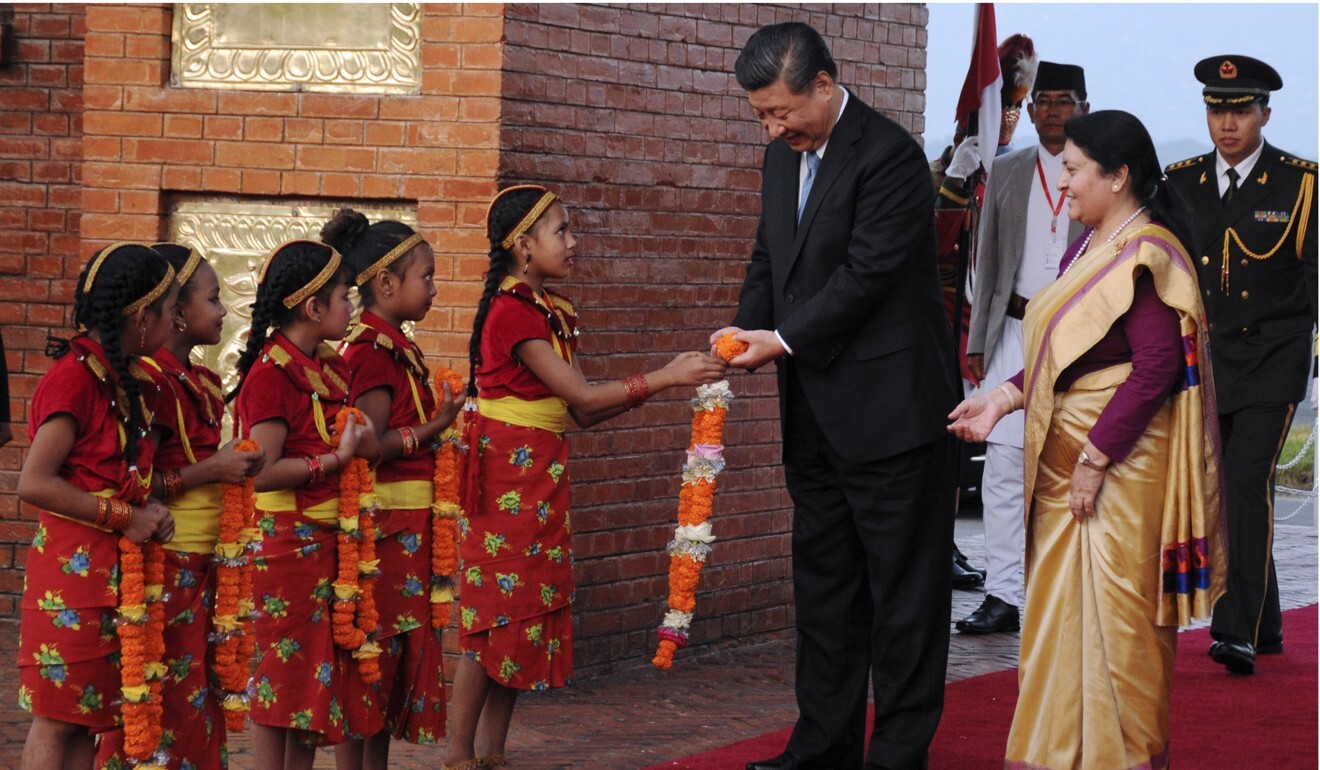
Chinese President Xi Jinping visited Nepal in October. Photo: EPA-EFE
Following a state visit to Nepal by Chinese President Xi Jinping in October, the two countries agreed to jointly launch a scientific research project to determine the exact height of Everest, recognising the peak as “an eternal symbol of the friendship between the two countries”.
China’s natural resources ministry said the project indicated a new step in the friendship and highlighted the historical significance of the mission, which coincides with the 60th anniversary of the first Chinese ascent of the mountain’s north side as well as the 45th anniversary of China’s first precise measurement of the peak.
The results of the survey will be used for geodynamics research and the precise depth of the summit’s snowcap, meteorological and wind speed data will offer first-hand materials for glacier monitoring and biological environment protection.
In a separate development, China Mobile said on Thursday that the entire peak now had 5G coverage.
In a joint project with Huawei, 5G antennas were installed at the mountain’s advance base camp, at a height of 6,500 metres. Antennas were installed earlier in April at the lower base camp, at 5,300 metres and at 5,800 metres.
Parliament earlier this month passed a Constitution amendment bill providing for 10 per cent reservation in government jobs and education for economically weaker sections in the general category.
SNS Web | New Delhi | January 25, 2019 12:01 pm
The Supreme Court on Friday refused to stay the implementation of 10 per cent reservation in jobs and education to the economically weaker section of general category.
However, a bench headed by Chief Justice of India Ranjan Gogoi said the court will examine the validity of the ‘EWS’ quota.
The top court also issued a notice to the Centre on pleas challenging the constitutional amendment that gives 10 per cent reservation for the economically weaker section of the general category.
The Government will respond to the Supreme Court on the matter in four weeks.
The judges will hear a batch of petitions challenging the decision, which takes the total quotas beyond the 50 per cent cap set by the Supreme Court.
Parliament earlier this month passed a Constitution amendment bill providing for 10 per cent reservation in government jobs and education for economically weaker sections in the general category.
The proposed quota would be over and above the 50 per cent reservation already available to SC/ST and other backward castes.
The major castes to benefit from the proposed law are Brahmins, Rajputs (Thakurs), Jats, Marathas, Bhumihars, several trading castes, Kapusand Kammas among other upper castes.
Influential castes such as Marathas, Kapus, Jats and Patidars have hit the streets in the past few years, seeking reservation benefits.
BJP chief Amit Shah described the bill as a “gift” to youths from poor families and said it is a lesson for political parties doing appeasement politics for years.
The Congress said it supported the bill but doubted the government’s intentions as it was merely a “gimmick” aimed at political gains in upcoming elections.



 CHINDIA ALERT: You'll be living in their world, very soon