28/04/2020
BEIJING (Reuters) – China’s factory activity likely rose for a second straight month in April as more businesses re-opened from strict lockdowns implemented to contain the coronavirus outbreak, which has now paralysed the global economy.
The official manufacturing Purchasing Manager’s Index (PMI), due for release on Thursday, is forecast to fall to 51 in April, from 52 in March, according to the median forecast of 32 economists polled by Reuters. A reading above the 50-point mark indicates an expansion in activity.
While the forecast PMI would show a slight moderation in China’s factory activity growth, it would be a stark contrast to recent PMIs in other economies, which plummeted to previously unimaginable lows.
That global slump, caused by heavy government-ordered lockdowns, as well as the cautious resumption of business in China, suggests any recovery in the world’s second-largest economy is likely to be some way off.
“The recovery so far has been led by a bounce-back in production, however, the growth bottleneck has decisively shifted to the demand side, as global growth has weakened and consumption recovery has lagged amid continued social distancing,” Morgan Stanley said in a note.
“The expected slump in external demand has likely capped further recovery in industrial production.”
The latest official data showed 84% of mid-sized and small business had reopened as of April 15, compared with 71.7% on March 24.
Hobbled by the coronavirus, China’s economy shrank 6.8% in the first quarter from a year earlier, the first contraction since current quarterly records began.
That has left Chinese manufacturers with reduced export orders and a logistics logjam, as many exporters grapple with rising inventory, high costs and falling profits. Some have let workers go as part of the cost-cutting efforts.
A China-based brokerage Zhongtai Securities estimated that the country’s real unemployment rate, measured using international standards, could exceed 20%, equal to more than 70 million job losses and much higher than March’s official reading of 5.9%.
Sheng Laiyun, deputy head at the statistics bureau, said on Sunday migrant workers and college graduates are facing increasing pressures to secure jobs, while official jobless surveys show nearly 20% of employed workers not working in March.
Chinese authorities have rolled out more support to revive the economy. The People’s Bank of China earlier in April cut the amount of cash banks must hold as reserves and reduced the interest rate on lenders’ excess reserves.
Source: Reuters
Posted in 15, 20%, 24, 50-point, 70, above, according, activity, amid, amount, April, banks, began, Beijing, bottleneck, bounce-back, brokerage, Business, businesses, capped, cash, caused, cautious, China, China's, China's economy, China-based, China’s, chinese authorities, college graduates, compared, consumption, contain, continued, contraction, contrast, coronavirus, coronavirus outbreak, cost-cutting, costs, country’s, current, cut, decisively, demand, deputy head, due, earlier, ease, economies, Economists, economy, efforts, employed, equal to, estimated, exceed, excess, expanding, expansion, expected, export orders, exporters, external, facing, Factory, falling, first, first quarter, forecast, from, further, global economy, global growth, global slump, government-ordered, grapple, growth, heavy, high, Hobbled, hold, implemented, increasing, indicates, industrial, Interest rate, international, inventory, job losses, jobless, jobs, lagged, latest, led b, left, lenders,, let, likely, lockdowns, logistics, logjam, lows, manufacturers, Manufacturing, many, March, March’s, Mark, measured, median, mid-sized, migrant workers, million, moderation, month, more than, Morgan Stanley, much higher, nearly, note, off, Official, official data, other, paralysed, part, People’s Bank of China’s, plummeted, PMI, PMIs, polled, pressures, previously, production, profits, purchasing managers’ index (PMI), quarterly, rate, re-opened, reading, real, recent, records, recovery, reduced, release, reopened, reserves, resumption, Reuters, Reuters Poll, revive, rising, rolled out, rose, said, second, seen, shifted, show, showed, shrank, side, since, slight, slump, small business, Social distancing, some way, standards, stark, statistics bureau, straight, strict, suggests, Sunday, support, surveys, Thursday, to fall, to secure, Uncategorized, unemployment, unimaginable, using, weakened, while, workers, world’s second-largest economy, would, year |
Leave a Comment »
13/04/2020
- China’s famed Yiwu International Trade Market, a barometer for the health of the nation’s exports, has been hammered by the economic fallout from Covid-19
- Export orders have dried up amid sweeping containment measures in the US and Europe and restrictions on foreigners entering China have shut out international buyers
The coronavirus pandemic has severely dented wholesale trade at the Yiwu International Trade Market in China. Photo: SCMP
The Yiwu International Trade Market has always been renowned as a window into the vitality of Chinese manufacturing, crammed with stalls showcasing everything from flashlights to machine parts.
But today, as the coronavirus pandemic rips through the global economy, it offers a strikingly different picture – the dismal effect Covid-19 is having on the nation’s exports.
The usually bustling wholesale market, home to some 70,000 vendors supplying 1,700 different types of manufactured goods, is a shadow of its former self.
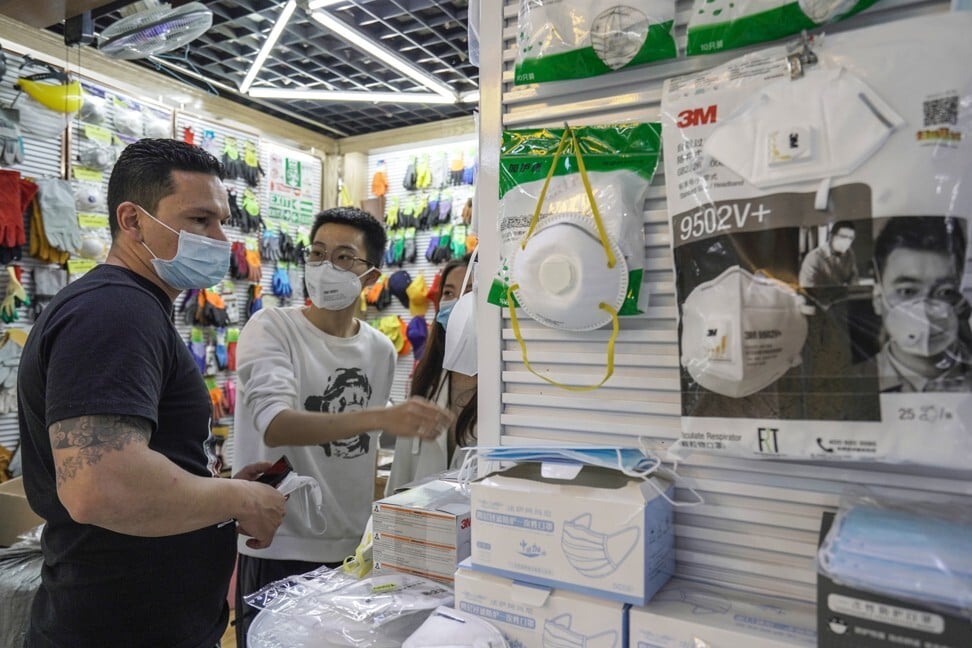
Only a handful of foreign buyers traipse through aisles of the sprawling 4-million-square-metre (43 million square feet) complex, while store owners – with no customers to tend to – sit hunched over their phones or talking in small groups.
A foreign buyer visits a stall selling face masks. Photo: Ren Wei
“We try to convince ourselves that the deep slump will not last long,” said the owner of Wetell Razor, Tong Ciying, at her empty store. “We cannot let complacency creep in, although the coronavirus has sharply hampered exports of Chinese products.”
Chinese exports plunged by 17.2 per cent in January and February combined compared to the same period a year earlier, according to the General Administration of Customs. The figure was a sharp drop from 7.9 per cent growth in December.
After riding out a supply shock that shut down most of its factories, China is now facing a
second wave demand shock, as overseas export orders vanish amid sweeping containment measures to contain the outbreak around the globe.
Nowhere is that clearer to see than in Yiwu. The city of 1.2 million, which lies in the prosperous coastal province of Zhejiang, was catapulted into the international limelight as a showroom for Chinese manufacturing when the country joined the World Trade Organisation in 2001.
Coronavirus: Is the gig economy dead, and should the self-employed worry?
Before the pandemic, thousands of foreign buyers would flock to the mammoth trade market each day to source all manner of products before sending them home.
But the outbreak, which has claimed the lives of more than 113,000 people and infected more than 1.9 million around the world, is proving a major test for the market and the health of the trade dependent city.
Imports and exports via Yiwu last year were valued at 296.7 billion yuan (US$42.2 billion) – nearly double the city’s economic output.
Businesses, however, are facing a very different picture in 2020. Most traders at the market say they have lost at least half their business amid the pandemic, which was first detected in the central Chinese city of Wuhan last year.
Just take a look at the situation in Yiwu and you will understand the extent of the virus’ effect on China’s trade with foreign countries – Tianqing
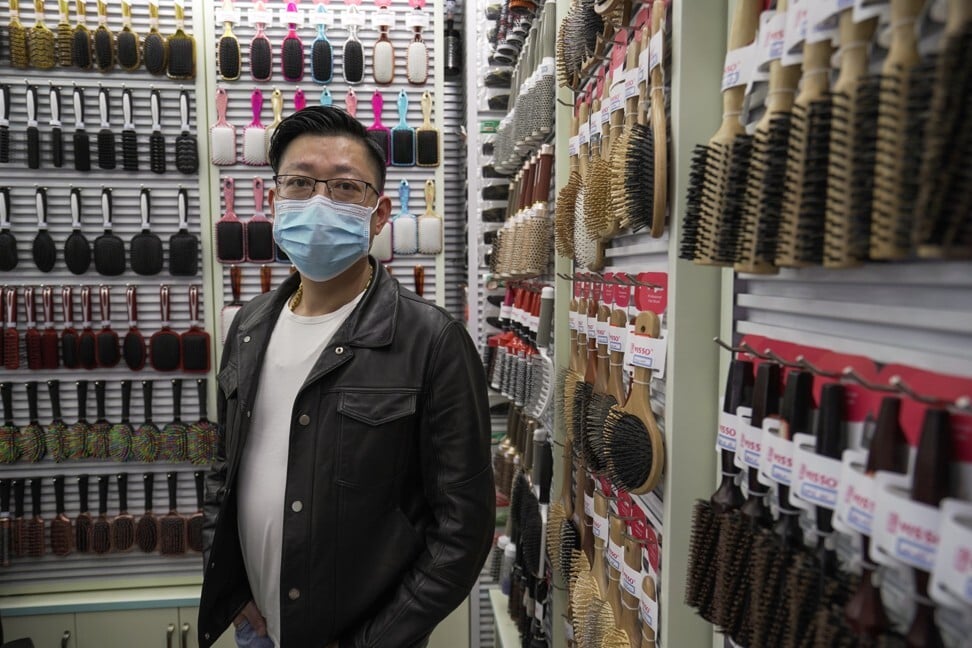
“Yiwu is the barometer for China’s exports,” said Jiang Tianqing, the owner of Beauty Shine Industry, a manufacturer of hair brushes. “Just take a look at the situation in Yiwu and you will understand the extent of the virus’ effect on China’s trade with foreign countries.”
Jiang said his business was only just hanging on thanks to a handful of loyal customers placing orders via WeChat.
“I assume it will be a drawn-out battle against the coronavirus,” he said. “We are aware of the fact that developed economies like the US and Europe have been severely affected.”
The Yiwu market reopened on February 18 after a one-month long hiatus following the Lunar New Year holiday and the government’s order to halt commercial activities to contain the spread of the outbreak.
Jiang Tianqing, owner of hair brush company Beauty Shine Industry. Photo: Ren Wei
But facing the threat of a spike in imported cases, Beijing banned foreigners from entering the country in late March – shutting out potential overseas buyers.
Despite the lack of business, local authorities have urged stall owners to keep their spaces open to display Yiwu’s pro-business attitude, owners said.
“For those bosses who just set up their shops here, it would be a do-or-die moment now since their revenue over the next few months will probably be zero,” said Tong. “I am lucky that my old customers are still making orders for my razors.”
The impact of the coronavirus is just the latest challenge for local merchants, who normally pay 200,000 yuan (US$28,000) per year for a 10-square-metre (108 square feet) stall at the market.
Traders were hard hit by the
trade war between China and the United States when the Trump administration imposed a 25 per cent tariff on US$200 billion of Chinese imports last year.
At the time, some Chinese companies agreed to slash their prices to help American buyers digest the additional costs.
“But it is different this time,” said Jiang. “Pricing does not matter. Both buyers and sellers are eager to seal deals, but we are not able to overcome the barriers [to demand caused by the virus].”
Even when businesses can secure orders, it is a struggle to deliver them
Ma Jun, a manager with a LED light bulb trading company, said the only export destination for her company’s products was war-torn Yemen because it was the only country with ports still open.
It is a public health crisis that ravages not just our businesses, but the whole world economy – Dong Xin
Dong Xin, an entrepreneur selling stationery products, said he could not ship the few orders he had because “ocean carriers have stopped operations”.
“It is a public health crisis that ravages not just our businesses, but the whole world economy,” he said. “The only thing can do is to pray for an early end to the pandemic.”
Most wholesale traders in the Yiwu market run manufacturing businesses based outside the city, so a sharp fall in sales has a ripple effect on their factories, potentially resulting in massive job cuts.
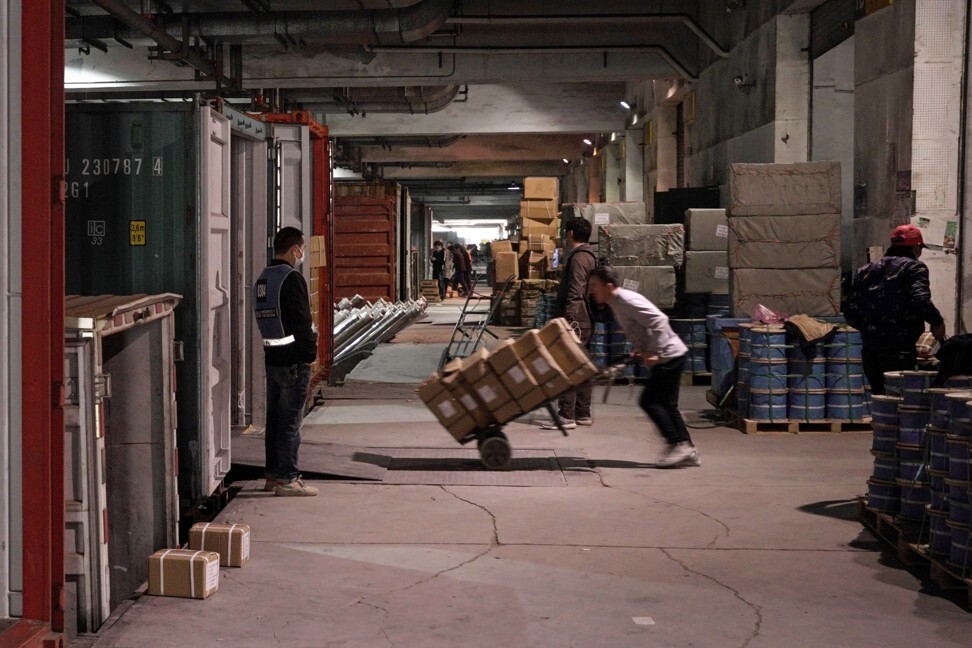
Workers pack containers at Yiwu Port, an inland port home to dozens of warehouses. Photo: Ren Wei
At Yiwu Port, an inland logistics hub full of warehouses where goods from the factories are unpacked and repacked for shipping abroad, container truck drivers joke about their job prospects.
“We used to commute between Shaoxing and here five times a week, and now it is down to twice a week,” said a driver surnamed Wang, describing the trip from his home to the shipping port, just over 100km away.
“At the end of the day, we may not be infected with the coronavirus, but our jobs will still be part of the cost of the fight against it.”
Source: SCMP
Posted in 2001, 25, abroad, aisles, banned, barometer, Beauty Shine Industry, Beijing, businesses, Buyers, catapulted, China, China’s, Chinese manufacturing, commute, complex, containers, containment, coronavirus, Coronavirus pandemic, Country, COVID-19, crammed, different picture, Dozens, dried up, economic fallout, entering, Entrepreneur, Europe, everything, export, export orders, face masks, factories, famed, February, flashlights, Foreigners, global, global economy, goods, grinds, hair brush company, halt, health, Home, imposed, infected, inland, international, International Trade Market, January, job cuts, jobs, joke, LED light bulb, limelight, logistics hub, Lunar New Year holiday, machine parts, mammoth, Manufacturing, March, massive, measures, ocean carriers, orders, outbreak, overseas, pack, pandemic, per cent, phones, Port, public health crisis, ravages, repacked, second wave, selling, Shaoxing, ship, shipping, shipping port, showcasing, Showroom, Stalls, stationery products, store owners, strikingly, sweeping, Tariff, trade war, traders, trading company, traipse, truck drivers, Trump administration, Uncategorized, United States, unpacked, vanish, vendors, warehouses, WeChat, whole, wholesale, workers, world economy., world trade organisation, Wuhan, Yemen, Yiwu Port, Zhejiang |
Leave a Comment »
04/04/2020
- Lockdown may have been lifted, but shops, bars and restaurants remain empty in Beijing, showing struggle facing economic recovery
- Controls have been returning in other parts of China, where cinemas and tourist attractions shut amid fears of new wave of infections
The nearly two month-long lockdown has changed the consumption behaviour of Chinese residents, many of whom have turned to home cooking to cut their spending. Photo: AFP
China’s urban lockdown may have eased, but deserted streets and stores in the capital Beijing this week suggest that for the services sector, the impact of the coronavirus outbreak could be deeper and longer than expected.
Many restaurants, cafes and pubs remained closed in the city, where vigilance remains high about a second wave of infections. Among those that were open, there were few customers to be seen.
The usually crowded Wangfujing shopping street was quiet on Wednesday, with just a few shoppers patronising what is usually the heartbeat of the city’s commerce and tourism. There were more staff than consumers at the Apple store, while everyone wore a mask. Shops along the pedestrianised zone closed their doors before sunset, but many did not open at all.
In a downtown food court, a handful of people dined during what would usually be the lunch rush hour, each restricted to their own small table to maintain social distancing, in great contrast with the usual frantic dash for seats.
Coronavirus: What impact will the economic fallout from the Covid-19 pandemic have on you?
While China has largely stemmed the domestic spread of Covid-19, threats of imported cases, with the virus having infected over one million people worldwide, and asymptomatic carriers continue to hamper the recovery in China’s
A survey published on Friday showed that in March, sentiment among small service sector firms remained depressed. The Caixin / Markit services purchasing managers’ index (PMI) was 43.0 for last month, with a number below 50 meaning the sector is shrinking. “There are too few people now. We only sold about a hundred bowls of noodles, that was just half of our normal level,” said one Beijing street vendor, who had also cut many items from the menu due to insufficient demand.
A bookstore in the city centre held an official opening ceremony after a soft opening followed by a two and a half month-long forced shutdown, but received only four visitors on a morning, one of which was the South China Morning Post reporter. All four were required to go through a body temperature check and write down their personal contact details before entering.
Service sector workers said the situation was surreal and that they were worried that there was no end in sight.
“I have never seen KFC look like this,” said an employee of the fast food chain restaurant at Wangfujing, pointing to the virtually empty dining hall.
A grocer at a nearby food market continually shook her head when talking about the decline in customers, but said she felt lucky that she could come back to Beijing from her hometown before the 14-day mandatory quarantine requirement was imposed on February 14.
This situation is not restricted to Beijing. When the Chinese government reopened around 500 cinemas nationwide in March, each one attracted on average
per day.
Now, many places across China are reimposing controls amid fears of a new spike in infections, the same fear leading people to stay home instead of going to those venues which have reopened.
Shanghai has closed tourist attractions while Sichuan has again closed karaoke lounges. Cinemas have also been reclosed across the country.
President Xi Jinping said during a visit to Hangzhou last Sunday that China must remain alert. “If you want to watch a movie, rather than going to a cinema, you can watch it online,” Xi said.
Services account for 60 per cent of China’s economy and the majority of employment. The slowness of the sector’s recovery is placing huge pressure on the world’s second
at a time when manufacturers are seeing export orders nosedive.
Liang Zhonghua, chief macro analyst at Zhongtai Securities, a brokerage, said that China’s damaged consumption alone could drag economic growth down by 4.5 per cent in the second quarter.
“(Chinese) residents’ fear of the epidemic is not over,” he wrote in a note this week.
Beijing’s malls still empty after coronavirus lockdown lifted
In Beijing all travellers entering the city are required to undergo a 14-day quarantine, while mass gatherings are still forbidden.
The containment measures have stopped many migrant workers from getting back to
, if they still exist. Many local residents still choose to work from home, even though authorities had been trying to encourage people to go out and spend money.
On April 1, the traffic flow on Beijing’s subway system was 3.05 million passengers a day, less than a third of the level a year ago, according to the operator, while car traffic was still about 15 per cent less than it was last year, government data showed.
I will keep cooking for myself, even when everything goes back to normal, it is much healthier and cheaper – Beijing resident
The nearly two month-long lockdown has changed the consumption behaviour of Chinese residents, many of whom have turned to home cooking to cut their spending.
“I will keep cooking for myself, even when everything goes back to normal, it is much healthier and cheaper,” said a Beijing lawyer whose family name is Li.
The effect of this behavioural shift is borne out in the 17.9 per cent drop in retail sales in the capital over the first two months of the year, only slightly better than the nationwide drop of 20.5 per cent.
Beijing businesses have clubbed together to issue some 150 million yuan in
to lure customers in since March 18. But with more economic hardship ahead, businesses and consumers alike are hunkering down for the storm.
Source: SCMP
Posted in bars, Beijing, cafes, Caixin / Markit services, Caixin/Markit Manufacturing Purchasing Managers’ Index (PMI), capital, China’s, chinese government, cinemas, consumption behaviour, coronavirus, coronavirus outbreak, customers, deserted shops, deserted streets, downtown, export orders, food court, food market, grocer, handful of people, Hangzhou, home cooking, karaoke lounges, KFC, lockdown, lunch rush hour, mandatory quarantine, manufacturers, nosedive, President Xi Jinping, pubs, purchasing managers’ index (PMI), residents, restaurants, second wave, services sectors, Shanghai, shopping street, shops, Sichuan, Social distancing, south china morning post, stores, tourist attractions, Uncategorized, urban lockdown, vigilance, Wangfujing, Zhongtai Securities |
Leave a Comment »
01/09/2019
- The manufacturing purchasing managers’ index, released by the National Bureau of Statistics on Saturday, was 49.5 in August
- Figure adds to a month of woe for policymakers in Beijing, even ahead of planned US tariff increases on September 1, October 1, and December 15
China’s manufacturing purchasing managers’ index fell by 0.2 points in August as the trade war continued to bite. Photo: Xinhua
As the trade war with the United States continues to gather pace, manufacturers in China remain gloomy about their prospects, with the sector activity contracting for the fourth successive month in August.
The manufacturing purchasing managers’ index (PMI), released by the National Bureau of Statistics (NBS) on Saturday, stood at 49.5 in August, down from a reading of
, and below analysts’ expectations. The median result of a survey of analysts by Bloomberg expected a reading of 49.6.
The PMI is a gauge of sentiment among factory operators, with 50 being the demarcation line between expansion and contraction in sector activity. In the survey, manufacturers are asked to give a view on business issues such as export orders, purchasing, production and logistics.
That the index has remained in contractionary territory for six of eight months this year shows that the effects of US tariffs are resonating through the Chinese economy. The manufacturing PMI only showed expansion in March and April of this year.
New and higher US tariffs scheduled to enter force on September 1, October 1 and December 15 could provide some very temporary boost to Chinese exports and therefore manufacturers, should they inspire American buyers to make early purchases to pay lower tariff rates. However the long term trajectory is negative, with many manufacturers scoping out or already relocating to production sites outside the world’s second largest economy.
Also released on Saturday was the official non-manufacturing PMI, a survey of the construction and services sectors. This stood at 53.8, up from 53.7 in July, showing that these sectors have remained more robust in the face of a general slowdown in China’s economy. The Bloomberg survey of analysts had expected non-manufacturing PMI in August to remain unchanged.
Composite PMI, a combined reading of both manufacturing and non-manufacturing, was 53, down from 53.1 in July.
The August PMI decline “indicates downward pressure on the economy,” said Zhang Liqun, an analyst with the China Federation of Logistics and Purchasing, which produces the index with the NBS.
“Corporations’ forecasts of the market outlook were quite poor while being cautious on their production operations,” Zhang said. The PMI indicated a drop in new orders, which also reflected a lack of domestic demand. Given that the US is escalating tensions with China, downward pressure on external demand is also apparent, Zhang said.
August was a month to forget for policymakers in Beijing, with a series of negative data highlighting the serious economic challenges facing the nation. With the trade war threatening to tip the global economy into a recession, China remains heavily exposed.
The trade war is having a significant impact on Chinese manufacturing. Photo: Xinhua
While exports grew by 3.3 per cent in July, a sign of front-loading, imports fell by 5.6 per cent, emphasising the issues with consumption in China. This problem was also clear in retail sales figure, which came in at a disappointing 7.6 per cent for July, down from 9.8 per cent growth in June.
, a measure of output in China’s manufacturing and mining sectors, grew by just 4.8 per cent in July, the lowest reading since February 2002.
Gross domestic product in China for the second quarter of 2019 grew at 6.2 per cent, the lowest rate since NBS quarterly records began in 1992.
Source: SCMP
Posted in Beijing, Bloomberg, China Federation of Logistics and Purchasing, China’s manufacturing, Chinese economy, Escalating trade war, export orders, factory operators, gross domestic product (GDP), hit, Industrial production, logistics, national bureau of statistics, National Bureau of Statistics (NBS), policymakers, production, purchasing, purchasing managers’ index (PMI), Uncategorized, United States, US tariff, Xinhua |
Leave a Comment »




 CHINDIA ALERT: You'll be living in their world, very soon