Archive for ‘extradition bill’

29/05/2020

Under shadow of Beijing’s security law, Taiwan president thanks Hong Kong bookseller for supporting democracy

  • Tsai Ing-wen visited exiled Hong Kong bookseller a day after NPC voted in favour of legislation
  • Lam Wing-kee said fleeing Hongkongers saw Taiwan as a step towards applying for asylum in the West
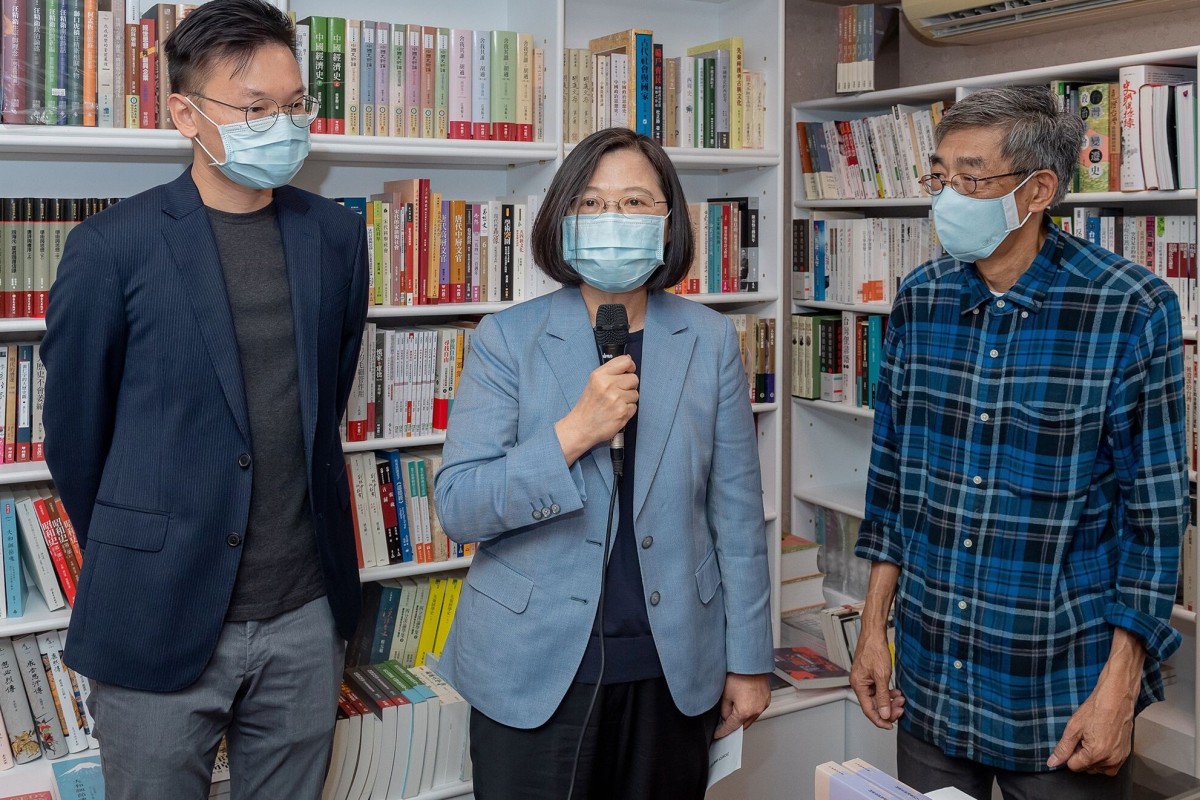
President Tsai Ing-wen (centre) shows her support for Hong Kong bookseller Lam Wing-kee (right) with Lin Fei-fan, deputy secretary general of the ruling Democratic Progressive Party. Photo: Taiwan presidential office/AFP
Taiwan’s President Tsai Ing-wen visited exiled Hong Kong bookseller Lam Wing-kee
on Friday in a show of support for Hongkongers amid Beijing’s plan to introduce a controversial national security law.
Her visit came a day after China’s legislature, the National People’s Congress, voted in favour of a resolution to initiate the legal process for a national security law to be imposed on Hong Kong, despite concerns from the United States, the European Union and elsewhere that the move would erode human rights, freedom and autonomy in the city.
“We want to thank the bookstore boss Lam Wing-kee for his persistent support of human rights, freedom and democracy in Hong Kong from the past to the present stage,” Tsai told Lam, who recently reopened the now-defunct Hong Kong Causeway Bay Books in Taipei.

Tsai said on behalf of all Taiwanese people, she welcomed Lam to stay in Taiwan where he could bolster the island’s efforts to further freedom and democracy.

Hongkongers who want to flee to Taiwan ‘will go through strict screening’
28 May 2020

Lam, one of the five shareholders and staff at Hong Kong’s Causeway Bay Books, fled to Taiwan in April last year after he was detained by Chinese agents for eight months in 2015 for selling books critical of the Chinese leadership.

All five went missing

between October and December that year and it emerged they had been detained on the Chinese mainland.
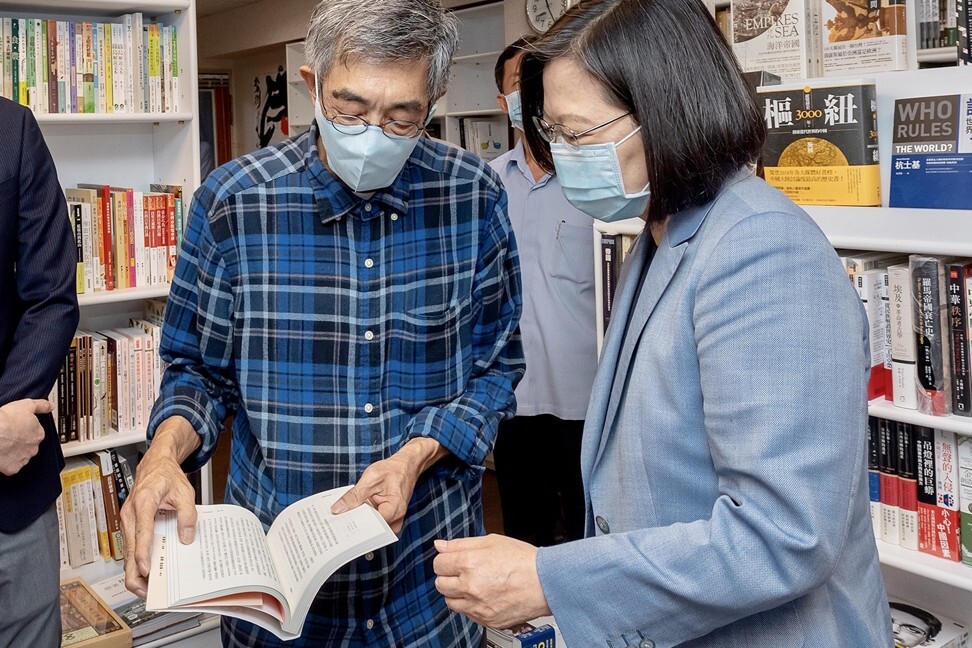
President Tsai Ing-wen looks at a book while visiting Lam Wing-kee on Friday. Photo: Taiwan presidential office/AFP
Lam later said he had been detained and blindfolded by police after crossing the border into mainland China from Hong Kong in October 2015.

The case triggered a huge controversy and raised fears of growing Chinese control in the city.

Seeing Lam as a representative of Hongkongers fleeing to Taiwan to avoid political persecution, Tsai said she wanted to understand what challenges these exiles faced and what help they needed during their stay on the self-ruled island.

“I want to tell Boss Lam [Wing-kee] and our Hong Kong friends that the government here has set up an ad hoc committee to offer help to them very soon,” she said.

On Wednesday, Tsai called for the government to set up an ad hoc committee to work out a “humanitarian help action plan” for Hong Kong people seeking to live in Taiwan or immigrate to the island. It was borne out of concern they would be arrested or prosecuted for taking part in months of anti-government protests triggered last year by the now-shelved extradition bill.

Chen Ming-tong, head of the Mainland Affairs Council, the island’s top mainland policy planner, said on Thursday his council would draft the measures for cabinet’s approval in a week.

Under the plan, the Mainland Affairs Council would issue special measures and coordinate with the island’s authorities on how to help Hongkongers relocate to Taiwan and take care of them.

Bookseller Lam told Tsai what Hongkongers needed most was to have their stay in Taiwan extended.

Lam said that currently, because of the absence of a political asylum law, Hongkongers could only apply to live in Taiwan through study, work, investment, their professional skills or close relatives.

He said fleeing Hongkongers usually came to Taiwan on tourist permits, which at most allowed them to stay for up to six months, giving them not enough time to apply for long-term residence in Taiwan.

“It would be better if they can stay for nine months and preferably one year,” he said.

Lam said some fleeing Hongkongers saw Taiwan as an intermediary base as they hoped to apply for asylum in the West, but it took a long time for Western countries to screen and approve their asylum requests.

Meanwhile, Premier Su Tseng-chang said Article 18 of the Laws and Regulations Regarding Hong Kong and Macau Affairs was good enough to deal with the current crisis in the absence of a political asylum law in Taiwan.

That article states that “necessary help shall be provided to Hong Kong or Macau residents whose safety and liberty are immediately threatened for political reasons”.

Source: SCMP
26/05/2020

China’s Hong Kong garrison ‘ready to safeguard national security’ in the city

  • PLA commander says new law will help to crack down on separatist and foreign forces in ‘two sessions’ interview
  • Military has ‘determination, confidence and ability’ to safeguard national security interests and Hong Kong prosperity
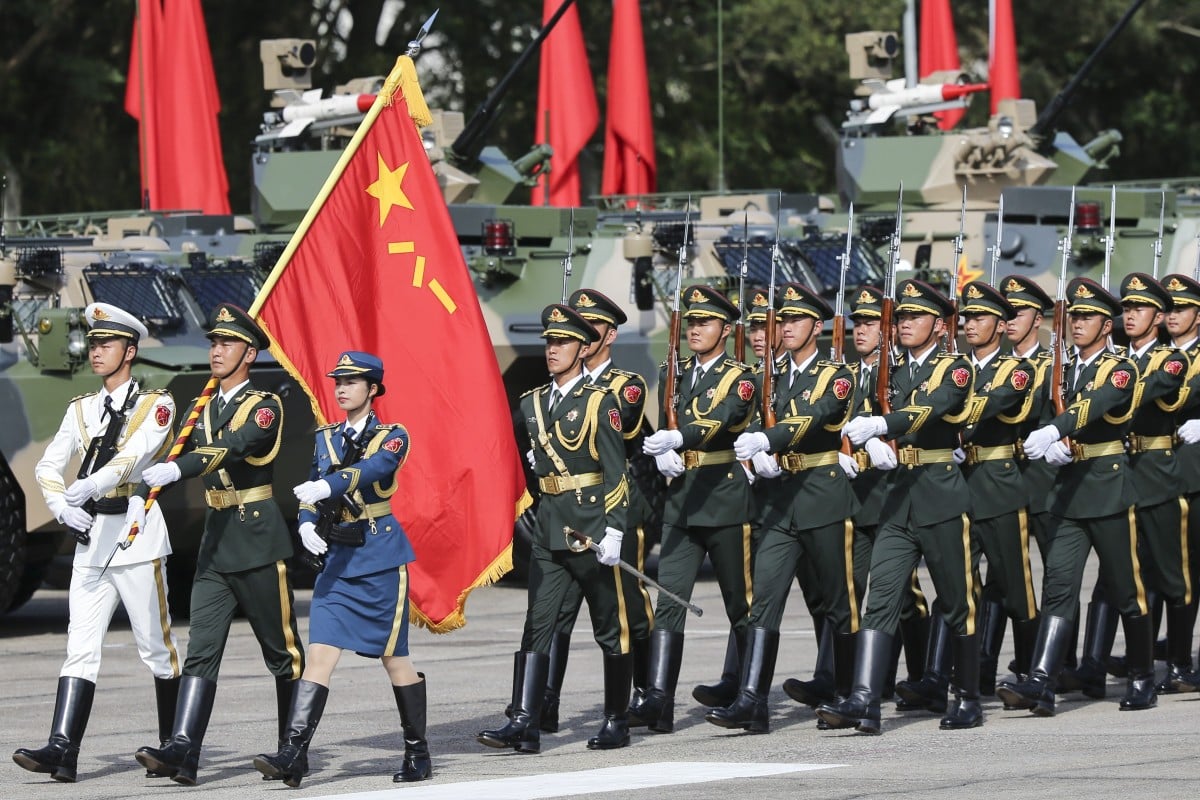
China’s People’s Liberation Army has said its Hong Kong garrison will “resolutely” safeguard national security and sovereignty. Photo: Sam Tsang
The People’s Liberation Army has said the Chinese military will “resolutely” safeguard China’s national security and sovereignty, in its first statement since Beijing announced plans to impose a sweeping national security law in Hong Kong.
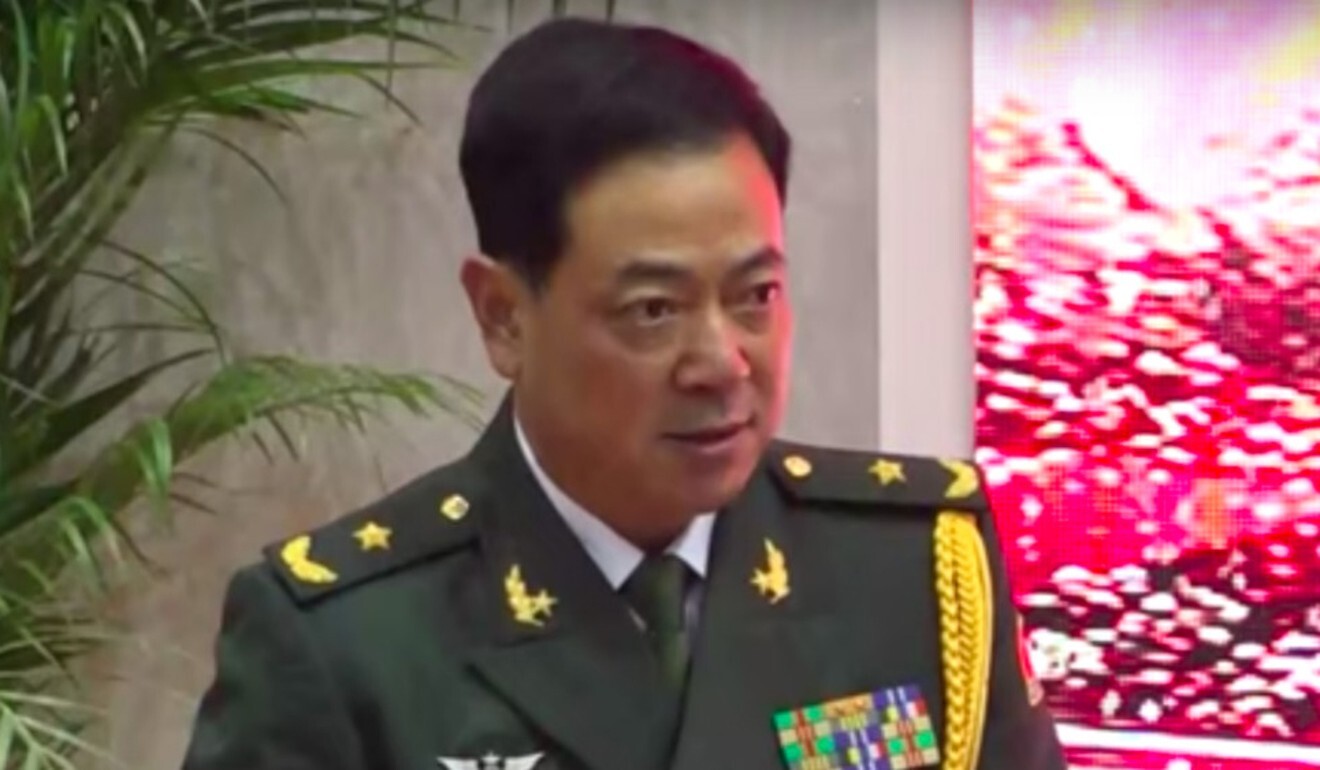
Chen Daoxiang, commander of the PLA’s Hong Kong garrison, said it would “act with firm resolve to implement the central government’s decision and plans” as well as continuing to implement the “one country, two systems” policy in the city.
How China is drafting a new Hong Kong national security law at the National People’s Congress
Speaking on the sidelines of China’s annual parliamentary meetings, also known as the

“two sessions”

, Chen told state broadcaster CCTV that the new law would help to crack down on separatist and foreign forces aiming to undermine China’s national unity.

“[The garrison] will implement, according to law, various tasks delegated by the party and the people, and has the determination, confidence and ability to safeguard national security and development interest as well as Hong Kong’s continuing prosperity,” he said.

Commander of the PLA Hong Kong garrison Chen Daoxiang. Photo: Weibo
The proposal to impose a national security law in Hong Kong – which will give Beijing more direct control over the city – was introduced by China’s legislature on Friday. Beijing has blamed foreign forces for inciting last year’s months-long protests in Hong Kong, sparked by opposition to a separate and now-withdrawn extradition bill, and described the unrest as a grave threat to national security.

Separately, CCTV reported that a group of top military officials said in a session on Tuesday that there was a “great urgency” for Beijing to impose the law in a bid to address the “new risks and challenges” in governing the city.

The officials, who included Central Military Commission vice-chairmen Xu Qiliang and Zhang Youxia, said the plan was a “very timely, necessary and important” step to prevent and punish efforts to undermine China’s national sovereignty and security.

They reiterated the PLA’s commitment to opposing intervention from foreign forces in Hong Kong as well as maintaining China’s national unity and territorial integrity.

“Hong Kong affairs are purely China’s internal affairs. We resolutely oppose efforts by any foreign country, organisation and individual in interfering with Hong Kong affairs, and will resolutely guard against and contain any attempts by external forces in … engaging any separatist, subversion and infiltration activities,” they said, according to CCTV.

The planned national security law has drawn strong condemnation from the US government, with Secretary of State Mike Pompeo calling it a “death knell” for the territory’s relative autonomy. White House national security adviser Robert O’Brien said on Sunday that the US government would likely impose sanctions on China if Beijing went ahead with the plan.

Source: SCMP
30/11/2019

Chinese police prepare for Macau handover anniversary with anti-terror drill near Hong Kong

  • Zhuhai police, at the end of the world’s longest sea bridge, use body armour and tear gas in preparation for Macau’s 20th anniversary celebration
  • Hong Kong is just an hour’s drive away from Macau using the bridge
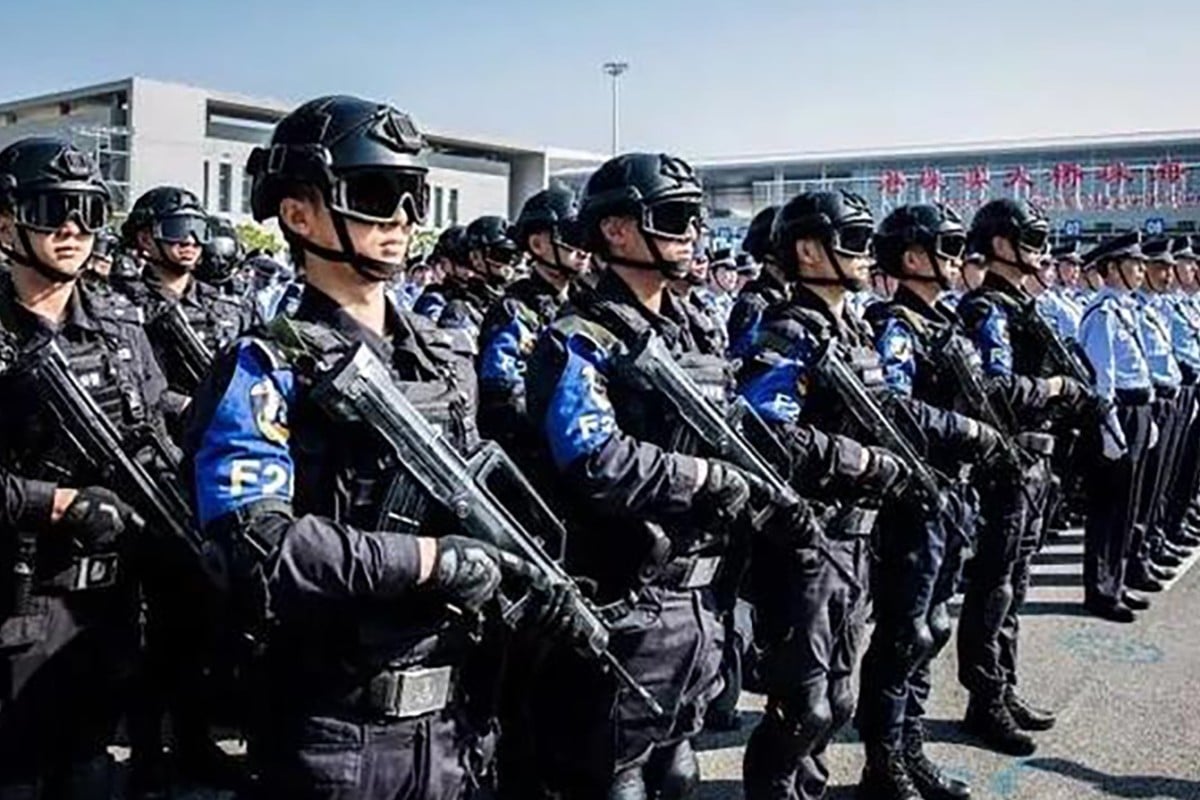
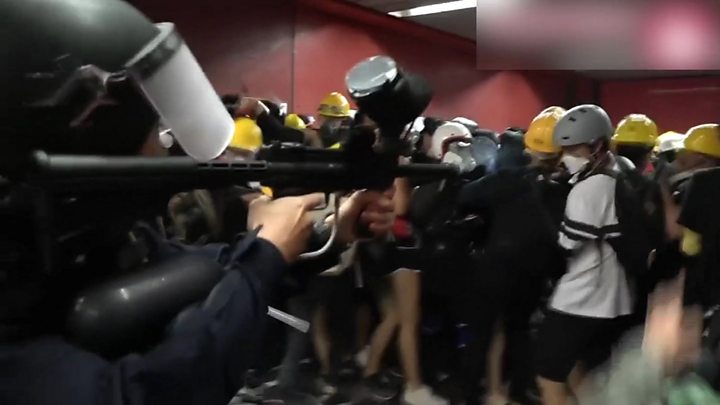
More than 1,000 police officers took part in the anti-terror drill in Zhuhai. Photo: Toutiao
Armed police in the southern Chinese city of Zhuhai held a massive anti-terror drill at its end of the Hong Kong-Zhuhai-Macau Bridge on Friday morning as part of its preparations for the 20th anniversary of the handover of Macau, when President Xi Jinping is expected to visit the city.
More than 1,000 police officers and 80 vehicles were involved in the exercise, amid 
ongoing political turmoil in Hong Kong

, according to local news portal Southcn.com.

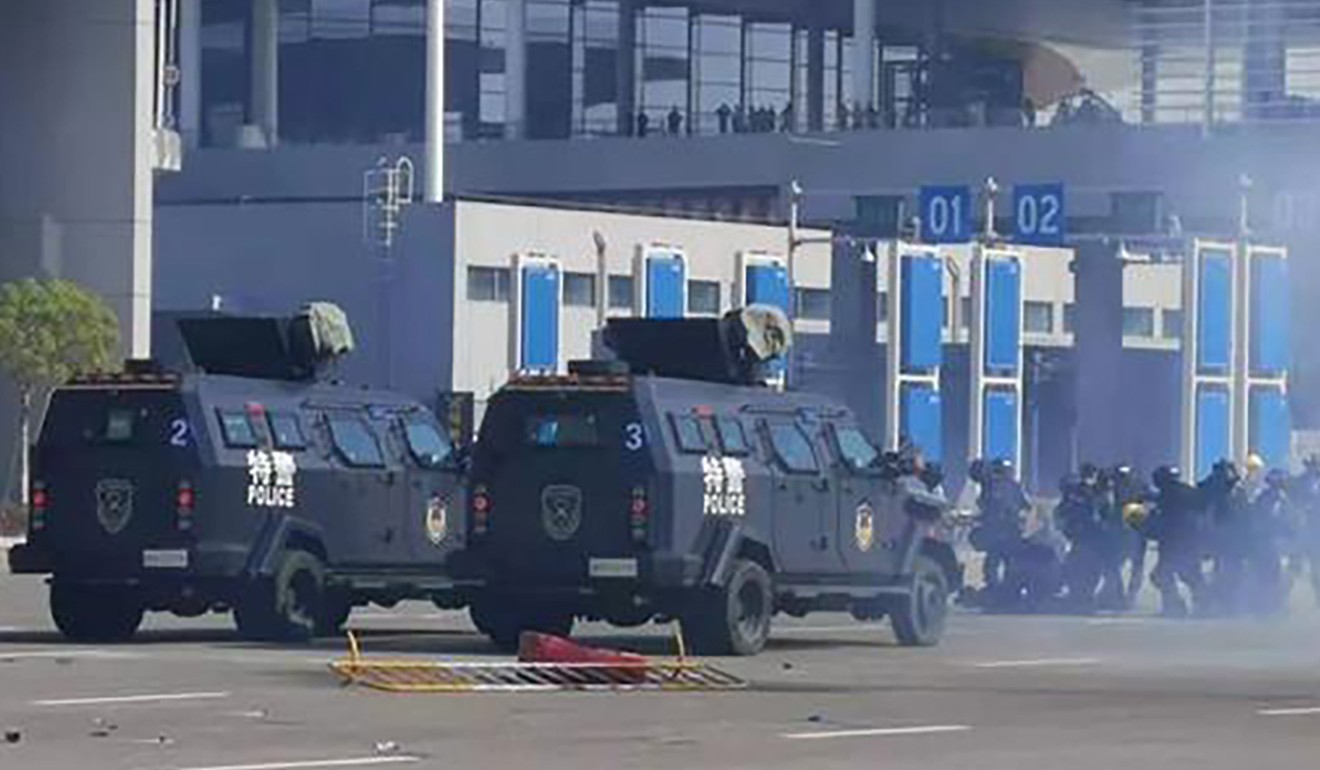
Photos circulated online showed officers in body armour, helmets and shields firing tear gas as they confronted a group of people carrying sticks and wearing black shirts and yellow helmets – attire associated with the protesters in Hong Kong, 60km (37 miles) away from Macau.
The drill was held three weeks before the 20th anniversary of Macau’s return to Chinese administration under the “one country, two systems” policy on December 20.
Police trucks and riot officers during Friday’s exercise at the Zhuhai end of the Hong Kong-Zhuhai-Macau Bridge. Photo: Toutiao

Security is expected to be tightened when Xi visits the city, in response to the violent clashes in Hong Kong over the past six months, which Beijing has repeatedly blamed on radical protesters.

The former Portuguese colony is connected to Hong Kong and its neighbouring city of Zhuhai, Guangdong province, by the world’s longest sea crossing bridge. It takes about an hour to drive from Hong Kong to Macau via the bridge.

Guo Yonghang, Zhuhai party chief, urged the local police to stay loyal to the party. “[Police] should be loyal and fulfil duty and mission to create a peaceful and stable political and social environment for the construction of the Guangdong-Hong Kong-Macau Greater Bay Area and the celebration of the 20th anniversary of Macau’s reunification to the motherland,” he said.

Macau was returned to China two years after Hong Kong and celebrations of its success under one country, two systems could be overshadowed by its neighbour’s anti-government protests which stemmed from opposition to proposed extradition legislation and have escalated into violence on the streets and in university campuses.

In August, two months after more than 2 million people in Hong Kong took to the streets to protest the now-suspended extradition bill, police in Shenzhen held at least three drills featuring anti-riot exercises involving tear gas, armoured vehicles and water cannon.

Source: SCMP
12/09/2019

Hong Kong protesters sing and boo China anthem

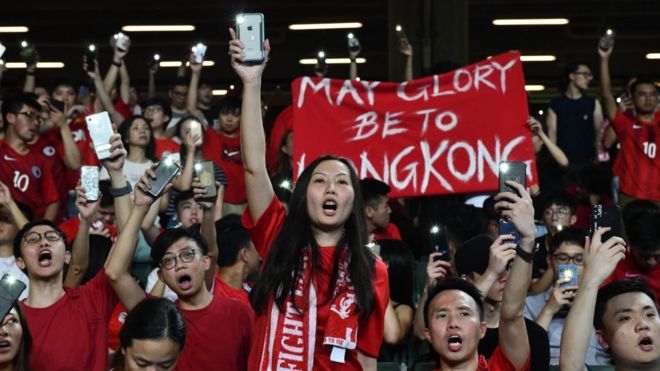
Football fans hold up their phones and shout during a protest at the end of the World Cup qualifying match between Hong Kong and Iran at Hong Kong Stadium on September 10, 2019Image copyright GETTY IMAGES
Image caption Protesters sang their new rallying cry at a stadium on Tuesday night

Hong Kong’s protest movement made its presence felt in a sports stadium and shopping malls on Tuesday.

Fans attending a football match drowned out the pre-game Chinese national anthem with loud booing.

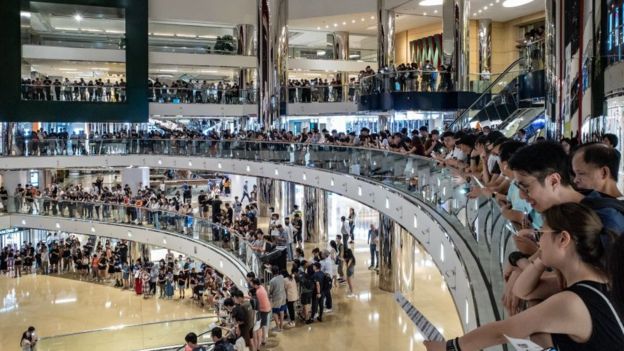
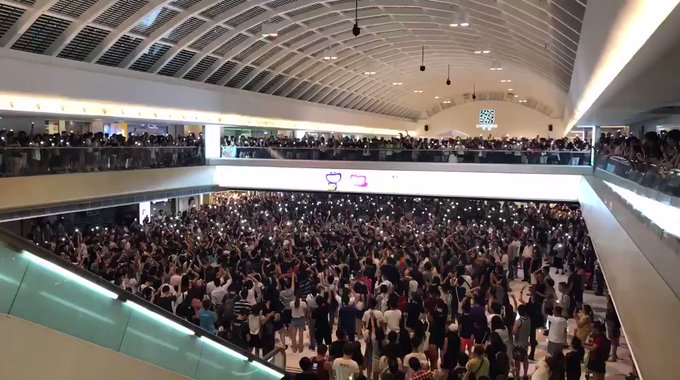
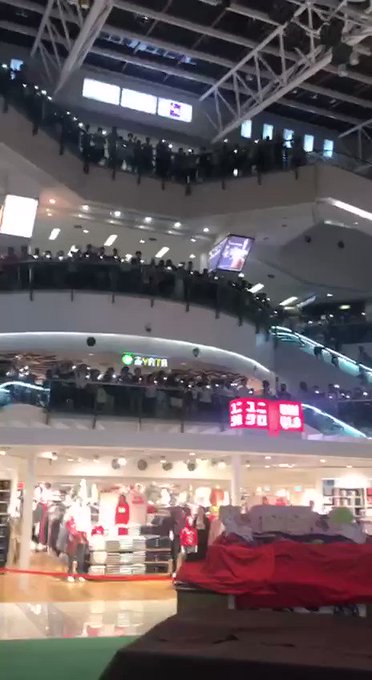
Protesters have also staged flash events in shopping malls, singing Glory to Hong Kong which has become an unofficial anthem of the movement.

The protesters won a major concession last week when the extradition bill which sparked the unrest was scrapped.

But this has failed to end the unrest as protesters continue to demand full democracy and an investigation into allegations of police abuses.

On Tuesday night, thousands of protesters gathered in shopping malls across Hong Kong chanting slogans and singing Glory to Hong Kong.

Residents and protesters sing songs and shout slogans as they gather at a shopping mall after business hours in Tai Koo districtImage copyright GETTY IMAGES
Image caption Many protesters flooded shopping malls

In the popular shopping district of Mongkok, a sea of protesters dressed in black were seen congregating across the different levels of one mall.

Another video showed protesters chanting “Go Hong Kong” – a phrase that has been used frequently as a sign of encouragement.

Shopping malls have been the scene of clashes in recent weeks, with one incident in July seeing riot police fight battles with protesters inside a mall in the district of Sha Tin.

But the recent events have played out peacefully.

Glory to Hong Kong was written by a local musician in response to calls for an anthem for protesters.

The lyrics include lines such as “Do you feel the rage in our cries? Rise up and speak up” and “persevere, for we are as one”.

The new rallying cry has joined other popular songs used by the protest movement, including Do You Hear the People Sing? from musical Les Miserables and the Christian hymn Sing Hallelujah to the Lord.

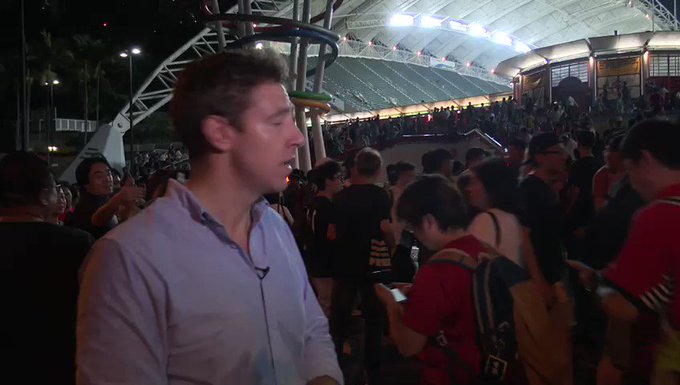
It was also heard at the Hong Kong v Iran football match on Tuesday at Hong Kong Stadium.

The 2022 Fifa World Cup qualifier saw thousands of protesting booing when the Chinese national anthem played before the start of the game.

The jeering, which could be heard from outside the stadium, was intended as a clear “message” to Beijing that they do not want to be part of China in the future, says the BBC’s Nick Beake who was at the game.

It’s not the first time people in Hong Kong have been heard booing the Chinese anthem – though it is not clear how long they might be able to do this.

In 2017 China passed a law making it illegal to disrespect the anthem, but the law has yet to be passed in Hong Kong.

‘Too little, too late’

Hong Kong, formerly a British colony, returned to Chinese rule in 1997.

Under the “one country, two systems” rule, the city is granted a high level of autonomy, an independent judiciary and rights such as freedom of speech.

But those freedoms – the Basic Law – expire in 2047 and it is not clear what Hong Kong’s status will then be.

There has been growing anti-mainland sentiment in recent years, and anger at what many feel is increasing mainland interference in Hong Kong affairs.

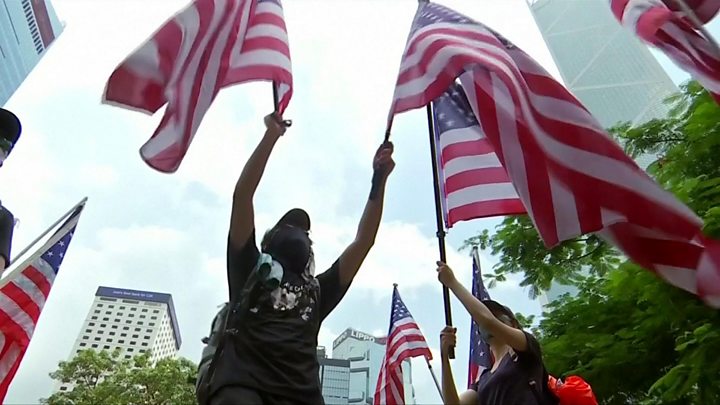
Media caption Protesters sang the US anthem outside the consulate

This reached a tipping point when the Hong Kong parliament proposed a new law that would have enabled suspects in Hong Kong to be extradited to China.

Hundreds of thousands of people marched on the streets in protest of the law, demanding that it be abandoned. The government initially suspended in June, and then finally dropped earlier this week – almost three months after protests first begun.

But protesters have said this is “too little, too late”, and their demands have evolved into calls for a much wider set of reforms, including a call for universal suffrage.

Source: The BBC

07/09/2019

Hong Kong protests: China’s premier backs government to end ‘chaos’

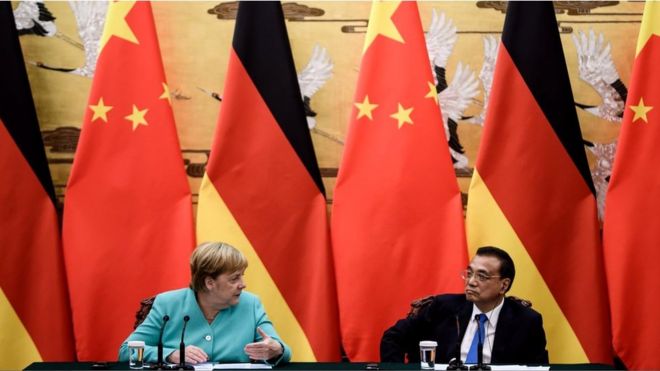
Angela Merkel and Li KeqiangImage copyright EPA
Image caption Ms Merkel calls for dialogue while Mr Li says China can handle its own matters

China’s Premier Li Keqiang has said Beijing supports the Hong Kong government “to end the violence and chaos”.

He is the most senior Chinese official to comment on the unrest which has rocked Hong Kong for months.

His comments came during a joint press conference with German Chancellor Angela Merkel in Beijing.

Hong Kong has seen months of often-violent protests calling for democracy and less influence from China.

The protests were sparked by changes to a law that would allow extradition to mainland China, but have since widened to include calls for an independent inquiry into police brutality and demands for greater democracy.

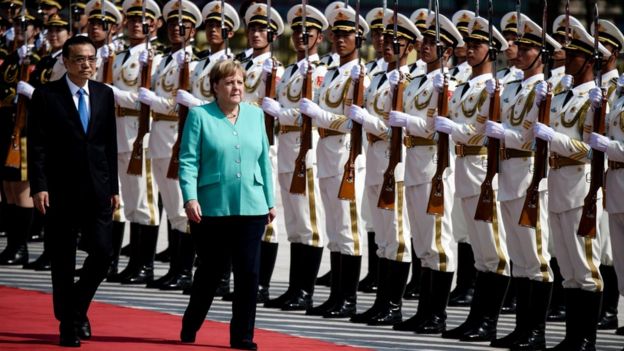
Li Keqiang and Angela MerkelImage copyright EPA
Image caption Hong Kong activists hope for Western support

On Wednesday, embattled Chief Executive Carrie Lam withdrew the controversial extradition bill but that has failed to appease the activists.

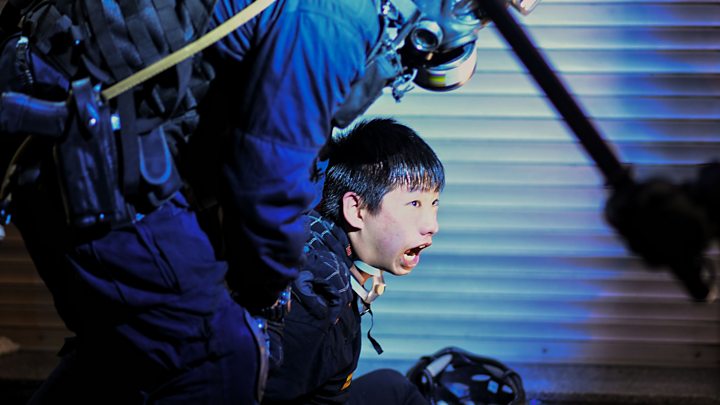
Instead, protests continued on Friday evening, when clashes erupted between police and the demonstrators outside a subway station on the Kowloon peninsula.

Riot police fired both tear gas and rubber bullets at protesters before clearing the nearby streets as the crowd of protesters was forced to retreat.

What did the Chinese premier say?

In August, China had likened to protests to terrorism, warning activists not to “underestimate the firm resolve” of the Beijing government.

Li Keqiang, China’s second highest-ranking leader, told reporters on Friday: “The Chinese government unswervingly safeguards ‘one country, two systems’ and ‘Hong Kong people govern Hong Kong people’.”

He said China backed Hong Kong “to end the violence and chaos in accordance with the law, to return to order, which is to safeguard Hong Kong’s long-term prosperity and stability”.

He said the world “needs to believe that the Chinese people have the ability and wisdom to handle their own matters well”.

Merkel calls for dialogue

German Chancellor Angela Merkel said a peaceful solution was needed for Hong Kong, urging that “in the current situation, violence must be prevented”.

Media caption How Hong Kong got trapped in a cycle of violence

She said there were signs Ms Lam would invite the necessary dialogue.

“I hope that materialises and that demonstrators have the chance to participate within the frame of citizens’ rights.”

She also stressed that the “rights and freedoms” for the people of Hong Kong “have to be granted”.

Soyrce: The BBC

07/09/2019

Germany’s Merkel presses for peaceful Hong Kong resolution

WUHAN, China (Reuters) – German Chancellor Angela Merkel renewed calls for a peaceful solution to unrest in Hong Kong on Saturday during her trip to China.

The Hong Kong protests have overshadowed a three-day visit Merkel had planned to use to press for greater access to Chinese markets for German businesses suffering a slowdown at home.

“I have advocated that conflicts be resolved without violence and that anything else would be a catastrophe from my point of view,” Merkel said.

After talks with President Xi Jinping and Premier Li Keqiang, Merkel said Beijing had listened to her views.

“This is important,” she added.

Hong Kong leader Carrie Lam announced concessions this week to try to end the protests, including formally scrapping a hugely unpopular extradition bill, but many said these were too little, too late.

Joshua Wong, a leader of pro-democracy protests in 2014 that were the precursor to the current unrest, thanked Merkel for addressing the topic with Beijing but said her comments fell short.

“Germany’s business interest should not override the universal values in which we believe,” Wong said in an interview with Germany’s mass-circulation Bild am Sonntag newspaper.

“If the Chancellor wants to do something, she must help to urge President Xi to respond to the demand for free elections.”

Source: Reuters

13/08/2019

Hong Kong protests: Airport cancels flights as thousands occupy

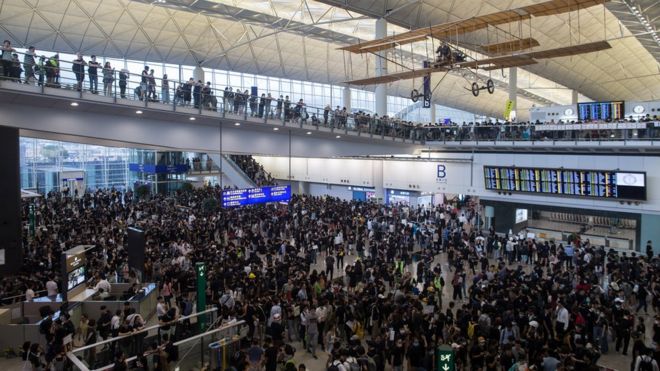
Protesters occupy Hong Kong Chek Lap Kok International Airport in Hong Kong, China,Image copyright EPA
Image caption Officials say about 5,000 gathered for the fourth day of protests at the airport

Hong Kong International Airport cancelled all departures on Monday, as thousands of anti-government protesters occupied and caused disruption.

Passengers have been told not to travel to the airport, which is one of the world’s busiest transport hubs.

In a statement, officials blamed “seriously disrupted” operations.

Many of those protesting are critical of the actions of police, who on Sunday were filmed firing tear gas and rubber bullets at close range.

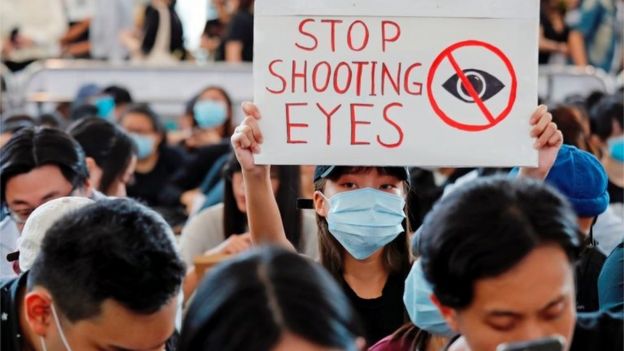
Some protesters wore bandages over their eyes in response to images of a woman bleeding heavily from her eye on Sunday, having reportedly been shot by a police projectile.

In a statement on Monday afternoon, Hong Kong’s Airport Authority said they were cancelling all flights that were not yet checked in.

More than 160 flights scheduled to leave after 18:00 local time (10:00 GMT) will now not depart.

Arrivals already heading into Hong Kong will still be allowed to land, but other scheduled flights have been cancelled.

Officials are now working to reopen the airport by 06:00 on Tuesday, a statement said.

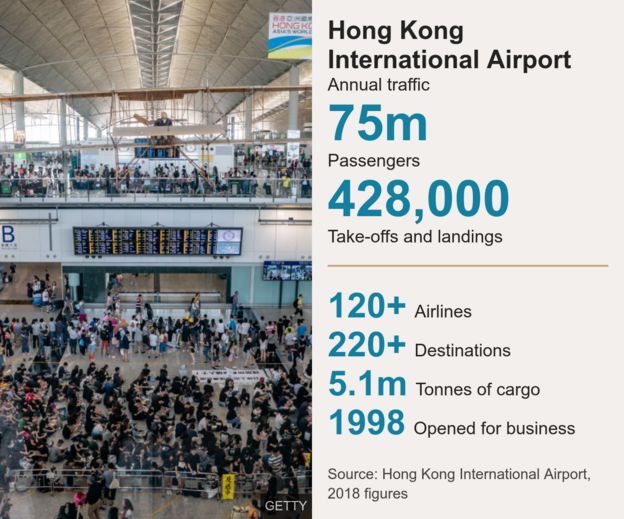
Graphic shows the scale of Hong Kong airport's operations
Some passengers expressed annoyance at the disruption. “It’s very frustrating and scary for some people,” one man from Pakistan told the BBC. “We’ll just have to wait for our next flight.”

Helena Morgan, from the UK, said she was set to return to the UK to get her exam results on Thursday. “I’m hoping we get back for them and we’re not on a flight,” she said.

But others were more understanding of the protests. “I was expecting something, given all the news,” one arrival, Gurinda Singh, told Reuters news agency.

As rumours spread that police plan to move in on protesters on Monday evening, thousands opted to leave on foot. There are large backlogs for transport back into the centre, local reports say.

The BBC’s Stephen McDonell, who is at the scene, says the airport has effectively shut down while authorities work out how to deal with the crisis.

Hong Kong’s mass demonstrations and unrest show no sign of abating, more than two months after they were sparked by a controversial extradition bill.

Beijing officials have strongly condemned Sunday’s violence and linked violent protesters to “terrorism”.

A protester in the airport holds a sign that says "stop shooting eyes"Image copyright REUTERS
Image caption Many of those who gathered carried signs condemning police conduct

What happened on Sunday?

On Sunday afternoon, a peaceful rally in the city’s Victoria Park led to clashes when protesters moved out of the area and marched along a major road despite a police ban.

There were confrontations in several central districts and police used rubber bullets in an attempt to disperse the demonstrators.

In the bustling central Wan Chai district, petrol bombs and bricks were thrown at police, who responded by charging at protesters.

A number of people, including a police officer, were injured in the clashes.

Videos on social media also showed officers storming enclosed railway stations and firing tear gas.

Footage inside another station showed officers firing what appeared to be rubber bullets at close range and several police officers beating people with batons.

Media caption Violence erupts in HK train stations

Local media outlets reported that suspected undercover police officers had dressed-up as protesters to make surprise arrests.

While protests in the city have turned increasingly violent, there were no reports of arrests during the three previous days of the airport sit-in.

What has the reaction been?

On Monday the Chinese authorities, who have not yet physically intervened to quell the unrest, used their strongest language yet to condemn violent protesters.

“Hong Kong’s radical demonstrators have repeatedly used extremely dangerous tools to attack police officers, which already constitutes a serious violent crime, and also shows the first signs of terrorism emerging,” Yang Guang, a spokesman for the Hong Kong and Macau Affairs Office (HKMAO), said at a press briefing.

“This wantonly tramples on Hong Kong’s rule of law and social order.”

Elsewhere, Cathay Pacific has warned staff they could be fired if they “support or participate in illegal protests” in Hong Kong. The development comes days after Beijing mounted pressure on the airline and a #BoycottCathayPacific campaign began to spread.

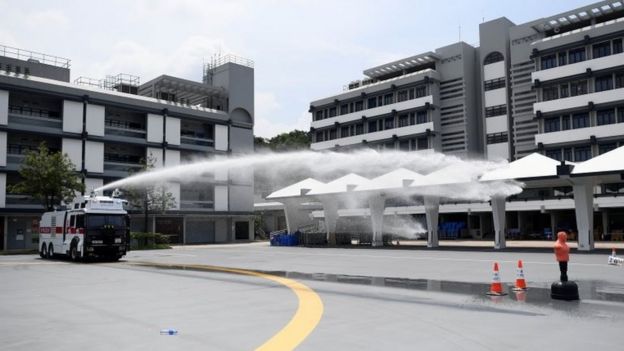
Hong Kong police have also unveiled a water cannon vehicle as a new tool to combat the protests.

Hong Kong Police demonstrate their new water cannon equipped vehicle at the Police Tactical Unit compound in Hong KongImage copyright AFP

Amnesty International has previously warned that the tool could cause serious injuries and inflame tensions.

Why are there protests in Hong Kong?

Demonstrations started in June in opposition to a proposed extradition bill, which would have allowed suspected criminals to be sent to mainland China for trial.

Critics said it would undermine Hong Kong’s legal freedoms, and could be used to silence political dissidents.

Although the government has now suspended the bill, demonstrators want it to be fully withdrawn.

Their demands have broadened to include calls for an independent inquiry into alleged police brutality, and an amnesty for all arrested protesters.

Hong Kong is part of China but its citizens have more autonomy than those on the mainland.

It has a free press and judicial independence under the so-called “one country, two systems” approach – freedoms which activists fear are being increasingly eroded.

Source: The BBC

Law of Unintended Consequences

continuously updated blog about China & India

ChiaHou's Book Reviews

continuously updated blog about China & India

What's wrong with the world; and its economy

continuously updated blog about China & India