Chindia Alert: You’ll be Living in their World Very Soon
aims to alert you to the threats and opportunities that China and India present. China and India require serious attention; case of ‘hidden dragon and crouching tiger’.
Without this attention, governments, businesses and, indeed, individuals may find themselves at a great disadvantage sooner rather than later.
The POSTs (front webpages) are mainly 'cuttings' from reliable sources, updated continuously.
The PAGEs (see Tabs, above) attempt to make the information more meaningful by putting some structure to the information we have researched and assembled since 2006.
BEIJING, May 17 (Xinhua) — China’s Chang’e-4 probe has survived 500 Earth days on the far side of the moon while conducting a scientific exploration of the virgin territory.
The lander and rover of the Chang’e-4 probe have resumed work for the 18th lunar day on the far side of the moon after “sleeping” during the extremely cold night.
The lander woke up at 3:25 a.m. Sunday (Beijing time), and the rover awoke at 11:53 a.m. Saturday. Both are in normal working order, according to the Lunar Exploration and Space Program Center of the China National Space Administration (CNSA).
The Chang’e-4 probe, launched on Dec. 8, 2018, made the first-ever soft landing on the Von Karman Crater in the South Pole-Aitken Basin on the far side of the moon on Jan. 3, 2019.
A lunar day equals 14 days on Earth, and a lunar night is the same length. The Chang’e-4 probe switches to dormant mode during the lunar night due to the lack of solar power.
The rover Yutu-2, or Jade Rabbit-2, has driven 447.68 meters, and is now 292 meters away from the lander. It has conducted scientific detection on lunar rocks, the lunar soil on its track and some impact craters.
Scientists used the Lunar Penetrating Radar on Yutu-2 to study the geological structure with a depth of 40 meters, unveiling the secrets buried under the surface of the far side of the moon, enriching our understanding about the history of celestial collisions and volcanic activities and shedding new light on the geological evolution on the moon.
Scientists also analyzed the data of the infrared imaging spectrometer on Yutu-2 and revealed the material composition on the moon’s far side, verifying that the lunar mantle is rich in olivine, which deepens our understanding of the formation and evolution of the moon.
China plans to launch its first Mars exploration mission Tianwen-1 in July. Due to the modification of the ground communication facilities, the rover and the lander will conduct in-situ detection during the 18th lunar day, said the CNSA.
The scientific tasks of the Chang’e-4 mission include conducting low-frequency radio astronomical observation, surveying the terrain and landforms, detecting the mineral composition and shallow lunar surface structure and measuring neutron radiation and neutral atoms.
The Chang’e-4 mission embodies China’s hope to combine wisdom in space exploration with four payloads developed by the Netherlands, Germany, Sweden and Saudi Arabia.
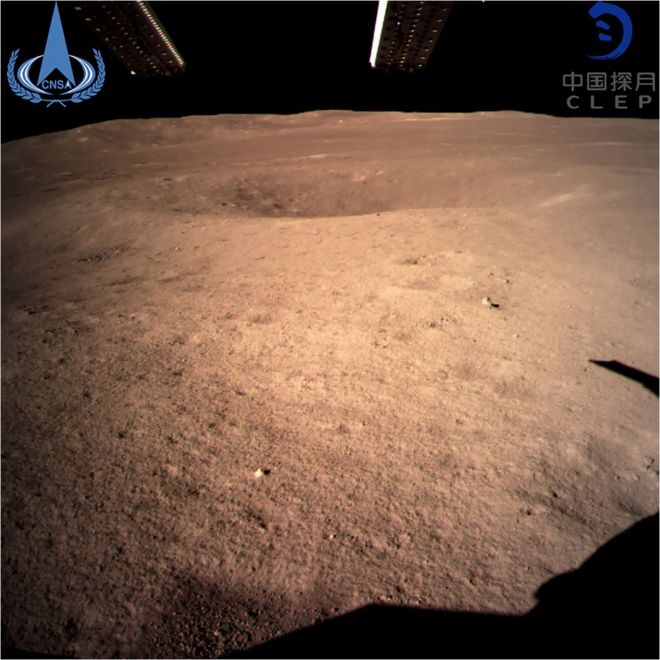
Image copyrightCNSA/AFPImage captionThe first close up pictures of the far side of the Moon
What will China’s Chang’e-4 mission learn about the far side of the Moon? Here are a few things the mission is designed to do.
Learn about the Moon’s history
No space mission has ever explored the far side from the surface. As such, it’s the first chance to explore a mysterious region of Earth’s natural satellite.
The “face” that’s never seen from Earth has some key differences to the more familiar “near side”. The far side has a thicker, older crust that is pocked with more craters. There are also very few of the “maria” (dark basaltic “seas” created by lava flows) that are evident on the near side.
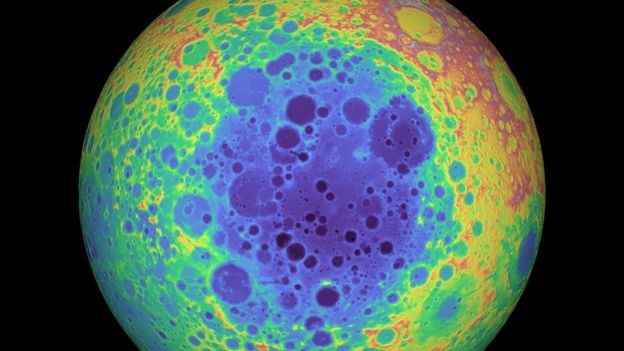
Chang’e-4 has reportedly landed at a site known as Von Kármán crater, a 180km depression located in the far side’s southern hemisphere. But Von Kármán lies within a much bigger hole punched in the Moon – the South Pole-Aitken basin.
It’s the oldest, largest and deepest such basin on the Moon and formed when an asteroid – perhaps 500km across, or more – collided with it billions of years ago.
This event was so powerful that it is thought to have ploughed through the Moon’s outer crust layer and through into the zone known as the mantle.
One of the mission’s objectives is to study any exposed material from the mantle present at the landing site. This would provide insights into the internal structure and history of the Moon.
Image copyrightNASAImage captionThe South Pole-Aitken basin was formed by a giant impact billions of years ago
Indeed, data from orbiting spacecraft show that the composition of the basin is different from the surrounding lunar highlands. But exposed mantle material on the surface is just one possibility among several to explain this observation.
The rover will use its panoramic camera to identify interesting locations and its Visible and Near-Infrared Imaging Spectrometer (VNIS) to study minerals in the floor of the crater (as well as of ejecta – rocks thrown out by nearby space impacts).
Additionally, the Lunar Penetrating Radar (LPR) instrument will be able to look into the shallow subsurface of the Moon, down to a depth of about 100m. It could probe the thickness of the lunar regolith – the broken up rocks and dust that make up the surface – and shed light on the structure of the upper lunar crust.
After the huge impact that created the South Pole-Aitken basin, a large amount of melted rock would have filled the depression. The science team wants to use Chang’e-4 to identify and study variations in its composition.
Filling an astronomy gap
The far side of the Moon has long been regarded as an ideal spot for conducting a particular kind of radio astronomy – in the low-frequency band – because it’s shielded from the radio noise of Earth.
There’s a frequency band (below about 10MHz) where radio astronomy observations can’t be conducted from Earth, because of manmade radio interference and other, natural factors.
Chang’e-4’s lander is carrying an instrument called the Low Frequency Spectrometer (LFS) which can make low frequency radio observations. It will be used in concert with a similar experiment on the Queqiao orbiting satellite.
The objectives include making a map of the radio sky at low frequencies and studying the behaviour of the Sun.
Speaking in 2016, Liu Tongjie, from the Chinese space agency (CNSA), said: “Since the far side of the Moon is shielded from electromagnetic interference from the Earth, it’s an ideal place to research the space environment and solar bursts, and the probe can ‘listen’ to the deeper reaches of the cosmos.”
Thus, the mission will fill a gap in astronomical observation, allowing scientists to study cosmic phenomena in a way that has never been possible from our planet.
Radiation on the Moon
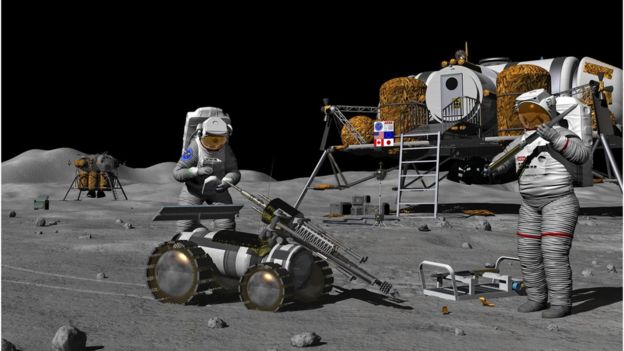
Image copyrightSCIENCE PHOTO LIBRARYImage captionUnderstanding the radiation environment will be vital for future human exploration
Several space agencies want to land humans on the Moon in the not-too-distant future, and might send astronauts there for longer than we’ve ever stayed before. So understanding the potential risks from radiation are vital.
Earth’s thick atmosphere and strong magnetic field provide adequate shielding against galactic cosmic rays and energetic charged particles travelling from the Sun.
But astronauts on the Moon will be outside this protective bubble and exposed to particles travelling through open space at near the speed of light – with potentially damaging consequences for their health.
It will provide dosimetry (measure the ionising radiation dose that could be absorbed by the human body) with a view to future exploration, and contribute to understanding of particles originating from the Sun.



 CHINDIA ALERT: You'll be living in their world, very soon