
A farmer picks apples at a fruit and vegetables specialized cooperative in Nanhai New Area of Weihai, east China’s Shandong Province, Oct. 23, 2019. (Xinhua/Guo Xulei)
Source: Xinhua
continuously updated blog about China & India

You will be living in their world, very soon

Beware the Waking Dragon
A farmer picks apples at a fruit and vegetables specialized cooperative in Nanhai New Area of Weihai, east China’s Shandong Province, Oct. 23, 2019. (Xinhua/Guo Xulei)
Source: Xinhua
NEW DELHI (Reuters) – Tens of thousands of runners have signed up for the Indian capital’s half marathon and other races on Sunday, officials said, despite the air quality hitting dangerous levels in one of the most heavily polluted cities in the world.
New Delhi’s air quality index was around 300 on Thursday, classified as very poor and meaning prolonged exposure can cause respiratory illness.
Delhi Chief Minister Arvind Kejriwal, who has described the city as a “gas chamber” in winter, has ordered emergency measures, including restricting the number of private vehicles on the roads under an “odd-even” scheme based on number plates.
Race organisers said pollution was a worry but they would take steps to reduce the impact on runners. Hours ahead of and throughout the race, the course will be sprayed with water.
“The air quality is a concern and will remain a concern, there is no question about it,” said Vivek Singh, joint managing director of Procam International that conducts the race sponsored by telecom operator Bharti Airtel.
“The measures that we take for those few hours to give our runners a good experience have worked in the past.”
The race has been moved this year to avoid a sharp rise in pollutants during Diwali, the Hindu festival of lights, when hundreds of thousands of firecrackers are lit.
But farmers burning crop stubble in the states north of Delhi have turned the air over Delhi toxic. The forecast for the next few days and into Sunday is “very poor”.
A record 40,633 people have signed up for the 21-km, 10-km and a 5-km races. Last year there were 34,916 runners, many of whom wore masks.
A former Olympic gold medallist, Carmelita Jeter of the United States, is the international event ambassador.
Doctors have advised citizens to restrict their outdoor activities and said runners must be made aware of the risks they are taking.
“Just two weeks before the odd-even scheme comes into play, how have the civic authorities allowed more than 30,000 people to expose themselves to toxic air?” asked said Desh Deepak, senior chest physician at the city’s Ram Manohar Lohia Hospital.
Source: Reuters
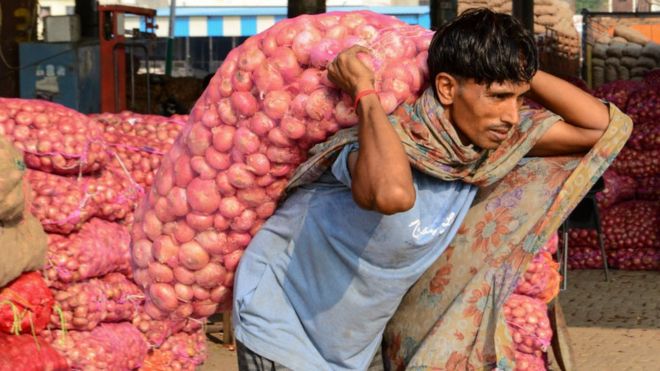 Image copyright GETTY IMAGES
Onion prices have yet again dominated the headlines in India over the past week. BBC Marathi’s Janhavee Moole explains what makes this sweet and pungent vegetable so political.
The onion – ubiquitous in Indian cooking – is widely seen as the poor man’s vegetable.
But it also has the power to tempt thieves, destroy livelihoods and – with its fluctuating price a measure of inflation – end the careers of some of India’s most powerful politicians.
With that in mind, it’s perhaps unsurprising those politicians might be feeling a little concerned this week.
In short: its price has skyrocketed.
Onion prices had been on the rise in India since August, when 25 rupees ($0.35; £0.29) would have got you a kilo. At the start of October, that price was 80 rupees ($1.13; £0.91).
Fearing a backlash, the Bharatiya Janata Party (BJP)-led government banned onion exports, hoping it would bring down the domestic price. And it did.
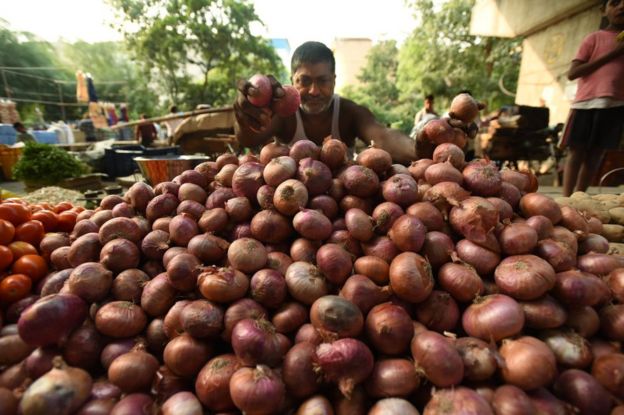 Image copyright GETTY IMAGES
A kilo was selling for less than 30 rupees on Thursday at Lasalgaon, Asia’s largest onion wholesale market, located in the western state of Maharashtra.
However, not everyone is happy.
While high prices had angered consumers in a sluggish Indian economy, the fall in prices sparked protests by exporters and farmers in Maharashtra, where state elections are due in weeks.
And it is not just at home where hackles have been raised: the export ban has also strained trade relations between India and its neighbour, Bangladesh, which is among the top importers of the vegetable.
The onion is a staple vegetable for the poor, indispensable to many Indian cuisines and recipes, from spicy curries to tangy relishes.
“In Maharashtra, if there are no vegetables or you can’t afford to buy vegetables, people eat ‘kanda bhakari’ [onion with bread],” explains food historian Dr Mohseena Mukadam.
True, onions are not widely used in certain parts of the country, such as the south and the east – and some religious communities don’t eat them at all.
But they are especially popular in the more populous northern states which – notably – send a higher number of MPs to India’s parliament.
“Consumers in northern India wield more power over the federal government. So although consumers in other parts of India don’t complain as much about higher prices, if those in northern India do, the government feels the pressure,” says Milind Murugkar, a policy researcher.
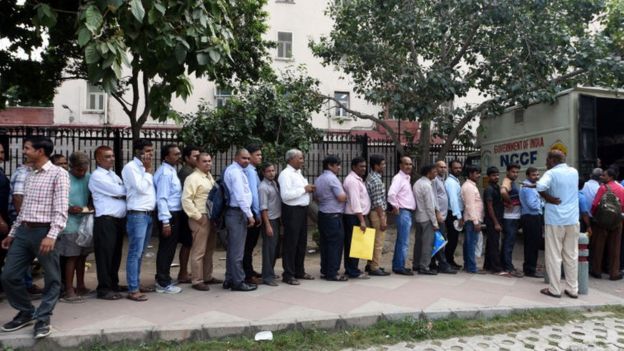 Image copyright GETTY IMAGES
A drop in prices also affects the income of onion farmers, mainly in Maharashtra, Karnataka in the south and Gujarat in the west.
“Farmers see the onion as a cash crop that grows in the short term, and grows well in dry areas with less water,” says Dipti Raut, a journalist, who has been on the “onion beat” for years.
“It’s like an ATM machine that guarantees income to farmers and sometimes, their household budget depends on the onion produce,” she said.
Onions have even attracted robbers: when prices skyrocketed in 2013, thieves tried to steal a truck loaded with onions, but were caught by the police.
Put simply, because the price moving too far one way or another is likely to anger a large block of voters, be they everyday households, or the country’s farmers.
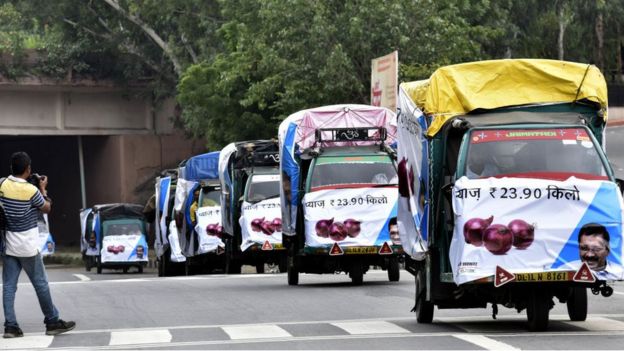 Image copyright GETTY IMAGES
Onions are so crucial they have even featured in election campaigns. The Delhi state government bought and sold them at subsidised rates in September when prices were at their peak: chief minister Arvind Kejriwal, it should be noted, is up for re-election next year.
Meanwhile, Indira Gandhi swept to power in 1980 on slogans that used soaring onion prices as a metaphor for the economic failures of the previous government.
A drop in supply, due to heavy rains and flooding destroying the crop in large parts of India, and damaging some 35% of the onions stocks in storage, according to Nanasaheb Patil, director of the National Agricultural Co-operative Marketing Federation.
He said the flooding had also delayed the next round of produce, which was due in September.
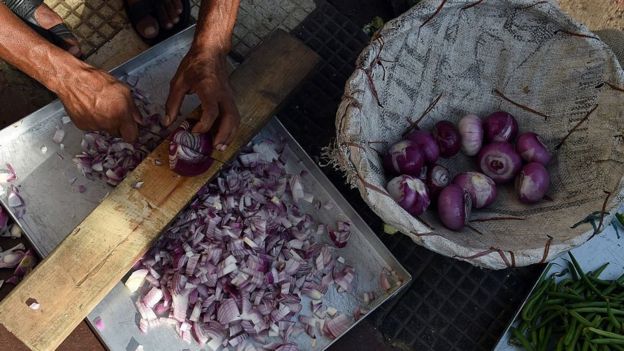 Image copyright GETTY IMAGES
“This has become a fairly regular phenomenon in recent decades,” Mr Murugkar said. “Onion prices swing heavily with a small drop or increase in production.”
In fact, the shortage – and subsequent rise in prices – happens almost every year around this time, according to Ms Raut.
“It’s a vicious cycle and the trader lobby and middlemen benefit from even the slightest price fluctuations,” she added.
Ms Raut says more grass-root planning and better storage facilities and food processing services will ease the problem – and making a variety of cash crops and vegetables available across the country would also ease the pressure on onions.
“The government is quick to act when onion prices rise. Why don’t they act as swiftly when prices fall?” asked Vikas Darekar, an onion farmer in Maharashtra. He said the government should buy onions from farmers at a “fair price”.
Mr Murugkar, however, feels that the government should never interfere in “onion matters”.
“If you are interested in raising purchasing power of the people, they should not curtail exports. Do we have such a ban on software exports? It’s really absurd. A government which has won such a huge majority should be able to withstand the pressures from a few consumers.”
Source: The BBC

The traditional role of grandparents in caring for China’s children has been called into question with two recent lawsuits sparking debate about whether seniors should be paid for their efforts.
Two grandmothers took their demands for compensation to court in separate cases which have highlighted the reliance of Chinese workers on their parents to provide childcare while they pursue professional advancement.
A woman in Mianyang, in the southwestern province of Sichuan, was awarded more than 68,000 yuan (US$9,500) by a local court after she sued her son and daughter-in-law for the costs of raising her nine-year-old grandchild, according to Red Star News.
The woman, identified only by her surname Wang, had been the child’s full-time carer for eight years after his parents left home to seek better-paid jobs elsewhere. Wang said she had taken care of most of her grandson’s living expenses and had decided to seek compensation when his parents said they were considering a divorce.
Despite winning the case, she has not received a penny and the boy still lives with her.
In another case, three months ago, a Beijing court supported a woman’s demand for compensation for helping to raise her granddaughter since her birth in 2002.
The stories of the two women generated a public reflection on the Chinese way of childcare which, for generations, has involved leaving most – if not all – of the burden on grandparents.
One of 60 million: life as a ‘left-behind’ child in China
From a cultural perspective, it has been a matter of course in a country with a long history of several generations living under one roof, for grandparents to participate in child rearing, according to Xu Anqi, a researcher specialising in family studies at the Shanghai Academy of Social Sciences.
“Today, as people face fierce competition and great pressure from work, it’s still common to rely on their old parents to look after their children,” she said.
While rapid urbanisation in recent decades has broken up multi-generational households, Chinese elderly still take an active role in child rearing, with many relocating to their children’s cities to take on the job.
Millions more families do it the other way round – with parents leaving children in their hometown with the grandparents while they seek better paying jobs in the cities. In August last year, according to the Ministry of Civil Affairs, China had nearly 7 million “left behind kids”, as they are known.
BEIJING, Sept. 23 (Xinhua) — Chinese President Xi Jinping extended greetings to farmers and people working in agriculture and rural areas as Monday marked the second Chinese farmers’ harvest festival.
Xi, also general secretary of the Communist Party of China (CPC) Central Committee and chairman of the Central Military Commission, sent his greetings via the China Central Television’s newly-launched channel dedicated to agriculture and rural affairs.
“With a solid foundation laid by agriculture, we have full confidence in development,” Xi said.
The achievements that China has made in the fields related to agriculture, rural areas and farmers are not only the outcomes of concerted efforts of the whole CPC and the country but also the results of hard work of all farmers and people working in agriculture and rural areas, he said.
Xi also congratulated on the launch of the new channel, expecting the channel to publicize agricultural policies, plans as well as new looks of farmers and rural areas in-depth.
Xi also expected the channel to lead the audience to pay attention to agriculture, care for the countryside and farmers, and contribute to poverty alleviation, reform and development in agriculture and the countryside, and the realization of rural revitalization.
The Chinese farmers’ harvest festival is the first national festival created specifically for the country’s farmers. Starting in 2018, the festival coincides with the Autumnal Equinox each year, which is one of the 24 solar terms of the Chinese lunisolar calendar and usually falls between Sept. 22 and 24 during the country’s agricultural harvest season.
The new channel is the first national all-media channel dedicated to agriculture and rural affairs. With daily 18-hour programs, the channel officially began broadcasting on Monday.
Source: Xnhua
 Image copyright GETTY IMAGES
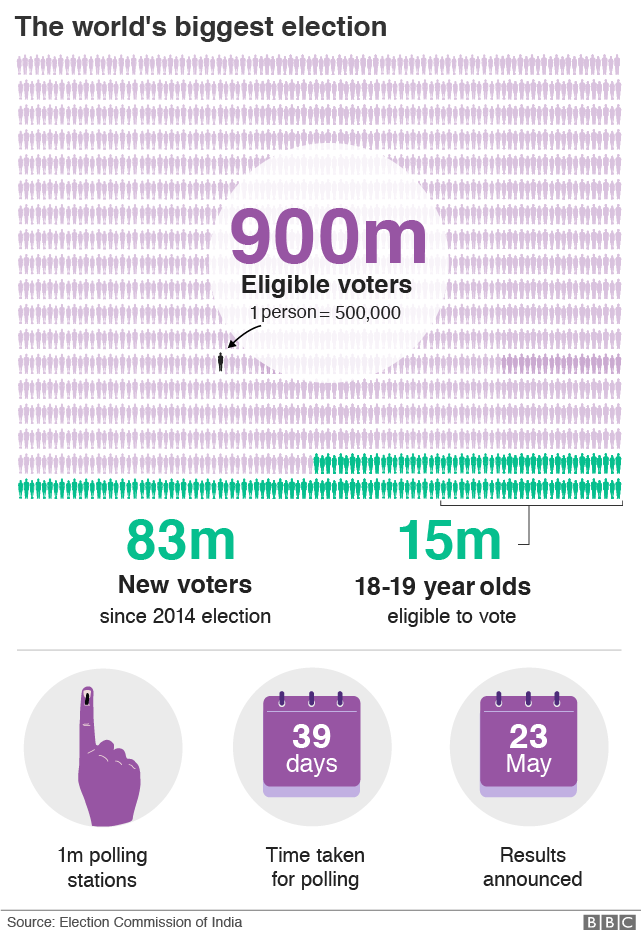
It is an election like no other. Those eligible to vote in India’s upcoming polls represent more than 10% of the world’s population and they will take part in the in history.
Voters will choose representatives for the Indian parliament, and in turn decide if Hindu nationalist Prime Minister Narendra Modi will run the country for another five years.
Whoever wins these elections and forms a government will control the destiny of the world’s largest democracy.
While they are in charge, is likely to overtake the UK’s and become the world’s fifth-largest.
Its population meanwhile – at more than 1.34bn people – is predicted to soon surpass China’s 1.39bn.
Hundreds of millions of Indians have escaped since the turn of the millennium but huge challenges remain.
is a major concern and is especially high among young people.
Millions of about low crop prices.
How the nuclear-armed country engages with the outside world – and manages a tricky – is also of immense importance to international security.
Indians are voting for members of parliament and the job of prime minister tends to go to the leader of the party or coalition with most seats. The current PM is .
His main rival is opposition leader .
Parliament has two houses: the Lok Sabha and the .
The lower house – – is the one to watch.
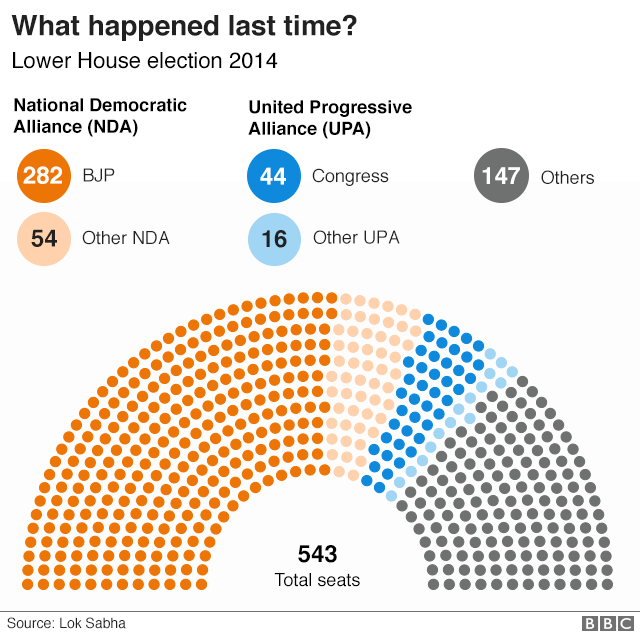
It has 543 elected seats and any party or coalition needs a minimum of 272 MPs to form a government.
At the last election in 2014, Mr Modi’s won 282 seats.
Mr Gandhi’s only took 44 seats in 2014 – down from 206 in 2009.
Because of the enormous number of election officials and security personnel involved, voting will take place in seven stages between 11 April and 19 May.
Different states will vote at different times.
Votes will be counted on 23 May and results are expected on the same day.
This election is being seen as a referendum on Mr Modi, a polarising figure adored by many but also accused of stoking divisions between and the country’s 200 million Muslims.
Until a few months ago, Mr Modi and his BJP party were seen as the overwhelming favourites. But the in December’s regional elections injected a sense of serious competition into the national vote.
Analysts are divided on whether Mr Modi will be able to win a simple majority again.
A recent escalation of tensions with Pakistan has given the BJP a new and popular issue to campaign on.
It will be hoping that a focus on patriotism will help the party to get past the serious challenge mounted by powerful regional parties and Congress.
Source: The BBC
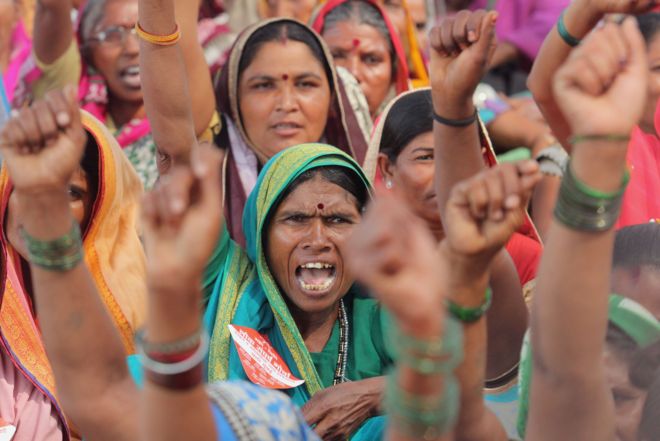 Image copyrightGETTY IMAGES
The plight of India’s farmers has been a major theme in the campaigns ahead of national elections, which get under way on 11 April.
Angry farmers have regularly taken to the streets demanding a better financial deal.
Many find themselves in debt and burdened by other liabilities they’ve taken on to buy seed, fertilisers and equipment.
Thousands of farmers commit suicide every year in India, although the reasons are often complex.

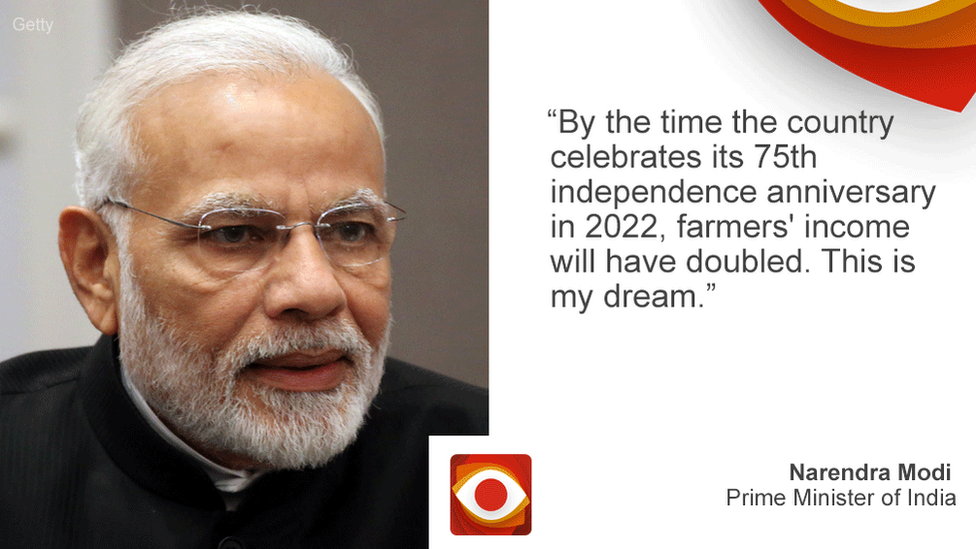
Pledge: Speaking in 2016, India’s Prime Minister, Narendra Modi, said farmers’ incomes would double by 2022.
Verdict: Official data shows farmers’ incomes were rising between 2013 and 2016. Income data for the past two years is not available but there are signs the rural economy is depressed. Unless there is a significant upturn, the doubling of farm incomes by 2022 is unlikely.
The government has now pledged to pay 6,000 Indian rupees (£64) a year to help farmers with holdings of less than two hectares (20,000 sq m), in a bid to reach that goal.
These moves have been criticised by opposition parties as vote-buying ahead of the elections.
The agricultural sector employs more than 40% of the workforce in India, despite its shrinking contribution to the country’s gross domestic product (GDP), the total value of goods and services produced.
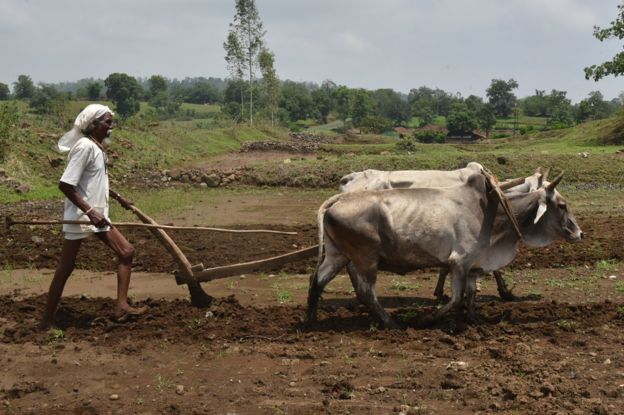
In 2016, the average monthly income of a farming household was about 9,000 Indian rupees (£100), according to a survey conducted by the National Bank for Agriculture and Rural Development.
This report also found that farmers’ income had increased by 40% in the three years up to 2016, the latest year for which data is available.
However, there is evidence of a more recent slowdown in the rural economy.
According to one estimate, farm income, which had grown by more than 14% in the year to 2017, slumped to just over a 2% growth rate between 2017 and 2018.
And in several state elections in December 2018, the ruling BJP fared poorly – something put down to growing discontent in rural areas.
Droughts, bad weather and a lack of modern equipment have plagued Indian agriculture for decades.
In addition, many of India’s farmers work on vulnerable small or marginal holdings.
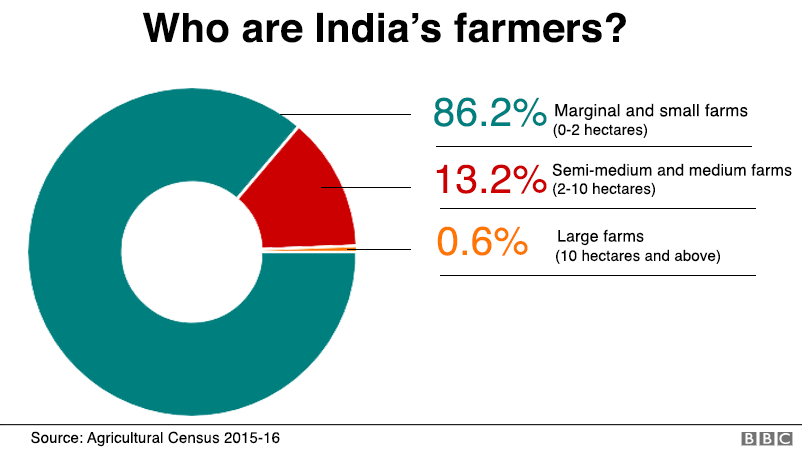
The current administration has introduced pro-farming policies that include:
But it’s also faced criticism for other policies that have negatively affected farmers – such as the sudden decision to 2016 withdraw the 500 and 1,000 rupee notes from circulation in a bid to tackle the black economy.
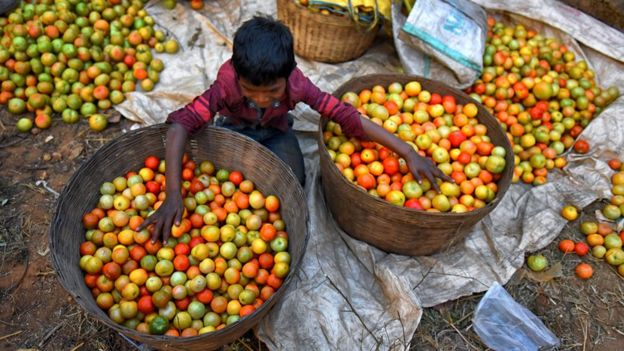 Image copyrightGETTY IMAGES
A very good harvest in any year will result in a sharp fall in the price of a commodity.
This helps keep food prices in check for urban consumers but is not so good for rural producers.
To counter this, the government sets a minimum purchase price for major agricultural products each year.
However, a recent official report pointed out serious shortcomings of these price controls.
It cited a lack of awareness among farmers, delays in payments and insufficient facilities to enable farmers to store produce at government-controlled warehouses.
At various times over the years, national and state governments have also announced loan waivers for farmers to write off their debts.
These schemes are expensive and not everyone qualifies for help.
Source: The BBC
BEIJING, March 14 (Xinhua) — Farmer Zhao Huijie, spiced with humor when speaking at panel discussions at the second session of the 13th National People’s Congress (NPC), China’s national legislature, has a clearer vision for the development of her village.
The 48-year-old woman from north China’s Inner Mongolia Autonomous Region has fought for fortune for her fellow villagers after she became the village Party chief in 2009, and now for the interest of more people in rural China now that she is a deputy to the NPC.
At the ongoing second session of the 13th NPC, Zhao submitted a suggestion on pollution control in animal husbandry and farming in rural areas.
“Random disposal of livestock waste has not only damaged the rural environment, but also polluted groundwater,” she said, advising the government to fund major livestock farms in harmless waste treatment.
She also suggested the government to subsidize farmers to use degradable plastic films to protect the environment.
Unlike legislators in the West who make a career of politics, NPC deputies are from all walks of life and work part-time. Of the nearly 3,000 national lawmakers, more than 15 percent are workers and farmers.
Zhao, an ethnic Manchu, is also one of the 400-plus ethnic minority deputies.
URBAN WOMAN’S RURAL LIFE
Born into a worker’s family, Zhao worked at a gold mine in the city of Chifeng, Inner Mongolia, where she got married in 1991.
“He was four years older than me. I think it was a perfect match considering I am talkative, while he is quiet,” Zhao said of her husband.
Their daughter was born in 1992. In the same year, the gold mine went bankrupt, forcing the couple back to her husband’s home in Xiaomiaozi Village.
Located between two mountains with a river traversing through, Xiaomiaozi was known for its poverty back then. Shabby houses, bumpy roads and barren farmland formed the major landscape, and the only crop villagers grew was corn.
To make ends meet, Zhao’s husband found a job in town, and she rented a small plot of farmland at home.
She had to learn how to farm from scratch, including driving a horse to plow in the field. When she was farming, she had to place her baby on the field ridge.
“I didn’t want to depend on my parents after getting married. If the other villagers could get used to the country life here, how could I not?” she said.
In 1995, she started teaching at the village elementary school. Four years later, she was assigned to take charge of family planning and women’s work in the village.
“I was familiar with every household — newborn babies, young brides marrying into our village, and the elderly,” Zhao said.
In 2009, she was elected unanimously as the village Party chief.
As soon as she took office, Zhao was asked to attend “a meeting” in the township.
“It turned out to be a training for Party chiefs of backward villages. That was shameful,” she said, determined to change the situation.
NEW ROAD, NEW LIFE
The first thing she decided to work on was to build a concrete road, as she found corn buyers were reluctant to come due to the bumpy roads. Higher transport costs even dragged down corn prices in the village.
For more than a year, Zhao visited door to door to persuade villagers to relocate to give way to the road. She talked so much that she was diagnosed with sphagitis, and had to undergo a surgery.
“I liked singing in the past, but after the surgery, I could never hold a high note,” she said.
After the road project was completed, Zhao had a bridge built, ending the days when villagers had to trek in waters to cross the river.
In 2013, when Zhao engaged herself in the bridge project, she broke her left arm and knee in a road accident.
“After work, I was riding my motorcycle in the dark when a donkey rushed on to the road. I was thrown away along with the vehicle,” she said.
Instead of lying in bed, Zhao insisted going to the construction site on crutches, touching the villagers and drawing more and more followers.
Li Yongbo, a villager who used to work in Beijing, was persuaded home and led the farmers to grow traditional Chinese medicine (TCM) such as balloon flower root, which secures three times the income of corn.
According to Li, the sandy soil, big day-and-night temperature difference and easy access to irrigation made the village an ideal place for TCM plantation.
The village has expanded the TCM plantation areas to more than 200 hectares now, producing more than 4,000 tonnes of TCM every year. A TCM processing workshop has been established, further doubling the income from mere TCM plantation.
The per capita income of the village reached 14,000 yuan (2,087 U.S. dollars) in 2018, 10,000 yuan more than the levels of 2010.
“As villagers get rich and spend more, my tiny store now can bring me more than 100,000 yuan of profit every year,” grocery runner You Junguang said.
Last year, Zhao was elected as a deputy to the 13th NPC. She suggested utilizing private investment in rural development.
“To my delight, the Ministry of Finance replied to me, accepting my suggestion and pledging to encourage private investors to contribute to revitalizing the rural areas.”
Zhao said they had registered “Xiaomiaozi Village” as a brand, and were talking to a tourism company on cooperation to entice tourists with the village’s Manchu and Mongolian ethnic cultures, as well as its beautiful landscape.
After graduating from college, Zhao’s daughter found a teaching job in Changsha City in central China in 2014. Her son is studying in a senior high school in Chifeng City. Zhao is too busy to visit them.
“I feel guilty because I have rarely taken care of my kids. But I hope I can set an example for them by trying my best to do everything, be it vital or trivial, and making positive contribution to the society,” she said.
Source: Xinhua
LHASA, March 6 (Xinhua) — To conserve the ecosystem while eradicating poverty, southwest China’s Tibet Autonomous Region hired 309,000 farmers and herders as forest rangers in 2018, bringing the total number of people engaged in environmental protection to 667,000.
Average annual subsidies in the jobs increased to 3,500 yuan (522 U.S. dollars), according to the regional department of ecology and environment.
Last year, Tibet invested 10.7 billion yuan in environmental protection funds, with 74,133 hectares of trees planted and forest coverage rising to 12.14 percent.
The region also invested 100 million yuan in enhancing the ecology along the upper reaches of the Yangtze, China’s longest river.
“Protecting the forests is equal to protecting our homeland,” said a local Tibetan forest ranger.
The implementation of a series of measures contributed to environmental protection, making Tibet one of the areas with the best ecological environment in the world, authorities said.
Source: Xinhua

continuously updated blog about China & India
continuously updated blog about China & India
continuously updated blog about China & India
 CHINDIA ALERT: You'll be living in their world, very soon