Archive for ‘FBI’

11/02/2020

Equifax: US charges four Chinese military officers over huge hack

The US has charged four Chinese military officers over the huge cyber-attack on credit rating giant Equifax.

More than 147 million Americans were affected in 2017 when hackers stole sensitive personal data including names and addresses.

Some UK and Canadian customers were also affected.

China has denied the allegations and insisted it does not engage in cyber-theft.

Announcing the indictments on Monday, Attorney General William Barr called the hack “one of the largest data breaches in history”.

According to court documents, the four – Wu Zhiyong, Wang Qian, Xu Ke and Liu Lei – are allegedly members of the People’s Liberation Army’s 54th Research Institute, a component of the Chinese military.

They spent weeks in the company’s system, breaking into security networks and stealing personal data, the documents said.

The nine-count indictment also accuses the group of stealing trade secrets including data compilation and database designs.

Chinese foreign ministry spokesman Geng Shuang denied the allegations on Tuesday and said China’s government, military and their personnel “never engage in cyber theft of trade secrets”.

He said China was itself a victim of cyber-crime, surveillance and monitoring by the US, Reuters reported.

The whereabouts of the four suspects is unknown and it is highly unlikely that they will stand trial in the US.

FBI Deputy Director David Bowdich said: “We can’t take them into custody, try them in a court of law, and lock them up – not today, anyway.”

What happened in 2017?

Equifax said hackers accessed the information between mid-May and the end of July 2017 when the company discovered the breach.

The accused allegedly routed traffic through 34 servers in nearly 20 countries to try to hide their true location.
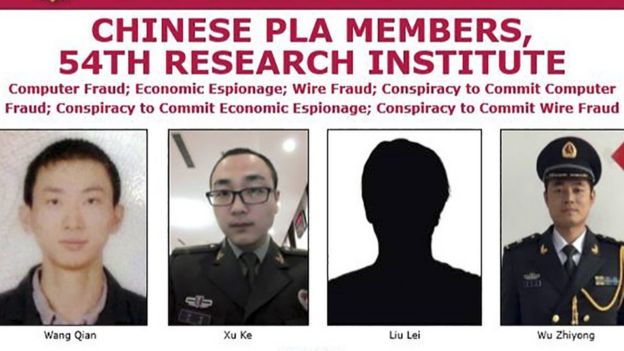
A picture of the wanted poster for the four Chinese menImage copyright FBI
Image caption The FBI released this wanted picture of the suspects

The credit rating firm holds data on more than 820 million consumers as well as information on 91 million businesses.

Mr Bowdich said there was no evidence so far of the data being used to hijack a person’s bank account or credit card.

Equifax CEO Mark Begor said in a statement that the company was grateful for the investigation.

“It is reassuring that our federal law enforcement agencies treat cybercrime – especially state-sponsored crime – with the seriousness it deserves.”

Critics have accused the company of failing to take proper steps to guard information and for waiting too long to inform the public about the hack.

Richard Smith, CEO of Equifax at the time of the hacking, resigned a month after the breach. He apologised for the firm’s failings, ahead of testifying in Congress.

Equifax was forced to pay a $700m (£541m) settlement to the Federal Trade Commission.

The US regulator alleged the Atlanta-based firm failed to take reasonable steps to secure its network. At least $300m of the settlement went towards paying for identity theft services and other related expenses run up by the victims.

In a statement Mr Barr said: “This was a deliberate and sweeping intrusion into the private information of the American people.

“Today we hold PLA hackers accountable for their criminal actions, and we remind the Chinese government that we have the capability to remove the internet’s cloak of anonymity and find the hackers that nation repeatedly deploys against us.”


Analysis box by Gordon Corera, security correspondent

This is not the first time the US has charged members of the Chinese military with hacking US companies.

The first indictment came back in 2014 and helped lead to a deal the following year to try to restrain such activity.

But clearly the US feels that it needs to return to the weapon of public indictments to increase pressure again.

The US has become increasingly concerned not just at the alleged theft of economic secrets but also the intelligence risks.

Equifax was one of a series of large data breaches linked to China – others include health care providers and, most significantly, the theft of data from the Office of Personnel Management which carried sensitive records for almost all US federal employees.

One of the concerns for US security officials is how Chinese spies may be able to put together these vast databases about US citizens.

Officials say the information could be used to create “targeting packages”, establishing which individuals have access to sensitive information and potential vulnerabilities which would allow them to be approached. They add, though, that so far they have not seen the Equifax information being used for that purpose.

Source: The BBC
06/05/2019

Ex-CIA agent Jerry Chun Shing Lee admits spying for China

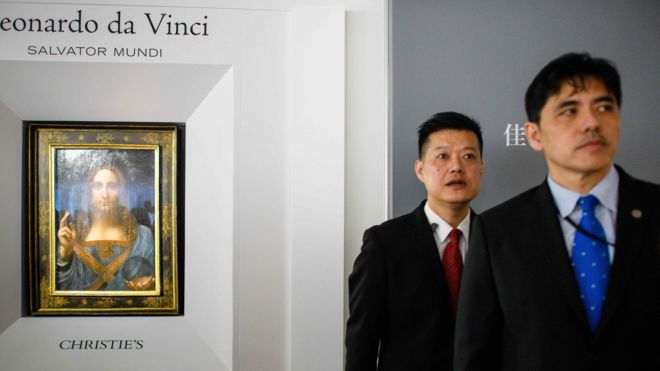
A man (R, wearing blue tie) identified by local Hong Kong media as former CIA agent Jerry Chun Shing LeeImage copyrightAFP
Image caption A man (R in blue tie) identified as Jerry Chun Shing Lee by Hong Kong media

An ex-CIA agent has pleaded guilty to spying for China, the US justice department says, in a case believed to be linked to the dismantling of a US espionage network.

Jerry Chun Shing Lee, 54, left the CIA in 2007 to live in Hong Kong, where he was recruited by Chinese agents.

Prosecutors say the naturalised US citizen was then paid to divulge information on US covert assets.

This led China to bring down a network of informants between 2010 and 2012.

About 20 informants were killed or jailed during that period – one of the most disastrous failures of US intelligence in recent years.

The US Assistant Attorney General for National Security, John Demers, said Lee’s case was the third involving US agents and China in less than a year.

“Every one of these cases is a tragic betrayal of country and colleagues,” he said.

What did Lee do?

Lee, who worked for the CIA between 1994 and 2007, pleaded guilty to conspiracy to deliver national defence information to aid a foreign government in a court in Virginia on Wednesday, the justice department said in a statement.

It said Lee was contacted by the Chinese intelligence agents in 2010. They offered him money, promising to take care of him “for life” in exchange for the required secret information. Hundreds of thousands of dollars were deposited in his Hong Kong bank account between May 2010 and December 2013.

Mr Lee created a document containing information about CIA activities, including locations to which US agents would be assigned.

In 2012, FBI agents searched a hotel room in Hawaii registered in Mr Lee’s name and found a USB drive. Investigators found the document on unallocated space in the drive, suggesting it had been deleted.

The search also revealed Lee to have a day planner and address book containing notes of intelligence provided by CIA agents, their true identities, operational meeting locations and phone numbers, and information about covert facilities.

Lee was interviewed by CIA officers in 2012 during which he said he had met Chinese intelligence officers but concealed the fact that they had set him tasks, the justice department said. In 2013 he first denied knowing about the document on his USB drive and then admitted he had created it but said he had never handed it on to Chinese agents.

Mr Lee was arrested at New York’s JFK airport in January 2018. He will be sentenced in August.


Spy v Spy

By Tara McKelvey, BBC News, Washington DC

The Lee case shows that the battle between Chinese and US spies has intensified over the past year, turning into a new “Cold War”, as Michael Collins, the deputy assistant director of the CIA’s East Asia mission center, called it.

The Chinese are investing more resources into their efforts to ferret out information about the US government, while the US government has become more aggressive in its pursuit of US citizens who have helped Chinese agents.

And when the guilty party is a former CIA officer, one of their own, the men and women who work in the field of US intelligence are ready to “bring the hammer down”, one senior intelligence official said.


CIA spy operation in China: Key dates

Three armed Chinese policemen guarding the US embassy in BeijingImage copyright AFP
Image caption Chinese police guard the US embassy in the capital, Beijing
  • 2010: Information gathered by the US from sources deep inside the Chinese government bureaucracy start to dry up
  • 2011: Informants begin to disappear. It is not clear whether the CIA has been hacked or whether a mole has helped the Chinese to identify agents
  • 2012: FBI begins investigation
  • May 2014: Five Chinese army officers are charged with stealing trade secrets and internal documents from US companies. Later that same month, China says it has been a main target for US spies
  • 2015: CIA withdraws staff from the US embassy in Beijing, fearing data stolen from government computers could expose its agents
  • April 2017: Beijing offers hefty cash rewards for information on foreign spies
  • May 2017: Four former CIA officials tell the New York Times that up to 20 CIA informants were killed or imprisoned by the Chinese between 2010 and 2012
  • June 2017: Former US diplomatic officer Kevin Mallory is arrested and charged with giving top-secret documents to a Chinese agent
  • January 2018: Former CIA officer Jerry Chun Shing Lee is arrested

Source: The BBC

05/02/2019

Why ‘India’s FBI’ agents are clashing with police

Mamata BanerjeeImage copyrightGETTY IMAGES
Image captionMamata Banerjee is a rare firebrand woman leader who commands mass support

Imagine state policemen in the US detaining FBI agents investigating a case on state territory.

Then imagine the governor of the state starting a public protest against the FBI and the president for carrying out what she calls an act of vendetta against her government.

Now imagine federal forces being deployed to protect their offices in the state, fearing attacks by supporters of the governor.

This possibly sounds like a plot from a dystopian political novel. But it is what is happening in India.

A group of detectives belonging to India’s federal investigation agency, the CBI, arrived at the well-secured home of the commissioner of police of Kolkata (formerly known as Calcutta) in West Bengal state on Sunday evening. They said they wanted to question Rajeev Kumar in connection with a ponzi scandal. (The multi-million dollar scam, involving businessmen, politicians, journalists and film producers, defrauded a large number of small investors.)

But Mr Kumar refused to meet the detectives. Instead his forces detained the agents – who are recruited from the police forces themselves – and took them away to a police station. They were freed after a few hours, and returned without being able to question Mr Kumar.

Mr Kumar had led the early local investigation into the scandal, before the case was taken over by the CBI under the supervision of the Supreme Court. The federal agency, say reports, unsuccessfully tried to question Mr Kumar half-a-dozen times in the past in connection with some evidence he had purportedly collected in the case. The agency believes that he is “hiding” something.

The ponzi scandal, involving at least two small investment companies, came to light in 2013 under the watch of the leader of West Bengal state. In India’s male-dominated politics, Mamata Banerjee is a rare firebrand woman leader who commands mass support. She took power in 2011, ending 34 years of communist rule in the state. (The following year, she was named one of Time magazine’s 100 most influential people in the world.) The feisty Ms Banerjee has ruled West Bengal ever since.

Central Bureau of InvestigationImage copyrightAFP
Image captionThe Central Bureau of Investigation is India’s top investigation agency

Ms Banerjee has a testy relationship with the federal government, run by Prime Minister Narendra Modi’s Bharatiya Janata Party (BJP). This is, in part, because Mr Modi’s party is trying to make inroads into Bengal, using its usual mix of development promises and sectarian rhetoric.

Source: The BBC

Law of Unintended Consequences

continuously updated blog about China & India

ChiaHou's Book Reviews

continuously updated blog about China & India

What's wrong with the world; and its economy

continuously updated blog about China & India