Archive for ‘finds’

26/01/2020

Coronavirus: Chinese embassy in Paris finds woman who ‘cheated’ checks

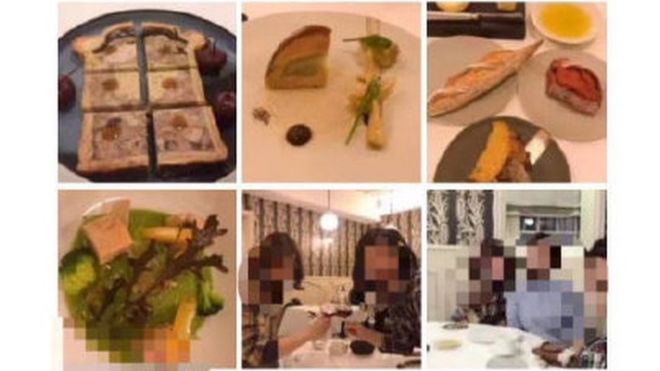
Pictures posted by the woman on WeChatImage copyright WEIBO
Image caption She posted pictures of her meal on social media platform WeChat

The Chinese embassy in Paris has tracked down a woman from Wuhan who said she took tablets to pass airport health checks.

The woman boasted on social media that she had been suffering from a fever, but managed to reduce her symptoms with medicine.

She later posted pictures showing herself dining at what she claimed was a Michelin-starred restaurant in Lyon.

The embassy has now confirmed that her symptoms are under control.

The woman left Wuhan – where the new coronavirus emerged late last year – before flights were suspended, but when thermal scanning was in place.

Since yesterday, public transport has been shut down, with residents told not to leave the city.

At least 25 people with the virus have died. It was first reported to the World Health Organization 31 December.

The virus has spread to countries as far as South Korea, Japan and the US.
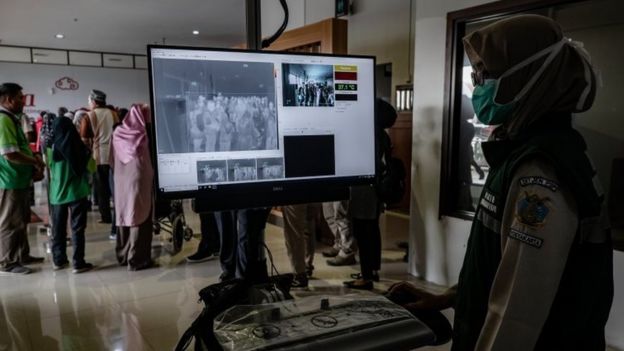
People have been thermally scanned when leaving Wuhan, and arriving at their destination. This picture was taken in Indonesia on ThursdayImage copyright GETTY IMAGES
Image caption People have been thermally scanned when leaving Wuhan, and arriving at their destination. This picture was taken in Indonesia on Thursday

The woman detailed her journey to Lyon on social media site WeChat.

“Finally I can have a good meal, I feel like I’ve been starving for two days. When you are in a gourmet city of course you have to eat Michelin [food],” she wrote.

“Just before I left, I had a low fever and cough. I was scared to death and rushed to eat [fever-reducing] medicine. I kept on checking my temperature. Luckily I managed to get it down and my exit was smooth.”

She also posted pictures of the meal she enjoyed. It is not clear exactly when she arrived.

Her post quickly went viral and she was widely criticised by other social media users.

The Chinese embassy in Paris said it had received calls and emails about the woman. It said she had taken antipyretics, and that it attached “great importance” to the case.

The embassy said it contacted her on Wednesday evening and asked her to refer herself to medical services.

On Thursday, in a new statement, the embassy said the woman’s temperature was under control, and that she had no more fever or cough symptoms.

It added that she did not require “further examinations” at this point.
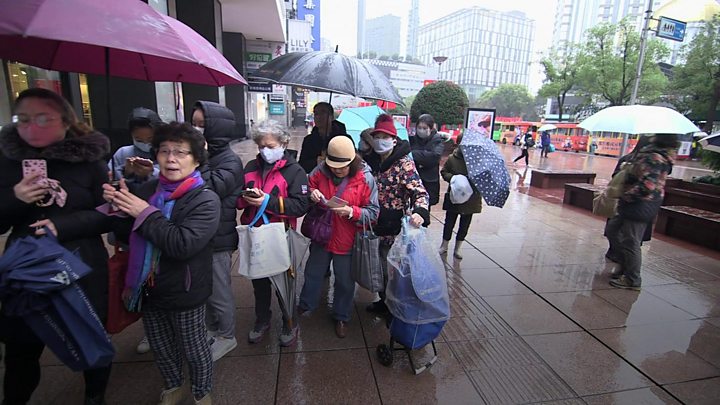
Media caption Fears over coronavirus in China trigger face mask shortage

China has effectively quarantined nearly 20 million people in Hubei province. Other major cities in China like Beijing and Shanghai are also affected.

Authorities have cancelled all large-scale celebrations in Beijing. Temple fairs are banned, film releases postponed and the Forbidden City will be closed to the public.

All this comes as millions of Chinese people are travelling across the country for Lunar New Year.

Currently known as 2019-nCoV, the virus is understood to be a new strain of coronavirus not previously identified in humans.

Source: The BBC

09/10/2019

Technology, not China, can be blamed for regional job losses in developed countries, IMF finds

  • Competition from China is not the primary reason for regional job losses in rich countries, new IMF research finds
  • Study finds technological advancement is bigger driver of unemployment, undermining populist argument China is stealing manufacturing jobs
The IMF said automation displaced more jobs in rich countries than China’s growing productivity. Photo: SCMP

Automation rather than market competition from China can be blamed for regional job losses suffered in developed countries, including American rust belt states, according to new research by the International Monetary Fund released on Wednesday.

“Increases in import competition in external markets associated with the rise of China’s productivity do not have marked effects on regional unemployment,” the Washington-based fund said in an academic paper. “Only technology shocks tend to have lasting effects, with even larger unemployment rises for vulnerable lagging regions.”

The paper, which looked at regional disparities within advanced countries, undermines a key argument pushed by US President Donald Trump in the ongoing trade war

 between Washington and Beijing – that China has been stealing American technology and jobs.
Although the research did not mention Trump, the IMF said the argument that market competition displaced jobs was flawed as imports from China could only cause job losses in the near term and such impact “quickly abates”.

The US goods trade deficit with China hit a record of US$419.2 billion in 2018, which the Trump administration has blamed for a decline in US manufacturing jobs.

In the paper, the IMF classified a region as “lagging” if two conditions were met – initial real gross domestic product (GDP) per capita was below the country’s median in 2000, and the region’s average growth between 2000 to 2017 was below average.

Labour productivity tended to be lower and employment in the agriculture sector higher in lagging regions, the IMF said. Within the United States, per capita GDP in the state of New York is 100 per cent higher than in Mississippi, parts of which are considered within the rust belt.

While increases in import competition tended to reduce labour force participation after one year, this impact faded quickly and did not have significant effects on regional unemployment on average, IMF analyst Weicheng Lian said.

The impact of technology was more far-reaching, however, with researchers pinpointing it as the main driver of rising unemployment in lagging regions.

Automation pressures

translate into a decline in the cost of machinery and equipment, leading to more persistent rises in unemployment and declines in labour force participation in lagging regions, compared with less vulnerable regions, the study said.

Lian said that poorer regions tend to specialise in agriculture and manufacturing industries rather than high productivity service sectors such as information technology, communications and finance.
“We find that a negative technology shock … raises unemployment in all regions that are more vulnerable to automation, but lagging regions are particularly hurt,” she said.
China-US trade war may cost US$700 billion by 2020 in synchronised global slowdown, new IMF chief says

US-China trade war could cost world economy US$700 billion by 2020: IMF

Read more

China tones down expectations ahead of US trade war talks as Vice-Premier Liu He leads team to Washington

China tones down expectations ahead of US trade war talks

Read more

Kristalina Georgieva is the new IMF chief, taking over from Christine Lagarde

Kristalina Georgieva is the new IMF chief

Read more

China, US urged to ease trade war tensions that are ‘weighing on’ global commerce, says IMF chief economist

China, US urged to ease tensions that are ‘weighing on global trade’

Read more

US-China trade war caused ‘self-inflicted’ damage to the global economy, says IMF after third 2019 forecast cut

US-China trade war caused ‘self-inflicted’ damage to the global economy

03/10/2019

Discover China: Run-down house finds new life as deluxe hotel

FUZHOU, Oct. 3 (Xinhua) — Zheng Yangmei, 35, has mixed feelings about working as a receptionist in her childhood home, a 400-year-old country lodge that has been adapted into a luxury hotel in southeast China’s Fujian Province.

The new profession gives her a different angle to perceive the beauty of the ancestral house built sustaining Tang Dynasty (618-907) architecture style, as experts marveled.

The restoration is beyond her family clan’s imagination, which keeps the historic details of the dilapidated residence as much as possible, while replacing the interior with modern decor suitable for comfortable living.

The place of a stinky hog pen in the yard, which Zheng remembers, is turned into a tea pavilion decorated with a neutral color palette. But the lodge is still roughly what she remembers, wood carvings, stone mills and the grey-tile roofs.

Tucked away in the idyllic village of Banding, an hour’s drive north of Fuzhou, the provincial capital, the old house offers a breathtaking view in the backdrop of lush mountains and a vast expanse of paddy fields.

Named “Sanluocuo,” or three juxtaposed houses, the wood and stone complex covers an area of 3,000 square meters and consists of over 200 dark shabby rooms, where Zheng spent part of her childhood life bunking with her parents and two siblings in a 25-square-meter room.

Since the mid 16th century, it has been held by the extended Zheng family clan. Zheng remembers that there were over 200 members living in the houses when she was there.

“There was no toilet, no tap water in each house,” said Zheng, whose family moved out of the aged buildings when she was 8, as they could no longer fix the house. Instead, they built new two-story brick houses 1,000 meters away.

The old buildings were completely abandoned by all the villagers in the early 2000s, Zheng recalled.

She left the village for college study at the age of 19 and then worked as a vet in several pig farms in more prosperous towns, until 2013 when she got married and returned to the village to raise her kids.

“Villagers seldom went back to the buildings, considering the place pretty spooky, with filthy water, messy electric wires hung in the air like spider webs and cracks on walls,” said Zheng, a mother of two daughters.

Elders of the family clan called on the clan members to raise funds to fix leaky roof tiles, control termites, and straighten leaning walls to prevent the ancestral houses from completely collapsing, but nobody would imagine it can be fixed in a way that the hotel developer later did.

With the local government-initiated plan for preserving ancient folk houses, a property company came in investing 150 million yuan (20.98 million U.S. dollars) to rehab the obsolete buildings.

After two years of reconstruction, “Sanluocuo” was turned into a trendy boutique hotel with centuries-old wooden beams, garden-like atriums, earthen walls and contemporary luxury.

The transformative creation of “Sanluocuo” is among the artworks selected for the China Pavilion overseas show at the ongoing Biennale de Curitiba 2019 in Brazil, as a model for “building a future countryside.”

“We actually leased the complex from the villagers for the renovation. The old rooms were very small. So we converted the original 200 cramped rooms into 40 guest rooms to make them comfortable for living, but we pay the rents based on 200 rooms to the villagers,” said Zhang Yiwen, operations manager of the project.

Targeted at high-flown customers, the hotel rooms in “Sanluocuo” are priced on average at over 600 yuan per night even in the off season.

Visitors can touch the original wood pillars with deep cracks, and decayed rammed-earth walls with weeds, while enjoying hot bath and clean toilets with heated seats inside each room.

The hall that used to house the Zheng family shrine and warehouses have been converted to galleries, restaurants, bars and stores attached to the hotel, which help the village unleash its cultural potential, and once again become a place that villagers like hanging around in leisure time.

The project has triggered an online sensation, after visitors post their travel photos inside the hotel, showing off their cultural and stylish taste on social media.

Zhang said weeks ahead of the National Day holiday, all of the 40 rooms were booked out.

Zheng and 30 other villagers are employed in the hotel, which has also sparked an entrepreneurial enthusiasm in the village. Zhang said the hotel is willing to help villagers open small inns, eateries and stores selling souvenirs and local delicacies, to further improve the village’s tourist potential.

Zhang said the real estate developer of “Sanluocuo,” Land Shine, has leased two more clusters of such old residence from a neighboring village, as folks bear wishes that their obsolete ancestry complex could shine as well as “Sanluocuo.”

Source: Xinhua

Law of Unintended Consequences

continuously updated blog about China & India

ChiaHou's Book Reviews

continuously updated blog about China & India

What's wrong with the world; and its economy

continuously updated blog about China & India