Archive for ‘fleet’

10/02/2020

Global defence firms line up as India goes shopping to update ageing fleet

LUCKNOW (Reuters) – U.S. and European defence firms backed Indian Prime Minister Narendra Modi’s military modernisation drive at a defence exhibition on Friday, despite a lengthy procurement process running into years and limited funds.

Airbus SE (AIR.PA) and U.S.-based Lockheed Martin Corp (LMT.N) and Boeing Co. (BA.N) are eying multi-billion dollar deals under Modi’s aim to upgrade an ageing fleet of aircraft and enhance local arms manufacturing to cut imports.

“I feel encouraged overall,” Anand Stanley, President and managing director of Airbus India and South Asia, told Reuters.

“Every year the government is doing capital allocation. They are spending,” he said.

The military is also looking to buy submarines, warships and battlefield communication systems. But these have made little headway.

Airbus is offering to set up an assembly line in India in partnership with the Tata Group to produce the C295W military transport aircraft as a replacement for Indian Air Force’s Avro fleet.

The 120 billion rupee Avro replacement programme has been in the pipeline for almost a decade.

Airbus on Thursday signed a memorandum of understanding (MoU) with India’s Adani Aerospace and Defence, part of the diversified Adani Group, for aircraft services in India and South Asia.

Boeing, which has pitched its F/A-18 Block III Super Hornet fighter for the India air force and navy and is competing with Lockheed Martin’s F-21, said it plans to push India’s armed forces’ drive for modernisation through a suite of five products – the Super Hornet, KC-46 tanker, P-8I aircraft, AH-64E Apache and CH-47(I) Chinook helicopters.

The company said it wants to build a global defence and aerospace ecosystem “that creates jobs and industrial capacity with Make in India,” said Salil Gupte, president, Boeing India in a statement during the exhibition.

Boeing and Lockheed will be competing with Sweden’s Saab AB (SAABb.ST) with its Gripen fighter and France’s Dassault Aviation SA (AVMD.PA) Rafale and Russian fighter aircraft.

Lockheed Martin, as part of its fighter jet F-21 proposal for the Indian Air Force, signed an MoU with Bharat Electronics Ltd (BAJE.NS) on Friday to explore industrial opportunities around the F-21 fleet, which is essentially building up a spare and supply ecosystem.

The three aerospace giants, with huge displays at the Defence Expo 2020 held in the northern city of Lucknow, displayed miniaturised versions of the latest aircraft and helicopters that they have pitched to India.

Another French defence firm, Dassault (DAST.PA), which recently delivered its first Rafale aircraft to the government in October under a contract to supply 36 units, said it is developing its facility in central India to make the Rafale jets in the subcontinent.

Source: Reuters
11/12/2019

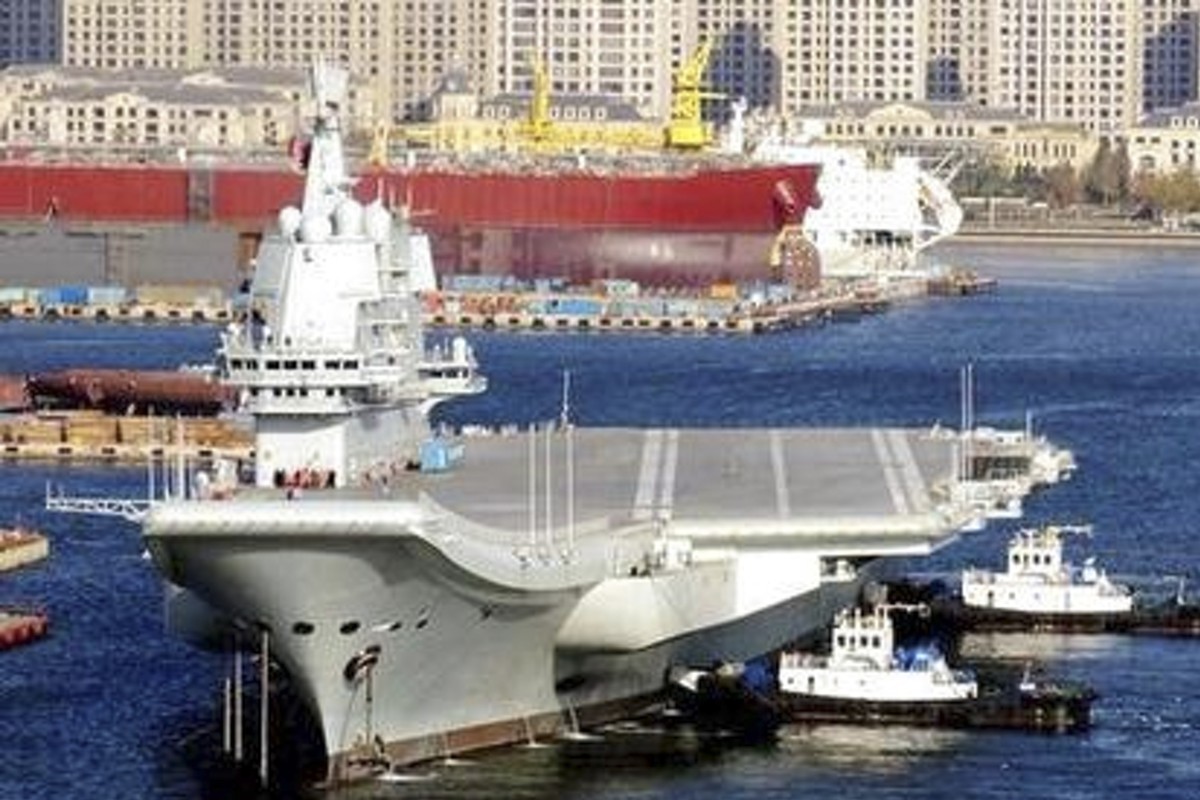
Chinese navy trains top guns to command expanding aircraft carrier fleet

  • Best pilots from carrier-borne squadrons sent to naval academy for warship training to meet ‘urgent need’ for commanders
  • They had to pass more than 10 assessments – from political thought to psychological testing – before they could join the programme
China’s second aircraft carrier, the Type 001A, is expected to be operational by the end of this year. Photo: Sina
The Chinese navy is training fighter pilots experienced in carrier-borne operations to command and manage its warships as it seeks to expand its global naval power.
Its best pilots from carrier-borne squadrons – including some qualified to fly fighter jets during both daytime and at night – were sent to a naval academy for warship combat and command training late last month, PLA Daily reported on Monday.
It did not say how many pilots had been selected, but all of them were required to pass more than 10 assessments – ranging from political thought to psychological testing – before they could join the training programme, the official People’s Liberation Army newspaper said.
Beijing-based naval expert Li Jie said the programme would focus on command and control skills for air and sea operations, and some of the pilots would ultimately be selected to command China’s new aircraft carrier strike groups.
As part of its ambition to build a powerful blue-water navy that can operate globally, China plans to have four aircraft carriers in service by 2035. Its second aircraft carrier – the first built in China, known as the Type 001A – is undergoing sea trials and is expected to be operational by the end of this year.

Work on the more modern Type 002 carrier started two years ago and a naval source told the South China Morning Post that construction of a second Type 002 vessel could begin as early as 2021.

But they will need suitable carrier pilots to take command.

“It’s quite an urgent need for the Chinese navy to have carrier group commanders – like its Western counterparts do – who are capable of commanding different warships and aircraft in modern joint-operation combat situations,” Li said.

China to deploy Sharp Sword stealth drone for new Type 001A aircraft carrier

“Aircraft carrier strike groups are supposed to sail on the high seas and into unfamiliar territory, so aside from having a background as naval aviators, all commanding officers should have a broad set of skills and knowledge – from foreign languages and international maritime law to air and sea operations – to help them make good decisions,” he said.

Other navies, such as the United States Navy, require more experience for the role – commanding officers of US aircraft carriers must be former naval aviators as well as former captains of different types of warships.

For example, Captain Pat “Fin” Hannifin, commanding officer of the Nimitz-class aircraft carrier USS Ronald Reagan, has over 2,800 flight hours in 33 different aircraft under his belt. He was also executive officer on another aircraft carrier and commander of an amphibious transport dock.

Rear Admiral Li Xiaoyan, the first captain of China’s only active aircraft carrier, the Liaoning, was a pilot with no experience on carrier-borne aircraft, though he did have experience on a destroyer and frigates. He was replaced by Zhang Zheng just days after the Liaoning formally joined the PLA Navy in 2012, and later by Liu Zhe – neither of whom had naval aviator backgrounds.

Li Xiaoyan was one of the first group of 10 pilots selected for a training programme designed specifically for China’s future aircraft carriers back in 1987. But the whole aircraft carrier plan was suspended in 1998 by premier Zhu Rongji for political and economic reasons, according to China’s Carrier, a book published by China Development Press.

China’s navy begins national search for trainee top-gun pilots

Naval expert Li Jie said the Chinese navy now had to catch up in terms of training pilots, and especially commanding officers, for its aircraft carriers.

“China resumed the aircraft carrier plan and in 2004 started refitting the hull of the Varyag. But after that first group of pilots was trained in 1987, there was no formal training in air and sea operations because there was no aircraft carrier training platform until 2012,” Li said, referring to the unfinished Admiral Kuznetsov-class vessel China bought from Ukraine in 1998, which became the Liaoning.

He said the latest training programme for commanding officers was a continuation of the one that began more than 30 years ago.

Source: SCMP

20/09/2019

Aviation watchdog may ask Boeing to set up 737 MAX simulators in India

NEW DELHI (Reuters) – India’s aviation safety regulator may ask Boeing (BA.N) to set up simulators in India to train pilots on the 737 MAX planes once it clears the aircraft as safe for flying, a senior official with direct knowledge of the matter told Reuters.

The 737 MAX, the fastest-selling plane in Boeing’s history, has been grounded the world over since March in the aftermath of two fatal crashes in five months that killed 346 people.

India’s Directorate General of Civil Aviation (DGCA) will also conduct an independent inspection of the grounded planes once they are cleared for flying by the U.S. regulator, the Federal Aviation Administration (FAA).

“Once FAA re-certifies it and says these issues have been resolved then we will evaluate whether what they are saying is right or wrong … We will carry out our own inspections,” the official said, adding that it is unlikely the planes will fly in Indian skies until next year.

Boeing is making software changes and drawing up a new pilot training plan, and will need to conduct a key certification test flight to get the FAA’s approval before it can put the planes back in the air. Some federal officials expect the test flight to be conducted in October.

“Later this year India will send a team. We would like to take a look at their flight data, some simulators will also be required for training pilots,” the official said, adding it may ask Boeing to have simulators in India.

Indian carrier SpiceJet (SPJT.BO) has about a dozen Boeing 737 MAX planes in its fleet and a total of 155 on order – among the largest single orders for the narrow-body plane.

Boeing has delivered some 385 737 MAX jets globally before the March grounding and has roughly 5,000 orders for the aircraft, a more fuel-efficient version of the manufacturer’s best-selling single-aisle 737 series.

Source: Reuters

Law of Unintended Consequences

continuously updated blog about China & India

ChiaHou's Book Reviews

continuously updated blog about China & India

What's wrong with the world; and its economy

continuously updated blog about China & India