Archive for ‘‘forced labour’’

23/12/2019

Tesco Christmas card factory in China denies ‘forced labour’

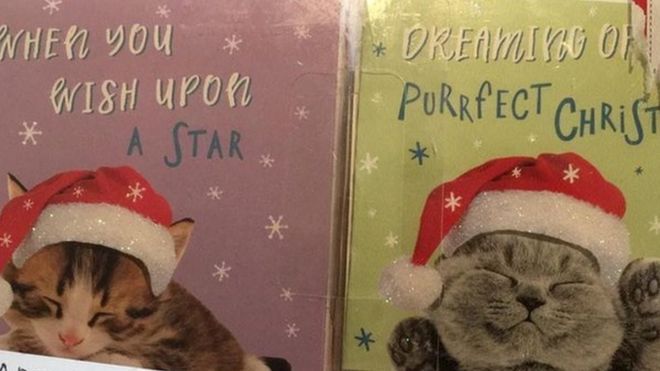
The card opened by Florence Widdicombe
Image caption The pack of cards cost £1.50 from Tesco

A factory in China has denied it used forced labour after a six-year-old girl found a message from workers inside a Tesco charity Christmas card.

The card supplier, Zhejiang Yunguang Printing, told China’s Global Times it had “never done such a thing”.

Tesco halted production at the factory on Sunday over the message, allegedly written by prisoners claiming they were “forced to work against our will”.

The Chinese foreign ministry said the allegation was “a farce”.

Speaking to the nationalist newspaper Global Times on Monday, a spokesman for the card supplier said: “We only became aware of this when some foreign media contacted us. We have never done such a thing.

“Why did they include our company’s name?”

The message – first reported by the Sunday Times – was found by Florence Widdicombe, who was writing cards to her school friends. She found that one of them – featuring a kitten with a Santa hat – had already been written in.

In block capitals, it said: “We are foreign prisoners in Shanghai Qingpu prison China. Forced to work against our will. Please help us and notify human rights organisation.”

The message in the card asked whoever found the message to contact Peter Humphrey, a British journalist who was himself imprisoned there four years ago.

Chinese foreign ministry spokesman Geng Shuang told reporters on Monday the allegation was “a farce” created by Mr Humphrey.

“Shanghai’s Qingpu prison has no such foreign prisoners undergoing forced labour,” Mr Shuang said.

Zhejiang Yunguang Printing’s factory manager, Shu Yunjia, told the BBC it had not outsourced any of its work to the Qingpu prison.
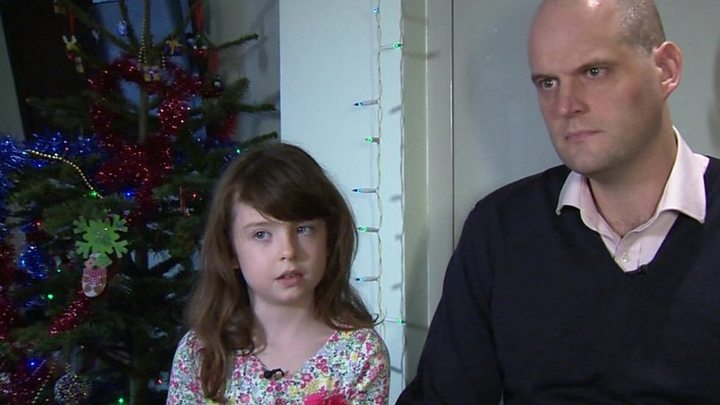
Media caption Florence Widdicombe was writing the cards last Sunday when she discovered the message

Florence, from Tooting in south London, said she was writing her “sixth or eighth card” when she saw “somebody had already written in it”.

“It made me feel shocked,” she said, adding that when it was explained to her what the message meant she felt “sad”.

Tesco added that it would de-list Zhejiang Yunguang if it was found to have used prison labour.

A Tesco spokeswoman said: “We were shocked by these allegations and immediately halted production at the factory where these cards are produced and launched an investigation.”

The supermarket said it has a “comprehensive auditing system” to ensure suppliers are not exploiting forced labour.

The factory in question was checked only last month and no evidence of it breaking the ban on prison labour was found, it said.

Sales of charity Christmas cards at the company’s supermarkets raise £300,000 a year for the British Heart Foundation, Cancer Research UK and Diabetes UK.

Tesco has not received any other complaints from customers about messages inside Christmas cards.

‘Very bleak life’

The message in the card urged the recipient to contact Peter Humphrey, who was formerly imprisoned at Qingpu on what he described as “bogus charges that were never heard in court”.

After the Widdicombe family sent him a message via Linkedin, Mr Humphrey said he then contacted ex-prisoners who confirmed inmates had been forced to work.
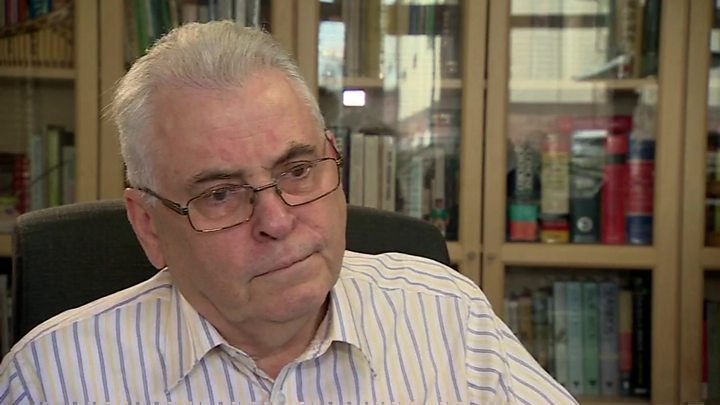
Media caption Peter Humphrey: “I think I know who it was but I will never disclose the name”

Mr Humphrey told the BBC that the cell block of foreign prisoners has about 250 people in it, who are living a “very bleak daily life” with 12 prisoners per cell.

He added that when he was in there, manufacturing labour work was voluntary – to earn money to buy soap or toothpaste – but that work has now become compulsory.

Mr Humphrey told the BBC: “I spent two years in captivity in Shanghai between 2013 and 2015 and my final nine months of captivity was in this very prison in this very cell block where this message has come from.

“So this was written by some of my cellmates from that period who are still there serving sentences.

“I’m pretty sure this was written as a collective message. Obviously one single hand produced this capital letters’ handwriting and I think I know who it was, but I will never disclose that name.”

It is not the first time that prisoners in China have reportedly smuggled out messages in products they have been forced to make for Western markets.

In 2012, Julie Keith from Portland, Oregon, discovered an account of torture and persecution by a prisoner who said he was forced to manufacture the Halloween decorations she had purchased.

And in 2014, Karen Wisinska from Co Fermanagh in Northern Ireland, found a note on a pair of Primark trousers reading: “Our job inside the prison is to produce fashion clothes for export. We work 15 hours per day and the food we eat wouldn’t even be given to dogs or pigs.”

Under the UN’s guidance for human rights and prisons, prisoners “should not be subordinated merely to making a profit either for the prison authorities or for a private contractor”.

The standard minimum rules for the treatment of prisoners state: “Prison labour must not be of an afflictive nature.”
 

Source: The BBC

13/11/2019

Xinjiang cotton sparks concern over ‘forced labour’ claims

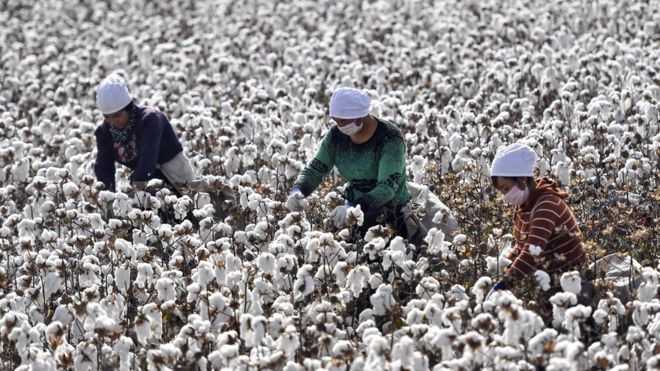
Farmers pick cotton during the harvest on October 21, 2019 in Shaya County, Xinjiang Uygur Autonomous Region of China.Image copyright GETTY IMAGES

Global retailers are facing scrutiny over cotton supplies sourced from Xinjiang, a Chinese region plagued by allegations of human rights abuses.

China is one of the world’s top cotton producers and most of its crop is grown in Xinjiang.

Rights groups say Xinjiang’s Uighur minority are being persecuted and recruited for forced labour.

Many brands are thought to indirectly source cotton products from the Xinjiang region in China’s far west.

Japanese retailers Muji and Uniqlo attracted attention recently after a report highlighted the brands used the Xinjiang-origin of their cotton as a selling point in advertisements.

H&M, Esprit and Adidas are among the firms said to be at the end of supply chains involving cotton products from Xinjiang, according to a Wall Street Journal investigation.

“You can’t be sure that you don’t have coerced labour in your supply chain if you do cotton business in China,” said Nathan Ruser, researcher at the Australian Strategic Policy Institute.

“Xinjiang labour and what is almost certainly coerced labour is very deeply entrenched into the supply chain that exists in Xinjiang.”

What is happening in Xinjiang?

UN experts and human rights groups say China is holding more than a million Uighurs and other ethnic minorities in vast detention camps.

Rights groups also say people in camps are made to learn Mandarin Chinese, swear loyalty to President Xi Jinping, and criticise or renounce their faith.

China says those people are attending “vocational training centres” which are giving them jobs and helping them integrate into Chinese society, in the name of preventing terrorism.

What is produced in Xinjiang?

The Xinjiang region is a key hub of Chinese cotton production.

China produces about 22% of global cotton supplies, according to a report by the Center for Strategic and International Studies (CSIS).

Last year, 84% of Chinese cotton came from Xinjiang, the report said.

That has raised concerns over whether forced labour has been used in the production of cotton from the region.

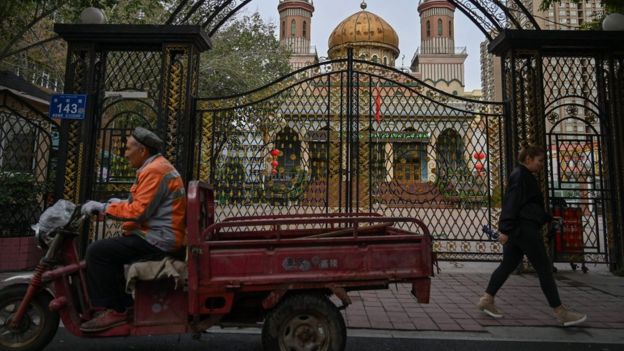
This photo taken on September 11, 2019 shows people walking past a mosque in Urumqi, the regional capital of Xinjiang.Image copyright GETTY IMAGES
Image caption The Uighurs are mostly Muslims, and number about 11 million in China’s Xinjiang region

Nury Turkel, chairman of the Uighur Human Rights Project in Washington, said the Uighurs were being “detained and tormented” and “swept into a vast system of forced labor” in Xinjiang.

In testimony to US congress, he said it was becoming “increasingly hard to ignore the fact” that the goods manufactured in the region have “a high likelihood” of being produced with forced labour.

Which brands use Xinjiang cotton?

Amy Lehr, director of CSIS Human Rights Initiative, said in many cases Western companies aren’t buying directly from factories in Xinjiang.

“Rather, the products may go through several stages of transformation after leaving Xinjiang before they are sent to large Western brands,” she said.

Some, like Muji, are very open about sourcing material from Xinjiang.

The Japanese retail chain launched a new Xinjiang Cotton collection earlier this year.

One of its advertisements boasts “soft and breathable” men’s shirts made from organic cotton “delicately and wholly handpicked in Xinjiang”.

Another Japanese fashion brand Uniqlo had also touted the Xinjiang region in an advertisement advertisment for men’s shirts.

In the fine print of the shirt description, the advert said the shirts were made from Xinjiang cotton, “famous for its superb quality”.

That reference was later removed from the advertisement “given the complexity of this issue”, according to a spokesperson for Uniqlo.

“Uniqlo does not have any production partners located in the Xinjiang region. Moreover, Uniqlo production partners must commit to our strict company code of conduct.

“To the best of our knowledge, this means our cotton comes only from ethical sources,” the spokesperson told the BBC.

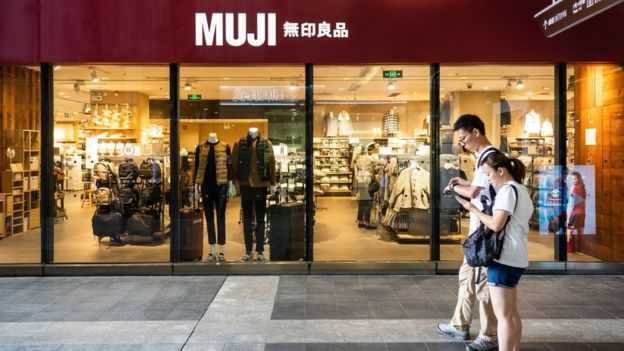
Pedestrians walk past a Japanese household and consumer goods retailer, Muji store in ShenzhenImage copyright GETTY IMAGES

According to the Wall Street Journal report which focused on workers at a mill operated by Huafu Fashion in Aksu, Xinjiang, yarn made in the region was present in the supply chains of several international retailers including H&M, Esprit and Adidas.

Many of the companies looked into the allegations, including those without clear links to the Huafu mill.

In a statement to the BBC, Adidas said: “While we do not have a contractual relationship with Huafu Fashion Co., or any direct leverage with this business entity or its subsidiary, we are currently investigating these claims.”

“We advised our material suppliers to place no orders with Huafu until we have completed those investigations,” the Adidas spokesperson said.

Esprit, which also does not source cotton directly from Xinjiang, said it had made several inquiries earlier this year.

“We concluded that a very small amount of cotton from a Huafu factory in Xinjiang was used in a limited number of Esprit garments,” the firm said in a statement.

The company has instructed all suppliers to not source Huafu yarn from Aksu, the statement said.

H&M said it does not have “a direct or indirect business relationship” with any garment manufacturer in the Xinjiang region.

“We have an indirect business relationship with Huafu’s spinning unit in Shanyu, which is not located in the Xinjiang region, and according to our data, the vast majority of the yarn used for our garment manufacturing comes from this spinning unit,” a spokesperson for H&M said.

“Since we have an indirect business relationship with the yarn supplier Huafu, we also asked for access to their spinning facilities in Aksu. Our investigations showed no evidence of forced labor.”

Source: The BBC

Law of Unintended Consequences

continuously updated blog about China & India

ChiaHou's Book Reviews

continuously updated blog about China & India

What's wrong with the world; and its economy

continuously updated blog about China & India