Archive for ‘Foreign Direct Investment (FDI)’

21/02/2020

Coronavirus: China’s car sales collapse, as officials warn of sharp trade decline to come

  • China Passenger Car Association said sales fell to just 4,909 units in the first 16 days of February, from 59,930 in the first quarter of 2019
  • The growth rate for China’s imports and exports is expected to decline sharply in the January-February period
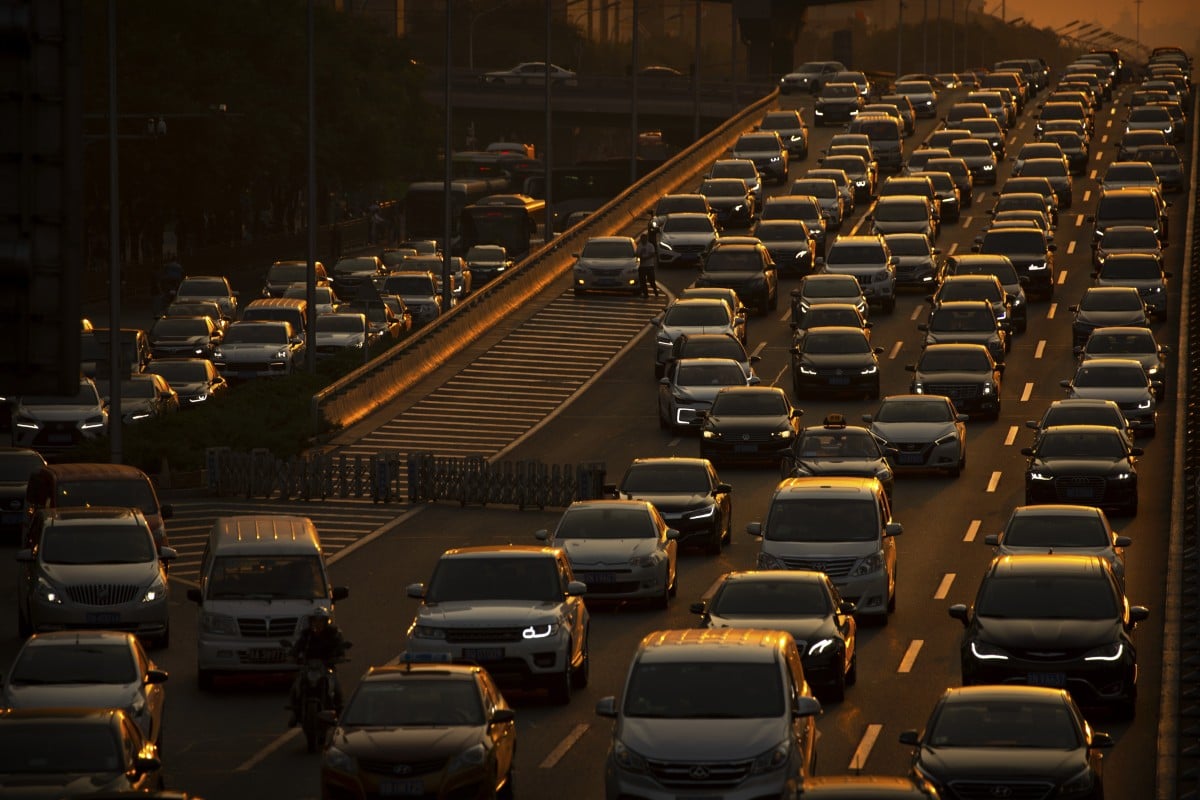
Commuters make their way along an expressway during rush hour in Beijing. Photo: AP

A 92 per cent drop in car sales in China in the first half of February provided the first real indicator of the economic impact of the coronavirus epidemic, with officials also warning of a sharp decline in Chinese exports and imports for the first two months of the year.

The China Passenger Car Association (CPCA) on Friday said that sales dropped to just 4,909 units in the first 16 days of the month, down from 59,930 vehicles in the same period a year earlier.

“Very few dealerships opened in the first weeks of February and they have had very little customer traffic,” said the CPCA.

China’s car market is likely to see sales slide more than 10 per cent in the first half of the year due to the outbreak, and around 5 per cent for the whole year, provided the virus is effectively contained before April, the country’s top industry body, the China Association of Automobile Manufacturers (CAAM), said last week.

Chinatowns around the world feel effects of coronavirus fears
The sector was already under pressure from the cooling economy, with car sales falling 3 per cent in 2018 in the first sales contraction since the 1990s, and 8.2 per cent in 2019, CAAM said.
“We must firmly believe that China’s auto market still has great development space and potential, and the automobile consumption demand is still strong,” Wang Bin, vice-director of the commerce market operation department at the commerce ministry, said on Thursday.
To stabilise the market, in which more than 25 million vehicles were sold last year, China’s commerce ministry said it will introduce more measures to boost consumption.
Li Xingqian, head of foreign trade at the Ministry of Commerce, said the growth rate for China’s exports and imports would decline sharply in the January-February period due to a collapse in logistics and the delayed start of work following the extended Lunar New Year holiday, which was aimed at controlling the coronavirus outbreak.
“The impact of the epidemic on the first quarter is here objectively, should not be underestimated, but [growth] is still within the tolerable range,” he said on Friday. “As the prevention and control [measures] achieve new staged results, foreign trade will inevitably resume its growth. China’s foreign trade development is expected to remain within a reasonable range throughout the year.”
China cancelled the release of its January trade data, with the General Customs Administration of China saying it will combine January and February’s data in an effort to remove seasonal volatility from the Lunar New Year period. Statistics will be released in early March.
Trade is traditionally volatile over the first two months of the year in China. Shipments are heavily affected by the Lunar New Year break, with this volatility to be exacerbated by the coronavirus outbreak, which causes the disease officially known as Covid-19.

Zong Changqing, head of the commerce ministry’s foreign investment department, also conceded the virus could hit inward investment over the entire first quarter of 2020. Zong claimed the impact would only be temporary, and that China remained an attractive environment for foreign investment.

Foreign direct investment (FDI) in China in 2019 rose 5.8 per cent from a year earlier to 941.5 billion yuan (US$134 billion), according to the commerce ministry. FDI in China also saw a steady year-on-year increase of 4 per cent last month, compared with a growth of 4.8 per cent registered in January 2019.

The impacts of the outbreak on foreign investment have begun to show, and are expected to become greater in February and March. Zong Changqing

“The impacts of the outbreak on foreign investment have begun to show, and are expected to become greater in February and March,” Zong said.

He confirmed that the ministry asked local authorities in Shandong province to push all 32 South Korean-owned car parts companies to restart production by the end of last week to keep the global supply chain stable.

He also said that over 80 per cent of key foreign-owned enterprises in Shanghai, Shandong and Hunan province had reopened, with most regions expected to restore production by the end of February, provided the spread of the virus is contained.

However, a survey by the American Chamber of Commerce in Shanghai, released earlier this week, found that in the vast majority of cases, factories that have reopened are running at a fraction of their production capacity.

Source: SCMP

05/10/2019

MoU signed for China-Nepal Friendship Industrial Park in eastern Nepal

NEPAL-CHINA-FRIENDSHIP INDUSTRIAL PARK-SIGNING CEREMONY

Maha Prasad Adhikari, Chief Executive Officer (CEO) of Nepal Investment Board (IBN) speaks during a signing ceremony of the construction of China-Nepal Friendship Industrial Park, in Kathmandu, Nepal, Oct. 3, 2019. Damak Clean Industrial Park, a China-invested company, has signed a Memorandum of Understanding with Nepal Investment Board (IBN) for the China-Nepal Friendship Industrial Park in Nepal’s eastern Jhapa district. (Photo by Sunil Sharma/Xinhua)

KATHMANDU, Oct. 4 (Xinhua) — Damak Clean Industrial Park, a China-invested company, has signed a Memorandum of Understanding with Nepal Investment Board (IBN) for the China-Nepal Friendship Industrial Park in Nepal’s eastern Jhapa district.

Damak Clean Industrial Park President Govinda Thapa and IBN Chief Executive Officer Maha Prasad Adhikari signed the MoU at a function on Thursday evening in Kathmandu.

Lhasa Economic and Technological Development Zone Investment Development Company Limited is investing in the project which aims to develop a complete industrial infrastructure for industries to come in and operate there.

“Industries related to food products, home appliances, transport equipment electrical and communication equipment will be brought inside the park,” Zhou Chengjie, chairman of Lhasa Economic and Technological Development Zone Investment Development Company Limited, said during the signing ceremony.

The location is the hometown of Nepali Prime Minister KP Sharma Oli.

The IBN, a government body focused on promoting large scale investment, approved Foreign Direct Investment (FDI) of 586 million U.S. dollar from the Chinese company in August.

“This investment is for the first phase of the works under which industrial park will be developed in 484.81 hectares of land out of planned development in 1,600 hectares,” Zhou said.

According to him, the project will be developed in four phases and his company has aimed to invest 1 billion U.S. dollar for the entire development. It will be one of the largest FDI to Nepal from China in recent years.

IBN CEO Adhikari said the China-Nepal Friendship Park would be milestone for industrial infrastructure development in Nepal as industrial infrastructure in the Himalayan country has remained poor.

“This will also help Nepal to utilize the economic opportunity offered by the Belt and Road Initiative,” he said.

Source: Xinhua

Law of Unintended Consequences

continuously updated blog about China & India

ChiaHou's Book Reviews

continuously updated blog about China & India

What's wrong with the world; and its economy

continuously updated blog about China & India