Archive for ‘founded’

24/05/2020

Xi Focus: “What is people first?” Xi points to how China saves lives at all costs

Chinese President Xi Jinping, also general secretary of the Communist Party of China Central Committee and chairman of the Central Military Commission, takes part in a deliberation with his fellow deputies from the delegation of Inner Mongolia Autonomous Region at the third session of the 13th National People’s Congress (NPC) in Beijing, capital of China, May 22, 2020. (Xinhua/Ju Peng)

BEIJING, May 23 (Xinhua) — “What is people first?” Chinese President Xi Jinping asked, before offering his own answer when he was talking with lawmakers at the ongoing national legislative session.

“So many people worked together to save a single patient. This, in essence, embodies doing whatever it takes (to save lives),” he said.

Xi, also general secretary of the Communist Party of China Central Committee and chairman of the Central Military Commission, is a deputy to the 13th National People’s Congress.

During his deliberations with fellow deputies from Inner Mongolia Autonomous Region on Friday, “people” was a keyword.

Xi referred to a story told by another deputy that morning. Luo Jie, from the COVID-19 hard-hit province of Hubei, told reporters at the session how medical workers in his hospital spent 47 days saving an 87-year-old COVID-19 patient.

“About 10 medical workers meticulously took care of the patient for dozens of days, and finally saved the patient’s life,” Xi said. “I am really impressed.”

In the COVID-19 pandemic, health workers around the world got to know the elderly are the most difficult to treat and require the most sophisticated medical resources. China has given every patient equal treatment irrespective of their age or wealth.

Chinese President Xi Jinping, also general secretary of the Communist Party of China Central Committee and chairman of the Central Military Commission, takes part in a deliberation with his fellow deputies from the delegation of Inner Mongolia Autonomous Region at the third session of the 13th National People’s Congress (NPC) in Beijing, capital of China, May 22, 2020. (Xinhua/Huang Jingwen)

In Hubei alone, more than 3,600 COVID-19 patients over the age of 80 have been cured. In the provincial capital Wuhan, seven centenarian patients have been cured.

“We mobilized from around the nation the best doctors, the most advanced equipment and the most needed resources to Hubei and Wuhan, going all out to save lives,” Xi said during the deliberations, adding that the eldest patient cured is 108 years old.

“We are willing to save lives at all costs. No matter how old the patients are and how serious their conditions have become, we never give up,” Xi said.

Xi joined political advisors and lawmakers on Thursday and Friday in paying silent tribute to the lives lost to COVID-19 as the top political advisory body and the national legislature opened their annual sessions.

This year’s government work report said China’s economy posted negative growth in the first quarter of this year, but it was “a price worth paying” to contain COVID-19 as life is invaluable.

“As a developing country with 1.4 billion people, it is only by overcoming enormous difficulties that China has been able to contain COVID-19 in such a short time while also ensuring our people’s basic needs,” the report said.

Epidemic response is a reflection of China’s governing philosophy.

The fundamental goal for the Party to unite and lead the people in revolution, development and reform is “to ensure a better life for them,” Xi said.

The nation’s average life expectancy reached 77 years in 2018, more than double that in 1949, when the people’s republic was founded.

Chinese people are not just living longer but better lives, with more material wealth and broader choices to pursue individual dreams. All rural poor will bid farewell to poverty this year as part of the goal of building a moderately prosperous society in all respects.

The Party’s long-term governance, Xi said, rests on “always maintaining close bond with the people.”

“We must always remain true to the people’s aspiration and work in concert with them through thick and thin,” Xi said.

Source: Xinhua
30/11/2019

Rediscovering the forgotten Indian artists of British India

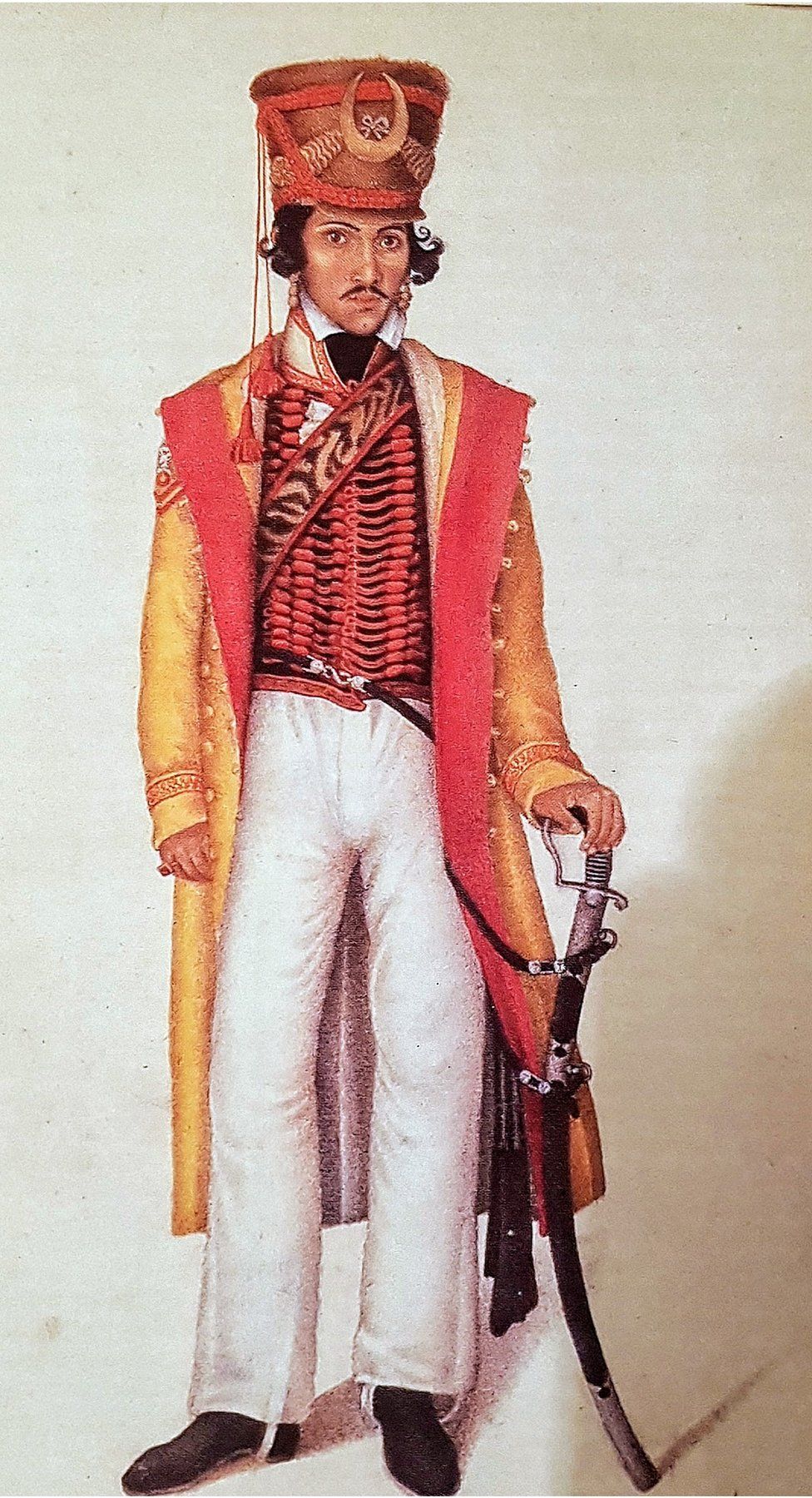
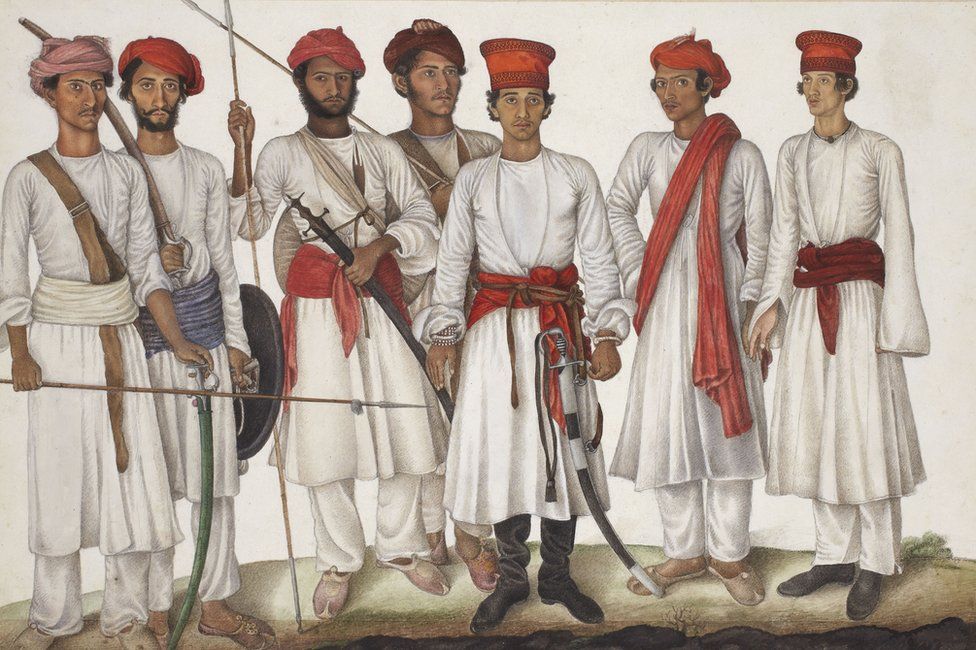
A group of Indian troopers who fought for the English by Ghulam Ali Khan, 1815-16Image copyright PEMILLE KLEMP
Image caption A group of Indian troopers who fought for the English, Ghulam Ali Khan, 1815-16

The English East India Company, founded in 1600, was established for trading. But as the powerful multinational corporation expanded its control over India in the late 18th Century, it commissioned many remarkable artworks from Indian painters who had previously worked for the Mughals. Writer and historian William Dalrymple writes about these hybrid paintings which explore life and nature.

Calcutta in the late 1770s was Asia’s biggest boom town: known as the City of Palaces, the East India Company’s bridgehead in Bengal had doubled in size to 400,000 inhabitants in a decade.

It was now unquestionably the richest and largest colonial city in the East – though certainly not the most orderly.

“It would have been so easy to turn it into one of the most beautiful cities in the world,” wrote the Count de Modave, a friend of Voltaire who passed through at this time. “One cannot fathom why the English allowed everyone the freedom to build in the most bizarre taste, with the most outlandish planning.”

Nor were visitors much taken by its English inhabitants. Most had come East with just one idea: to amass a fortune in the quickest possible time.

Impey
Image caption An Indian trooper who fought for the English, Ghulam Ali Khan, 1819
Calcutta (now Kolkata) was a city where great wealth could be accumulated in a matter of months, then lost in minutes in a wager or at the whist table. Death, from disease or excess, was a commonplace, and the constant presence of mortality made men hard and callous.

Rising with Olympian detachment above the mercantile bawdiness of his contemporaries was the rotund figure of the chief justice of the new Supreme Court, Sir Elijah Impey.

A portrait of him by Johan Zoffany still hangs, a little lopsidedly, in the Kolkata High Court. It shows him pale and plump, ermine gowned and dustily bewigged.

Impey was, however, a serious scholar and unusual in taking a serious interest in the land to which he had been posted.

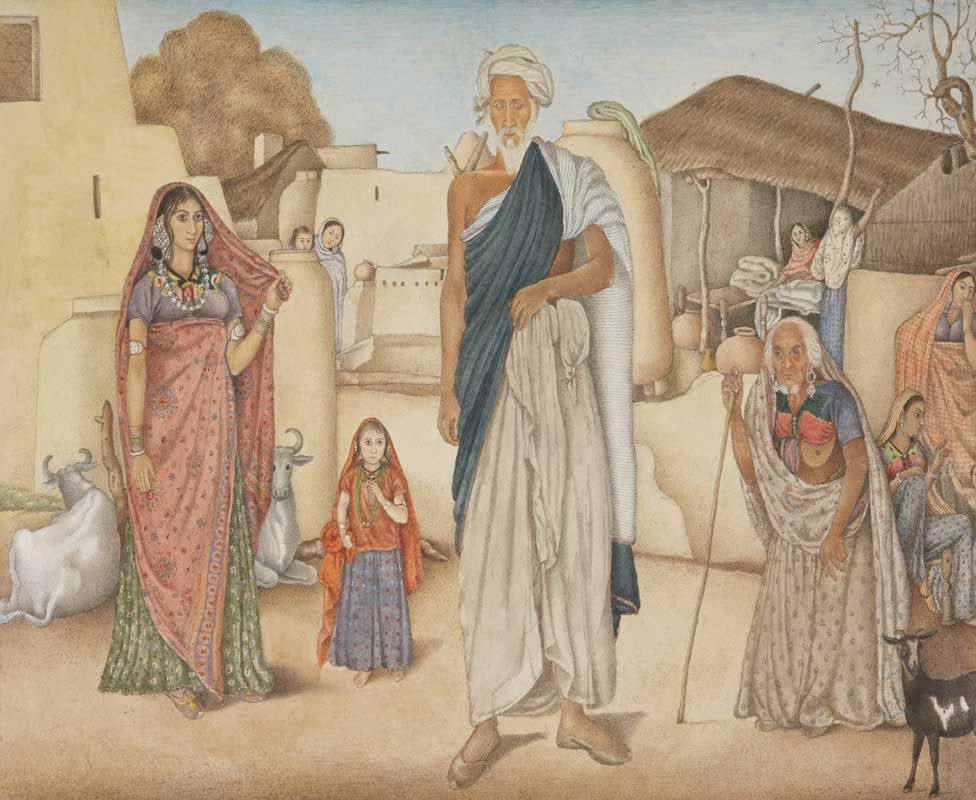
Indian villagers by Ghulam Ali Khan, 1815-16Image copyright PEMILLE KLEMP
Image caption Indian villagers by Ghulam Ali Khan, 1815-16Presentational white space

On the journey out to India, a munshi (administrator) had accompanied him to teach him Bengali and Urdu, and on arrival the new chief justice began to learn Persian and collect Indian paintings. His house became a meeting place where the more cultured elements of Calcutta society could discuss history and literature.

Impey and his wife Mary were also greatly interested in natural history and began to collect a menagerie of rare Indian animals.

At some stage in the mid-1770s, the Impeys decided to bring a group of leading Mughal artists – Sheikh Zain ud-Din, Bhawani Das and Ram Das – to paint their private zoo.

It was probably not the first commission of Indian artists by British patrons. “The Study of Botany is of late Years become a very general Amusement,” noted one enthusiast, and we know that the Scottish nurseryman James Kerr was sending Indian-painted botanical drawings back to Edinburgh as early as 1773.

But the Impeys’ albums of natural history painting remain among the most dazzlingly successful of all such commissions: today, a single page usually reaches prices of more than £330,000 ($387,000) at auctions, and the 197 images from the Impey Album are now widely recognised as among the very greatest glories of Indian painting.

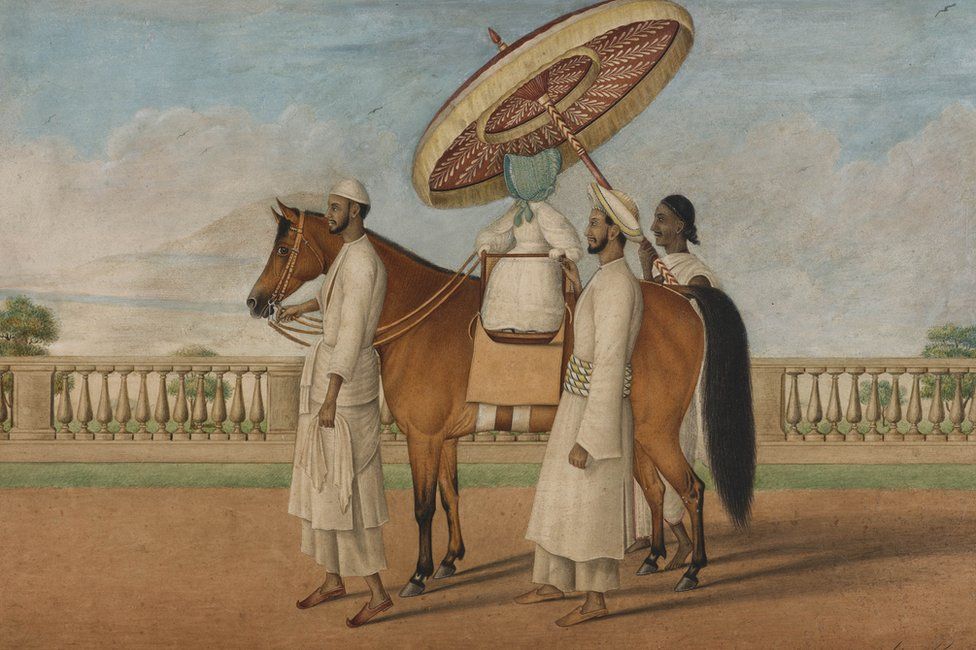
English child seated on a pony and surrounded by three Indian servants, 1830-1850Image copyright FRANCIS WARE
Image caption English child seated on a pony and surrounded by three Indian servants by Shaikh Muhammad Amir

This month, for the first time since the Impey Album was split up in the 18th Century, around 30 of its pages will be reassembled for a major exhibition in the Wallace Collection in London.

Forgotten Masters: Indian Painting for the East India Company celebrates some of the extraordinary work which resulted from commissions made by East India Company patrons from master Indian artists between the 1770s and 1840s.

It will be a unique chance to see some of the finest Indian paintings which are now scattered in private collections around the world.

The three artists who Impey summoned to his fine classical house in Middleton Street were all from Patna, 200 miles (320km) up the Ganges.

The most prolific was a Muslim, Shaikh Zain-al-Din, while his two colleagues, Bhawani Das and Ram Das, were both Hindus.

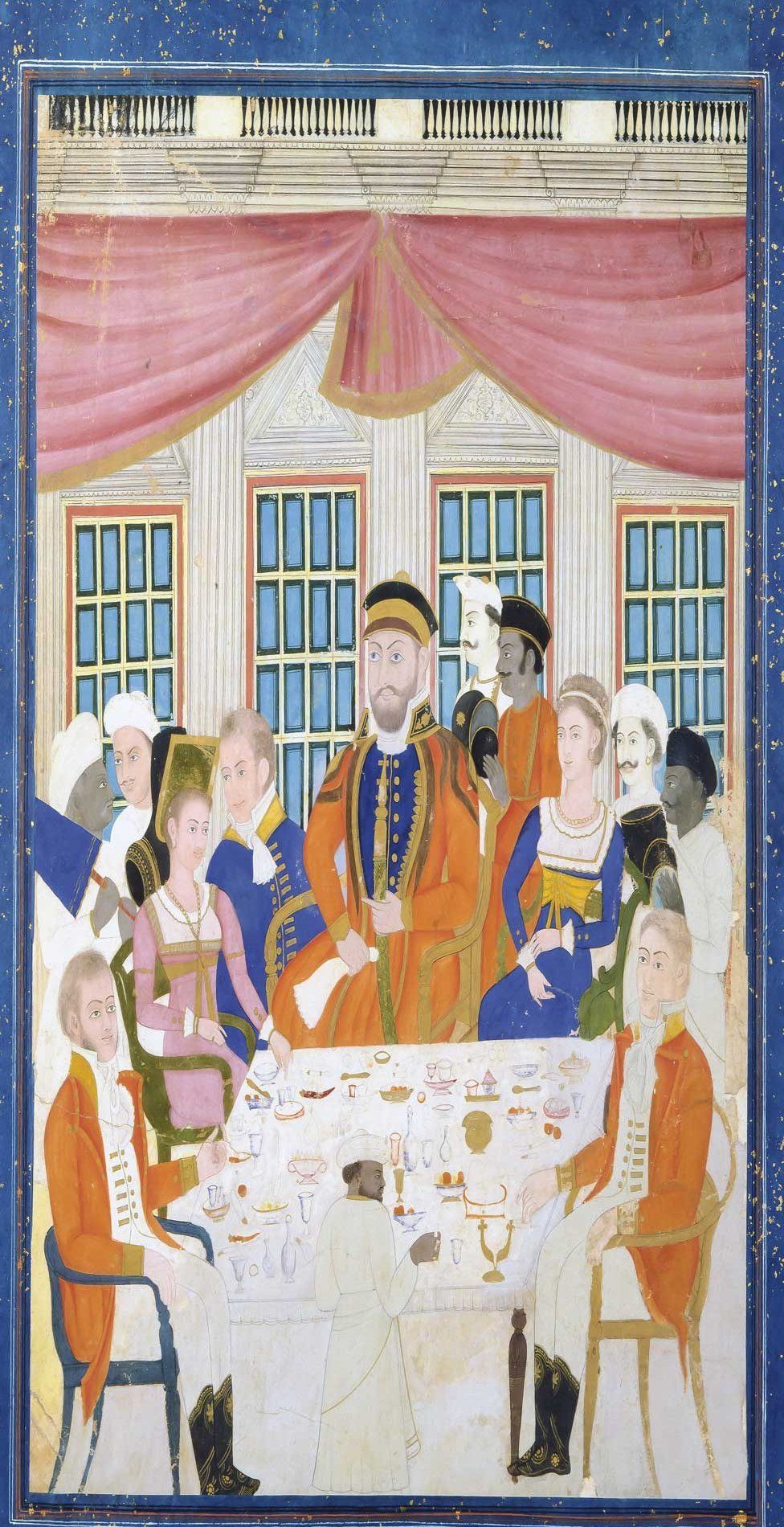
A finely painted miniature depicting four British officers with their wives taking refreshments at a table
Image caption A finely painted miniature depicting four British officers with their wives taking refreshments at a table, artist unknown

Trained in the late Mughal style and patronised by the Nawabs of Murshidabad and Patna, they quickly learned to use English watercolours on English Watman watercolour paper, and take English botanical still lives as their models. In this way an extraordinary fusion of English and Mughal artistic impulses took place.

Zain ud-Din’s best works reveal a superb synthesis between a coldly scientific European natural history specimen illustration, warmed with a profoundly Indian sensibility and vital feeling for nature.

At his best – whether by instinct or inherited knowledge and training – he channels the outstanding Mughal achievement in natural history painting of 150 years earlier, when the great Mughal artist Mansur painted animals and birds for the Emperor Jahangir.

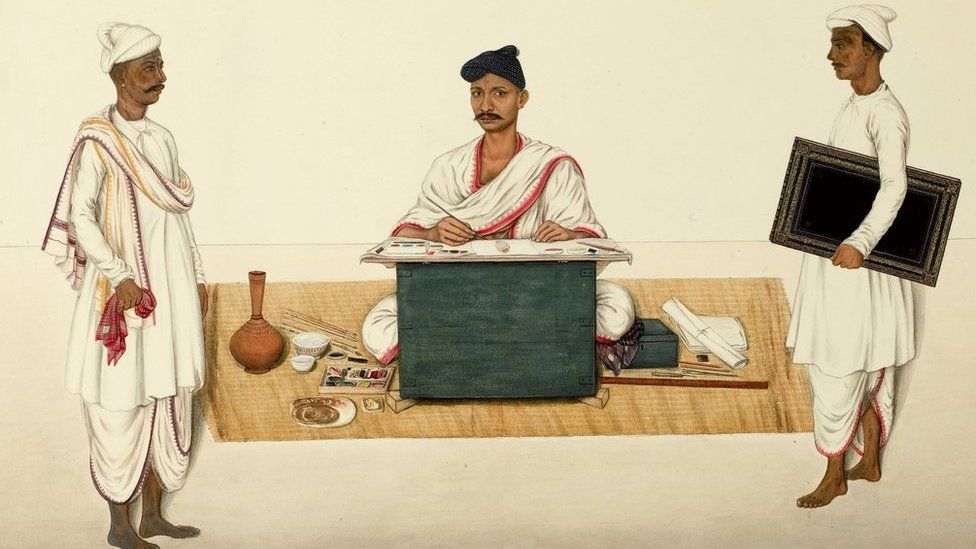
A man sits and draws while attended by two other men
Image caption Portrait of a Mughal artist, by Yellapah Of Vellore, 1832-1835

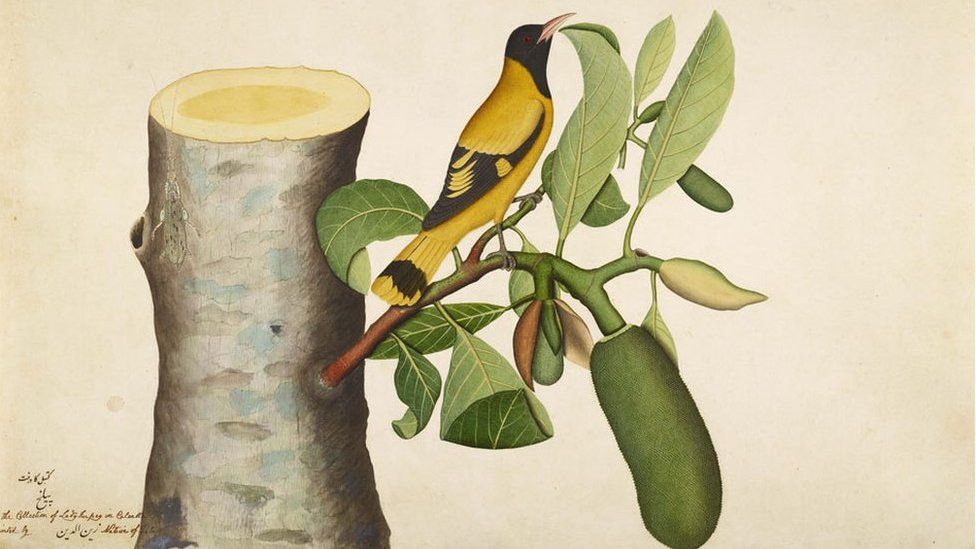
Nowhere are the merits of Company Painting better illustrated than in Zain ud-Din’s astonishing portrait of a Black Headed Oriole (No. 27).

At first glance, it could pass for a remarkably skilful English natural history painting. Only gradually does its hybrid origins become manifest.

The brilliance and simplicity of the colours, the meticulous attention to detail, the gem-like highlights, the way the picture seems to glow, all these point unmistakably towards Zain ud-Din’s Mughal training.

Zain Ud din’s portrait of black headed oriole
Image caption Portrait of a black headed oriole by Zain ud-Din

An idiosyncratic approach to perspective also hints at this background: the tree trunk is rounded, yet the grasshopper which sits on it is as flat as a pressed flower, with only a hint of outline shading to give it depth – the same technique used by Mansur.

Yet no artist working in a normal Mughal atelier would have placed his bird detached from a landscape against a white background, with the jackfruit tree on which its sits cut into a perfect, scientific cross-section.

Equally no English artist would have thought of painting the bark of that cross section the same brilliant yellow as the oriole; the tentative washes of a memsahib’s watercolour are a world away.

The two traditions have met head on, and from that blinding impact an inspirational new fusion has taken place.

Bhawani Das, who seems to have started off as an assistant to Zain ud-Din, is almost as fine an artist as Zain ud-Din.

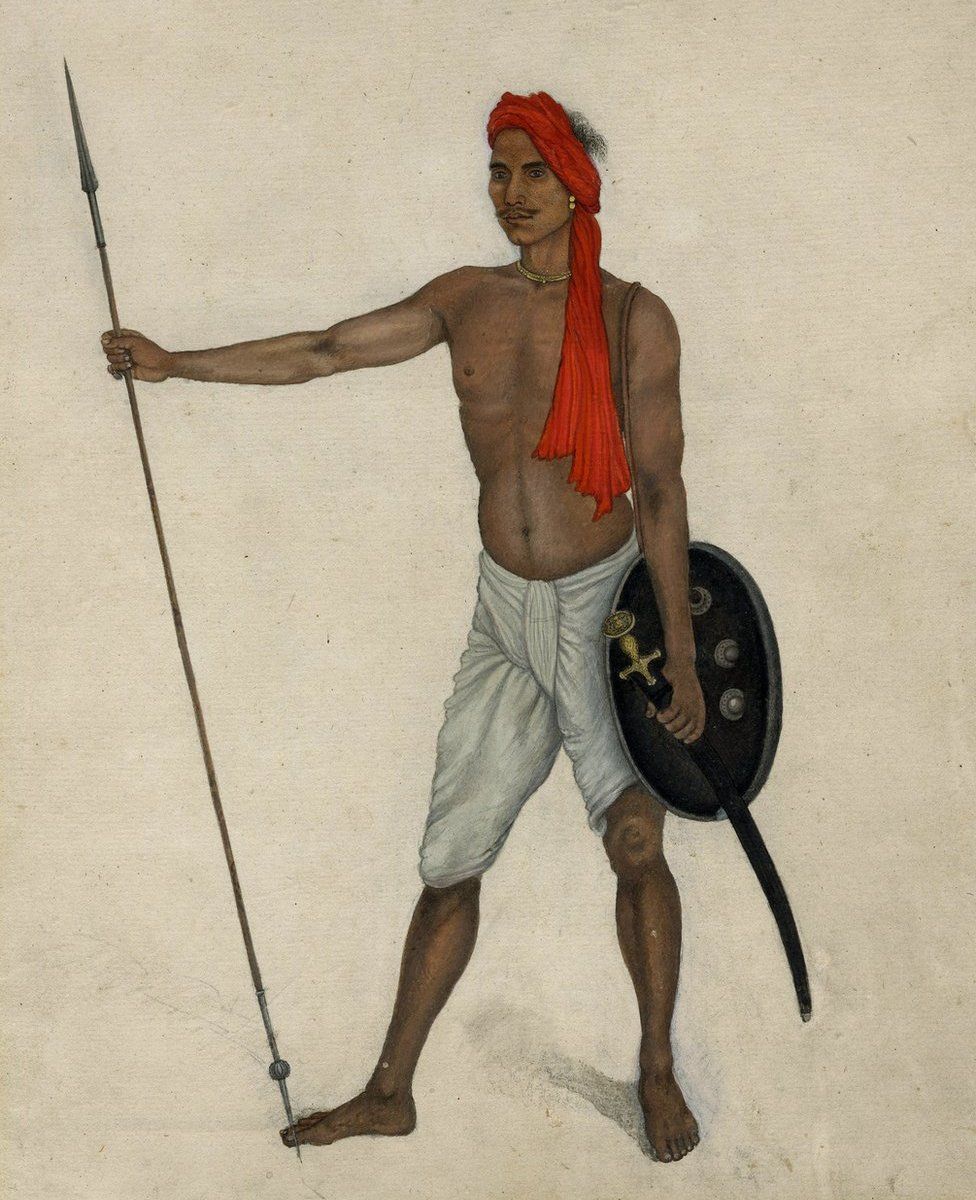
Indian trooper holding a spear by Ghulam Ali Khan, 1815-186
Image caption Indian trooper holding a spear by Ghulam Ali Khan, 1815-186

He is acutely sensitive to shape, texture and expression, as for example in his celebrated study of a great fruit bat with the contrast between its soft, furry body with the angular precision of its blackly outstretched wings, as if it were some caped Commendatore ushering a woman into a Venetian opera rather than a creature in a colonial menagerie.

Now, for the first time, the work of these great Indian artists painting in this brilliantly hybrid Anglo-Indian style are beginning to get the attention they deserve.

The first-ever museum show of this work in the UK aims to highlight and showcase the work of a series of extraordinary Indian artists, each with their own style and tastes and agency. Indeed the greatest among them – such as Zain ud-Din- deserve to be remembered as among the most remarkable Indian artists of all time.

William Dalrymple is the author, most recently, of The Anarchy: The Relentless Rise of the East India Company and Forgotten Masters: Indian Painting for the East India Company (Bloomsbury)

Source: The BBC

Law of Unintended Consequences

continuously updated blog about China & India

ChiaHou's Book Reviews

continuously updated blog about China & India

What's wrong with the world; and its economy

continuously updated blog about China & India