Archive for ‘Gabon’

19/02/2020

WHO sends coronavirus test kits to African nations after first coronavirus case confirmed

  • Forty countries will be able to diagnose the disease, and the Africa CDC is training health workers
  • Until two weeks ago, there were only two laboratories on the continent that could test for the virus, in Senegal and South Africa
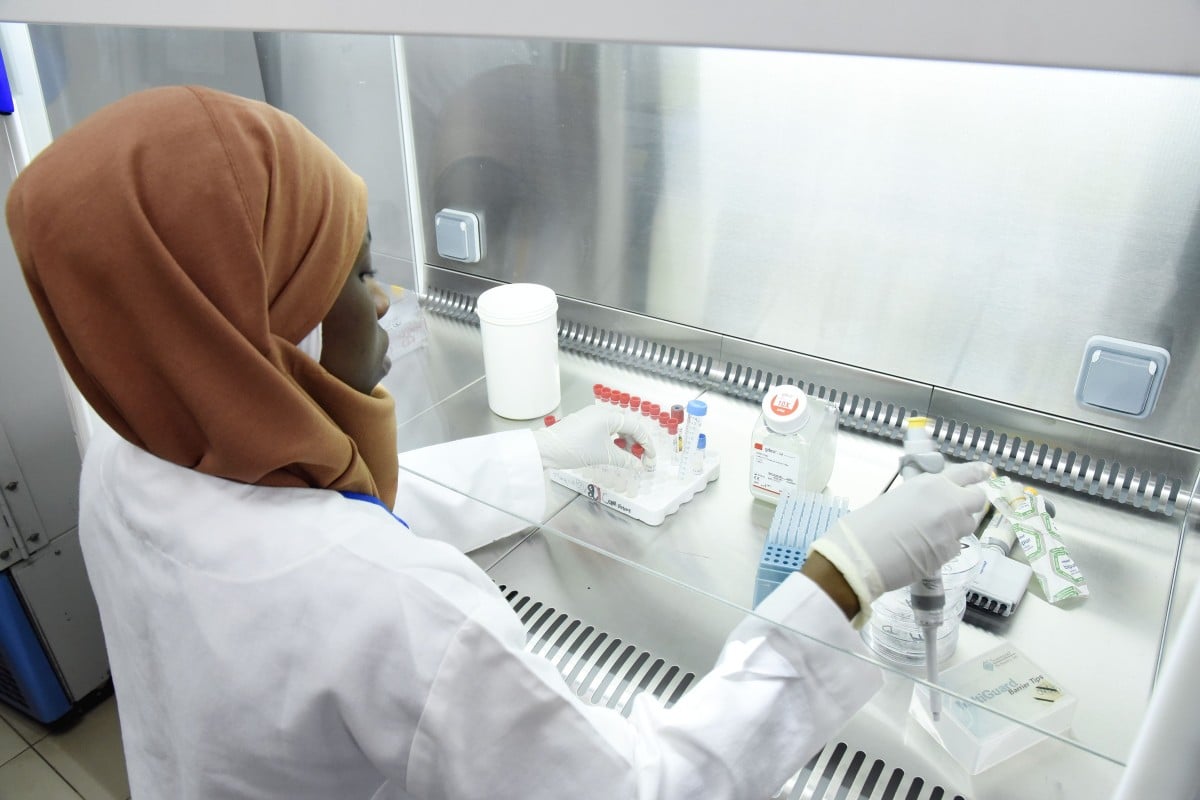
A scientist researches the coronavirus at the Pasteur Institute in Dakar, Senegal, which until two weeks ago was one of just two labs in Africa that could test for the disease. Photo: AFP
Forty countries in Africa will be able to test for the deadly new coronavirus
by the end of the week, the WHO said, after Egypt confirmed the first case on the continent last week.
The World Health Organisation said many of those nations had been sending samples elsewhere for testing and waiting several days for results.
“Now they can do it themselves, within 24 to 48 hours,” WHO director general Tedros Adhanom Ghebreyesus said in a media briefing on Tuesday.
Until about two weeks ago, there were only two laboratories in the continent of 54 countries – in Senegal and South Africa – with the reagents needed to test for the virus. That meant dozens of nations that had quarantined suspected patients were sending samples to South Africa or Senegal to be tested.
The WHO earlier this week sent reagent kits for coronavirus diagnosis to more than 20 countries in Africa to step up diagnosis of the virus, which causes a disease now known as Covid-19. The global health body said more countries in Africa were expected to receive testing kits this week.

In addition, the WHO last week sent testing kits to Cameroon, Ivory Coast, the Democratic Republic of Congo, Egypt, Ethiopia, Gabon, Ghana, Kenya, Morocco, Nigeria, Tunisia, Uganda and Zambia.

Coronavirus: WHO urges caution over study showing ‘decline’ in new Covid-19 cases in China
Tedros said some countries in Africa, including the Democratic Republic of Congo, were using systems developed to test for the deadly Ebola virus to now test for the coronavirus.

“This is a great example of how investing in health systems can pay dividends for health security,” Tedros said.

Several countries, including Ethiopia and South Sudan, were prioritising surveillance and monitoring at ports of entry, he said. “We’re also working with partners in some of the most fragile contexts, from Syria to the Central African Republic, to prepare countries for the arrival of the virus,” he said.

The WHO and Egyptian health officials on Friday confirmed that a 33-year-old foreigner had tested positive for the coronavirus. Egypt’s health ministry said the patient had tested positive for the virus without any symptoms, raising concern that there could be undetected cases on the continent, as countries scramble to equip labs to test for the disease.

The asymptomatic patient in Egypt was identified through contact screening of an index case who travelled to Cairo on a business trip from January 21 to February 4 and tested positive for the virus on February 11 in China, the WHO regional office said.

The new virus strain has killed more than 2,000 people and infected over 74,000 since the outbreak began in central China in December. It has spread to more than 20 countries.

Screening measures have been stepped up across Africa, including quarantining all passengers arriving from Chinese cities, amid fears that poorer countries with weaker health systems may struggle to cope if the virus spreads on the continent. More than a dozen countries still do not have the capacity to test for the pneumonia-like illness.

There are concerns that Africa’s close links with China put it at high risk for the spread of the new virus. Africa has become home to millions of Chinese since Beijing started looking to the continent for raw materials for its industries and markets for its products. China has been Africa’s largest trading partner since 2009, after it overtook the United States, with two-way trade standing at US$108 billion last year, according to China’s commerce ministry.

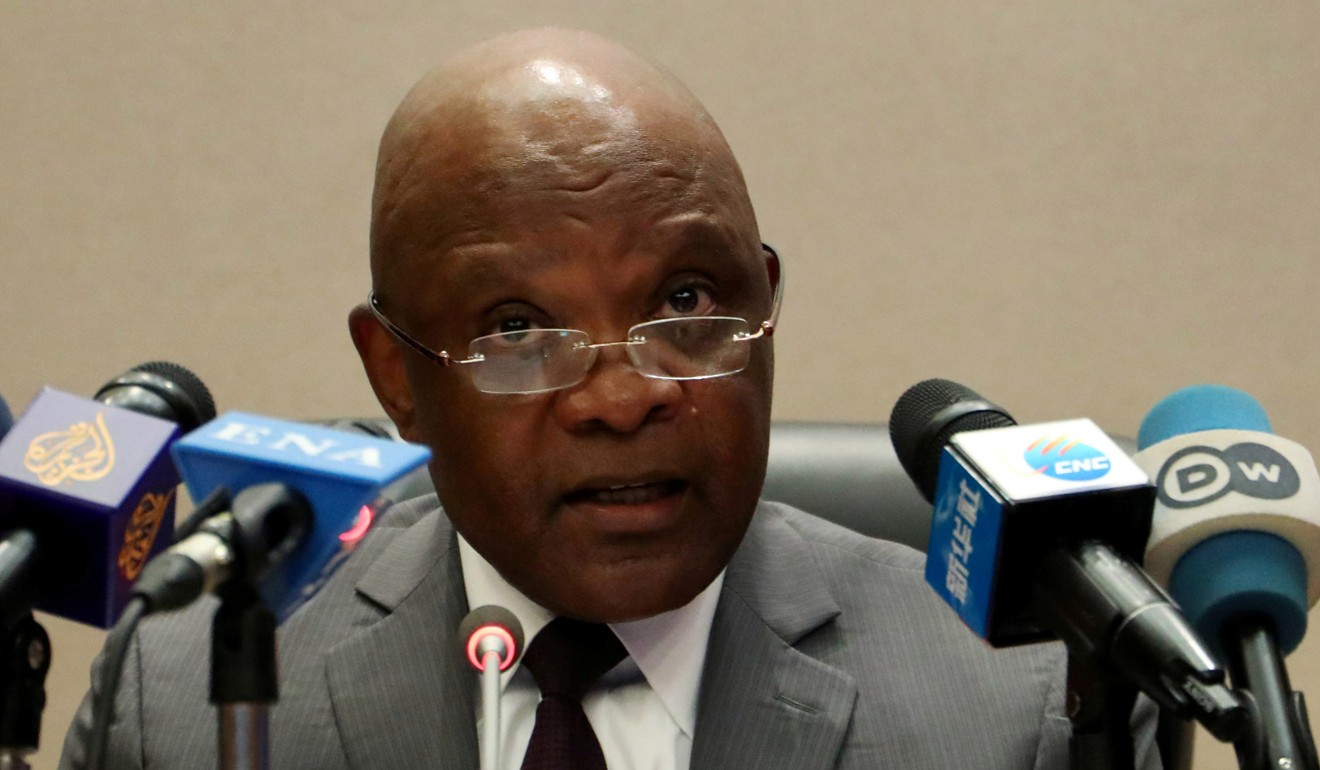
Africa CDC director John Nkengasong said it had been “investing in preparedness and response to the disease”. Photo: Reuters
John Nkengasong, director of the Africa Centres for Disease Control and Prevention (Africa CDC), said it was working closely with the WHO and other partners to ensure that Egypt had the diagnostic tools it needed, and that the right actions were taken to contain the spread of the virus.
“We anticipated that the Covid-19 outbreak would inevitably impact Africa. That is why the Africa CDC has been working actively with African Union member states and partners in the past four weeks and investing in preparedness and response to the disease,” he said.
“[Last week in Dakar, Senegal] we conducted training and supplied test kits to 16 African laboratories, including from Egypt. Egypt also received additional test kits from the WHO,” Nkengasong said.
The Africa CDC would train 40 health workers from nine countries, including Egypt, in Nairobi this week, he said, on “enhancing detection and investigation of Covid-19 at points of entry”.
The Chinese medical workers on the front line of the coronavirus fight in Wuhan
On Monday, Ethiopia, home to one of the continent’s busiest airports, said it had received equipment and reagents for virus detection and control. “We are working hard day and night with the government to improve the critical measures needed to ensure that the country is ready to effectively respond to an outbreak of Covid-19,” said Boureima Hama Sambo, the WHO representative in Ethiopia.
National flag carrier Ethiopian Airlines has continued flying to Chinese cities
 despite pressure for it to suspend services to the country. Many countries on the continent have restricted travel to and from mainland China, while six out of eight African airlines with Chinese routes have halted flights until the virus is contained, including EgyptAir.
Egypt has suspended all flights to and from the mainland until the end of the month and has evacuated more than 300 Egyptians from Wuhan, the epicentre of the epidemic.
Source: SCMP
08/09/2019

How a ban on sale of wild African elephants to zoos could affect China

  • International watchdog to vote on whether to extend restrictions to southern African countries that are the biggest exporters
  • If passed, China may find it hard to buy elephants from Africa
An elephant is hoisted into Chongqing zoo in southwestern China, on loan from another Chinese zoo. Photo: Reuters

China, one of the leading buyers of African elephants, could face difficulty in acquiring the mammals if a widening of a ban on their sale to zoos is ratified next week by the global regulator of wildlife trade.

A motion further restricting the sale of live elephants was on Sunday supported by 46 countries at the committee stage of the Convention on International Trade in Endangered Species of Wild Fauna and Flora (Cites) in Geneva. It will go to a final vote on August 28.

The sale of elephants from West, Central and East Africa is already banned – but there is a lower level of protection for them in southern African countries such as South Africa, Namibia and Zimbabwe, which are the top three exporters of wild elephants to overseas zoos, according to Cites.

Keeping elephants caught from the wild in zoos is considered cruel by conservation and animal rights groups.

Conservationists criticised Zimbabwe’s capture of 35 baby elephants that were exported to a Chinese zoo in February. There was also uproar from activists in 2015 when a video filmed in a Chinese zoo showed two dozen elephants bought from Zimbabwe exhibiting signs of distress.

Zimbabwe was among 18 countries that opposed the potential ban at the committee stage, along with the United States – another leading buyer of elephants from Africa. China was one of 19 countries that abstained, while the European Union’s 28 countries did not vote.

If the motion is passed, China and the US – both known to be buying elephants from Africa and keeping them in so-called captive facilities or zoos – may find it hard to source the animals from the continent. Zimbabwe has come under global scrutiny
for its capture and sale of elephants to captive facilities including zoos and safari parks in China and the US.

Peter Knights, founder and chief executive of WildAid, an environmental organisation in San Francisco, explained that Cites still allowed the movement of live elephants for on-site conservation efforts such as moving the animals back into the wild or to a national park where they had been depleted.

“This is not primarily a conservation issue but more about animal welfare,” he said. “As highly social, intelligent animals, African elephants do not usually do well in captivity, requiring very large areas, and often developing behavioural problems in captivity and not usually reproducing successfully – indicating far from ideal housing.”

According to Humane Society International, which promotes animal welfare, Zimbabwe has sold more than 100 baby elephants to zoos in China since 2012, with a further 35 reportedly awaiting export.

On Monday, 55 elephant specialists protested to the US wildlife management agency about plans for the country’s zoos to import juvenile elephants caught in the wild from Zimbabwe. They asked the agency to prohibit imports of wild-caught elephants for captivity in US facilities.

“We are vehemently opposed to the proposed imports,” the experts wrote in a letter to the agency. “Young elephants are dependent on their mothers and other family members to acquire necessary social and behavioural skills. Male calves only leave their natal families at 12 to 15 years old and females remain for life. Disruption of this bond is physically and psychologically traumatic for both the calves and remaining herds and the negative effects can be severe and lifelong.”

The letter said that eSwatini, formerly Swaziland, had sold a total of 11 wild elephants to two American zoos in 2003, and a further 18 to three US zoos in 2016.

‘Hundreds’ of elephants are being poached each year in Botswana

Concerns about keeping elephants in zoos come at a time when the animals remain under threat in Africa from poachers who kill them for ivory.

Southern African countries such as Botswana, Namibia, Zimbabwe and Zambia are pushing to reopen the trade in ivory. Zambia is seeking to have the classification of its elephants downgraded to allow commercial trade in registered raw ivory with approved trading partners.

Other countries, including Kenya, Nigeria and Gabon, are seeking the highest possible levels of protection for all of Africa’s elephants.

Two previous attempts at regulating the ivory trade failed to curb poaching, which has caused elephant numbers to dwindle over the past two decades. A 2016 study estimated that 30,000 to 40,000 elephants were being killed every year, with about 400,000 remaining in total.

Knights, of WildAid, said that between 1975 and 1989 – the first period in which the ivory trade was regulated – half of Africa’s elephants were lost. During the second attempt at regulation between 2008 and 2017, participating countries claimed to have addressed the problem but poaching increased.

“It is clear that we cannot control ivory trade and that legal trade stimulates poaching and demand for ivory, rather than substituting for it as some countries suggest. The price fell by two-thirds when China banned domestic sales,” Knights said, adding that demand for ivory came primarily from Asia.

“Most seized shipments are en route to China. It has banned all sales and is making a great effort to crack down on illegal trade.”

Source: SCMP

24/06/2019

China Focus: African ministers in Beijing to discuss closer cooperation with China

CHINA-BEIJING-WANG YI-CAMEROON-FM-MEETING (CN)

Chinese State Councilor and Foreign Minister Wang Yi (R) meets with Cameroon’s Foreign Minister Lejeune Mbella Mbella in Beijing, capital of China, June 23, 2019. Lejeune Mbella Mbella was here to attend the coordinators’ meeting on the implementation of the Forum on China-Africa Cooperation (FOCAC) Beijing Summit outcomes. (Xinhua/Yin Bogu)

BEIJING, June 23 (Xinhua) — Chinese State Councilor and Foreign Minister Wang Yi held talks or meetings here Sunday with foreign ministers from eight African countries, who are here to attend the upcoming coordinators’ meeting on the implementation of the Forum on China-Africa Cooperation (FOCAC) Beijing Summit outcomes.

The foreign ministers are Sierra Leone’s foreign minister Nabeela Tunis, Gabon’s foreign minister Alain Claude Bilie, Cameroon’s foreign minister Lejeune Mbella Mbella, San Tome and Principe’s foreign minister Elsa Teixeira Pinto, Somali foreign minister Ahmed Isse Awad, Madagascar’s foreign minister Andriantsit Ohaina Franck Michel Niaina, Congo’s foreign minister Jean Claude Gakosso and Senegal’s foreign minister Amadou Ba.

In talks with Tunis, hailing the two countries as “good friends and good brothers”, Wang called on the two sides to continue to firmly support each other on issues concerning each others’ core interests and major concerns, strengthen alignment of the Belt and Road Initiative and the eight major initiatives proposed at the FOCAC Beijing Summit with Sierra Leone’s medium-term national development plan, and beef up cooperation on infrastructure, agriculture and fishery, health care, communication, and capacity building.

Sierra Leone supports Africa and China to deepen partnership and is ready to strengthen communication and coordination with China on implementing the sustainable development goals of the 2030 Agenda, the Paris Agreement on climate change, and reform of the global governance system, Tunis said.

When meeting with Bilie, Wang said 53 countries in Africa have sent high-level delegations to the coordinators’ meeting, including 25 foreign ministers. The move fully reflected the importance that the African side attaches to the China-Africa ties and the unbreakable solidarity and friendship between the two sides.

Wang said the two sides should continue the support to each other on issues involving each other’s core interests, seize opportunities of the 45th anniversary of diplomatic ties between China and Gabon this year to create new progress in ties, and expand cooperation on Belt and Road Initiative and multilateral issues.

Bilie said Gabon is willing to strengthen exchanges of experience with China in governance and seek synergy between its own development strategy with the Belt and Road Initiative.

In meeting with Mbella, Wang said Cameroon is China’s traditional friend and important partner in Africa. Both sides should continue to understand and support each other on issues involving each others core interests and major concerns. China’s financial support for African countries is based on equality and voluntarism and aims to help Africa improve its capacity for independent and sustainable development.

There is no such thing as a “debt trap” between China and Cameroon or between China and Africa, said Wang, adding that China will not seek any political purpose.

Mbella said that Cameroon spoke highly of China’s policy toward Africa and thanked China for its understanding and sincere assistance to Cameroon in alleviating the debt problems.

When meeting with Pinto, Wang said facts have proved that the resumption of diplomatic relations is in full compliance with the interests of the two countries and peoples. The Chinese side appreciates Sao Tome and Principe’s active support for the Belt and Road Initiative and is willing to continue to provide assistance within its capacity to the African country.

Pinto said Sao Tome and Principe will firmly adhere to the one-China principle, strengthen political and diplomatic dialogue with China, actively promote cooperation in infrastructure and enhance non-governmental exchanges.

In the meeting with Awad, Wang said China supports Somalia to restore stability and embark on the path of recovery. China is ready to explore new ways to develop mutually beneficial cooperation with Somalia under the new situation, and conduct cooperation in the areas most needed by Somalia such as agriculture, fisheries and processing industries.

Awad said Somalia expects to strengthen exchanges with China, and promote cooperation in areas such as infrastructure construction.

In the meeting Niaina, Wang expressed the will to promote the alignment with Madagascar’s development strategy, and said China is ready to enhance the cooperation on multilateral issues.

When meeting with Gakosso, Wang hailed bilateral relationship and also reiterated China’s stance to safeguard multilateralism.

In the talks with Amadou Ba, Wang said China would like to work with other international partners in conducting tripartite cooperation in Senegal, on the basis of respecting Senegal’s willingness.

The coordinators’ meeting will be held in Beijing from June 24 to 25. There will be over 80 African ministerial-level officials at the meeting. On the sidelines of the meeting, more than 40 bilateral and multilateral activities will be held to implement the outcomes of the FOCAC Beijing Summit, synergize efforts, consolidate consensus and deliver more benefits to the peoples.

Source: Xinhua

Law of Unintended Consequences

continuously updated blog about China & India

ChiaHou's Book Reviews

continuously updated blog about China & India

What's wrong with the world; and its economy

continuously updated blog about China & India