Archive for ‘Gambia’

27/11/2019

China overtakes United States to boast world’s biggest diplomatic network, think tank says

  • But Washington still commands more diplomatic influence, analyst says
  • Beijing extends its reach as its interests grow abroad and as Taipei loses allies
China has 276 embassies, consulates and other missions around the world, surpassing the US with 273 missions, according to a global index. Photo: AP
China has overtaken the United States to have the biggest number of diplomatic outposts around the world, as its international ambitions and economic interests expand.
According to the 2019 Global Diplomacy Index, released by the Lowy Institute in Australia on Wednesday, China has 276 embassies, consulates and other missions globally, surpassing the US with 273 missions. France was third on 267.

Bonnie Bley, the index report’s lead researcher, said that while a country’s total did not equate to diplomatic influence, “diplomatic infrastructure is still important”

“China’s newly held lead serves as a telling metric of national ambition and international priorities,” Bley said.

Beijing has 169 embassies or high commissions, while Washington has 168. However, China had 96 consulates while the US had 88, suggesting that Beijing’s diplomatic expansion was closely linked to its economic interests, she said.
Beijing bulks up diplomacy budget as China extends global reach

Renmin University international relations professor Shi Yinhong said China had close and growing trade and investment ties with many developing countries, especially those taking part in the Belt and Road Initiative, increasing the need for consulates.

“One of the consulates’ main goals is to serve the citizens and businesses located in those countries,” Shi said.

Beijing has also expanded its reach at Taipei’s expense. Since 2016, when the index was first published, Taiwan’s total number of embassies fell from 22 to 15, the biggest drop among the 61 places ranked.

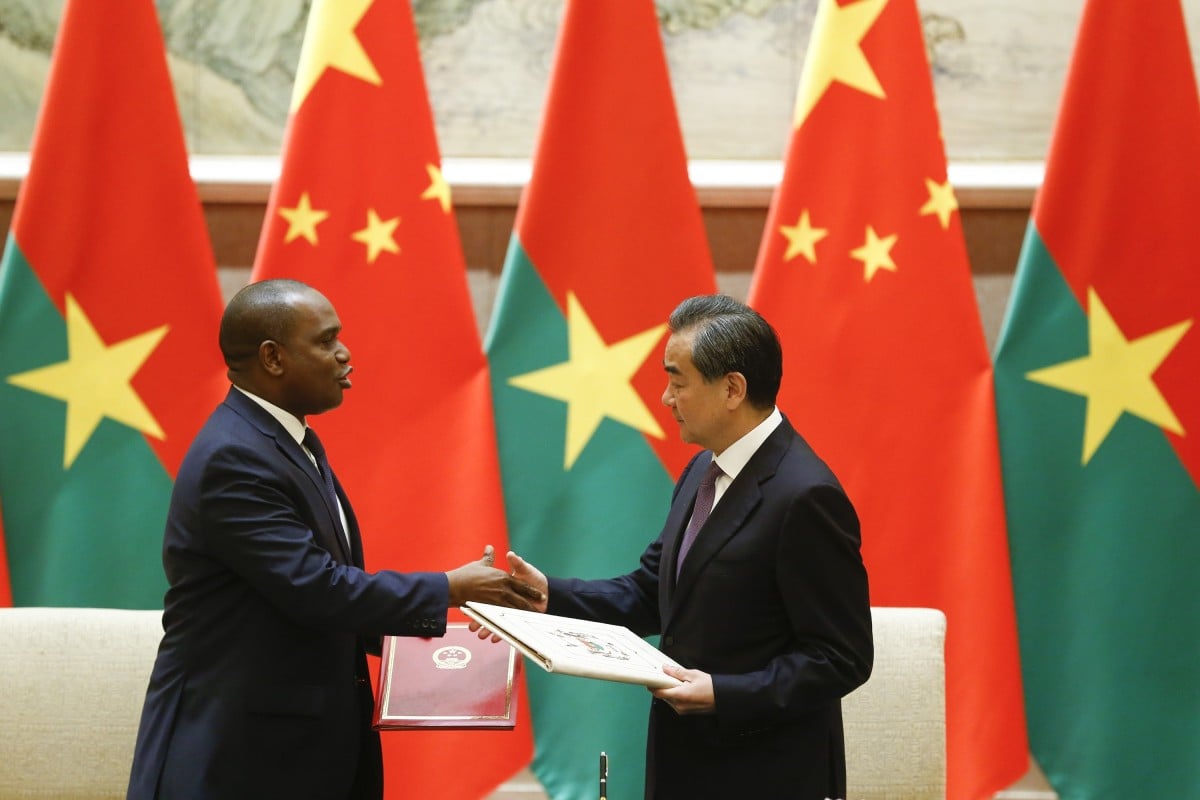
China opened five new embassies – in El Salvador, Burkina Faso, Gambia, São Tomé and Príncipe and the Dominican Republic – countries that severed official diplomatic ties with Taiwan. This directly contributed to China’s lead over the US, the report said.

Beijing’s diplomatic expansion also comes as the US, under the administration of President Donald Trump, is taking an “America first” approach to foreign policy.
Sri Lanka rejects fears of China’s ‘debt-trap diplomacy’ in belt and road projects
Trump has sought to cut funding to the US State Department and the White House has not appointed US ambassadors for at least 17 countries, including Brazil and Egypt, according to the American Foreign Service Association.
“Even though the US has a strong diplomatic base but it is not so proactive any more. It has fewer consulates and fewer foreign service workers,” Shi said.
“For the long term, China is in a more advantageous position.”
But a country’s diplomatic ability and influence did not rest on the number of foreign service postings and the US still held more international diplomatic sway than China, he added.
Some of China’s biggest diplomatic missions include Islamabad in Pakistan, Washington and London.
Source: SCMP
25/06/2019

China, African countries vow to enhance cooperation

CHINA-BEIJING-WANG YI-SOUTH AFRICA-FM-MEETING (CN)

Chinese State Councilor and Foreign Minister Wang Yi (R) meets with South African Foreign Minister Naledi Pandor in Beijing, capital of China, June 24, 2019. Naledi Pandor was here to attend the Coordinators’ Meeting on the Implementation of the Follow-up Actions of the Beijing Summit of the Forum on the China-Africa Cooperation (FOCAC). (Xinhua/Zhai Jianlan)

BEIJING, June 24 (Xinhua) — Chinese State Councilor and Foreign Minister Wang Yi held respective meetings with foreign ministers from nine African countries on Monday, and they pledged efforts to strengthen cooperation and uphold multilateralism.

The foreign ministers are Naledi Pandor from South Africa, Palamagamba Kabudi from Tanzania, Ezechiel Nibigira from Burundi, Aurelien Agbenonci from Benin, Nhial Deng Nhial from South Sudan, Mamadou Tangara from Gambia, Joseph Malanji from Zambia, Luis Filipe Tavares from Cape Verde, and Gbehzohngar Findley from Liberia.

The African foreign ministers are in Beijing to attend the Coordinators’ Meeting on the Implementation of the Follow-up Actions of the Beijing Summit of the Forum on the China-Africa Cooperation (FOCAC), with the aim of better implementing the outcomes of Beijing Summit in 2018.

While holding talks with Pandor, Wang hailed the solid mutual trust and deep-rooted traditional friendship between China and South Africa.

Wang said China and South Africa, both as major representatives of emerging markets and developing countries, should jointly safeguard the missions and principles of the United Nations Charter, champion multilateralism, uphold basic norms governing international relations, and oppose any form of unilateralism and bullying, to promote world peace, development and prosperity.

Pandor said South Africa and the whole African continent, as China’s partners for jointly resisting unilateralism and bullying practice, would stand together with China in safeguarding multilateralism and an open, inclusive global trade system.

In the meeting with Kabudi, Wang expressed China’s readiness to work with Tanzania to keep high-level exchanges, and avail the opportunity of jointly building the Belt and Road and the Coordinators’ Meeting to ensure better outcomes in bilateral cooperation.

Calling the Beijing Summit of the FOCAC a milestone, Kabudi said Tanzania is willing to facilitate cooperation in infrastructure construction, industrial capacity, and in cultural, educational sectors and other areas.

In respective meetings with Nibigira, Agbenonci, Nhial and Tangara, Wang said the current international situation is complex but China’s determination to strengthen its solidarity and friendship with African countries remains unchanged.

Nibigira said Burundi agreed with the Belt and Road Initiative and would continue to support China on issues concerning China’s core interests and major concerns.

Agbenonci said multilateralism was now the only correct choice. Only through multilateralism can the voice of small and medium-sized countries, especially African nations, be heard, he said.

Nhial said South Sudan thanked China for its help in various fields, especially its support and contributions to the peace process in South Sudan.

Tangara said since the resumption of diplomatic relations between China and Gambia, bilateral cooperation in various fields had developed fast, and Gambia can be trusted as a sincere partner of China.

When holding separate meetings with Malanji, Tavares and Findley, Wang said China would continue to uphold justice and pursue the shared principles of sincerity, results, affinity and good faith.

China’s cooperation with Africa is sincere and selfless, and has no geopolitical purposes, said Wang, adding that China had always followed the principle of non-interference, provided aid as Africa needed, carried out South-South cooperation, and helped achieve common development.

He said China-Africa cooperation was conducive to Africa’s infrastructure construction, economic and social benefits, and self-development.

“Africa offers a grand stage of cooperation between different countries, not an arena of major powers’ game,” said Wang, adding that “African friends will get a right conclusion on who truly attaches importance to, respect, and support Africa.”

Malanji said claims that Zambia-China cooperation had led to Zambia’s debt problem were inconsistent with the facts and China’s loans were used on the infrastructure that Zambia needs most, to promote Zambia’s economic development and bring social welfare.

Tavares said Cape Verde cherished relations with China and upheld the one-China principle. He said Cape Verde stood ready to fully implement consensus reached by leaders of the two countries, enhance strategic dialogue, and deepen cooperation, particularly marine economy cooperation, to push bilateral relations into a new era.

Findley said China is Liberia’s true friend which has helped fight Ebola alongside Liberia and played an important role in post-epidemic reconstruction. He said Liberia is ready to enhance mutually beneficial cooperation with China.

Also on Monday, Yang Jiechi, a member of the Political Bureau of the Central Committee of the Communist Party of China (CPC) and director of the Office of the Foreign Affairs Commission of the CPC Central Committee, met with all delegation heads here to attend the coordinators’ meeting.

The meeting will formally open Tuesday morning.

Source: Xinhua

07/01/2019

China-Gambia relations see rapid development on all fronts: Chinese FM

GAMBIA-BANJUL-WANG YI-TANGARA-MEETING

Chinese State Councilor and Foreign Minister Wang Yi (L) meets with his Gambian counterpart Mamadou Tangara in Banjul, capital of Gambia, Jan. 5, 2019. (Xinhua/Lyu Shuai)

BANJUL, Jan. 5 (Xinhua) — China and Gambia have seen rapid development on all fronts in their relations since the resumption of diplomatic ties more than two years ago, said visiting Chinese State Councilor and Foreign Minister Wang Yi on Saturday.

During the meeting with his Gambian counterpart Mamadou Tangara, Wang said China and Gambia have restored exchanges in various fields and achieved notable results in cooperation on major infrastructure projects, enabling the bilateral friendship to take root among the two peoples.

Facts have proved that resuming bilateral diplomatic relations fully conforms with the fundamental interests of Gambia and its people, the universal consensus on the one-China principle and the common aspiration for unity and cooperation by the Chinese and African peoples, Wang said.

The Chinese foreign minister said Gambia’s reaffirmed commitment to the one-China policy will help lay a firm political foundation for a comprehensive and healthy development of bilateral ties. He said the two countries should further increase mutual trust as well as mutual support on issues concerning each other’s core interests.

China and Gambia should step up communication and coordination to implement the major consensus between leaders of the two countries and the results from the Forum on China-Africa Cooperation (FOCAC) Beijing Summit, Wang said.

In this respect, he suggested that Gambia combine the China-Africa cooperation initiatives proposed at the FOCAC Beijing Summit with its national development plans and find priorities, so as to push for progress in various fields of bilateral cooperation to benefit both sides.

Wang noted that China-Africa cooperation in essence is South-South cooperation, and the China-Africa efforts towards common development and prosperity will help promote equality and peace in the world.

China is willing to do everything within its power to help with the economic and social development in Gambia and other African countries based on Africa’s realities and actual needs, he said.

For his part, Tangara thanked China for its help in Gambia’s economic development and improvement of people’s livelihood while voicing the hope that Wang’s visit would lead to a closer bilateral relationship.

The Gambian foreign minister said Gambia firmly adheres to the one-China policy, and will support China on various international occasions as well as on issues of core interest, pushing further development of bilateral ties on the right track.

He said Gambia is ready to strengthen communication with China at various levels, enhance mutual trust and promote cooperation in fields like economy, energy and technology.

Tangara said the major cooperation initiatives proposed at the FOCAC Beijing Summit showed China truly addresses the concerns of African countries and supports their efforts to enhance their own capabilities in national development.

While praising China as a leader in defending multilateralism and the interests of developing countries amid the headwinds of unilateralism in the world, the minister said his country is willing to strengthen coordination and cooperation with China in various international affairs.

Law of Unintended Consequences

continuously updated blog about China & India

ChiaHou's Book Reviews

continuously updated blog about China & India

What's wrong with the world; and its economy

continuously updated blog about China & India