Chindia Alert: You’ll be Living in their World Very Soon
aims to alert you to the threats and opportunities that China and India present. China and India require serious attention; case of ‘hidden dragon and crouching tiger’.
Without this attention, governments, businesses and, indeed, individuals may find themselves at a great disadvantage sooner rather than later.
The POSTs (front webpages) are mainly 'cuttings' from reliable sources, updated continuously.
The PAGEs (see Tabs, above) attempt to make the information more meaningful by putting some structure to the information we have researched and assembled since 2006.
PAHALGAM, India (Reuters) – India is hailing a Hindu pilgrimage to a holy cave high in the snow-capped mountains of contested Kashmir as an example of communal harmony, in a region where the Muslim-majority population is overwhelmingly hostile to its rule.
India and arch-rival Pakistan have fought two wars over Kashmir, and came close to a third in February after a suicide-bomb attack by Pakistan-based militants on Indian paramilitary police near the pilgrimage route.
India’s Hindu-nationalist government led by Prime Minister Narendra Modi has made “pilgrimage tourism” a focus, spending huge sums on January’s Kumbh Mela festival, where more than a hundred million Indians came to bathe in the holy Ganges river.
For the Amarnath Yatra pilgrimage in the Pahalgam area, the Jammu and Kashmir state government has spent a record $72 million on preparations for the six-week event that began on July 1.
“It is a perfect example of religious harmony,” said Anup Kumar Soni, additional chief executive of the Amarnath Ji Shrine Board, which organises the pilgrimage.
Amarnath Cave, covered by snow almost all year round, contains an ice stalagmite that is considered a physical manifestation of Lord Shiva, a Hindu god.
Saffron-clad Hindu ascetics, some barefoot and with photos of the cave around their necks, trudge the 46 km (28 mile) route to the cave across glaciers and waterlogged trails.
Muslim Kashmiri villagers in long woollen coats clear the way of snow and ice, and thousands of Indian troops are deployed to guard against attacks by Muslim militant groups.
The route is arduous. One in four of the 300,000 pilgrims who have visited this year have required medical treatment, and 24 have died, mainly from heart attacks and hypertension, according to government statistics.
‘ALWAYS FRIENDLY’
While thousands of Kashmiris work to clear the path, thousands more rent ponies and palanquins to the pilgrims, and tents for them to sleep in.
“Everyone is always friendly, there is no hostility here,” said a Hindu pilgrim who give his name as Abhhinav, hiking up a steep track in driving rain to one of the passes on the route that reaches nearly 4,500 metres (15,000 feet) in places.
The pilgrimage has been attacked repeatedly by militant groups – the last time in 2017 when eight pilgrims were killed in an ambush.
This year, the government has set up a bar-coding system, allowing only registered people onto the trail.
Separatists in Muslim-majority Kashmir have been campaigning against the government of Hindu-majority India for years, including a campaign of violence by militants, and an Indian security force response that Kashmiris often condemn as heavy handed.
The trouble has badly affected the region’s farming and tourism industries.
In Pahalgam, the pilgrimage offers a lifeline for many families.
“There is no private sector here, and so educated youth and many other Kashmiris are depending on the Yatra,” said Firoz Ahmed Wani, a history graduate and part-time tutor renting out two tents to pilgrims paying 200 rupees ($2.90) a night, at a camp along the route.
“We’re ordinary people. The conflict is something for the politicians to decide.”
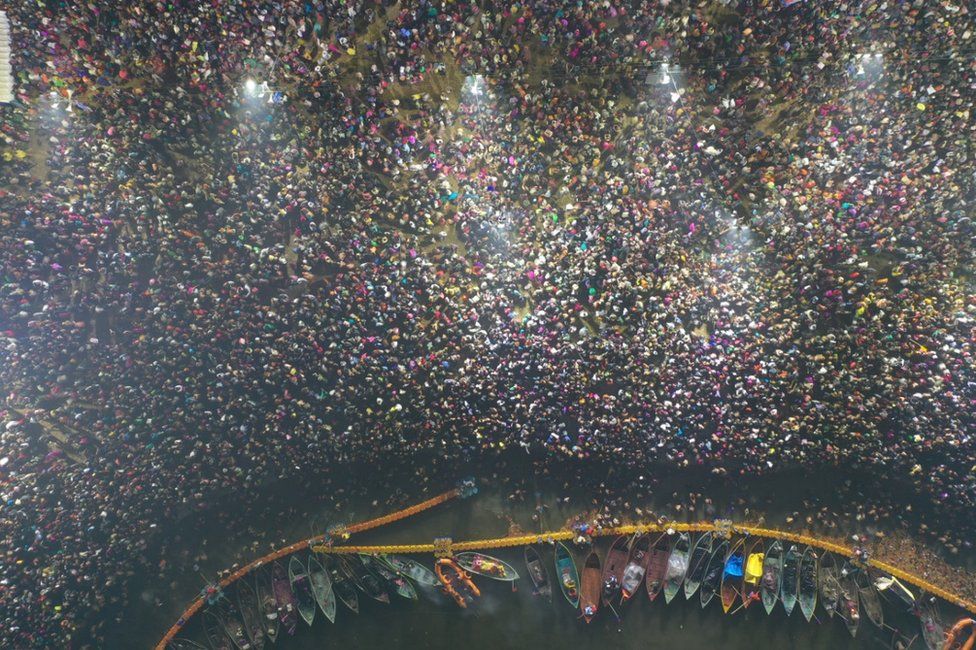
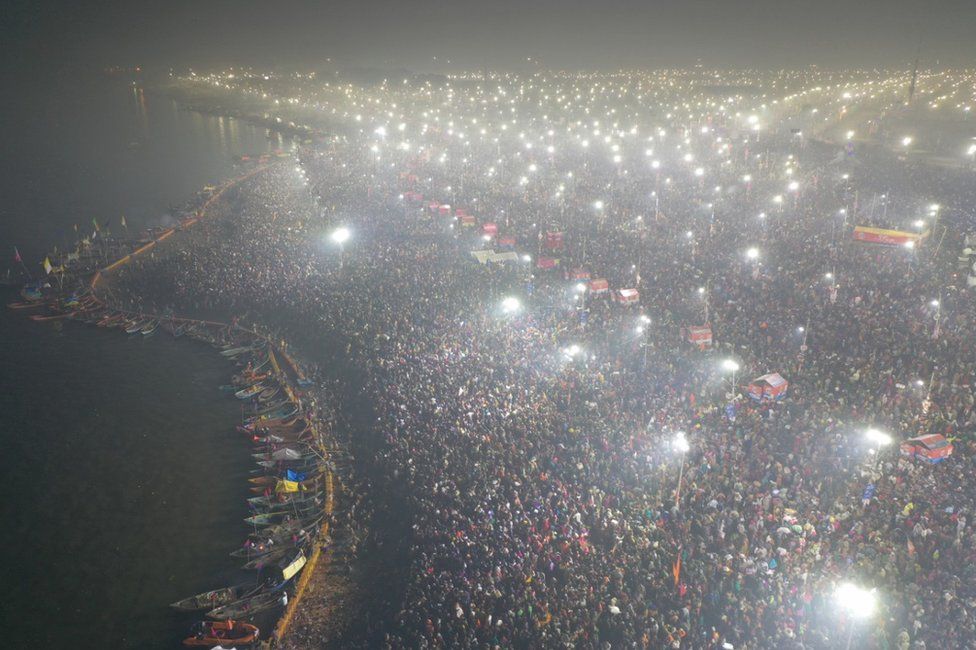
The main day of bathing has been held at India’s Kumbh Mela, with tens of millions of pilgrims taking a dip at the confluence of the Ganges and Yamuna rivers.
This is the most auspicious of six bathing days at the event, billed as the world’s biggest human gathering.
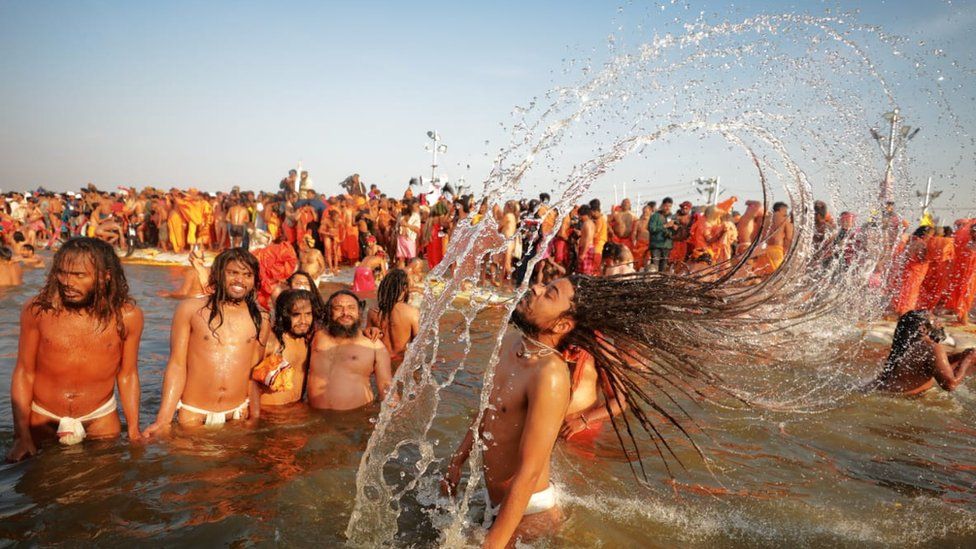
Hindus believe bathing at the rivers will cleanse them of their sins and help them attain “moksha”, setting them free from the cycle of birth and death.
The mela (meaning “fair” in Hindi) has been held in Allahabad city (recently renamed Prayagraj) in the northern state of Uttar Pradesh for centuries now. But it has grown into a mega event in the past two decades.
Image copyrightANKIT SRINIVAS
The BBC’s Vikas Pandey, who is at the festival, said people had arrived from all parts of the country and had walked miles to take a dip. “Every street in the city leading to the mela grounds is flooded with people,” he said.
The bathing began at midnight with people chanting “hail mother Ganges”.
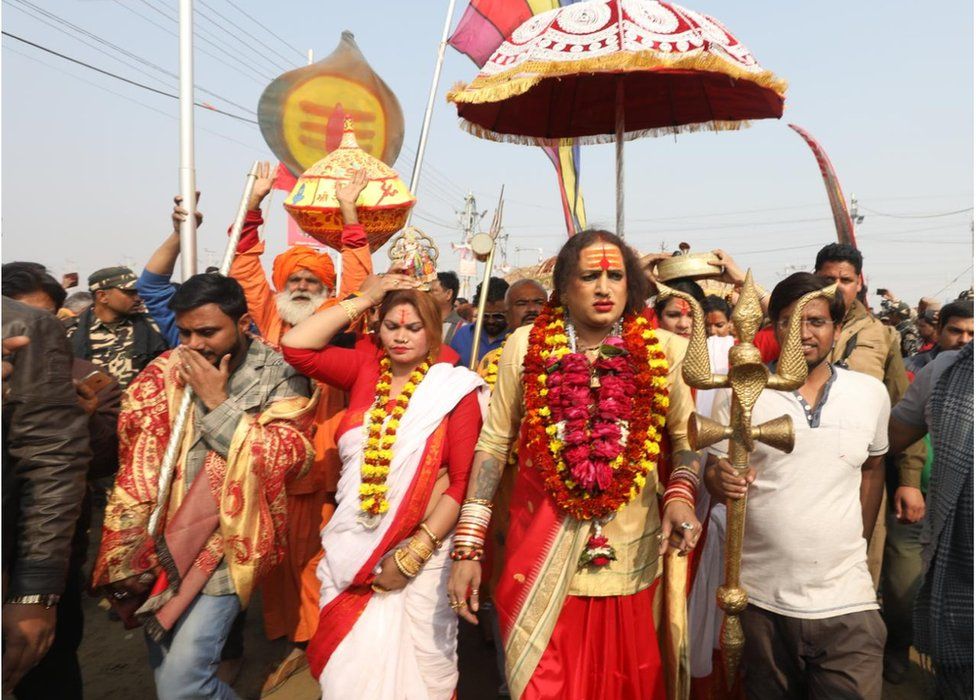
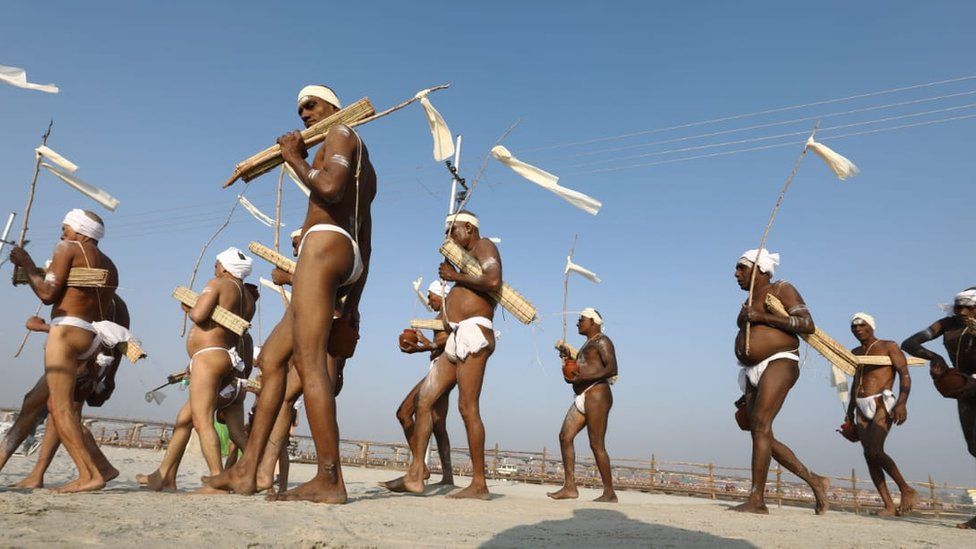
At dawn, visitors jostled to get a glimpse of the Akharas – different congregations of Hindu saints – who had started their procession.
Image copyrightANKIT SRINIVAS
These processions are highly coveted as people line up to see holy men and women perched on top of heavily decorated floats.
“It is so crowded but everyone seemed excited, despite having walked long distances in the cold,” our reporter said.
Officials say more than 10 million people have already taken a dip and the number is likely to rise during the day.
Avnish Tripathi, who had arrived from Madhya Pradesh state, walked for five hours from the outskirts of Allahabad city to reach the festival. “Once I got there, I had to wait for two hours to take a dip because of the crowds. But it was a magical experience and I didn’t feel tired at all,” he told the BBC.
Many other devoted pilgrims had walked more than 50km (31 miles) in the hope of taking a dip.
Image copyrightUTTAR PRADESH GOVERNMENT
“It has been nearly 12 hours since bathing began but the crowds haven’t thinned,” our reporter added.
The Naga sadhus are the biggest draw of the festival. Thousands of the Sadhus, naked and wearing garlands around their necks, charged into the river with swords and tridents in their hands.
They were escorted by the police as people watched from behind barricades.
Image copyrightANKIT SRINIVAS
This year’s festival is an “ardh Kumbh” – a “half-size” version that falls mid-way between two Kumbhs – but there’s nothing diminutive about it. In fact, it’s much bigger than the last.
NEW DELHI (Reuters) – The Ganges river, holy to most Indians, flows from the western Himalayas down to the Bay of Bengal through crowded cities, industrial hubs and some of the most populated areas in the world.
The river begins as pristine, clear waters in the icy heights of the tallest mountain range in the world. But pollution, untreated sewage and use by hundreds of millions of people transform parts of it into toxic sludge by the time it reaches the sea, about 2,525 kilometres downstream.
Personified by Hindus as the goddess Ganga, the river is the site of thousands of cremations and ash scatterings every day. The Hindu nationalist government of Prime Minister Narendra Modi has launched a nearly $3 billion five-year plan to clean up the river by 2020, but Reuters found last year that only a tenth of the funds had been used in the first two years of the project.
A Reuters team that investigated the state of the holy river has compiled data and photographs to portray its condition.
The government maintains it is on track to clean up the river.
Water Resources Minister Nitin Gadkari said last month that the Ganges will be 70 percent to 80 percent clean within three months and 100 percent clean by March 2020. He did not give details on how the government had arrived at the figures and did not respond to requests for further comment.
Image copyrightMANSI THAPLIYALImage captionAtmabodhanand, 26, stopped taking food on 24 October
Over the past two decades, holy men in India have gone on dozens of fasts demanding governments honour their promise to revive the polluted Ganges, a river revered by Hindus. The recent death of one of the most prominent hunger strikers made headlines. Soutik Biswas went to find out more.
In a quiet ashram (retreat) near the pilgrim town of Haridwar, a young seer says he would die to save the Ganges.
Atmabodhanand is on the 40th day of a fast begun after the ashram’s most prominent resident starved himself to death two months ago.
The 26-year-old computer science dropout from Kerala state spends his days lying under a blanket on a bed beneath a mango tree. When night falls and the air gets chillier, he moves inside the spartan quarters and sleeps.
“I am ready to die,” he told me. “Our ashram has a history of sacrifice.”
Matri Sadan is a leafy, three-acre ashram that sits on the edge of the river. Atmabodhanand stopped taking food on 24 October and now survives on water, salt and honey – his is the 60th such fast by residents since it was founded in 1997.
Using a mix of folksy activism and hunger strikes, residents have put pressure on successive governments to scrap big dams, ban sand mining, clean up the river and pass laws to protect it. Many governments have acceded to their demands in the past.
Image captionThe Ganges is the longest river in India
Seven years ago Swami Nigamanand, 36, fell into a coma and died after refusing food for 115 days – the longest hunger strike in the ashram’s history. He had demanded the government halt all stone quarrying near the river.
A 39-year-old local seer and ashram resident, Sant Gopal Das, is currently being force fed in hospital to keep him alive.
But it was the death in October of GD Agarwal, an 86-year-old former environmental engineer, that grabbed international headlines. Agarwal, also known as Swami Gyan Swaroop Sanand, died after fasting for 111 days at the ashram.
Agarwal was an alumnus of University of California, Berkeley, and taught at the elite Indian Institute of Technology. He worked as an engineer with the federal pollution control authority and was a vocal critic of the government’s half-hearted efforts at cleaning up the river. In 2011, he renounced the material world and became a seer. Before his death he wrote three letters to Prime Minister Narendra Modi with his demands . He didn’t receive an answer.
“He was an inspiration to us all to do the best, and be our best, in all that we do,” Mary Stacey of the University of California wrote to the ashram after his death.
Two days after Agarwal began refusing water, his condition deteriorated and he died after being forcibly moved to the hospital. Within two weeks, Atmabodhanand took up the cudgels and began his hunger strike, inspired by his famous predecessor. He also believes that one man’s hunger can “bring back the river from the dead”.
Image captionEnvironmentalist GD Agarwal died in October after a 111-day-long hunger strike
The longest Indian river, Ganges flows from the Himalayas to the Bay of Bengal. Concerns over the declining water levels and waning health of the 2,500km (1,553-mile)-long river, which supports a quarter of India’s 1.3 billion people, have been mounting for years.
Hindus revere the river as a god, and believe that bathing in her waters can wash away a person’s sins.
But the Ganges has been choked by more than 1,000 irrigation dams, the water table in its basin shrunk by reckless extraction of groundwater and its own water poisoned by toxic industrial effluent and household sewage. The river in Haridwar itself caught fire in 1984 when someone put a lit match on the water. “Indians are killing the Ganges with pollution and the polluted Ganges, in turn, is killing Indians,” says Victor Mallet, author of River of Life, River of Death, a new book on the river.
Now, say the seers at the ashram, Narendra Modi’s Hindu nationalist BJP government, which rode to power in 2014 promising to clean up the Ganges, is “arrogant and isn’t interested in saving the river”.
They find it ironical that despite Agarwal being close to a Hindu nationalist organisation, he actually appeared to be listened to more by the previous Congress government. He fasted eight times while it was in power, and extracted some major concessions, including scrapping a dam and declaring a key 100km stretch of the river as sensitive.
“We will die for the river. If the government wants blood, we will give them blood,” says Swami Shivanand, the 72-year-old head of the ashram, who has also fasted in the past.
Image captionThe Ganges is one of the world’s most polluted rivers
Five years ago, Atmabodhanand quit college and travelled from Kerala in the south to Haridwar in northern Uttarakhand state by train, bus and foot. Seeking a life of renunciation, he says he was disillusioned by the way most holy men lived, and decided to end his life by disappearing into the Himalayas.
That is when he met Swami Shivanand who took him in. At the ashram he immersed himself in prayers and other activities and ran its social media accounts.
Atmabodhanand has gone on eight hunger strikes since 2014. During his longest fast, which lasted 47 days, he had hypothermia – when the body loses heat faster than it can produce it – and had to be taken to hospital. He has protested against sand mining on the river and stone crushing on its banks, and ended his strikes, he says, after authorities listened to the demands and took steps.
“This time, it is a fight to the finish. It’s going to be a long haul,” he says.
On the day I visited the ashram, rattled authorities, panicky at the prospect of another hunger death on the premises, sent doctors with an ambulance to check Atmabodhanand and take blood and urine samples to test for blood sugar, malaria and dengue. His blood pressure was normal, and he had no fever.
They updated his medical records in a government log book called Medical Examination of Hunger Strikers. All this while, residents chided the officials and accused them of trying to take away the hunger striker to “poison” him in hospital. The officials wondered aloud what they would gain by “killing a hunger striker”.
Hunger as a form of political protest is not new to India – Gandhi is arguably the most famous hunger striker in history, having resorted to more than a dozen fasts, the longest one lasting 21 days.
Image captionAtmabodhanand lies on a bed under a tree in the ashram during the day
Much later, in 2011, anti-corruption campaigner Anna Hazare undertook a high-profile 12-day hunger strike to press for anti-corruption laws. But what makes the fasts at the ashram in Haridwar stand out are their frequency and the two deaths. “Hunger strikers believe that the voice of hunger has a power disproportionate to its source,” says Prof Sharman Apt Russell, author of Hunger: An Unnatural History. “Hunger can strengthen the weak, inspire the timid, bully the powerful.”
But the lack of widespread public support for the fasting residents of Matri Sadan is sometimes glaring. “People have become selfish. They don’t care about their own good any more,” says Atmabodhanand feebly.
Himanshu Thakkar, a water expert with the advocacy group South Asian Network on Dams, says the hunger strikes by the seers at Matri Sadan have had “some impact” all right. Sand mining on the river has been stopped from time to time, and stone crushing factories removed from near the river. “But my impression is fasting must be a part of a larger strategy in which people from different sections of society must be mobilised.”
Image captionSwami Punyanand is on a fruits only diet to prepare for a future hunger strike
The BJP’s water resources minister Nitin Gadkari says a $3bn plan involving 254 projects to clean up the river and its surroundings is in progress, and most of the cleaning work of the river will be completed by next year. “The people’s dream of a rejuvenated Ganges will soon be fulfilled,” he told a meeting in Delhi recently.
But the seers insist the government is not doing enough. So hunger remains a constant companion of the residents at the retreat.
“I am next in the queue. This time, we will not stop,” says Swami Punyanand, a 61-year-old former automobile workshop owner from Delhi who became a seer years ago. He has gone on a simple fruit diet to “prepare for fasting to death”.
In the hermitage of hunger, this is how they prepare to give up their lives for the river.





 CHINDIA ALERT: You'll be living in their world, very soon