Archive for ‘gas’

14/05/2020

India’s carbon emissions fall for first time in four decades

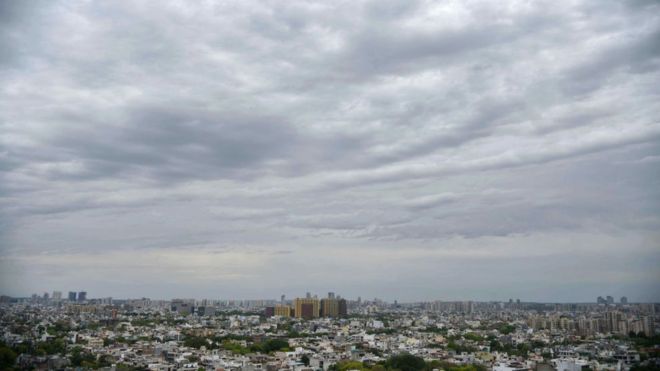
A view of clear blue and white skies, clean air in the city during the nationwide lockdown to curb spread of coronavirus (Covid-19) at sector-30 near Delhi-Gurugram expressway on April 20, 2020 in Gurugram, India.Image copyright GETTY IMAGES

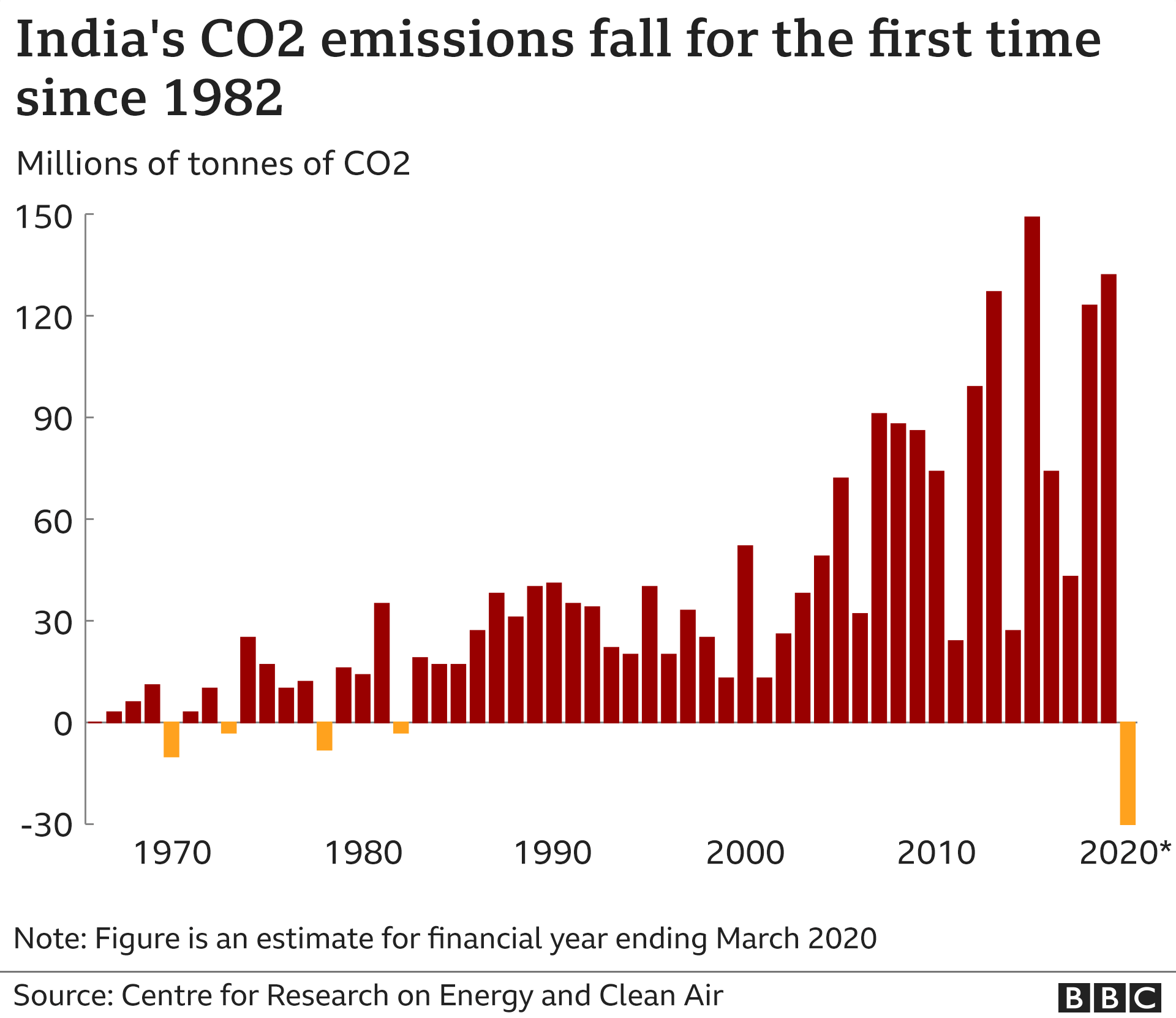
India’s CO2 emissions have fallen for the first time in four decades – and not just as a result of the country’s coronavirus lockdown.

Falling electricity use and competition from renewables had weakened the demand for fossil fuels even before the coronavirus hit, according to analysis by the environmental website, Carbon Brief. However, it was the sudden nationwide lockdown in March that finally tipped the country’s 37-year emissions growth trend into reverse.

The study finds that Indian carbon dioxide emissions fell 15% in March, and are likely to have fallen by 30% in April.

Virtually all of the drop-off in power demand has been borne by coal-fired generators, which explains why the emissions reductions have been so dramatic.
India emissions fall chart

Coal-fired power generation was down 15% in March and 31% in the first three weeks of April, according to daily data from the Indian national grid.

But even before India’s sudden coronavirus lockdown, the demand for coal was weakening.

The study finds that in the fiscal year ending March 2020, coal deliveries were down by around 2%, a small but significant reduction when set against the trend – an increase in thermal power generation of 7.5% a year set over the previous decade.

Indian oil consumption shows a similar reduction in demand growth.
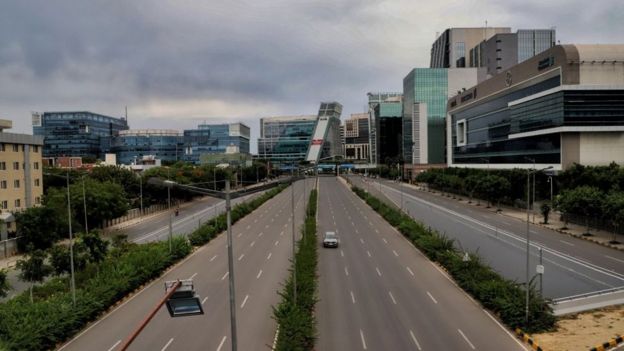
Vehicles move through DLF Cybercity during nation wide lockdown amid Covid-19 coronavirus pandemic in GurugramImage copyright GETTY IMAGES
Image caption The nationwide lockdown finally tipped a 37-year emissions growth trend into reverse

It has been slowing since early 2019.

And, once again, the trend has been compounded by the impact of the Covid-19 lockdown measures on the transport industry.

Oil consumption was down 18% year-on-year in March 2020.

Meanwhile, the supply of energy from renewables has increased over the year and has held up since the pandemic struck.

This resilience the renewables energy sector shows in the face of the sudden reduction in demand caused by coronavirus is not confined to India.
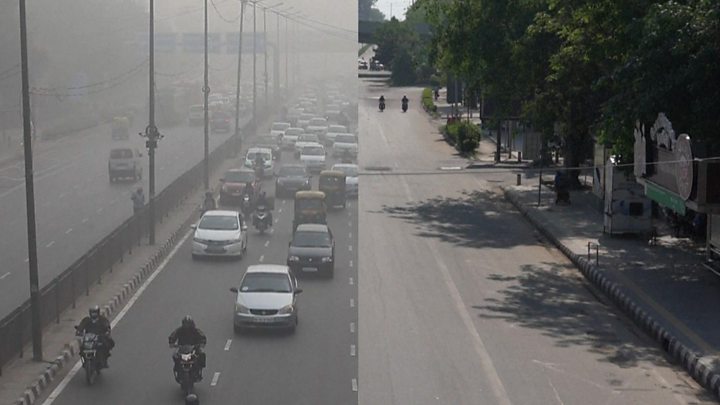
Media caption Delhi smog disappears during India’s lockdown

According to figures published by the International Energy Agency (IEA) at the end of April, the world’s use of coal was down 8% in the first quarter of the year.

By contrast, wind and solar power saw a slight uptick in demand internationally.

A key reason that coal has taken the brunt of the fall in electricity demand is that it cost more to run on a day-to-day basis.

Once you have installed a solar panel or a wind turbine, operating costs are very low and, therefore, tend to get priority on electricity grids.
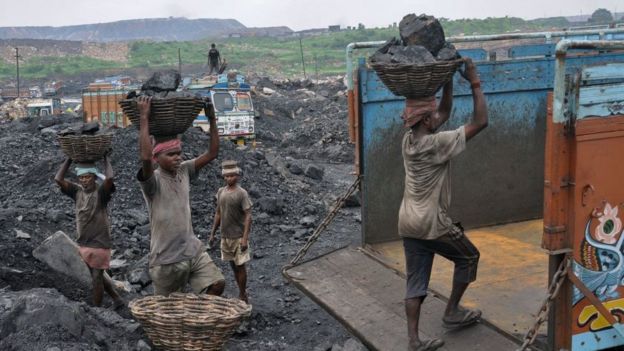
This photo taken on December 7, 2017 shows Indian labourers loading coal onto trucks at an open mine in Dhanbad in the eastern Indian state of Jharkhand.Image copyright GETTY IMAGES
Image caption India’s use of coal has plummeted, in line with that of other countries

Thermal power stations – those powered by coal, gas or oil – by contrast, require you to buy fuel in order to generate power.

But analysts warn that the decline in fossil fuel use may not last.

They say when the pandemic subsides, there is a risk that emissions will soar again as countries attempt to kick-start their economies.

The US has already started to relax environmental regulations and the fear is other nations could follow suit.

However, the analysis from Carbon Brief suggests there are reasons to think India could buck this trend.

The coronavirus crisis has brought the long-brewing financial troubles in the Indian coal sector to a head, and the Indian government is finalising a relief package which could top 900bn rupees ($12bn; £9.6bn).

But, at the same time, the government is talking about supporting renewable energy as part of the recovery.
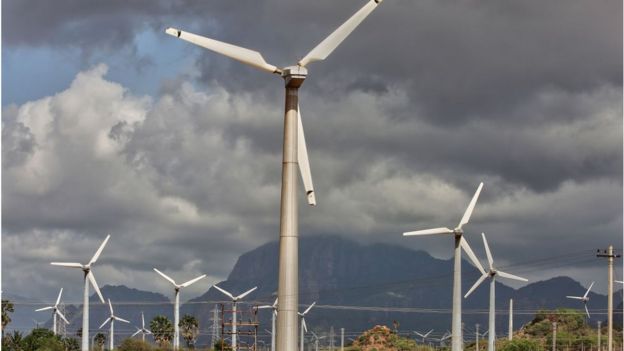
Wind turbines generate electricity in Punniyavalanpuram, Tamil Nadu, India.Image copyright GETTY IMAGES
Image caption Renewables have the economic edge in India, offering far cheaper electricity than coal

Renewables have the economic edge in India, offering far cheaper electricity than coal.

The report claims that new solar capacity can cost as little 2.55 rupees per kilowatt hour, while the average cost for electricity generated from coal is 3.38 rupees per hour.

Investing in renewables is also consistent with the country’s National Clean Air Programme, launched in 2019.

Environmentalists hope the clean air and clear skies Indians have enjoyed since lockdown will increase public pressure on the government to clean up the power sector and improve air quality.

Source: The BBC

07/05/2020

Gas leak at S.Korea-owned factory in India kills 11, hundreds hospitalised

CHENNAI (Reuters) – At least 11 people were killed in India in a gas leak at a South Korean-owned factory making polystyrene products that made hundreds of people sick and led to the evacuation of villagers living nearby, officials said.

The accident occurred some 14 km (9 miles) inland from the east coast city of Visakhapatnam, in Andhra Pradesh state, at a plant operated by LG Polymers, a unit of South Korea’s biggest petrochemical maker, LG Chem Ltd.

Srijana Gummalla, commissioner of the Greater Visakhapatnam Municipal Corporation, said gas from styrene, a principal raw materials at the plant, leaked during the early hours of the morning, when families in the surrounding villages were asleep.

Yashwanth Saikumar Ambati, 23, who lives about 300 metres away from the plant, said he woke up around 4.30 a.m. because of a strong smell.

“I went back to sleep and I woke up around 6 because the smell got stronger. My eyes were itchy, and I was feeling drowsy, light-headed and slightly breathless,” he told Reuters, adding that neighbours also complained of eye irritation and stomach aches.

In a statement issued from Seoul, LG Chem said that the gas emitted in the leak can cause nausea and dizziness when inhaled, adding that it was seeking to ensure casualties received treatment quickly.

Video from Reuters partner ANI shot later on Thursday showed emergency workers in the area rushing to help victims, some of whom appeared to be listless and disoriented.

A number of victims lay unconscious on the streetside, as volunteers fanned them and others carried them to ambulances.

A spokesman for LG Chem in Seoul said the leak was discovered by a night shift maintenance worker and has been brought under control.

According to both the company spokesman and Gummalla, the plant was being reopened after India relaxed a nationwide lockdown that had been imposed on March 25 to contain the spread of the new coronavirus.

Thursday’s incident brought back bad memories of a gas leak at an factory of U.S. chemical firm Union Carbide that killed thousands in the central Indian city of Bhopal in 1984, but thankfully it was on a far smaller scale.

“I pray for everyone’s safety and well-being in Visakhapatnam,” Prime Minister Narendra Modi said in a tweet.

S.N. Pradhan, director general of the National Disaster Response Force, said that at least 11 had died after around 1,000 people living near the plant were exposed to the gas.

FALLING, RUNNING AWAY

B.V. Rani, a revenue official in the district, said she received a call at around 4 a.m. from a police officer near the facility, who sounded panicky. “He asked me to come to the spot immediately,” Rani told Reuters.

When Rani went there, she saw that people had collapsed unconscious in the village adjoining the 60-acre site of the plant.

“I personally helped more than 15 people get to an ambulance who had tried to run away from the village but dropped down within a few metres,” she said.

At least one child was among the dead, a policeman at the site told ANI, whose video showed at least two other children being lifted into an ambulance.

Between 300-400 people were hospitalised, Swarupa Rani, an Assistant Commissioner of Police in Visakhapatnam told Reuters. Another 1,500 people had been evacuated, mostly from a neighbouring village.

Areas within approximately 3-kilometre (nearly 2-mile) radius of the plant were evacuated, he said, with emergency services going from door-to-door to find anyone left behind.

TOP PETROCHEMICAL MAKER

Andhra Pradesh Chief Minister Jagan Mohan Reddy said in a televised address that the gas leak occurred because raw material was stored for a long period of time.

The state government will give 10 million rupees ($131,900) compensation to the families to those who died, and it will also form a panel to investigate the cause of the accident, said P.V. Ramesh, a senior aide to the chief minister.

“Obviously something has gone wrong,” Ramesh told Reuters. “Nobody will be spared.”

LG Chem’s share priced closed nearly 2% weaker on Thursday, in a Seoul market that was broadly flat.

South Korea’s top petrochemical maker by capacity, LG Chem acquired the plant in 1997 and established LG Polymers India Private Limited (LGPI), according to a company website.

The LG Polymers plant makes polystyrene products which are used in manufacturing electric fan blades, cups and cutlery and containers for cosmetic products such as make up.

“LG Polymers is a multi national, reputed company, and it is sad that the incident has happened in their plant,” Chief Minister Reddy said in a televised media address.

($1 = 75.8140 Indian rupees)

Source: Reuters

17/04/2020

Coronavirus: China oil titan warns of gathering ‘black swan’ risks for Beijing after pandemic

  • Fu Chengyu, the former chairman of China National Offshore Oil Corporation (CNOOC), says hostility towards Beijing will increase after the coronavirus
  • US will try to ‘thwart China’s rise’ and economic fallout from Covid-19 will be worse than the global financial crisis, says Fu
Former Sinopec chairman Fu Chengyu says China will face a more hostile world post coronavirus. Photo: EPA

The world is set to become more hostile for China after the coronavirus as the risk of “black swan” events gathers for Beijing, a heavyweight in China’s state oil industry has warned, reflecting growing wariness about the geopolitical environment among political and business elites.

Fu Chengyu, the former chairman of both China National Offshore Oil Corporation (CNOOC) and Sinopec Group, painted an ominous picture of increasing antagonism from the United States and damaging unforeseen events, known as black swans, like Covid-19

 at an online symposium organised by business magazine Caijing.
The US would “mercilessly” suppress China in the fields of economics, trade, finance and technology, and Washington was set on taking advantage of the coronavirus pandemic to “forge a less favourable international environment for” the nation, Fu said this week.

“We’ve smelled the odours and new plots against China are in formation,” he said.

After the epidemic, the external environment for our survival will be more severe – Fu Chengyu
“After the epidemic, the external environment for our survival will be more severe … we must prepare for the worst and do our best to achieve the best possible results.”
While Fu has retired from his posts at state companies, he is an influential voice in

China’s oil industry

with decades of experience and contacts in the US petroleum sector.

Fu was a counterpart of Rex Tillerson, who was chairman of ExxonMobil from 2006 to 2017, and served as US State Secretary under President Donald Trump until March 2018.

While at the helm of CNOOC in the early 2000s, he felt political heat from Washington over a US$18.5 billion takeover bid for the American oil company Unocal in 2005, which the company was subsequently forced to withdraw.

China says no evidence to suggest coronavirus virus came from Wuhan’s lab
Speaking at the event in Beijing, Fu said that the coronavirus, which has heightened tensions between Beijing and Washington, will have impacts on global value chains and the world trade landscape for years to come.

“The crisis stemming from the coronavirus pandemic won’t be over in just one or two years … the impact will last longer than the 2008 global financial crisis,” he said.

He added that China would face numerous “black swan” risks in the future.

President Xi Jinping warned in 2019 that China must be on guard for black swan risks as well as “grey rhino” events, referring to an obvious threat that is often neglected.

Geopolitics is getting worse and worse, and we need to be very careful. The US will try various ways to thwart China’s rise, and energy is an important area

To respond to the economic fallout from the coronavirus, China must do more to create a self-sustaining domestic economy, Fu said, and in particular reduce input prices for gas and electricity and boost public services such as health care and education.

“Geopolitics is getting worse and worse, and we need to be very careful,” Fu said. “The US will try various ways to thwart China’s rise, and energy is an important area.”

The US could potentially form a new oil export alliance with Saudi Arabia and Russia to make it possible to cut oil supplies to China, he said.

“China must be prepared for such a scenario, and even when supplies are cut off, we can have some basic self-protection.”

Source: SCMP

10/09/2019

Block of flats collapses in southern China after ‘sinking into ground’

  • Residents evacuated from building in Shenzhen as it leans to one side
  • An investigation is launched and utilities in the area are cut off
The building leans to one side after apparently sinking into the ground. Photo: Weibo

Emergency workers sealed off a building in the southern Chinese city of Shenzhen after it collapsed on Wednesday morning, local authorities said.

At around 11.20am, a block of flats in Luohu district suddenly sank into the ground and leaned to one side, the Shenzhen government said on Weibo, China’s equivalent of Twitter.

“Before it happened, the local community office heard noises coming from underground, and evacuated residents. Right now there are no casualties,” the Weibo post said. “The case is being investigated.”

In a short video published by state broadcaster CCTV, a residential building appears to have sunk into the ground and leans on the neighbouring building, with bricks and concrete strewn on the ground.

The area was closed off as police, ambulance crews and firefighters attended the scene.

The authorities also evacuated residents from surrounding buildings, moving them into temporary housing. A panel of experts began to investigate the cause of the collapse, while water, gas and electricity supplies were cut off in the area and construction work was halted as a precaution.

Earlier this month, a stadium in Shenzhen collapsed while demolition work was being carried out, killing three workers and injuring three. The part of the venue that collapsed had previously been used as a basketball court but was being renovated, with most of the interior having been torn down apart from a few pillars supporting the roof.

Source: SCMP

08/03/2019

China Focus: China to ramp up efforts to provide better elderly care

BEIJING, March 7 (Xinhua) — As China is faced with a growing aging population, the government has pledged to provide better elderly care services and facilities for the silver-haired, and give a strong boost to domestic demand.

Elderly care remains high on the agenda in this year’s government work report, which said that significant steps would be taken to develop elderly care, especially community elderly care services.

The number of people in China aged 60 and above reached 250 million by the end of 2018, accounting for 17.9 percent of the country’s population.

“Growing demand will trigger greater market potential in China’s senior care industry,” said Tang Wenxiang, founder of Fullcheer Group, a major elderly care services provider based in Changsha, capital of central China’s Hunan Province.

Fullcheer Group has 50 branches in more than 10 provinces and cities with a total of 5,000 beds. Tang expects the number of his company’s beds to increase to 50,000 in five years.

“There is still a huge gap between the demand of China’s aging population and the number of elder care facilities,” Tang said.

The country will provide support to institutions offering services in the community like day care, rehabilitation care, and assisted meal services and outdoor fitness services using measures such as tax and fee cuts and exemptions, funding support, and lower charges for water, electricity, gas and heating, according to the government work report.

Tang said government’s measures to develop elderly care services greatly boosted the confidence of entrepreneurs who run businesses in the sector.

Developing the elderly care industry is good for improving people’s well-being and stimulating consumption, said Xu Hongcai, an economist with the China Center for International Economic Exchanges.

“Consumption on elderly care requires the supply of the elder care market, offered by both the government and the market,” he said.

A research report issued by Guolian Securities suggests that a string of policies have been carried out in China to encourage the participation of the social sector in the senior care industry, which will boost the country’s consumption in the health and medical sectors.

As China opens this sector, foreign firms such as France’s Orpea and Japan’s Nichii have tapped the elderly service market in China.

China still lacks leading players in the senior care market which includes nursing care, rehabilitation assistive devices and daily necessities for seniors, Tang said.

The long-term care insurance system will help increase the occupancy rate of some elderly services facilities given a number of elderly people can hardly afford the expenses, according to Tang.

Source: Xinhua

Law of Unintended Consequences

continuously updated blog about China & India

ChiaHou's Book Reviews

continuously updated blog about China & India

What's wrong with the world; and its economy

continuously updated blog about China & India