Chindia Alert: You’ll be Living in their World Very Soon
aims to alert you to the threats and opportunities that China and India present. China and India require serious attention; case of ‘hidden dragon and crouching tiger’.
Without this attention, governments, businesses and, indeed, individuals may find themselves at a great disadvantage sooner rather than later.
The POSTs (front webpages) are mainly 'cuttings' from reliable sources, updated continuously.
The PAGEs (see Tabs, above) attempt to make the information more meaningful by putting some structure to the information we have researched and assembled since 2006.
Chinese president tells heads of state that Beijing is ready to do all it can to help Europe fight Covid-19, as death toll on the continent passes 5,000
‘Public health crises are the common challenges facing humankind, and unity and cooperation are its most powerful weapons,’ Xi tells German Chancellor Angela Merkel
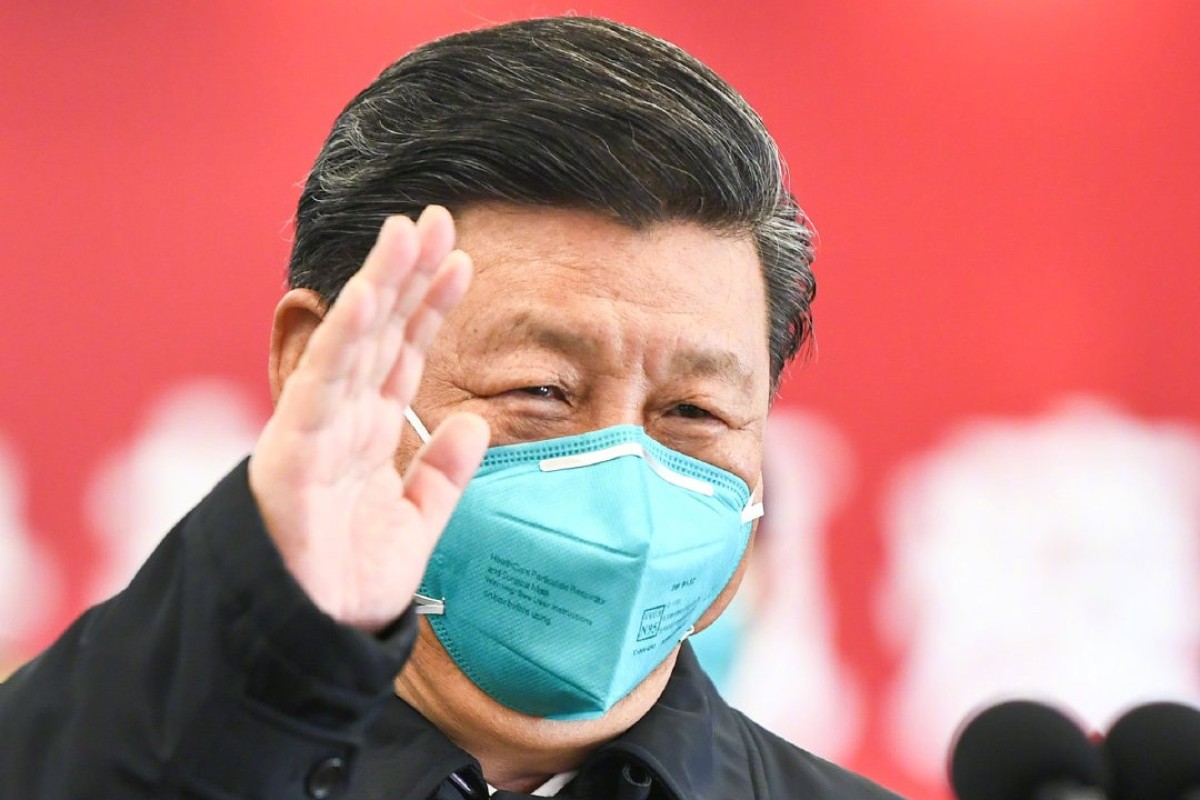
Chinese President Xi Jinping reached out a helping hand to four European leaders on Saturday. Photo: Xinhua
Chinese President Xi Jinping made an unusually intense diplomatic gesture towards Europe on Saturday by calling the leaders of France, Germany, Spain and Serbia to offer support in their fight against Covid-19.
The calls came as many European nations are facing shortages of the essential medical supplies and equipment they need to combat the pandemic that has already killed more than 5,000 people across the continent.
Italy has been the worst hit, with more than 4,000 people killed and over 47,000 infected. In Spain, the death toll jumped by more than 300 on Saturday to 1,326, while the number of confirmed cases neared 25,000.
In contrast, China has reported no new local transmissions for three days. As a result, the industrial powerhouse has been able to send millions of face masks it might otherwise have needed to Europe.
“If Germany is in need, China is willing to provide help within our capabilities,” he was quoted as saying by Xinhua, which reported on all of the calls.
“Public health crises are the common challenges facing humankind, and unity and cooperation are its most powerful weapons,” he said, adding that China was willing to share its “information and experience”.
Beijing was also ready to work with Berlin in other areas, such as vaccine development, Xi said.
Germany, which has reported more than 20,000 cases and 44 deaths, is the only country out of the four Xi called that has not yet requested medical supplies from China.
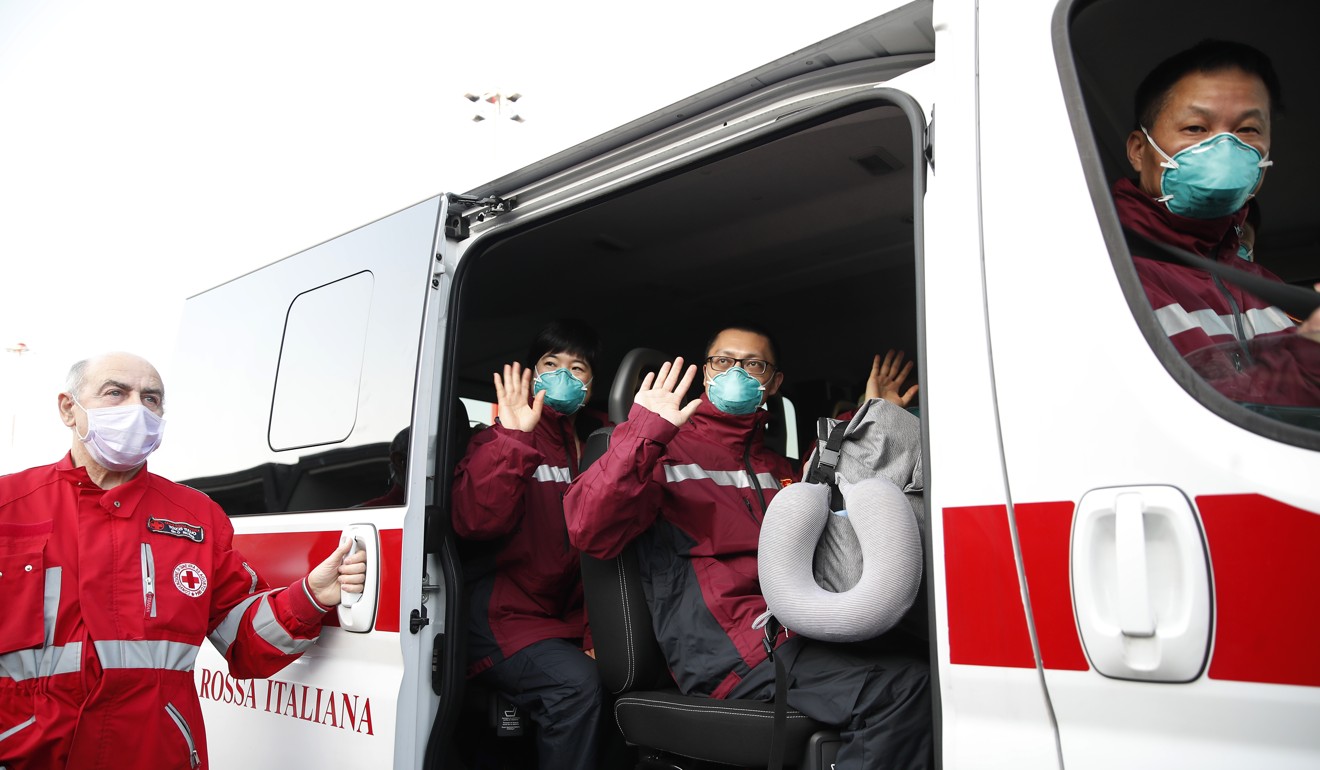
Xi Jinping promised to send Chinese medical support teams to Serbia, like this one that was deployed to Italy. Photo: AP
Of the four countries Xi called, only Serbia is not a member of the European Union. Its president, Aleksandar Vucic, earlier dismissed the EU’s vow of solidarity as a “fantasy” and turned to China for help.
“China and Serbia are comprehensive strategic partners,” Xi told Vucic on Saturday. “The hard-as-iron friendship of the two countries, and of the two peoples, shall last forever.”
Xi pledged to provide Serbia with protective gear and medical equipment, as well as helping it to source materials from China.
Vucic also managed to secure a guarantee from the Chinese president that he would send medical teams to Serbia, like those already deployed in Italy and Spain, the Xinhua report said.
Despite Vucic’s criticism of the EU, the bloc said on Friday it would provide Serbia with €7.5 million (US$8 million) worth of aid.
“Next week, big cargo airplanes will bring critical medical equipment. EU [is] always with Serbia in times of need,” EU ambassador to Belgrade Sem Fabrizi said on Twitter, adding: “Action not words.”
French President Emmanuel Macron has reportedly called for more power to be given to the European Commission, the executive arm of the EU, as member states, current and future, could lose trust in the institution as the health crisis unfolds.
In his phone call with Macron, Xi also appealed for support from the World Health Organisation.
“China is willing to work with France to jointly promote international cooperation on preventing and controlling the disease, and on supporting the UN [United Nations] and WHO in playing a core role in perfecting global public health management,” he said.
The call was the second in three days between the two leaders.
In a poll published on Friday, Macron’s popularity rating rose past 50 per cent for the first time since 2018, France24 reported. The result suggests the French public approves of the way in which he is handling the health crisis.
Xi’s telephone call to Spain was unusual in that he spoke to King Felipe, the ceremonial head of state who generally stays out of politics.
Nonetheless, Xi again pledged his support and willingness to share China’s experiences in handling the disease and treating patients, Xinhua said.
After three days of no new domestic infections in mainland China, some residents of
, the Chinese city hardest hit by the disease, celebrated with fireworks as local authorities began removing checkpoints. Restrictions were also eased in other cities.
Beijing’s containment efforts are now focused on preventing imported cases. National Health Commission spokesman Mi Feng said on Saturday that the number of such infections had surged by 216 per cent to 269 on Friday, from just 85 on March 11. In the same period, the total number of infections worldwide had risen by 98 per cent.
“We have to strictly stop imported cases, step up epidemic control and avoid any rebound,” he said.
‘What we are seeing here is reciprocity,’ the German leader says, referencing the EU’s aiding stricken China earlier this year
But critics dismissed China’s show of largesse as propaganda designed to deflect US claims that the contagion originated in China
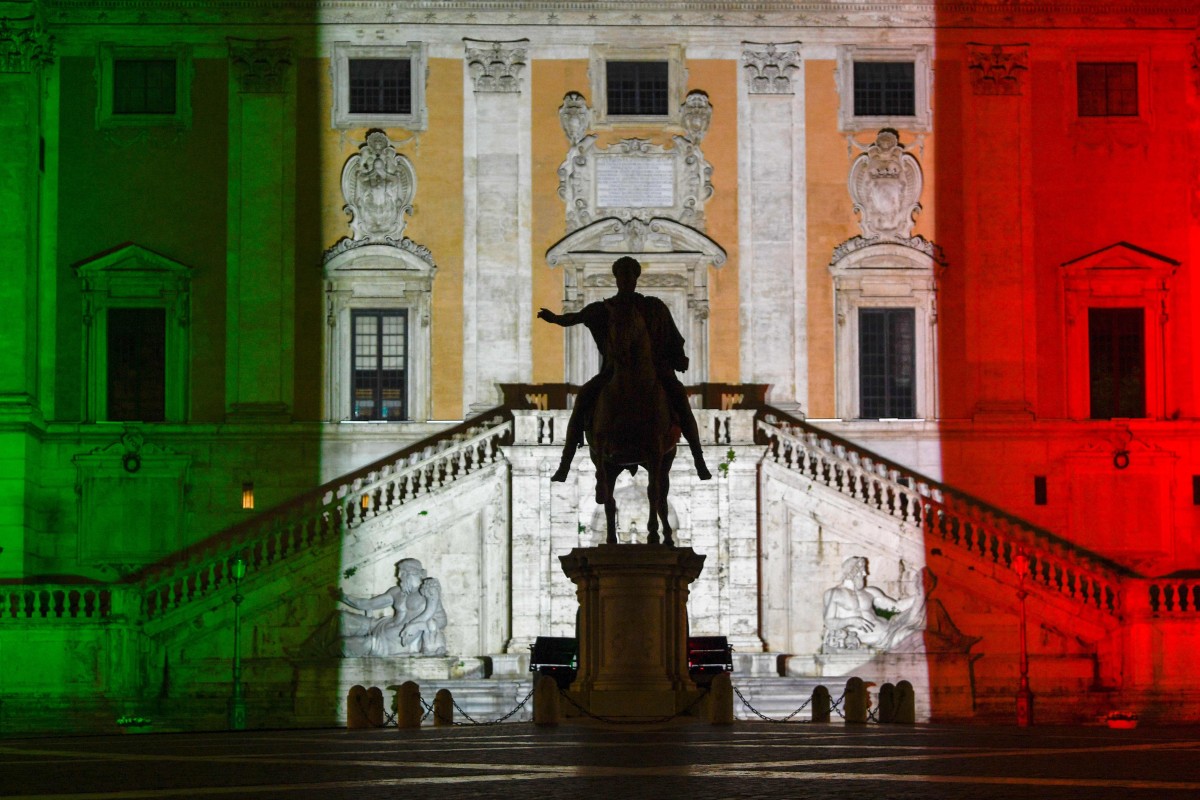
The colours of the Italian flag are projected onto the Palazzo Senatorio building on Capitoline Hill in Rome on Tuesday as a “sign of hope in this difficult and delicate moment”, Rome’s mayor stated. Photo: AFP
German Chancellor Angela Merkel has downplayed concerns over China’s provision of medical supplies to European countries hit hardest by the Covid-19 pandemic, calling the move a gesture of reciprocity.
The European Union continued to face criticism over its slow reaction to calls for medical supplies from Italy and Spain, amid the encouraging news that new cases in Italy were seeing their slowest rate of increase since the contagion came to light in late February.
“The European Union sent medical equipment to China [when] China asked for help at that time,” Merkel said at a Tuesday press conference, referring to the outbreak’s start earlier this year. “What we are seeing here is reciprocity.”
“As we are having a crisis at this time, we cannot expect everything to be provided in the framework of the EU. We are very pleased about [China’s provision],” Merkel said.
Chinese President Xi Jinping has guaranteed that China will provide Italy and Spain – the two most severely hit European countries – with medical equipment such as face masks, ventilators and protective equipment for medical professionals.
Critics, however, called China’s action part of a propaganda campaign designed to deflect US claims that the coronavirus originated in China.
Spanish Prime Minister Pedro Sanchez reached out to Xi for help obtaining medical supplies in a phone call on Tuesday.
Speaking to reporters, Sanchez confirmed that the matter had come up during the call, just days after the Spanish government had ordered an unprecedented national lockdown to halt the virus’ spread.
Chinese state media reported that Xi had told Sanchez that “China is willing to respond to the urgent needs of Spain and spare no effort to provide support and assistance, and share experience in prevention, control and treatment.”
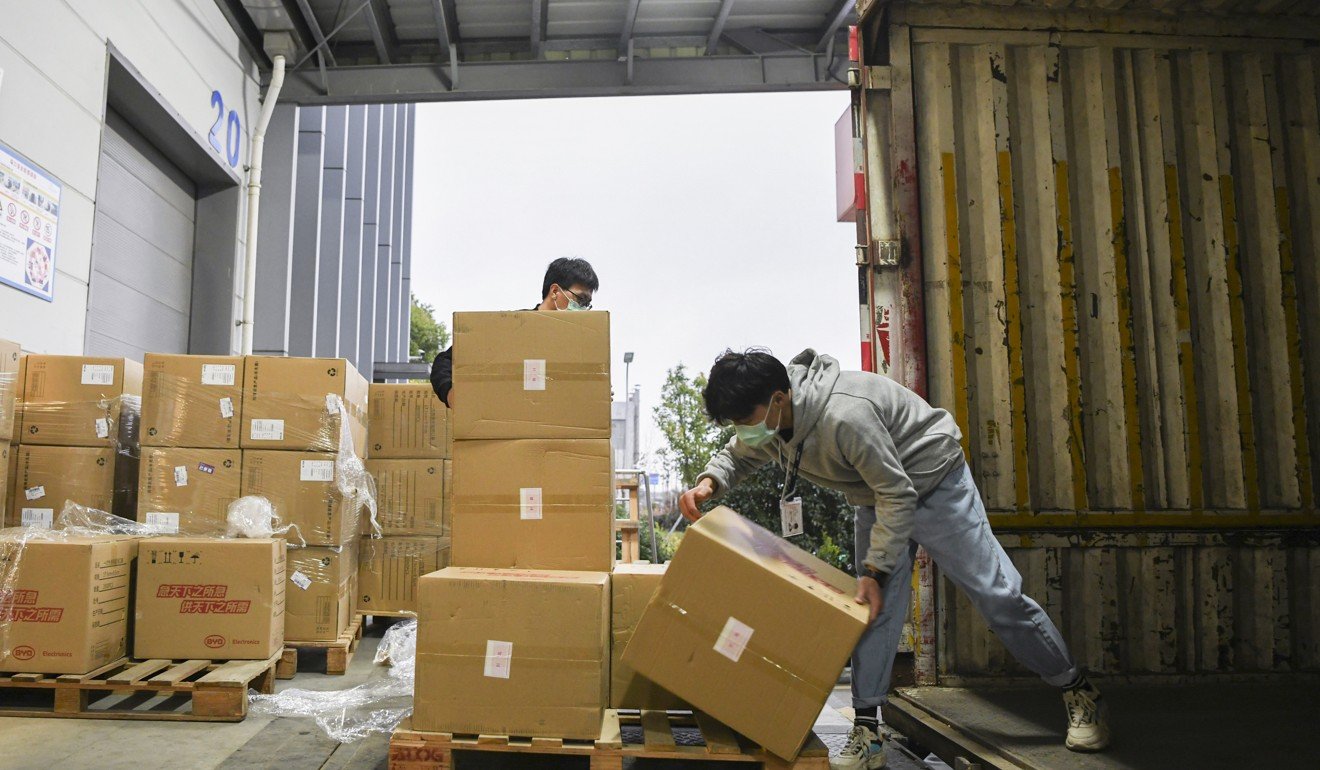
Workers loading boxes of surgical masks donated by China’s BYD, bound for the United States. Photo: Jack Ma Foundation
On Tuesday, a plane from Shanghai landed in the northern Spanish city of Zaragoza, carrying 500,000 masks donated by e-commerce giant Alibaba, AFP reported. (Alibaba owns the South China Morning Post.)
According to a statement, the delivery was part of a donation of 2 million masks and coronavirus test kits to certain countries from Alibaba’s Chinese billionaire founder Jack Ma.
Europe to shut border for month as France braces for 15-day coronavirus lockdown
17 Mar 2020
Xi’s call with Sanchez came a day after one with Italian Prime Minister Giuseppe Conte, in which the Chinese leader similarly pledged to provide Italy with medical support, including teams with expertise in treating Covid-19.
On Tuesday, Italy reported 345 new coronavirus deaths in 24 hours, taking its overall death toll to 2,503.
Spain registered 183 deaths, 53 per cent more than in the previous 24 hours, driving the total number of deaths to 524. More than 2,000 newly infected cases were reported, pushing the total to 11,681.
Elsewhere on Tuesday, France entered a national shutdown, while Belgium, where the EU is headquartered, announced a similar halt to public activities starting on Wednesday.
European Commission President Ursula von der Leyen said all 27 member states have agreed to ban non-EU citizens from visiting the region for the next 30 days. The method of enforcement will be determined by the individual countries, she said.
MUNICH (Reuters) – U.S. Secretary of State Mike Pompeo defended on Saturday his nation’s global role despite misgivings in Europe, vowing that Western values would prevail over China’s desire for “empire”.
Pompeo was seeking to reassure Europeans troubled by U.S. President Donald Trump’s “America first” rhetoric, ambivalence over the transatlantic NATO military alliance and tariffs on European goods.
“I’m happy to report that the death of the transatlantic alliance is grossly exaggerated. The West is winning, and we’re winning together,” he said in a speech at the Munich Security Conference, listing U.S. steps to protect liberal democracies.
RELATED COVERAGE
U.S., allied firms testing alternatives to Chinese 5G technology – Esper
Pompeo was, in part, responding to German President Frank-Walter Steinmeier, who on Friday accused the United States, Russia and China of stoking global mistrust.
Trump’s decision to pull out of the 2015 Iran nuclear deal, as well as the Paris climate accord, have undermined European priorities, while moves such as recognition of Jerusalem as Israel’s capital have weakened European diplomacy, envoys say.
Pompeo defended the U.S. strategy, saying Europe, Japan and other American allies were united on China, Iran and Russia, despite “tactical differences.”
He reiterated Washington’s opposition to the Nord Stream 2 gas pipeline under construction between Russia and Germany under the Baltic Sea, a project backed by the government of German Chancellor Angela Merkel.
Citing Russia’s 2014 annexation of Crimea, cyber threats in Iran and economic coercion by China, Pompeo said those countries were still “desiring empires” and destabilising the rules-based international system.
U.S. Secretary of Defense Mark Esper, speaking immediately after Pompeo, focused his remarks solely on China, accusing Beijing of a “nefarious strategy” through telecommunications firm Huawei [HWT.UL].
“It is essential that we as an international community wake up to the challenges presented by Chinese manipulation of the long-standing international rules-based order,” Esper said.
He said it was not too late for Britain, which last month said it would allow Huawei a limited role in building its 5G networks, to take “two steps back,” but added he still needed to asses London’s decision.
“We could have a win-win strategy if we just abide by the international rules that have been set in place for decades … that respect human rights, that respect sovereignty,” he said.
NEW DELHI (Reuters) – German Chancellor Angela Merkel and Indian Prime Minister Narendra Modi signed wide-ranging agreements in New Delhi on Friday to deepen strategic cooperation and exchanged notes on ways to boost bilateral trade.
Merkel, accompanied by several cabinet colleagues and a business delegation, is in India on a three-day visit that began on Thursday.
“We’re encouraging our private sectors to give an impetus to our growing bilateral trade and Chancellor Merkel and I will meet some of the top business and industry leaders,” Modi told a joint news conference with the German leader.
“We’re encouraging our private sectors to give an impetus to our growing bilateral trade and Chancellor Merkel and I will meet some of the top business and industry leaders,” Modi said.
Bilateral trade between the two countries rose to $24.06 billion (18.5 billion pounds) in the 2018/19 fiscal year ending in March from $22 billion the previous year, while German companies have invested nearly $12 billion in India since 2000.
Germany is India’s largest trading partner in Europe and more than 1,700 German companies are operating in India.
The agreements struck on strategic cooperation, included agriculture, cyber security and artificial intelligence. Modi said the two countries would also bolster ties to combat “terrorism and extremism”.
Germany and India also agreed to join hands in the area of education.
“As many as 20,000 Indian nationals are studying in Germany and we would like to see more,” Merkel said.
Although Merkel and Modi didn’t mention anything about restarting talks on finalising a free trade agreement between India and the European Union, sources earlier said the two leaders could take up the trade deal.
Eric Schweitzer, president of the Association of German Chambers of Commerce and Industry (DIHK), earlier said India had enormous potential but there has been uncertainty among companies after an investment protection agreement between the two countries ended in 2016.
“Small and medium-sized German companies stand in a labyrinth of regulations and shy away from larger investment. Negotiations should restart and Merkel’s visit could help,” he said.
VDA, Germany’s car industry association that counts automakers like Volkswagen (VOWG_p.DE), Daimler, BMW and Audi as members, also wanted India to restart the FTA talks.
Daimler’s Mercedes-Benz, BMW and Audi dominate India’s luxury car market.
The trip comes amid growing resistance from European leaders over what they see as China’s failure to change long-term practices unfair to foreign investors
French President’s trip to Beijing follows Chinese leader’s visit to France in March
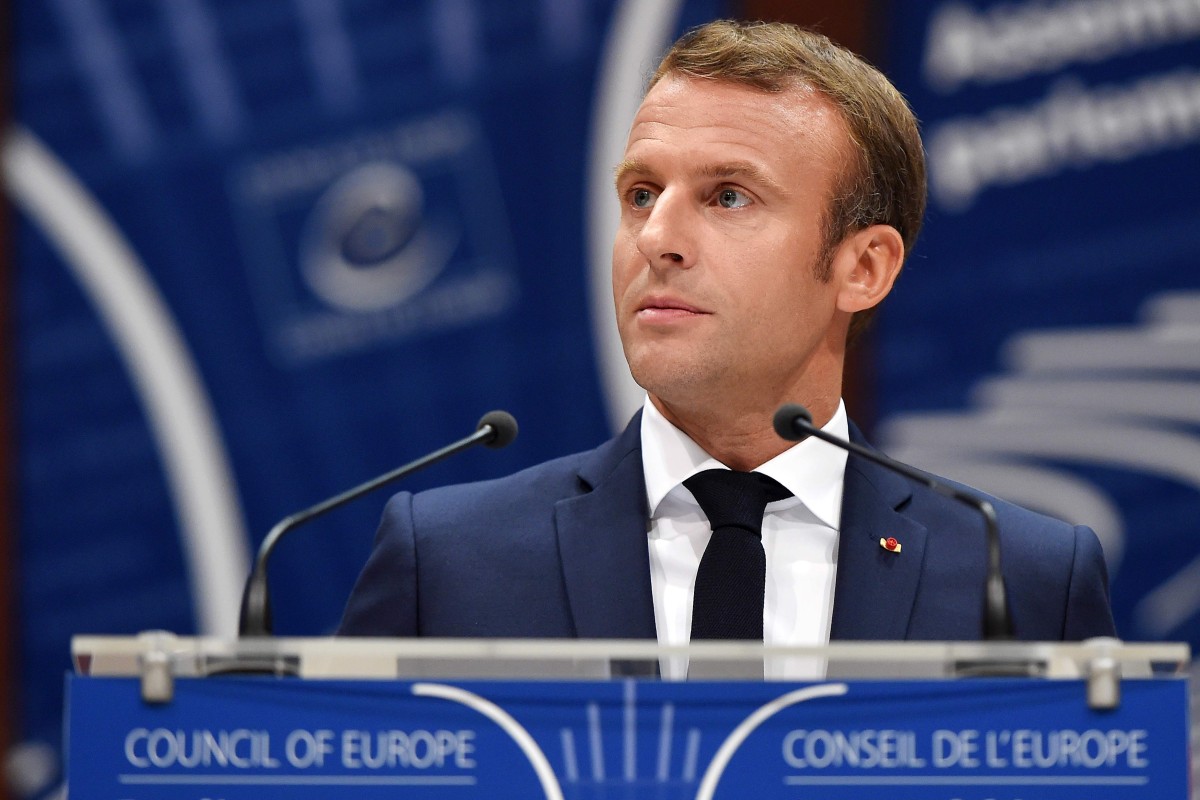
President Emmanuel Macron of France speaks to the Council of Europe parliamentary assembly on Tuesday. Photo: AFP
French President Emmanuel Macron will visit China next month as Europe’s most diplomatically active leader focuses on climate change cooperation and trade promotion with Asia’s leading power, a source briefed on the Elysee Palace’s discussions said.
This will be the second Chinese tour for Macron since he took office in 2017, and it will come amid escalating resistance from European politicians and business communities over what they see as China’s failure to change long-standing practices unfair to foreign investors.
His visit also comes at a time when France – as well as the European Union as a whole – is bracing for Washington’s potential levies of tariffs on European products, and the lack of progress on climate change policies with US President Donald Trump’s administration.
“President Macron will meet President Xi [Jinping], while France strives for better cooperation with China on climate and trade,” the source said. “His itinerary is still in the pipeline, but he is expected to visit Beijing and Shanghai.”
Macron, 41, who is widely seen as emerging as Europe’s most aggressive leader filling the political vacuum left by German Chancellor Angela Merkel’s political twilight, has cast himself as an honest broker between Russia and Ukraine, and between the US and Iran.
He has also been critical of China’s influence in Europe, joining forces with Merkel to push for a tougher EU stance on the world’s second biggest economy.
In March, when Xi claimed a major diplomatic victory by clinching a memorandum of understanding with Italy on the Belt and Road Initiative, Macron declared: “The time of European naivety is ended. For many years we had an uncoordinated approach and China took advantage of our divisions.”
Macron also backed investment screening mechanisms for Chinese business moves in Europe, while endorsing plans to change the EU’s notoriously strict antitrust rules in order to facilitate mergers between large European groups and companies to counter Chinese companies’ global ambitions.
Macron urges Iran and US to show ‘courage of building peace’
The EU is also wary of China’s effort to “divide and rule” the European Union. Greece and Hungary – both recipients of large amounts of Chinese investments – have repeatedly wanted to water down EU’s stance on issues deemed sensitive to Beijing, including the South China Sea and China’s human rights violations.
“It would be good [for Macron] to stress that 17+1 is irritating,” said Joerg Wuttke, president of EU Chamber of Commerce in China, in reference to China’s engagement with a group of EU and non-EU member states in eastern and southeastern Europe.
“After all, the EU has a ‘one China’ policy, [so] EU could expect this position from China too.”
Macron’s domestic call for EU unity has translated into diplomatic appeals, with China being one of the targets.
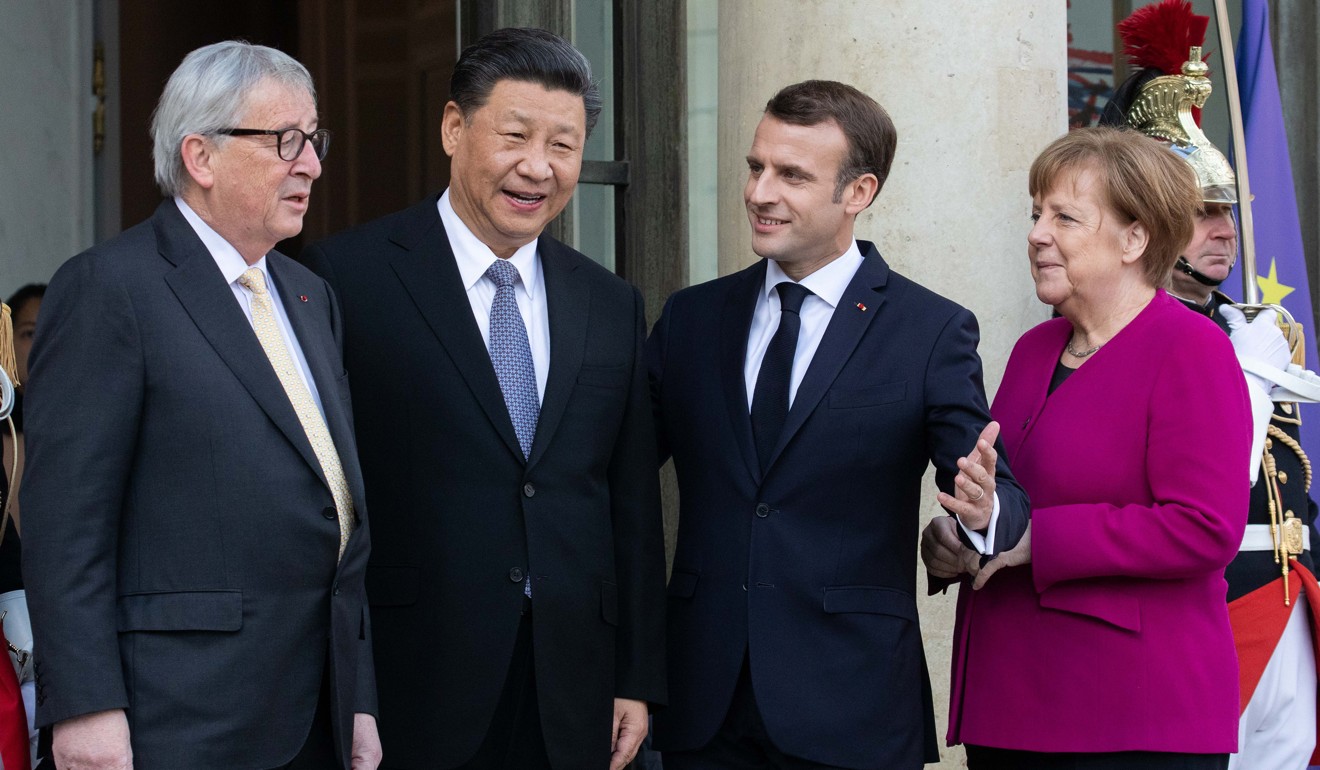
(From left) Jean-Claude Juncker, president of the European Commission; Xi Jinping, China’s leader; Emmanuel Macron, France’s president; and Angela Merkel, Germany’s chancellor, ahead of a meeting in Paris on March 26. Photo: Christophe Morin/Bloomberg
When Xi visited France in March, Macron hosted him at the Elysee Palace in the presence of Merkel and European Commission President Jean-Claude Juncker, showcasing European solidarity when it comes to EU-China policies.
In terms of French-Chinese bilateral ties, trade imbalances have persisted after Macron called for a “rebalancing” during his last visit.
France has a 1.4 per cent market share in China, compared with China’s 9 per cent market share in France. China represents France’s largest bilateral trade deficit, totalling €US$29.2 billion (US$31.9 billion) last year, ahead of Germany.
The EU has been calling for reciprocal investment treatment with China, a call that European business leaders in China expect Macron to make.
France bids farewell to late president Jacques Chirac
“We [Europe] need … a solid investment agreement to allow EU business to conduct their affairs in a similar manner as Chinese companies can operate in Europe. The agreement should be finalised in 2020, but not at all cost,” said Wuttke.
“The last thing EU business needs in China is a weak agreement that institutionalises imbalances,” he added.
Part of that involves building “more efficient defensive tools to prevent abusive technology transfers and to address the deep asymmetry in EU-China relations when it comes to access to public procurement markets,” said Mathieu Duchâtel, director of Asia programme at the Paris-based think tank Institut Montaigne.
Duchâtel added that it was also important to convey the message to Beijing that there are areas for cooperation even amid a more defensive China policy from France.
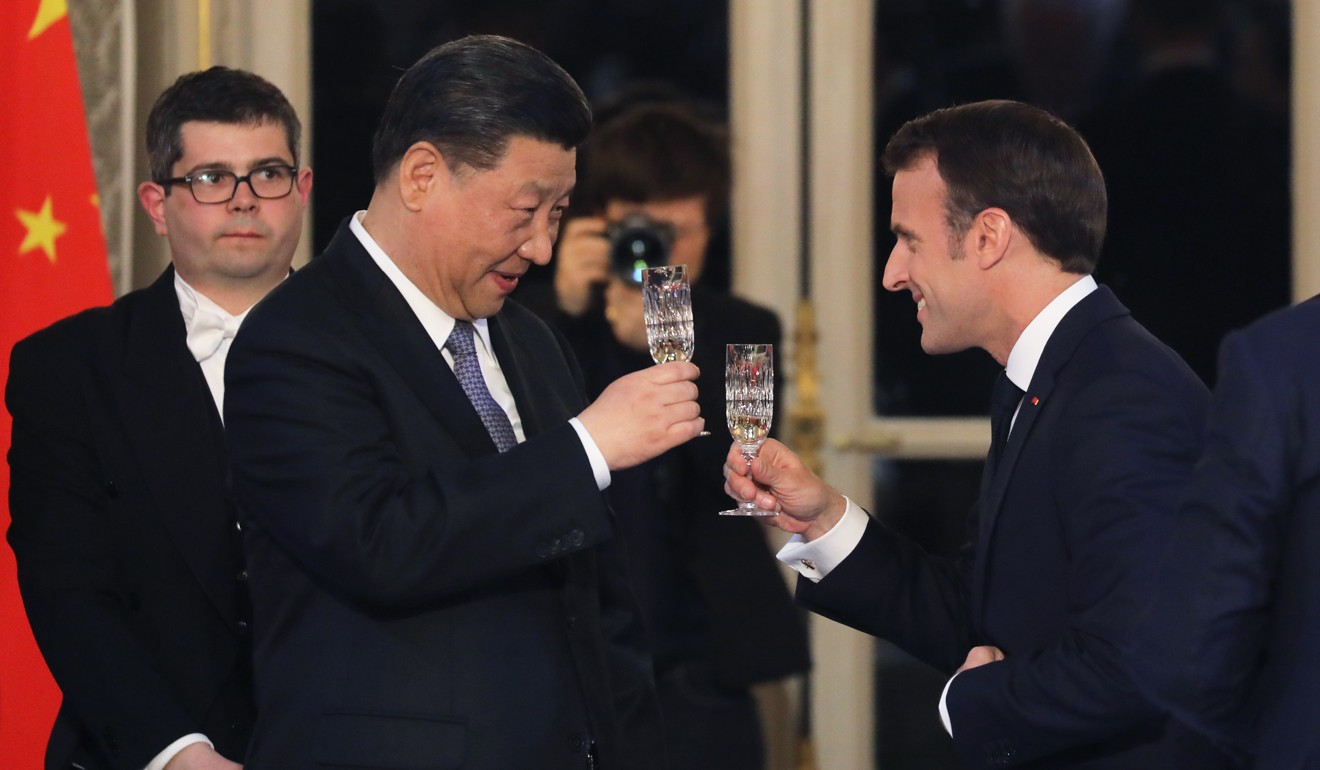
Chinese President Xi Jinping and French leader Emmanuel Macron toast raise a toast during a state dinner in Paris on March 25. Photo: EPA-EFE
One such area is the climate and environment, where China is “an important partner” for France to reach its goal of global carbon neutrality by 2050, he said.
“The energy/environment agenda is a political priority in Paris and one of very few issues on which cooperation with China remains promising and will continue to create business opportunities,” he said.
China is the world’s biggest carbon polluter, producing around 30 per cent of the planet’s man-made carbon dioxide. It remains committed to the 2015 Paris accord on climate change, even after Trump pulled the US out of the deal.
Under the agreement, the long-term temperature goal is to keep the increase in global average temperature to well below 2°C above pre-industrial levels, and to pursue efforts to limit the increase to 1.5°C.
Merkel makes the case on sensitive issues in Beijing without being offensive, observer says
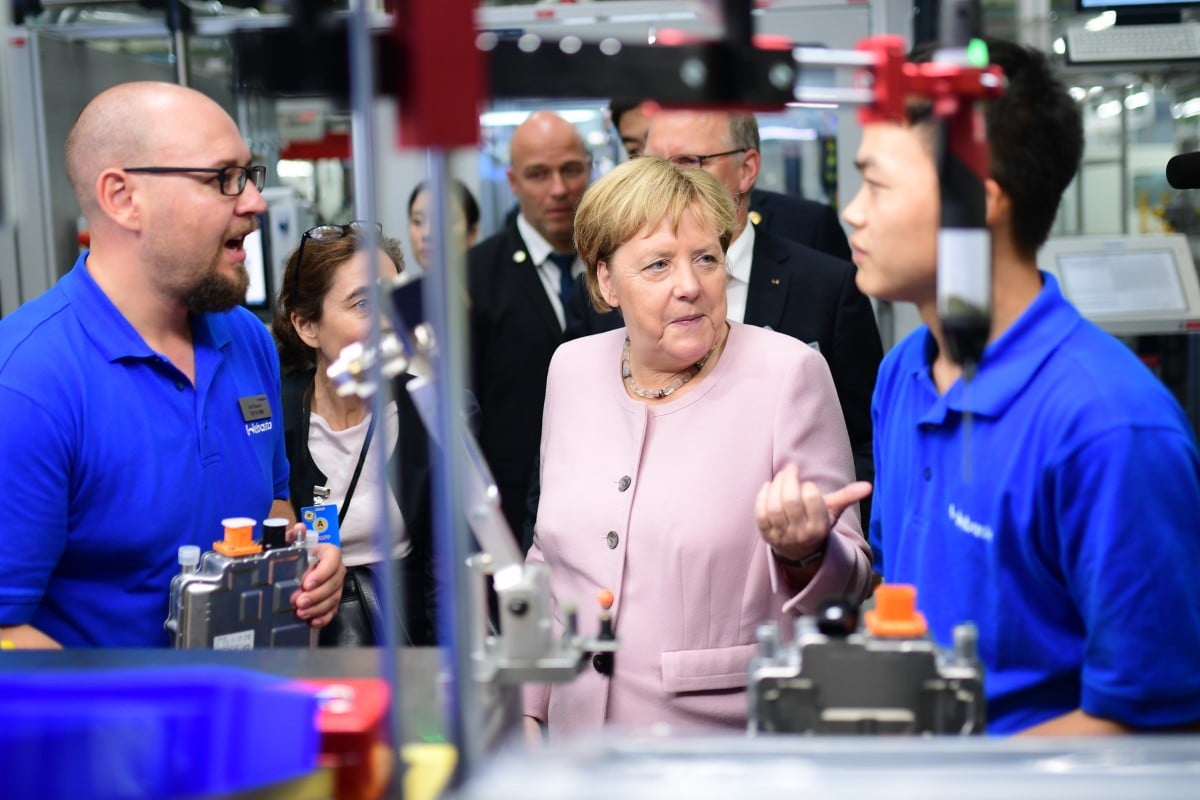
German Chancellor Angela Merkel (centre) talks to staff at manufacturer Webasto during a visit in Wuhan on Saturday. Photo: EPA-EFE
German Chancellor Angela Merkel may be slowly declining in influence in European politics but she remains the EU’s strongest voice in dealing with China, analysts said after her latest trip to China last week.
During the two-day visit, Merkel and Chinese President Xi Jinping discussed the sensitive topic of Hong Kong and the social credit system in China.
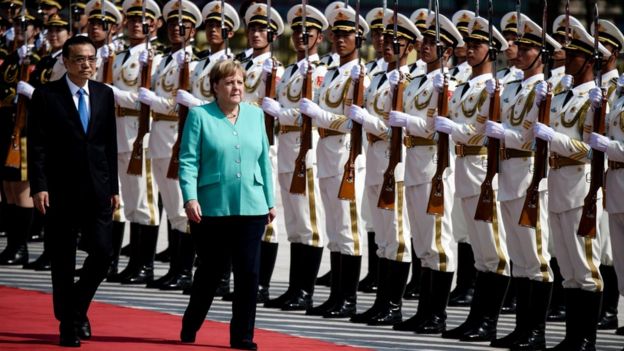
German diplomats also averted a plan by Chinese officials to scrap a joint press conference by Merkel and Chinese Premier Li Keqiang out of concerns that it could be dominated by questions about the escalating protests in Hong Kong.
Two sources told the South China Morning Post that the Chinese side initially suggested not letting journalists ask questions during the press conference. German diplomats persisted, saying that Merkel would hold her own press conference to take media questions, the sources said.
Germany’s Angela Merkel renews call for peaceful resolution to Hong Kong protests
After talks with the Chinese president and premier, Merkel said Beijing had listened to her views about resolving the Hong Kong conflict without violence, adding: “This is important.”
She said she also pressed the European Union’s position that the Sino-British Joint Declaration on Hong Kong remained effective, countering Beijing’s assertion that the 1984 document has ceased to be valid.
“Merkel navigated the narrow line to raise these sensitive issues without being overly offensive,” said Jan Weidenfeld, of the Berlin-based Mercator Institute for China Studies.
Joerg Wuttke, president of the EU Chamber of Commerce in China, said Merkel’s biggest achievement was to raise the issue about the social credit system in China, a policy that aims to rank every individual and corporate entity based on their compliance with state-stipulated social norms.
“It is important to us that she makes the Chinese leadership aware that the German business community would like to get better briefed and prepared for this major change in company compliance by the Chinese authorities,” Wuttke said. “Merkel was the first foreign leader to do so.”
Despite Merkel’s tough approach, China’s foreign ministry was full of praise for the German leader’s visit, saying both sides were “satisfied” with the outcomes.
“This is Chancellor Merkel’s 12th China visit, so she should be one of the Western leaders who visited China the most times and knows China the best,” ministry spokeswoman Hua Chunying said on Monday.
Hong Kong is a matter for China, Premier Li Keqiang tells Angela Merkel
Back home, however, German media and businesses remained sceptical about the future.
Bild, the country’s biggest-circulation newspaper, has been following closely the arrest of Hong Kong pro-democracy activist Joshua Wong Chi-fung, who was detained at Hong Kong airport on his way to Berlin at the newspaper’s invitation. Wong was later cleared to travel abroad.
Several newspapers have put pressure on Merkel to speak out for Hong Kong, with one calling on her to replace a stop in mainland China with one in the former British colony, which she refused.
On the business side, German businesses also urged Merkel to caution Beijing against sending troops to Hong Kong out of concerns that the lucrative Chinese market would become subject to international sanctions.
Another concern is the slow pace of structural reforms that would open up Chinese markets to foreign businesses.
German Chancellor Angela Merkel visits Wuhan Yangtze River Bridge in Wuhan, capital city of central China’s Hubei Province, Sept. 7, 2019. German Chancellor Angela Merkel visited Wuhan on Saturday. (Xinhua/Xiao Yijiu)
WUHAN, Sept. 7 (Xinhua) — Angela Merkel Saturday visited central China’s Wuhan during her 12th trip to the country as German Chancellor since 2005.
Before Wuhan, capital city of Hubei province, Merkel had visited a number of cities besides Beijing during her China trips in the past.
When talking with students of Huazhong University of Science and Technology, Merkel highlighted the importance of international cooperation in the era of globalization, and called on the students to be participants.
Saying that a nation’s prosperity is part of the prosperity of the whole world, she voiced her hope that students should shoulder common responsibilities to combat global challenges.
In the speech, Merkel reviewed her past trips to China. In Shenyang, she witnessed economic upgrading. In Chengdu she learned about development of western China. In Shenzhen she saw remarkable progress brought by the reform and opening-up.
She said quite a few noted German companies including Siemens, and small and medium-sized innovation enterprises are operating business in Wuhan. Wuhan and Duisburg became the first pair of sister cities between China and Germany in 1982.
Merkel exchanged views with students on internet, artificial intelligence, intelligent manufacturing, and environmental protection.
Before wrapping up her trip, Merkel also visited a local hospital and a factory of the German company Webasto.
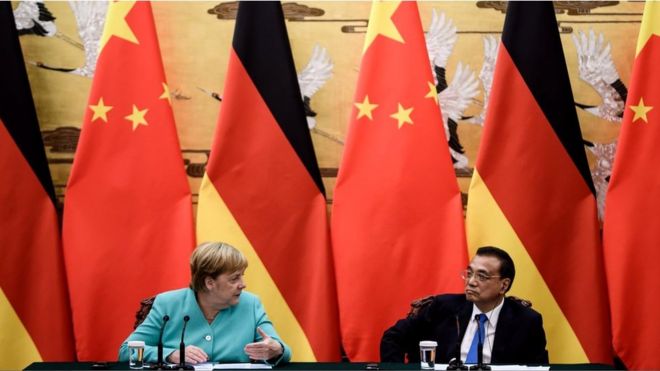
Image copyright EPAImage caption Ms Merkel calls for dialogue while Mr Li says China can handle its own matters
China’s Premier Li Keqiang has said Beijing supports the Hong Kong government “to end the violence and chaos”.
He is the most senior Chinese official to comment on the unrest which has rocked Hong Kong for months.
His comments came during a joint press conference with German Chancellor Angela Merkel in Beijing.
Hong Kong has seen months of often-violent protests calling for democracy and less influence from China.
The protests were sparked by changes to a law that would allow extradition to mainland China, but have since widened to include calls for an independent inquiry into police brutality and demands for greater democracy.
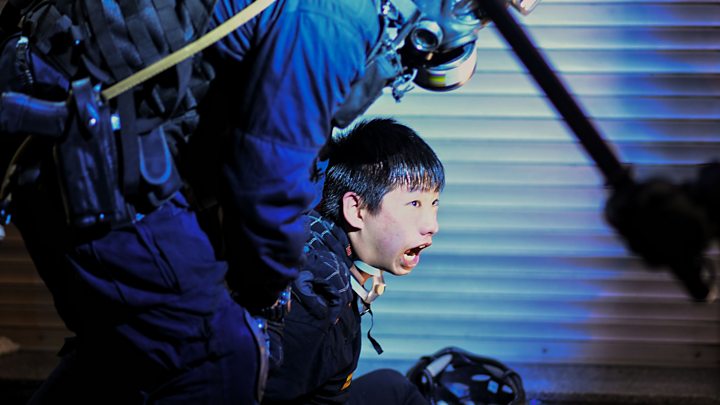
Image copyright EPAImage caption Hong Kong activists hope for Western support
Instead, protests continued on Friday evening, when clashes erupted between police and the demonstrators outside a subway station on the Kowloon peninsula.
Riot police fired both tear gas and rubber bullets at protesters before clearing the nearby streets as the crowd of protesters was forced to retreat.
What did the Chinese premier say?
In August, China had likened to protests to terrorism, warning activists not to “underestimate the firm resolve” of the Beijing government.
Li Keqiang, China’s second highest-ranking leader, told reporters on Friday: “The Chinese government unswervingly safeguards ‘one country, two systems’ and ‘Hong Kong people govern Hong Kong people’.”
He said China backed Hong Kong “to end the violence and chaos in accordance with the law, to return to order, which is to safeguard Hong Kong’s long-term prosperity and stability”.
WUHAN, China (Reuters) – German Chancellor Angela Merkelrenewed calls for a peaceful solution to unrest in Hong Kong on Saturday during her trip to China.
The Hong Kong protests have overshadowed a three-day visit Merkel had planned to use to press for greater access to Chinese markets for German businesses suffering a slowdown at home.
“I have advocated that conflicts be resolved without violence and that anything else would be a catastrophe from my point of view,” Merkel said.
After talks with President Xi Jinping and Premier Li Keqiang, Merkel said Beijing had listened to her views.
“This is important,” she added.
Hong Kong leader Carrie Lam announced concessions this week to try to end the protests, including formally scrapping a hugely unpopular extradition bill, but many said these were too little, too late.
Joshua Wong, a leader of pro-democracy protests in 2014 that were the precursor to the current unrest, thanked Merkel for addressing the topic with Beijing but said her comments fell short.
“Germany’s business interest should not override the universal values in which we believe,” Wong said in an interview with Germany’s mass-circulation Bild am Sonntag newspaper.
“If the Chancellor wants to do something, she must help to urge President Xi to respond to the demand for free elections.”





 CHINDIA ALERT: You'll be living in their world, very soon