Archive for ‘global health’

17/05/2020

Lufthansa Cargo adds more flights to mainland China, ferrying urgent supplies to Europe

  • There has been strong demand for air freight services since April, when Chinese factories got back to work
  • Cargo flights have become critical in moving protective health equipment across the globe
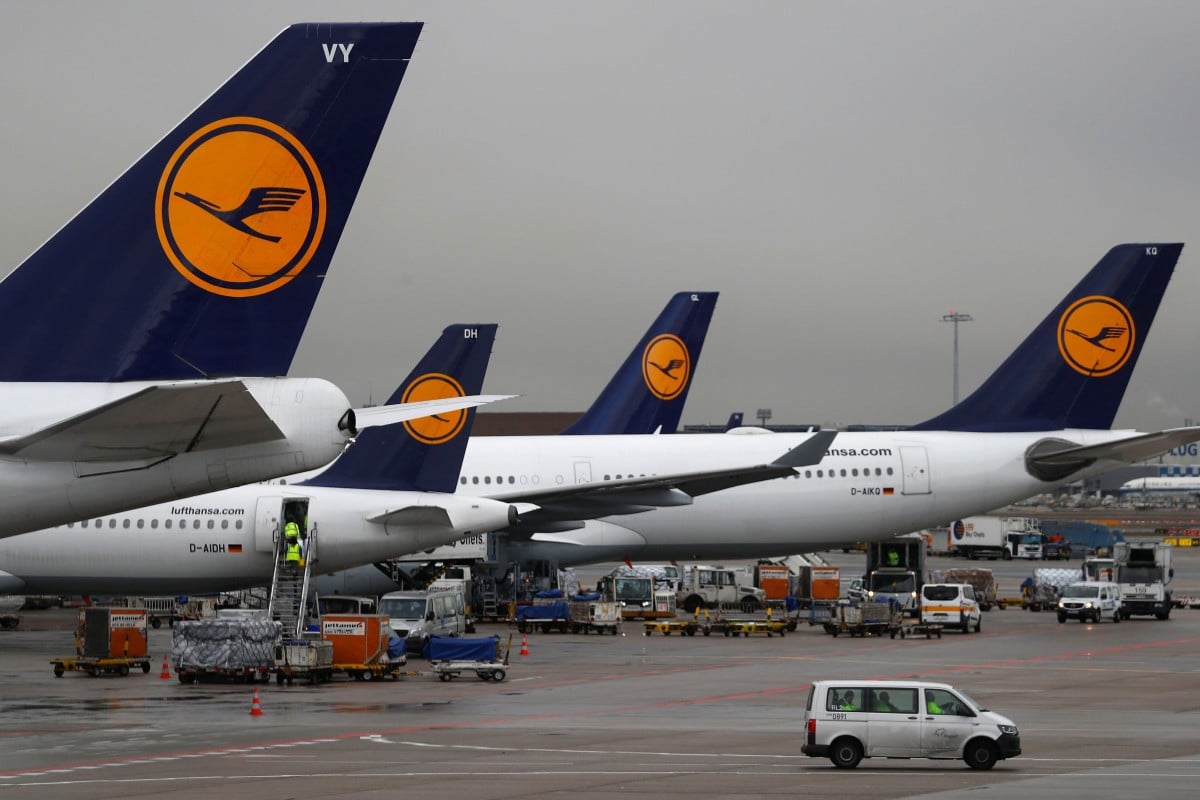
Planes of German air carrier Lufthansa at the country’s largest airport in Frankfurt. Photo: Reuters

German freight carrier Lufthansa Cargo is expanding in China, surpassing 100 weekly flights for the first time, and adding new flights to Shenzhen.

Peter Gerber, CEO of Europe’s largest cargo airline, said there had been heavy demand for its services, though this might cool by the peak of summer.

“At the moment, cargo demand is very, very strong,” he told the Post. “It started to get strong in April, when Chinese industries got back to work, and after that we have seen a constant, heavy demand, a real peak.”

Cathay Pacific and Cathay Dragon report combined HK$4.5 billion loss for start of 2020

15 May 2020
Global air freight capacity has been squeezed as two-thirds of the world’s aircraft have been grounded by the Covid-19 pandemic.
The collapse of air travel has practically put a stop to passenger flights, which typically carry half of all air cargo.

Since the pandemic, cargo flights have been critical in moving protective health equipment across the globe. From sending masks and other supplies to China in February, the German carrier is now taking urgent supplies from the mainland back to Europe.

Peter Gerber says Lufthansa Cargo has a high responsibility in maintaining supply chains, for both global health and world trade. Photo: Handout
“We have a high responsibility in maintaining supply chains in these unprecedented times for both global health and world trade,” Gerber said.

With the addition of Shenzhen, Lufthansa Cargo will fly to five destinations in China. It serves more than 300 destinations in 100 countries.

The cargo carrier is part of the Lufthansa Group and coordinates all the freight that goes into the passenger planes of its sibling brands, including Lufthansa, Swiss and Austrian.

Coronavirus: South Africa asks Hong Kong to remove its citizens from government quarantine list

16 May 2020

By next week, Lufthansa Cargo will be running more freight flights to China than the 72 passenger flights the group flew weekly before the pandemic to Beijing, Shanghai, Shenyang, Nanjing and Qingdao.

Lufthansa Cargo has a fleet of seven Boeing 777 Freighters (777Fs), with two new 777Fs arriving this year as part of its strategy to operate a fleet with a single aircraft type.

It also has six McDonnell Douglas-11Fs that Gerber said would still be retired as planned at the end of 2020, despite the extra demand for cargo capacity.

Its additional flights to China will make use of “preighters” – passenger aircraft flying cargo only. Gerber felt the trend of using empty passenger planes as “preighters” had peaked, pointing out that they cost the same to operate as freighters but carry only a fraction of the cargo.

Although he did not rule out future expansion, he said: “Demand will gradually come down in the next two or three months because a lot of equipment would have been shipped by then and some shipments will go on rail or ocean shipping.”

Coronavirus: Cathay Pacific could get cash injection from shareholder Qatar Airways

13 May 2020

He said some uncertainty remained over continued demand for airfreighted cargo, given the battered state of the world economy. Airlines would have to consider longer-term demand before deciding to invest more in cargo aircraft. “It depends how it looks beyond the next year,” he said.

Gerber said no decision had been taken yet on whether to convert some of the group’s orders for Boeing’s newest widebody 777X passenger aircraft into cargo planes.

He added that future plane orders would be balanced against the wider needs and spending decisions at Lufthansa Group, which is currently negotiating a government pandemic bailout package in the region of 9 billion (US$9.7 billion).

Source:SCMP
15/05/2020

Coronavirus: Can China test all of Wuhan in only 10 days?

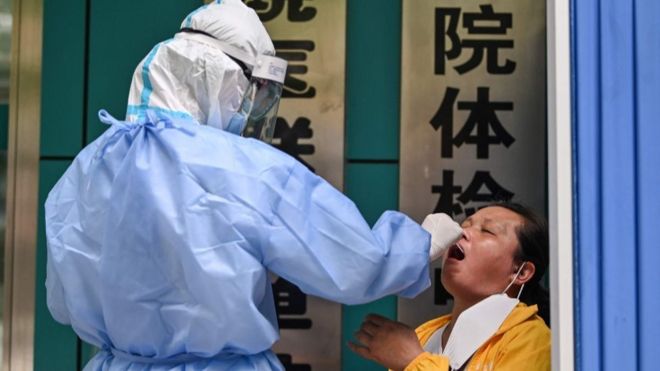
A medical worker takes a swab sample from a woman to be tested for the COVID-19 novel coronavirus in Wuhan, in Chinas central Hubei province on May 13, 2020.Image copyright GETTY IMAGES
Image caption Testing everyone in 10 days would be a huge challenge

China is drawing up ambitious plans to test the entire population of Wuhan, the city where the Covid-19 pandemic began.

The announcement came after the emergence of six new coronavirus cases in the city – the first ones since early April.

The authorities had originally promised to test all 11 million people in 10 days.

But it now appears they might be aiming for a less ambitious timetable.

How long will the testing take?

In late April, the Hubei provincial government reported 63,000 people were being tested in Wuhan every day.

And by 10 May, that figure had dropped to just under 40,000.

There are more than 60 testing centres across the city, according to the official Hubei Daily newspaper.

These have a maximum capacity of 100,000 tests a day at most, making it hard to see how a target of testing the entire population in just 10 days could be met.

So the authorities have indicated the tests will not all start and finish within the same 10-day period.

“Some districts [in the city] will start from 12 May, others from 17 May, for example,” the Wuhan Centre for Disease Control said.

“Each district finishes its tests within 10 days from the date it started.”

And according to a Reuters report on 13 May, preparations for carrying out tests had begun in two out of the city’s 13 districts.

What proportion have been tested already?

The authorities say they have now tested more than three million people in the city.

Wuhan University pathogen biology department deputy director Yang Zhanqiu told the Global Times newspaper he believed up to five million Wuhan residents may have already been tested.

The population of the city – originally 11 million – has also fluctuated over time.

The authorities said up to five million people had left the city for the lunar New Year holiday before it was locked down on 23 January.

The lockdown then lasted until 8 April, but it is unclear how many of these residents have now returned.

Should everyone be tested?

Wuhan University’s Yang Zhanqiu said there was no need to test everyone living in neighbourhoods with no reported cases.

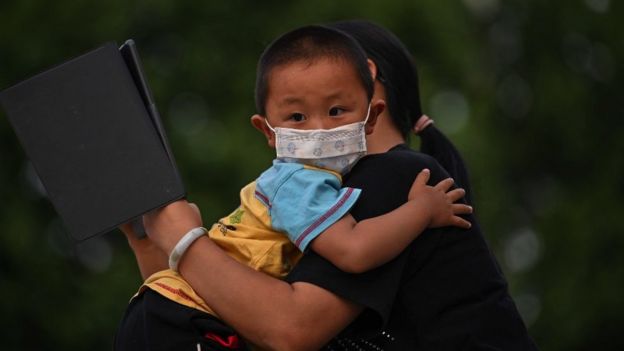
A mother holds his son next to Yangtze River in Wuhan, in Chinas central Hubei province on May 12, 2020. -Image copyright GETTY IMAGES
Image caption There are worries about asymptomatic coronavirus cases

The authorities have said they will begin with people considered most at risk – for example in the older, more densely populated areas, as well as those in key jobs such as healthcare.

Also, people who have been tested in the previous seven days will not need to be tested again.

But Chinese Center for Disease Control and Prevention chief epidemiologist Wu Zunyou told state TV: “The virus could take longer to manifest itself in patients with weak immunity and these people are also prone to ‘on’ and ‘off’ symptoms.”

Banner image reading 'more about coronavirus'
Banner

Yang Zhanqiu adds: “You’ll never know if people were infected after testing negative.”

And US-based Council for Foreign Affairs senior fellow for global health Yanzhong Huang said: “There would still be the possibility of isolated outbreaks in the future, which even large-scale testing will not address.”

Source: The BBC

Law of Unintended Consequences

continuously updated blog about China & India

ChiaHou's Book Reviews

continuously updated blog about China & India

What's wrong with the world; and its economy

continuously updated blog about China & India