29/07/2019
- Chinese scientists say they have developed controls to help steer spent boosters crashing back to Earth
Lattice-like grid fins are used to guide spent boosters as they fall to Earth. Photo: Science and Technology Daily
China says it has successfully tested new fins on its Long March rockets to help guide spent boosters away from populated areas, possibly paving the way for development of reusable technology like SpaceX’s Falcon 9.
China successfully launched a Long March 2C rocket on Friday using grid-fin technology to guide its spent booster to a landing spot in Guizhou province in the country’s southwest, state-run Science and Technology Daily reported on Sunday, citing China Aerospace Science and Technology Corporation (CASC), a key contractor for the Chinese space programme.
The report said China was the second country to master the technology, after the United States.
Grid fins are aerodynamic control surfaces that are folded during the launch but deployed in flight. In the more sophisticated applications such as the Falcon 9, the fins manipulate the direction of the rocket during re-entry.
A Long March-2C carrier rocket carrying remote sensing satellites blasts off from the Xichang Satellite Launch Centre in Xichang, Sichuan province, on Friday. Photo: Xinhua
Shanghai-based online news outlet The Paper reported that the 2C’s grid fins were developed by a team of about a dozen engineers, all under the age of 35.
The team also designed a new companion electrical control system to control the fins, taking about six months to complete the task.
China has conducted frequent satellite launches in recent years, including 38 last year, the highest total for any country in 2018. But landing safety has become an issue as traditional zones grow more populated.
Chinese start-up rocket maker counts down to launching “shoebox” satellites
Chinese media reported in January 2018 that a booster from a Long March 3B rocket created a massive fireball after it fell from the sky and exploded in a residential area, though no casualties were reported.
And Shaanxi Television reported in May this year that debris was found on a motorway in northwestern China’s Shaanxi province, with residents saying they heard a loud noise and saw an object fall to the ground.
Under existing arrangements, authorities in projected landing zones have to evacuate the areas each time, not only inconveniencing residents but adding to the economic cost and difficulty of the work, according to the The Paper. The grid fins are expected to help ease some of those problems.
“The successful test of the [grid-fin] technology is of great significance to solving the landing issue,” the report quoted CASC assistant director He Wei as saying.
“It also lays a solid foundation for recoverable and reusable technologies.”
China plans more satellites to build up navigation system to rival GPS
Long Lehao, chief commander and designer of Long March 3A rocket series, said the development of reusable technologies could support large-scale development and use of space in the future, as well as make the space programmes more commercially competitive, The Beijing News reported.
Beijing sees space as an important driver for growth and an opportunity to promote hi-tech industries.
On Thursday,
became the first private firm in China to successfully launch a rocket into space.
Source: SCMP
Posted in China Aerospace Science and Technology Corporation (CASC), China’s Long March, global space race, grid-fin tech, Guizhou Province, Lift-off, reusable rockets, Science and Technology Dail, shaanxi province, sichuan province, SpaceX’s Falcon 9, The Beijing News, Uncategorized, Xichang Satellite Launch Centre |
Leave a Comment »
17/06/2019
- China has become the first nation to fully own and operate a floating launch platform for its space missions
China has successfully launched a rocket into space from the Yellow Sea, making it the first nation to fully own and operate a floating sea launch platform. Photo: China National Space Administration
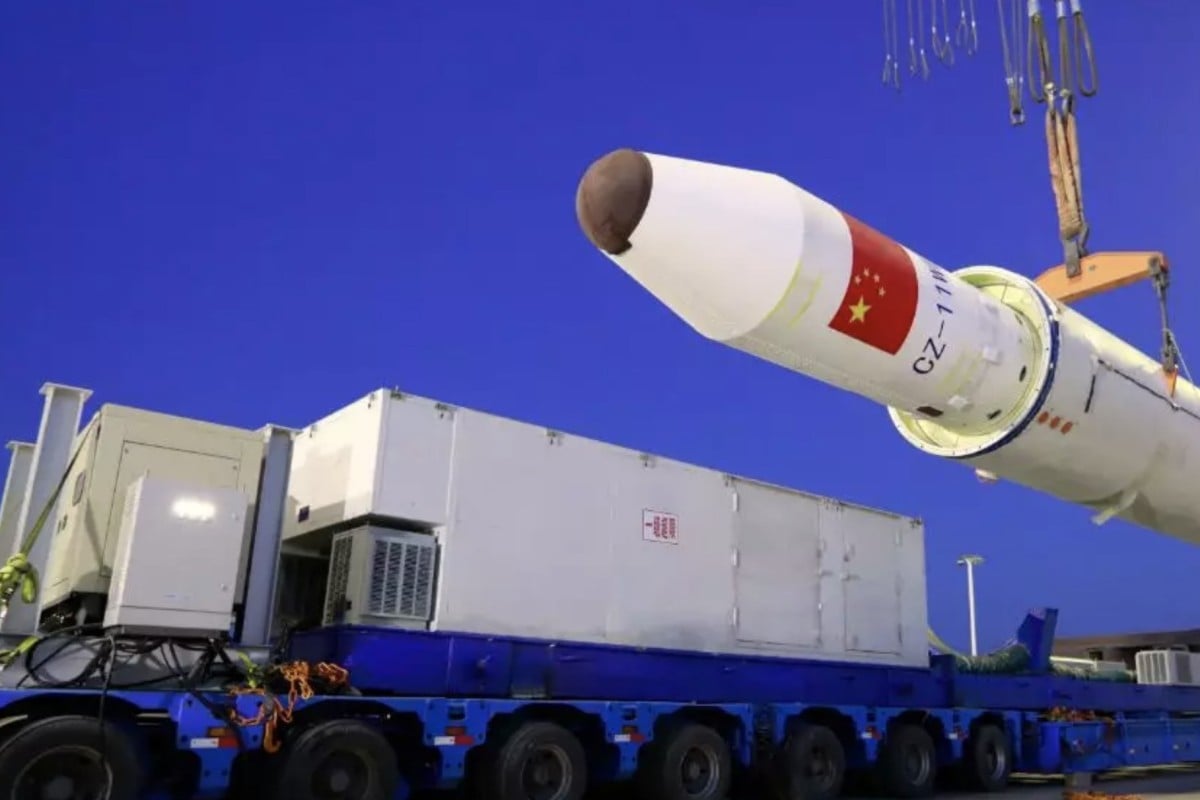
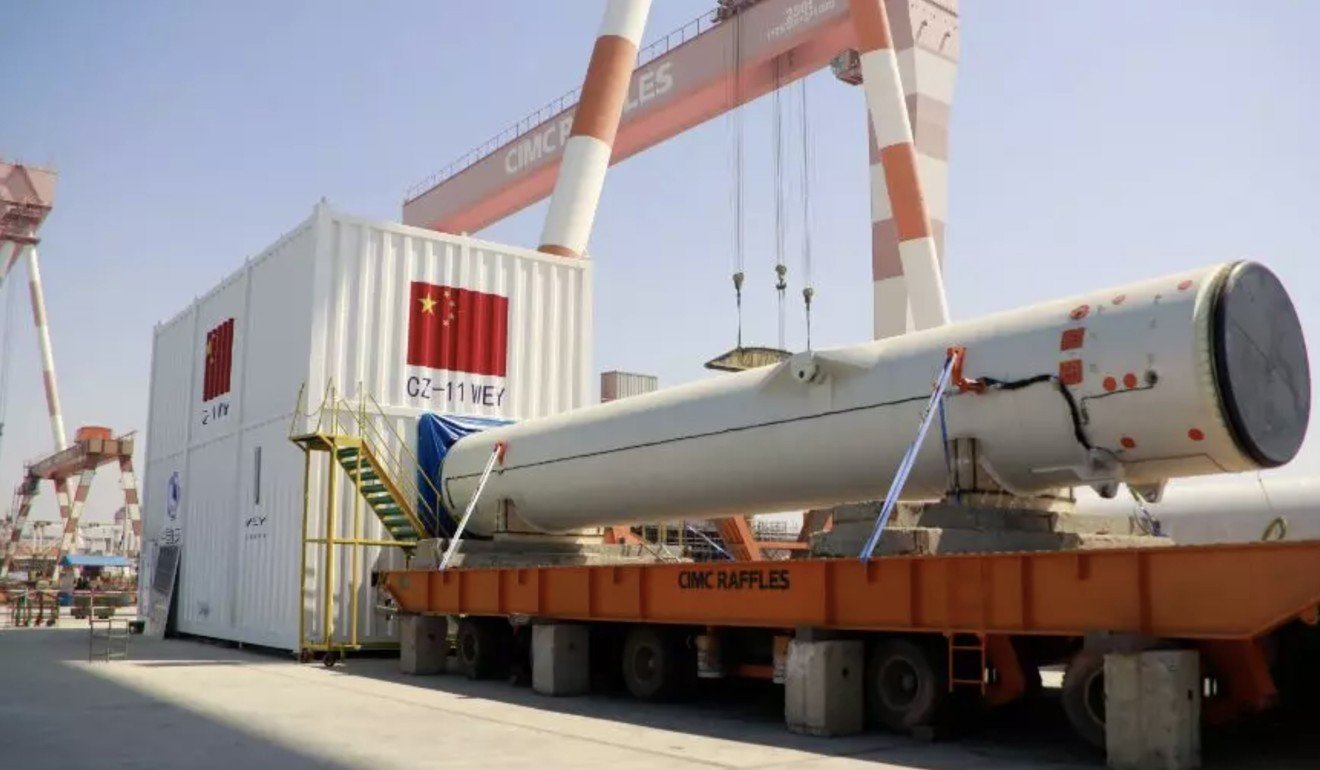
China successfully launched a rocket into space from a civilian cargo ship at sea on Wednesday, becoming the first nation to fully own and operate a floating sea launch platform, a technology expected to significantly reduce the cost and risk of space missions.
A Long March 11WEY rocket blasted off from the ship in the Yellow Sea at noon Beijing time, according to the China National Space Administration.
About six minutes later, five commercial satellites and a pair of “technical experiment” probes – called Bufeng, or Wind Catchers – reached their designated orbits.
The Wind Catchers will work together to detect winds on the surface of the world’s oceans. They will boost China’s ability to monitor and forecast typhoons and other extreme weather events, according to the administration.
“Launching a rocket from the sea has the advantages of high flexibility, good adaptability for specific tasks, and excellent launch economy,” said a statement on the administration’s website.
“It can flexibly select the launch point and touchdown area to meet the needs of various payloads for different orbits, and provide better aerospace commercial launch services for countries along the belt and road,” it added, referring to the Belt and Road Initiative, China’s plan to grow global trade.
The Long March 11 is a four-stage, solid fuel rocket with a design similar to a ballistic missile. It can carry a payload of about 700kg to the Earth’s lower orbit.
The first two stages of the rocket dropped in open waters in the northern Pacific Ocean, according to the administration. The rocket was equipped with a flight suspension system in case of any abnormal situation, but none occurred.
“The rocket debris will not cause damage to surrounding waters,” the administration said.
The world’s first ocean rocket launch platform, the Sea Launch, was jointly built by companies from Russia, the United States, Norway and Ukraine in the late 1990s. Its operation was halted in 2014 after military conflicts broke out between Russia and Ukraine.
Li Hong, president of the China Academy of Launch Vehicle Technology, told state media in March that the Chinese rocket and launch platform were designed and owned entirely by China, so it would not have similar problems caused by international disputes as the Sea Launch.
The launch was expected to encounter many technical and engineering challenges, including simplified procedures for pre-launch testing, the rocking motion of the ship and heat dissipation in a confined space.
But Chinese space authorities have argued the inconvenience would be offset by numerous advantages. For instance, the technology would allow China to move its launch site to as far away as Hawaii for quicker, cheaper satellite insertion to certain orbits, according to Xinhua.
Preparations get under way for Wednesday’s successful Chinese space launch from the northern Pacific ocean. Photo: China National Space Administration
A maritime launch is also expected to reduce the risk of rocket debris falling into densely populated areas.
Chinese space launch sites are typically located inland for defence purposes.
China has built its sea launch capability mainly to bolster the commercial space sector, according to Chinese space authorities.
In this mission, the rocket was sponsored and named after WEY, a young luxury car brand by Chinese sports utility vehicle manufacturer Great Wall Motor.
Chang’e 4 landing marks start of new China-US space race
Some cutting-edge car technology, such as new paint materials, will go into space for testing in the most extreme environments, according to state media reports.
The payloads include the Jilin 03A, the latest addition to a high-definition Earth observation satellite network, according to Changguang Satellite Technology Corporation, the satellite’s owner.
The company said the constellation, which will eventually comprise more than 20 satellites, would achieve global coverage for commercial applications.
One of the satellites launched on Wednesday belongs to Shanghai-based LinkSure Network, which has ambitious plans to provide free Wi-fi to everyone on the planet. The company has said it plans to eventually launch more than 200 satellites as part of the project.
Source: SCMP
Posted in Bufeng, Changguang Satellite Technology Corporation, China Academy of Launch Vehicle Technology, China alert, China National Space Administration, civilian cargo ship, floating launch platform, free Wi-fi, global space race, Great Wall Moto, Great Wall Motor, Hawaii, Jilin 03A, Long March 11WEY rocket, monitor and forecast typhoons, Norway, Pacific Ocean, Planet, rockets to forefront, Russia, sea launch, Shanghai-based LinkSure Network, success, Ukraine, Uncategorized, United States, Wind Catchers, Yellow Sea |
Leave a Comment »



 CHINDIA ALERT: You'll be living in their world, very soon