Archive for ‘Good news’

07/11/2014

China, Japan set aside isle row, paving way for leaders to meet | Reuters

China and Japan agreed on Friday to work on improving ties and signaled willingness to put a bitter row over disputed islands on the back burner, paving the way for their leaders to meet at an Asian-Pacific summit next week.

The agreement, ahead of an expected ice-breaking chat between Japanese Prime Minister Shinzo Abe and Chinese President Xi Jinping at the gathering in Beijing, signals a thaw in ties between the world’s second- and third-biggest economies.

Relations have been soured over the past two years by the territorial row, regional rivalry and the bitter legacy of Japan’s wartime occupation of China.

Abe said the two sides were making final arrangements for one-on-one talks, although neither he nor China’s foreign ministry confirmed that the talks were set.

“Both Japan and China are coming to the view that it would benefit not just the two countries but regional stability if a summit is held,” he told a TV program.

via China, Japan set aside isle row, paving way for leaders to meet | Reuters.

04/11/2014

Smog-Heavy China Tops Clean-Tech Investment Rankings – Businessweek

The best developing country in which to invest in clean-tech? It’s China, according to a new analysis (pdf) by Climatescope, a collaborative research project whose partners include Bloomberg New Energy Finance and the U.K. Department for International Development.

A solar thermal power generation system being built in Anhui province, China

China is, paradoxically, both the world’s top emitter of greenhouse gases and the largest investor in green energy. This can be true because China’s demand for energy is increasing quickly enough to stoke demand for both traditional fossil fuels and renewable energy. As the report notes, China’s annual energy consumption ballooned a stunning 51 percent from 2008 to 2013. In the same period, India’s power generating capacity expanded 56 percent, while the U.S.’s rose just 6.8 percent.

China is now the world’s top maker of wind and solar equipment, with numerous factories supplying both component parts and finished products. While its solar manufacturing industry was originally export-oriented, China since 2013 has been “the largest demand market for renewables” and “has taken major strides to improve its domestic policy framework” for green energy investment, the report finds.

via Smog-Heavy China Tops Clean-Tech Investment Rankings – Businessweek.

19/10/2014

China, Vietnam pledge to ‘address and control’ maritime disputes | Reuters

China and Vietnam have agreed to “address and control” maritime disputes, state media said on Friday, as differences over the potentially energy-rich South China Sea have roiled relations between the two countries and other neighbors.

Chinese coastguard ships give chase to Vietnamese coastguard vessels (not pictured) after they came within 10 nautical miles of the Haiyang Shiyou 981, known in Vietnam as HD-981, oil rig in the South China Sea July 15, 2014. REUTERS/Martin Petty

Ties between the Communist countries sank to a three-decade low this year after China deployed a $1 billion-oil rig to the disputed waters which straddle key shipping lanes.

Vietnam claims the portion of the sea as its exclusive economic zone, and the rig’s deployment sparked a wave of violent protests in Vietnam.

The two countries should “properly address and control maritime differences” to create favorable conditions for bilateral cooperation, Chinese Premier Li Keqiang told Vietnamese Prime Minister Nguyen Tan Dung on Thursday on the sidelines of the Asia-Europe Meeting (ASEM) in Milan.

“Thanks to efforts from both sides, China-Vietnam relations have ridden out the recent rough patch and gradually recovered,” the official Xinhua news agency cited Li as saying.

Xinhua said Dung agreed and endorsed boosting “cooperation in infrastructure, finance and maritime exploration”.

The comments were a reiteration of earlier pledges by leaders from the two countries.

China’s Defense Minister Chang Wanquan held talks with his Vietnamese counterpart, Phung Quang Thanh, on Friday in Beijing, Xinhua reported, during which both sides agreed to “gradually resume” military ties.

The two leaders vowed that the countries’ militaries would “play a positive role in properly dealing with their maritime disputes and safeguarding a peaceful and stable situation”, the news agency said.

China claims almost the entire South China Sea, believed to be rich in deposits of oil and gas resources. Brunei, Malaysia, the Philippines, Taiwan and Vietnam also have claims in the waters where $5 trillion of ship-borne goods pass every year.

Alarmed by China’s military rise and growing assertiveness, Vietnam has broadened its military relationships in recent years, most notably with Cold War-era patron Russia but also with the United States.

Beijing has told Washington to stay out of disputes over the South China Sea and let countries in the region resolve the issue themselves.

via China, Vietnam pledge to ‘address and control’ maritime disputes | Reuters.

19/10/2014

After border row, India, China plan counter-terror drills to build trust | Reuters

India, which under Prime Minister Narendra Modi has struck an assertive national security posture, also agreed to China’s request to move next month’s exercises away from the border with Pakistan with which China shares a close relationship.

The manoeuvres will come just weeks after thousands of Indian and Chinese soldiers confronted each other on their de facto border in the western Himalayas, accusing each other of building roads and observations posts in disputed territory.

“The exercises are a confidence-building measure, it is in everyone’s interest,” Jayadeva Ranade, the China specialist on India’s National Security Advisory Board, told Reuters.

“It doesn’t mean anyone is conceding anything.”

The row in the Chumar sector of the Ladakh region erupted just as China’s President Xi Jinping was visiting New Delhi for his first summit with Modi since the Indian leader’s election in May. The leaders of the Asian giants aim to ramp up commercial ties.

India sees the anti-terrorism collaboration with China as a way to highlight the threat they both face from Islamist militants in Pakistan.

It had arranged for the Chinese to practise mock assaults in Bhatinda, about 110 km (70 miles) from the Pakistan border.

via After border row, India, China plan counter-terror drills to build trust | Reuters.

02/10/2014

India launches campaign to boost manufacturing – Businessweek

India’s prime minister has launched a campaign to entice investment and promote the country as the world’s next cheap labor economy.


Embed from Getty Images

The “Make in India” campaign is as much a slick marketing campaign as it is a promise to streamline bureaucracy and make India investor friendly.

Prime Minister Narendra Modi said at a launch event Thursday that “the whole world is ready to come here.”

India’s 1.2 billion people are anxious to see the economy expand and create more jobs. Some 13 million Indians become old enough each year to join the workforce.

Modi has been promoting India as the next manufacturing powerhouse. That’s a title long held by China, which is now growing wealthier and pushing toward becoming a consumer economy.

via India launches campaign to boost manufacturing – Businessweek.

18/09/2014

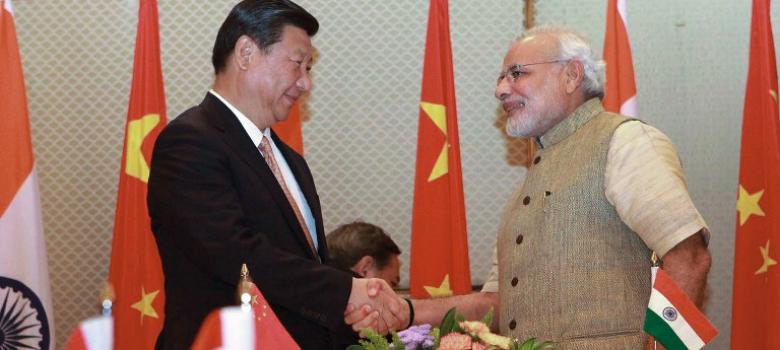
After Modi-Xi meeting, China agrees to quickly settle border dispute, demarcate LAC – Hindustan Times

Prime Minister Narendra Modi and Chinese President Xi Jinping on Thursday agreed to quickly resolve the border dispute and demarcate the Line of Actual Control to improve peace and cooperation between both countries.

Addressing the media after the conclusion of one-on-one meeting with visiting Chinese President Xi Jinping, Modi said India is concerned about the frequent incursions along the border. The Line of Actual Control should be demarcated soon to ensure peace and tranquility in the area, he said.

President Xi, in response, said that China will work to settle the border issue at the earliest date. Since the border is not demarcated there will be some incidents, but both countries are capable of settling it at various levels without causing a bigger impact, he said.

President Xi said both countries would be respectful and sensitive to each others concerns. “We also have the sincerity to work with India to maintain peace and tranquility in the border areas before we are finally able to settle the border question,”he said.

The latest incident India was referring to was the  fresh incursion by the Chinese army in Chumar area, even as talks were on between both the leaders.

via After Modi-Xi meeting, China agrees to quickly settle border dispute, demarcate LAC – Hindustan Times.

18/09/2014

Despite the Xi-Modi bromance, Indians and Chinese don’t actually like each other

One in two Indians thinks China is a major threat.

In the last two days alone, Chinese President Xi Jinping has called India an ancient, magic, enchanting, and beautiful land. And Indian Prime Minister Narendra Modi has reciprocated with syrupy adjectives, reminding visiting journalists how ancient Chinese technology was responsible for sugar being called cheeni in India.

The pictures of the two leaders’ bonhomie on Wednesday went even further. By the time you get to the sight of Modi and Xi sitting on a swing by the Sabarmati, most would imagine that India and China are steadfast allies who support each other through thick and thin.

Which is why it might be worth pointing out that we don’t actually like each other very much, and that Indians and Chinese people have very different intentions for the bilateral relationship. And it’s not just about the trade deficit and the border disputes. Ordinary Indians and Chinese people simply aren’t sure whether they like each other.

via Scroll.in – News. Politics. Culture..

17/09/2014

Is China Ready to Step Up and Invest in India? – India Real Time – WSJ

While Chinese companies have been great at peddling their products in India, they have been surprisingly reluctant to invest here. China has invested less in India than even Poland, Malaysia or Canada have.

President Xi Jinping’s three-day visit to India starting Wednesday is likely to include some massive pledges to try to remedy this imbalance.

When Prime Minister Narendra Modi visited Japan recently, Japan pledged to invest $35 billion in India. President Xi is expected to try to eclipse Japan’s promises, possibly pledging $100 billion in investment according to some local reports. His meetings with Mr. Modi are predicted to lay the groundwork for a wave of Chinese money to build industrial parks and bullet trains.

Annual trade between India and China has galloped to $66 billion from $3 billion 14 years ago, something that underscores the rise of Beijing as the global manufacturing hub and India’s growing appetite for everything from phones to machinery from China.

While the trade relationship between the two countries has bloomed, foreign direct investment from China has not. According to Indian government statistics, the country has received a total of around $400 million from China in investment in the last 14 years. Even if you add the $1.2 billion of direct investment India received from Hong Kong, China is still well behind the $22 billion in foreign direct investment from the United Kingdom, $17 billion from Japan, $13 billion from the Netherlands and $1.9 billion from Spain.

It’s not that China doesn’t invest abroad. According to data from United Nations Conference on Trade and Development, China was the third biggest source of foreign direct investment last year, having invested more than $100 billion in other countries. In the seven years to 2012, it invested more than $25 billion in the 10 members of the Association of Southeast Asian Nations alone.

Chinese investment has tended to focus on the resources sector to power its economy. Much of it has gone into getting control of oil, natural gas and coal in Africa, Australia, Indonesia and elsewhere. India has not attracted much of this investment as it is a net importer of resources and has a heavily regulated energy sector, said Rajiv Biswas, economist for IHS.

“China wants to increase investment in India and wants Chinese companies on the ground there,” Mr. Biswas said. “Most of it will be in manufacturing and infrastructure space.”

Chinese companies may also be looking to move some of their manufacturing to India as they struggle with rising wages at home, said Ajay Sahai, director general and chief executive at Federation of India Export Organization.

If India can’t find better ways to fix its trade imbalance with China, New Delhi may want to increase taxes on some imports such as auto-components and pharmaceuticals to encourage Chinese companies to set up factories in India, he said.

“This will not only raise Chinese investment in India but also help in fixing the trade imbalance,” said Mr. Sahai.

via Is China Ready to Step Up and Invest in India? – India Real Time – WSJ.

17/09/2014

5 Things to Look Out for During Xi Jinping’s Visit to India – WSJ

Manan Vatsyayana/Agence France-Presse/Getty Images

1 INFRASTRUCTURE

Prime Minister Narendra Modi is looking for foreign capital and expertise to build “smart cities”, high-speed trains and modern airports of the kind that China has built for itself in the past decade. The two leaders are expected to sign a deal to bring bullet trains to India and may also reach an agreement for the building of world-class railway stations and airports.

2 INDUSTRIAL PARKS

The two countries laid the groundwork for Chinese investment in industrial parks in India when Indian Vice-President Hamid Ansari visited Beijing in June. Indian officials say they expect to ink deals worth $5 billion for two parks – one in the western state of Gujarat, Mr. Modi’s home state, and the other in Maharashtra. The idea is to make it easier for Chinese companies to set up shop in India.

3 BORDER TROUBLES

Territorial disputes that have long dogged Sino-Indian ties aren’t the focus of this visit, but are sure to come up. Two reports this week – one about an alleged incursion by Chinese troops in Ladakh and another about protests by Chinese civilians and troops against the construction of an Indian canal along the disputed border – have highlighted the unresolved issues. Even after 17 rounds of talks, no solution has emerged – don’t expect one during this visit either.

4 COMPETITION WITH JAPAN

Indian newspapers have been filled with anticipation about whether China will outdo its Asian rival, Japan, in promising investments for India. Earlier this month, Japan pledged to pour $35 billion into India over five years; China is expected to go further. Expect reams of analysis of Mr. Xi’s rapport with Mr. Modi. When Japanese Premier Shinzo Abe met Mr. Modi, they bear hugged.

5 BREAKING OUT OF THE MOLD

Officials have raised hopes of a “directional change” and an “orbital jump” in Sino-Indian ties, which have long been bogged down by bureaucratic mistrust. Trade relations have flourished in the past decade, but are skewed in China’s favor– and investments have remained very low. Experts are hoping Mr. Modi – who worked with Chinese as chief minister of Gujarat – will adopt a pragmatic approach to push for Chinese money. If he succeeds, the visit may set the stage for an era of economic collaboration between the two Asian giants.

via 5 Things to Look Out for During Xi Jinping’s Visit to India – WSJ.

17/09/2014

Is China’s promised $100 billion India investment more dangerous than its border policy?

Experts believe that China deliberately uses trade as part of its geo-strategic arsenal.

The script is almost predictable. Right before meetings of Indian and Chinese heads of state, something happens on the border to remind everyone that sentiment between the two countries is not exactly neighbourly. Last year it was a standoff in Daulat Beg Oldi about infiltration by the Chinese army. This year, with everyone excited at China’s promise to pump $100 billion into India, there’s another incursion by the Chinese into Demchok in Ladhak.

Chinese President Xi Jinping arrives in India today and will visit Ahmedabad on Prime Minister Narendra Modi’s birthday. But Chinese troops have also been reported to have moved 500 meters into Indian territory.

Beijing’s approach seems to be sweet-talking – this time taking the form of foreign direct investment – coupled with regular pinpricks that remind India that they have the stronger position on the border.

But could the proposed investment be as much of a threat to India as the border dispute?

Trading places

India’s total trade with China was around $65 billion in 2013-’14. Of that, only $14 billion were Indian exports heading into China, leaving India with a trade deficit of $36 billion. If oil imports are included, Chinese imports are responsible for nearly half of India’s overall trade deficit. This is a great many Indian eggs in one Chinese basket.

For many economists, this isn’t a problem. It’s simply the way efficient markets ought to function, with India buying the goods it needs from the most competitive seller. “The more competitive the trading partner, the more India should buy from it, and the bigger should be the bilateral trade deficit,” wrote commentator Swaminathan Aiyar last year. “China is the most competitive exporter of all, so India should run its biggest trade deficit with this country.”

Yet India does feel the need to reduce the trade deficit with China. Answering a question in the Lok Sabha earlier this year, minister of state for commerce Nirmala Sitharaman admitted that the balance of trade was heavily in China’s favour and that India was taking steps to address this.

“With a view to reducing the trade deficit with China, efforts are being made to diversify the export basket,” Sitharaman said.

via Scroll.in – News. Politics. Culture..

Law of Unintended Consequences

continuously updated blog about China & India

ChiaHou's Book Reviews

continuously updated blog about China & India

What's wrong with the world; and its economy

continuously updated blog about China & India