Archive for ‘Good news’

13/05/2014

India Poll Prospects Drive Auto Shares – India Real Time – WSJ

Shares of most automobile companies in India surged on Tuesday on expectations that the pro-business Bharatiya Janata Party will emerge victorious when national election results are announced Friday.

Maruti Suzuki India Ltd.532500.BY +1.97%, Mahindra & Mahindra Ltd.500520.BY +1.40%, Tata Motors Ltd.500570.BY +0.81%, Ashok Leyland Ltd.500477.BY +1.19% and Hero MotoCorp Ltd.500182.BY +3.17% were trading around their 52-week highs when markets closed Tuesday evening.

“This (share-buying) is mainly sentiment-driven,” said an analyst at a Mumbai-based brokerage, who did not wish to be named.  He expected auto shares to trade even higher if a BJP-led government with a clear majority were to emerge the winners of India’s federal election.

The analyst said investors are hoping that a government led by BJP’s Prime Ministerial candidate Narendra Modi would take strong steps to revive economic growth, increase foreign investment, and boost industrial growth, which would in turn improve market sentiment and demand for new vehicles in India, the world’s sixth-largest car producing market.

via India Poll Prospects Drive Auto Shares – India Real Time – WSJ.

Enhanced by Zemanta
11/05/2014

Chinese premier vows to combat poaching, ivory smuggling – Xinhua | English.news.cn

Visiting Chinese Premier Li Keqiang said here Saturday that China is strongly committed to protecting wildlife and will spare no effort in combating poaching and ivory smuggling.

The premier made the remarks to Chinese and foreign journalists after visiting the Ivory Burning Site Monument in the Nairobi National Park with Kenyan President Uhuru Kenyatta.

In 1989, then Kenyan President Daniel Arap Moi burned 25 tons of ivory and other hunting trophies in the park. To mark the incineration, the Kenyan government reserved the burning site and set up a monument.

China highly appreciates and respects Kenya’s hardworking effort and remarkable achievement in wildlife protection, Li said, adding China shares Kenya’s considerable emphasis on the issue.

“Our visit to the monument together shows that the two sides are cooperating in good faith to jointly combat poaching and ivory smuggling, and protect wildlife,” the Chinese leader said.

It also indicated that the Chinese government is determined to provide any assistance within its capabilities to help Kenya build the capacity to protect wildlife, he added.

Li said that as a signatory to the UN Convention on International Trade in Endangered Species of Wild Fauna and Flora, China has always abode by the pact.

To counter the rising global ivory smuggling and illegal trade over recent years, he said, China has been taking a series of legal actions and creating inter-agency action mechanism to fight against the crime.

Earlier this year, China destroyed 6.1 tons of confiscated ivory, and will continue to strengthen cooperation with Kenya and other countries on ecological and wildlife protection, Li said.

China will promote such a concept in the world — protecting wildlife is to safeguard our common homeland, and protecting biological diversity is to ensure the colorfulness of the Earth, he said.

via Chinese premier vows to combat poaching, ivory smuggling – Xinhua | English.news.cn.

Enhanced by Zemanta
09/05/2014

India’s Women’s Vote Becomes More Independent – Businessweek

To avoid upsetting her husband, Urmila Devi told him she’ll heed his request to vote for India’s ruling Congress party when their village of 50 families participates in national elections. Once inside the polling booth, she plans to ignore his suggestion. “I’ll vote for a different party,” Devi, 26, says outside her one-room house in Galanodhan Purwa village in Uttar Pradesh state, where she cares for her two children. “I’m concerned about women’s safety. It should be the government’s top priority.”

India's Women's Vote Becomes More Independent

A growing number of women are defying traditional gender roles in India and asserting their voice in elections that began on April 7 and end on May 16. Prompting the change: Higher literacy rates, greater financial independence, and a desire to stem violence against women, which became a highly visible issue after the gang rape and murder of a student in New Delhi in December 2012.

“Over the years, we’ve asked women if they voted on their own or if they voted for whoever their husbands or fathers asked them to,” says Sanjay Kumar, New Delhi-based director of the Centre for the Study of Developing Societies, which conducts opinion polls. “Women were reluctant to tell us earlier, but increasingly they’re saying they’re voting on their own, no matter what the men say.”

via India’s Women’s Vote Becomes More Independent – Businessweek.

Enhanced by Zemanta
28/04/2014

Experts: Patent process needs update – China – Chinadaily.com.cn

Spiking demand for intellectual property services shows large room for growth

Experts: Patent process needs update

China’s patent mechanisms need to be upgraded with foreign expertise, amid a growing demand for international intellectual property services from domestic enterprises, experts said.

The number of patent applications, the demand for legal support, and intellectual property consultation in various sectors have soared in recent years, inspired by the central government’s call to develop intellectual property strategies.

But the development also poses challenges to the country’s immature patent services, they said.

The State Intellectual Property Office said China has 1,001 patent agencies and 8,861 professional practicing agents registered under the office. The entire patent agency industry generated income of more than 8.7 billion yuan ($1.4 billion), including application and managing fees, last year.

There is still room for the industry to thrive as lots of IP-related services have not yet been fully developed in China, said He Hua, the office’s deputy director.

“The skyrocketing demand in the patent application processing each year shows how big the industry is going to be, and the industry is far from realizing its potential,” He said at an IP symposium held by the All-China Patent Attorneys Association on Saturday.

China received 825,000 invention patent applications last year, a 26.3 percent increase year-on-year. The 2.38 million patent applications filed was the highest in the world for the third consecutive year, the office said earlier this month.

Chinese companies are paying more attention to international patents, with a rising awareness of their IP edge in the global market. The country received 22,924 international patent applications according to the Patent Cooperation Treaty in 2013, a 15 percent increase from 2012.

But of all the domestic and foreign patent applications filed last year, only 60 percent were processed through patent agencies, a 15 percent drop from 10 years ago.

Local agencies’ lack of knowledge of the international IP system and legal frameworks in overseas markets has forced major innovation companies to seek patents on their own.

Chinese telecommunication giant Huawei Technologies developed a 300-staff intellectual property rights department in 1995 and processed almost half the applications of its more than 30,000 international patents, said Cheng Xuxin, deputy director of Huawei’s IPR department.

via Experts: Patent process needs update – China – Chinadaily.com.cn.

Enhanced by Zemanta
23/04/2014

Xi’s Corruption Crackdown Hits China’s Restaurants – Businessweek

Dirty officials aren’t the only ones getting slammed as Xi Jinping continues his crackdown on corruption and waste. China’s restaurant industry grew 9 percent, to 2.56 trillion yuan ($411 billion), last year, its slowest growth in more than two decades, according to a report released by the China Cuisine Association on April 19.

Xi's Corruption Crackdown Hits China's Restaurants

Restaurants, particularly the pricier ones, have long been popular venues for China’s bureaucrats and the businessmen wanting to curry favor with them. “This is a sign that the central government’s antigraft campaign against waste and extravagance has been well implemented,” said Feng Enyuan, deputy chairman of the CCA, reported the China Daily on April 21.

Midrange and high-end restaurants have been particularly hard hit, according to the association. China Chuanjude Group, the 150-year-old state-owned roast duck chain, saw its revenue fall 2.13 percent, to 1.9 billion yuan, while net profit dropped 27.6 percent last year, to 110 million yuan. In response, the chain has tried to lure more families and friends, in part by adding more affordable dishes to its menu.

via Xi’s Corruption Crackdown Hits China’s Restaurants – Businessweek.

Enhanced by Zemanta
19/04/2014

In His First Year, China’s Xi Puts Unprecedented Focus on Africa – Businessweek

A little over a year ago, Xi Jinping embarked on his first foreign trip as China’s president, making stops in Russia and Africa. Over the past 13 months, his administration has focused unprecedented attention on strengthening economic and political ties in Africa, according to a new policy briefing by Brookings Institution scholar Yun Sun.

Chinese President Xi Jinping shakes hands with Namibian Prime Minister Hage Geingob on April 8 in Beijing

While China’s People’s Liberation Army has long maintained what Sun calls a “tacit operating principle of ‘no troops on foreign soil,’” last spring Beijing sent 170 combat troops from the PLA Special Force to accompany the United Nations peacekeeping mission in Mali. In the past, only Chinese engineers and medical personnel had ever been dispatched to foreign soils under a UN mandate.

“China’s choosing Africa to dispatch combat troops for the first time does suggest Beijing’s rising interests,” writes Sun, as well “enhanced commitment and [a] direct role in maintaining [the] peace and security of Africa.” China has also “dispatched a total of 16 fleets and escorted more than 5,300 ships and vessels” around the Gulf of Aden, in effect taking responsibility for maintaining the security of key shipping lanes.

via In His First Year, China’s Xi Puts Unprecedented Focus on Africa – Businessweek.

Enhanced by Zemanta
16/04/2014

A Green Group Sees Hope in ‘The End of China’s Coal Boom’ – NYTimes.com – NYTimes.com

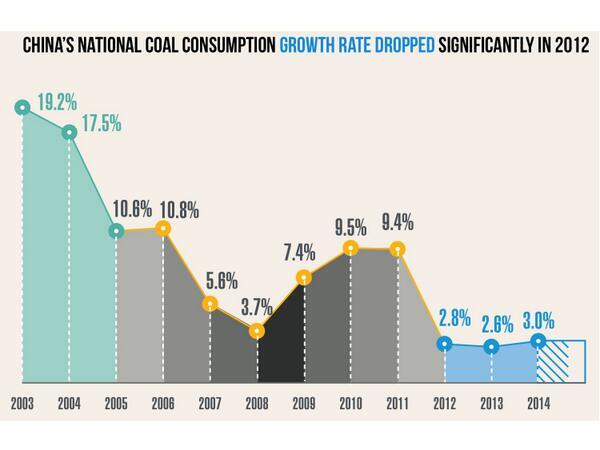
A report from Greenpeace charts slowing growth in China’s coal use.

Through much of its history, Greenpeace has been big on what I call “woe is me, shame on you” messaging on the environment. As I explained at a TEDx event in Portland, Ore., over the weekend, fingerpointing (including Greenpeace’s) is appropriate in many instances, but doesn’t work well with human-driven global warming. The blame game too often ends up resembling a circular firing squad.

This is why “The End of China’s Coal Boom,” a valuable new report from Greenpeace’s East Asia office, is so refreshing and worth exploring. I was led to it by a Twitter item from the group’s outgoing director, Phil Radford, that focused on a telling graphic:

View image on Twitter

via A Green Group Sees Hope in ‘The End of China’s Coal Boom’ – NYTimes.com – NYTimes.com.

Enhanced by Zemanta
16/04/2014

India Signs Power Contracts for 700 Megawatts of Solar Capacity – Businessweek

India signed contracts to purchase solar power from companies building 700 megawatts of capacity awarded in a national auction.

English: Photovoltaic system with 19 Megawatts...

English: Photovoltaic system with 19 Megawatts peak near Thüngen/Bavaria Deutsch: Solarpark/photovoltaikanlage mit 19 Megawatt Spitzenleistung nahe Thüngen/Bayern (Photo credit: Wikipedia)

The government is waiting to sign purchase agreements for the remaining 50 megawatts from the auction in February, Tarun Kapoor, joint secretary at the Ministry of New and Renewable Energy, said today in an interview in New Delhi. The agreements, which lock in rates for the power generated for 25 years, bind developers to complete the plants within 13 months.

Two developers dropped out after winning bids, including St. Peters, Missouri-based SunEdison Inc. (SUNE:US), which said last week it gave up a 20-megawatt project because local equipment shortages and prices make it unviable. The other developer that Kapoor didn’t identify forfeited its project after failing to get permission from its parent to proceed, he said.

via India Signs Power Contracts for 700 Megawatts of Solar Capacity – Businessweek.

Enhanced by Zemanta
11/04/2014

Chinese civil society: Beneath the glacier | The Economist

AGAINST a powerful alliance of factory bosses and Communist Party chiefs, Zeng Feiyang cuts a frail figure. Mr Zeng, who is 39, works from a windowless office in Panyu, on the edge of the southern city of Guangzhou, where he runs a non-governmental organisation (NGO) called the Panyu Migrant Workers’ Service Centre. For more than a decade his organisation has battled against the odds to defend the rights of workers in the factories of Guangdong province. For his troubles, Mr Zeng has been evicted from various premises, had his water and electricity cut off, and been constantly harassed by local officials and their thugs. Then last autumn he received a call from one such official. “The man asked if I wanted to register the NGO,” he says. “I was very surprised.”

Over the past three years other activists at unregistered NGOs have received similar phone calls from the authorities about the sensitive issue of registration, an apparently mundane bit of administrative box-ticking which in fact represents real change. China has over 500,000 NGOs already registered with the state. The number comes with a big caveat. Many NGOs are quasi-official or mere shell entities attempting to get government money. Of those genuine groups that do seek to improve the common lot, nearly all carry out politically uncontentious activities. But perhaps 1.5m more are not registered, and some of these, like Mr Zeng’s, pursue activism in areas which officials have often found worrying.

These unregistered NGOs are growing in number and influence. They are a notable example of social forces bubbling up from below in a stubbornly top-down state. The organisations could be a way for the Communist Party to co-opt the energy and resources of civil society. They could also be a means by which that energy challenges the party’s power. And so their status has big implications. Guo Hong of the Sichuan Academy of Social Sciences in Chengdu calls the liberalisation of NGO registration laws “the partial realisation of freedom of association”. Just as economic liberalisation in the early 1980s had a profound material effect, so these latest moves could have a profound social one.

via Chinese civil society: Beneath the glacier | The Economist.

Enhanced by Zemanta
11/04/2014

In China, Xi’s Anticorruption Drive Nabs Elite, Low Ranks Alike – Businessweek

Chinese President Xi Jinping’s anticorruption campaign has lasted longer, gone deeper, and struck higher than many analysts and academics had expected. Xi has been so zealous that since late last year retired Communist Party leaders including ex-President Jiang Zemin have cautioned him to take a more measured pace and not be too harsh, say Ding Xueliang, a professor of social science at the Hong Kong University of Science & Technology, and Willy Lam, an expert on elite politics at the Chinese University of Hong Kong.

Chinese President Xi Jinping in Berlin on March 28

Xi is cracking down on the army and the police at the same time, something no leader has done before, says Ding. Gu Junshan, a lieutenant general in charge of logistics for the People’s Liberation Army (PLA), has been charged with bribery, embezzlement, and abuse of power, the official Xinhua News Agency reported on March 31. He will be tried in military court.

China’s former top cop and security czar Zhou Yongkang is under investigation for corruption, say Ding and Lam. When asked at a March 2 press conference whether Zhou was under suspicion, a government spokesman avoided a direct answer, saying, “Anyone who violates the party’s discipline and the state law will be seriously investigated and punished, no matter who he is or how high ranking he is.” He added what seems to be a veiled confirmation: “I can only say so much so far. You know what I’m saying.”

More than 180,000 party officials were punished for corruption and abuse of power last year, according to the Central Commission for Discipline Inspection, the party’s watchdog. While most were low-level officials—or “flies,” as Xi has put it—they also included senior party members—“tigers,” in Xi’s words. Thirty-one senior officials were investigated by the commission last year: Eight had their graft cases handed over to prosecutors. The remaining 23 are still being investigated.

via In China, Xi’s Anticorruption Drive Nabs Elite, Low Ranks Alike – Businessweek.

Enhanced by Zemanta
Law of Unintended Consequences

continuously updated blog about China & India

ChiaHou's Book Reviews

continuously updated blog about China & India

What's wrong with the world; and its economy

continuously updated blog about China & India