Archive for ‘government think tank’

29/05/2019

China showing signs similar to Japanese housing bubble that led to its ‘lost decades’, expert warns

  • China’s housing market showing signs of bubble similar to that seen in Japan in 1980s, says Asian Development Bank Institute dean and CEO Naoyuki Yoshino
  • China’s loose policy following 2008 global financial crisis laid foundations for current housing bubble, with US-China trade war adding to concerns
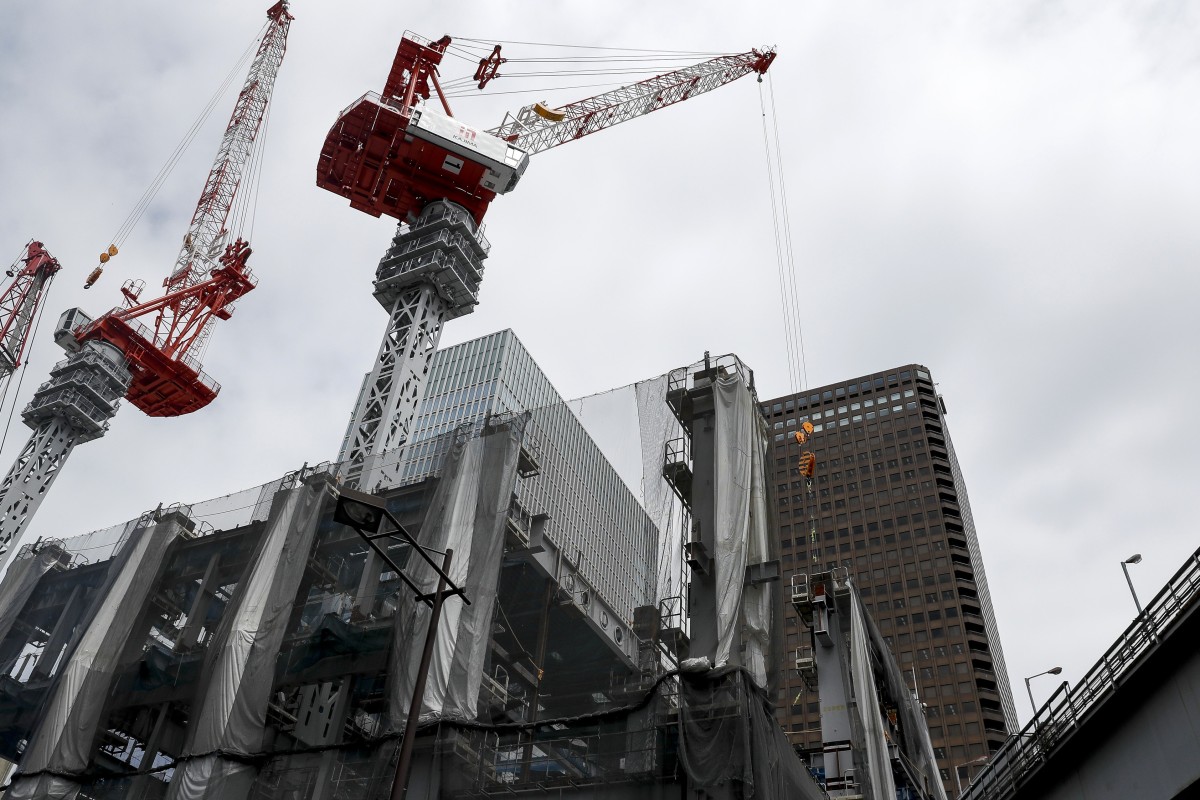
The average price of a home in Beijing has soared from around 380 yuan (US$55) per square feet in the early 2000s to the current level of well above 5,610 yuan (US$813) per square foot, according to property data provider creprice.cn. Photo: Bloomberg
China must exercise extreme caution in handling its housing sector because it is showing signs similar to those witnessed during Japan’s bubble period of the 1980s that contributed to the collapse of Japanese asset prices and its subsequent “lost decades” of weak economic growth and deflation, a Japanese financial system expert warned.
The parallels between China’s current landscape and Japan’s three decades ago are readily apparent, stemming from a loose monetary policy that laid the foundation for the expansion of a housing bubble, said Naoyuki Yoshino, dean and CEO of the Asian Development Bank Institute.
China flooded its economy with credit in response to the 2008 global financial crisis, fuelling rapid growth in mortgages, real estate borrowings and investments over the past decade.
In the same vein, the Japanese government’s relaxed monetary policy in the 1980s triggered an economic bubble that eventually burst and sank the economy into a recession that 
lasted almost 25 years,

with the Bank of Japan continuing to still keep interest rates at or below zero per cent to this day in an attempt to spur inflation.
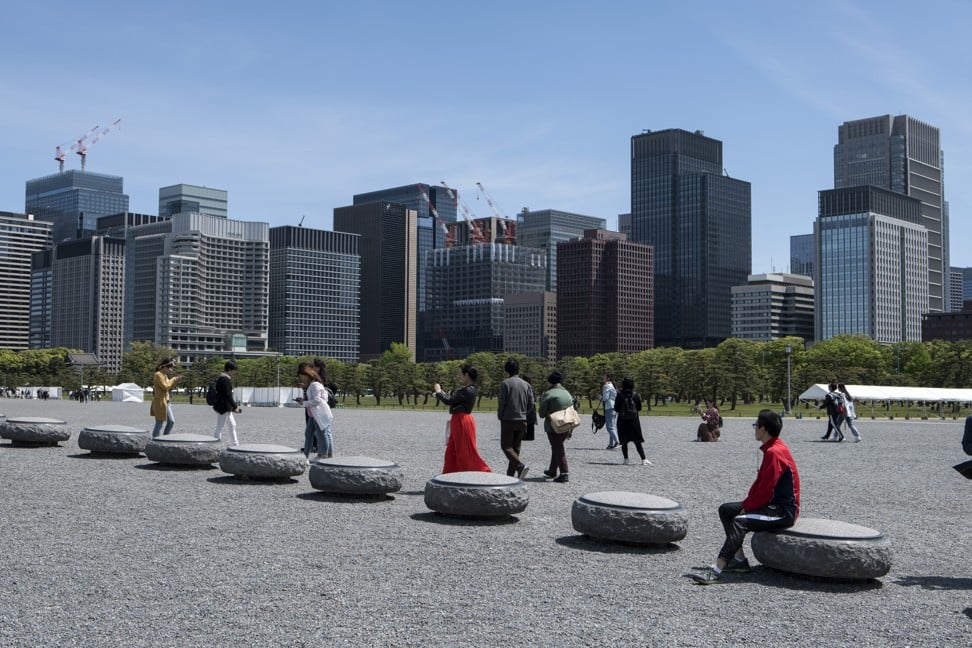
The Japanese government’s relaxed monetary policy in the 1980s triggered an economic bubble that eventually burst and sank the economy into a recession that lasted almost 25 years. Photo: Bloomberg

Japan’s experience could serve as a lesson on how to avoid a housing market collapse that would be especially detrimental to China’s financial sector and real economy, according to Yoshino.

“I’m very much concerned that if land prices keep on rising and if the population starts to shrink along with aggregate demand, then China will experience a similar situation to that of Japan,” Yoshino said.

There are already several strong signs of a housing bubble in China, according to Yoshino, firstly the astronomical surge in property prices in recent years.

I’m very much concerned that if land prices keep on rising and if the population starts to shrink along with aggregate demand, then China will experience a similar situation to that of Japan Naoyuki Yoshino
Home ownership is one of the few ways for Chinese families to generate wealth because of limited investment opportunities. The average price of a home in Beijing has soared from around 4,000 yuan (US$578) per square metre, or 380 yuan (US$55) per square feet, in the early 2000s to the current level of well above 60,000 yuan (US$8,677) per square metre, or 5,610 yuan (US$813) per square foot, according to property data provider creprice.cn.

The increase has also lifted the housing price to income ratio sharply from 5.6 in 1996 to 7.6 in 2013, well above the Japanese rate of 3.0 at its peak in 1988. The price to income ratio is the basic affordability measure for housing.

According to the Global Times, a reasonable home price should be three to six times the median household income. That means a family with an average income can buy a house with three to six years’ annual income. The house price to income ratio in China is above 50 in the first-tier cities and 30 to 40 in the third- and fourth-tier cities, the newspaper said in October. There are four levels of cities in China, defined by a number of factors including gross domestic product (GDP) and population, with Beijing, Shanghai and Shenzhen considered tier-one cities.

Another worrying sign, according to Yoshino, is that China’s financial sector has lent more heavily to the real estate sector than did Japanese banks during their bubble period.

Thirdly, the ratio of Chinese housing loans to the nation’s GDP has consistently been higher than Japan’s by about three times more.

Ever since US President Donald Trump started imposing tariffs on Chinese imports in July, worries have been mounting that China’s property bubble and its record debt level would make the economy vulnerable to the impact of rising trade tensions, leading to a sharper-than-expected economic slowdown.

Despite a government crackdown on debt and risky lending over the last several years, housing prices and bank lending to the sector have continued to rise, pushing homes beyond what the vast majority of people can afford, as well as putting many property developers deeply into debt.

The Chinese Academy of Social Sciences, a top government think tank, said in a report last week that the growth in housing prices in China’s bigger cities, caused by a relatively short supply of new homes, is likely to push up costs across the country.

“The government should closely monitor these cities to avoid overheating,” said Wang Yeqiang, a researcher at the Chinese Academy of Social Sciences who co-authored the report.

Property developers have begun a debt-fuelled land-buying spree just as urban housing demand is entering a long-running structural decline, said Julian Evans-Pritchard, senior China economist at Capital Economics. The potential supply of property that could be built on developers’ land reserves jumped last year to a record high, meaning the risk of a glut of new housing is real, Evans-Pritchard added, if developers were to convert all their land reserves into housing tracts.

“Since real estate drives around a fifth of GDP, a sharp downturn in this sector would be contagious, resulting in a jump in defaults across a wide swathe of the economy that could quickly erode bank capital buffers,” he warned.

China’s corporate debt stood at 155 per cent of GDP in the second quarter of 2018, much higher than other major economies, according to data from the Organisation for Economic Cooperation and Development. In comparison, Japan’s corporate debt level is 100 per cent of GDP and is 74 per cent in the US. China’s corporate debt includes issuances by its 

local government

vehicles which by extension is mostly credit with an implicit guarantee from the central government.

Since real estate drives around a fifth of GDP, a sharp downturn in this sector would be contagious, resulting in a jump in defaults across a wide swathe of the economy that could quickly erode bank capital buffersJulian Evans-Pritchard

China’s imbalance between housing supply and demand may worsen because it faces a similar economic transition that is already well underway in Japan – a

rapidly ageing population

and

shrinking workforce

that led to Japan’s long-term deflation problem, said Yoshino, who is also the chief adviser to the Japan Financial Services Agency’s Financial Research Centre.
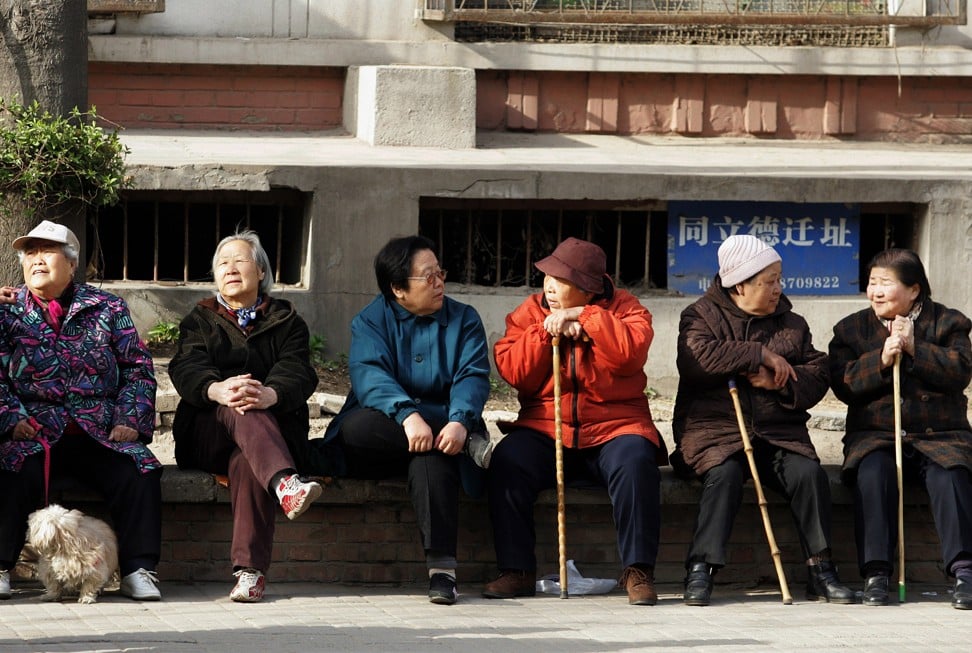
Even if rising housing demand due to urbanisation were to push China’s housing prices higher over the near term, the country faces risks from an oversupply of housing in the longer term due to its increasingly unbalanced demographic structure, he said.
The government has proposed that China’s retirement ages of 45 to 50 years for females and 55 to 60 years for males introduced in the 1980s be gradually increased to 65 years for both by 2045 due to a rapidly ageing population.
The rising population of retirees will consume fewer goods and services compared to younger families with children, and in turn, could dampen business investment given lower expected rates of return.
At the same time, more retirees means a bigger burden on the younger generation of taxpayers, which would reduce their wealth and change patterns of consumption. This is especially worrying on the back of China’s high debt level and pension funding gap, similar to the situation in Japan, Yoshino said.
In Japan, benefits from government pension schemes account for an increasing share of the country’s accumulated debt as spending on social protection programmes now represents more than a third of the government’s total budget.
China’s national pension fund is forecast to peak at 6.99 trillion yuan (US$1 trillion) in 2027 before it gradually runs out by 2035, according to the Chinese Academy of Social Sciences. Photo: AFP
The strain is also evident in China with the

national pension fund

forecast to peak at 6.99 trillion yuan (US$1 trillion) in 2027 before it gradually runs out by 2035, according to the Chinese Academy of Social Sciences, forcing the government to start to transfer assets from state-owned companies to fill the funding gap.

Against the broader economic slowdown, compounded by the trade war with the US, policymakers are also expected to carve out a highly expansionary fiscal budget for this year, with the broad deficit surging to 6.6 per cent of China’s GDP, up from 4.7 per cent last year, according to Larry Hu, head of China economics at Macquarie Capital.

Alicia Garcia Herrero, Asia-Pacific chief economist at Natixis, noted that the US criticisms of China’s unfair trade practises and currency manipulation were reminiscent of the US-Japan disputes in the 1980s and 1990s.

Because Japan was politically and economically dependent on the US at that time, it inevitably implemented economic policies to reduce its current account surplus. Subsequently, Japan suffered from the bursting of its asset price bubble, which led to deflation and the lost decades.

However, Herrero said that the modern China is less dependent on the US and so is in a better position to resist pressure to adjust its economic policies to create demand for American products.

Wang Yang, one of the seven members of China’s elite Politburo Standing Committee, said the US-China trade war could slash one percentage point off Beijing’s economic growth this year. Last year, growth expanded at its slowest pace since 1990, while corporate bond defaults hit a record high and banks’ non-performing loan ratio hit a 10-year high.

Source: SCMP
08/05/2019

India election 2019: How sugar influences the world’s biggest vote

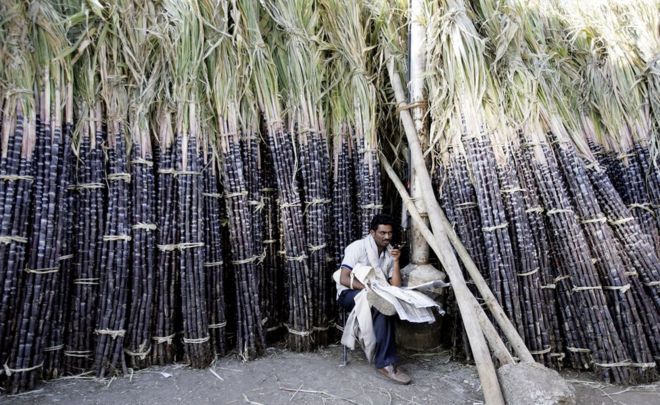
An Indian vendor sits among sugarcane kept at the main wholesale market ahead of celebrations surrounding the festival of Pongal in Bangalore,Image copyright AFP
Image caption Some 30 million farmers are engaged in cane farming in India

When Prime Minister Narendra Modi held a recent election meeting in the northern Indian state of Uttar Pradesh, he was compelled to make a promise relating to sugar, a diet staple.

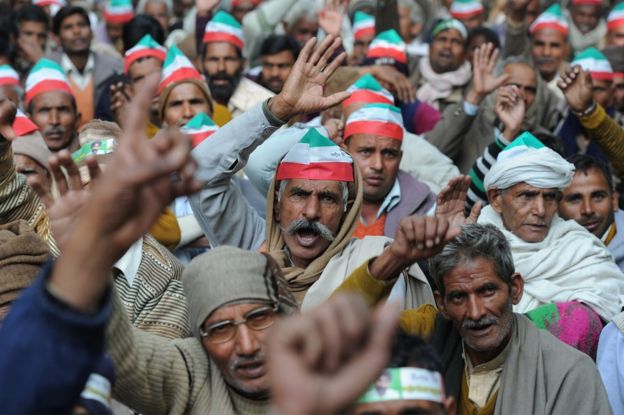
Farmers who grow cane in the politically crucial state ruled by Mr Modi’s Bharatiya Janata Party (BJP) were angry because sugar mills had not paid their dues in time. They held protests and blocked railway tracks. “I know there are cane dues. I will make sure every penny of yours will be paid,” Mr Modi told the audience.

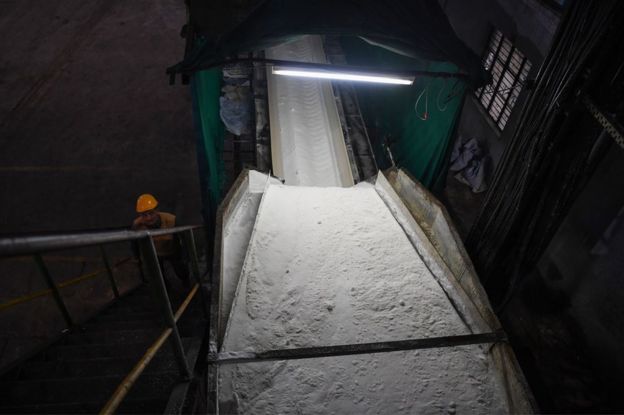
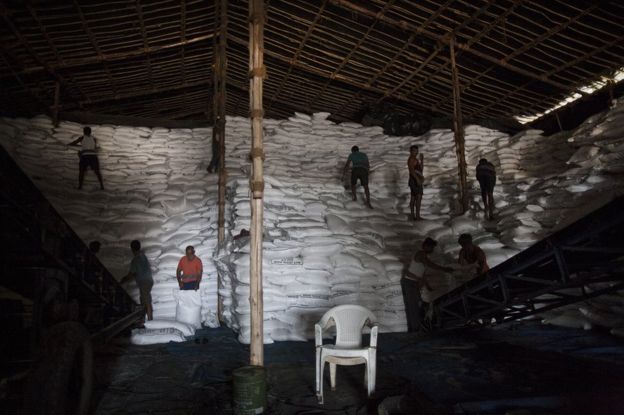
India’s sugar mills are bleeding money and collectively owe billions of dollars to 50 million cane farmers, many of whom haven’t been paid for nearly a year. Niti Ayog, a government think tank, says the arrears have reached “alarming” levels. More than 12 million tonnes of unsold sugar have piled up in factories. There is little incentive to export more as India’s sugar price is higher than the international price.

Sugar is serious business in India. Around 525 mills produced more than 30 million tonnes of sugar in the last crushing season, which lasted from October to April. This makes it the world’s largest producer, unseating Brazil. A large number of mills are run by cooperatives where farmers own shares proportional to the land they own and pledge their produce to the mill.

An Indian worker is pictured next to a sugarcane processing unit at the Triveni sugar refining factory in Sabitgarh village, in Bulandshahr district in the northern state of Uttar Pradesh.Image copyrightAFP
Image captionIndia is the world’s largest producer of sugar

That’s not all. Some 50 million farmers, tightly concentrated geographically, are engaged in cane farming. Millions more work in the mills and farms and are engaged in transportation of cane.

As with much of India’s politics, cane growers appear to be a reliable “vote bank”. Uttar Pradesh and Maharashtra, which together produce 60% of the country’s sugar, send 128 MPs to the parliament. The price of cane can swing votes in more than 150 of the 545 seats in the ongoing general election, according to one estimate. Sugar is possibly the “most politicised crop in the world”, says Shekhar Gaikwad, the sugar commissioner of Maharashtra.

Presentational grey line

India votes 2019

Presentational grey line

Indians are also voracious consumers of sugar. The bulk of the supply goes into making sweets, confectionary and fizzy drinks that are beginning to contribute to a rising obesity problem, like elsewhere in the world. “The world’s sweet tooth continues to rely on cane sugar, much as it did four centuries ago,” says James Walvin, author of How Sugar Corrupted the World.

Indian sugarcane farmers shout slogans during a protest in New Delhi on December 4,2012Image copyright AFP
Image caption Cane farmers have held protests, demanding higher crop prices

On the face of it, cane growers and owners of sugar mills should be happy.

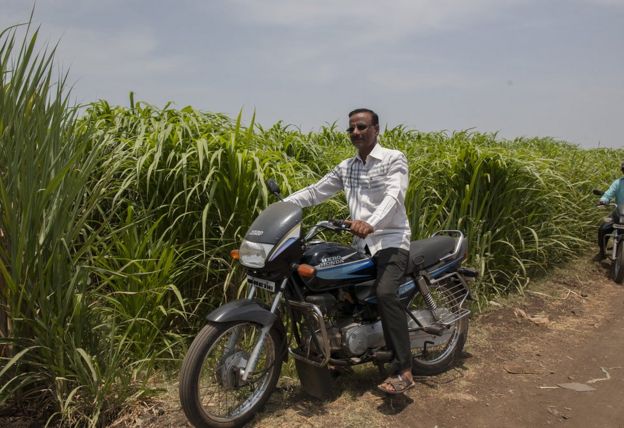
The government sets cane and sugar prices, allocates production and export quotas, and hands out ample subsidies. State-run banks give crop loans to farmers and production loans to mills. When mills run out of cash, public funds are used to bail them out. “I earn around 7,000 rupees ($100; £76) from growing sugar every month. It’s not a lot of money, but it’s an assured income,” says Sanjay Anna Kole, a fourth-generation, 10-acre cane farm owner in Maharashtra’s Kolhapur district.

But protectionism may be yielding diminishing returns. Generous price support for the crop means the price at which mils buy cane has outstripped the price at which they sell sugar. Among large producers – Thailand, Brazil and Australia – India pays the highest cane price to farmers. It also spends more than Brazil, for example, in producing sugar.

Sanjay Anna KoleImage copyrightMANSI THAPLIYAL
Image captionFarmer Sanjay Anna Kole says cane farming provides an ‘assured income’

The involvement of politicians may not be helping matters. Since the inception of the first mills in the 1950s, politicians have owned or gained control of them by winning mill co-operative elections. Almost half a dozen ministers in Maharashtra, India’s second-biggest cane growing state, own sugar mills.

A study on the links between politicians and sugar mills by Sandip Sukhtankar, associate professor of economics at University of Virginia, found that 101 of the 183 mills – for which data was available – in Maharashtra had chairmen who competed for state or national elections between 1993 and 2005.

He also found that cane prices paid by “politically controlled” mills fell during election years, and that this was not entirely due to loss of productivity.

These mills have also been blamed for holding on to arrears and releasing them before elections to win over voters; and political parties have been accused of using money from the mills to finance campaigns. “One would think that perhaps political parties that don’t benefit from links to sugar might have incentives to reform the sector, but we have seen parties everywhere want a piece of the action,” says Dr Sukhtankar. “There are resources in the sugar industry to be extracted for political purposes.”

Sugar stocked in Maharashtra factoryImage copyright MANSI THAPLIYAL
Image caption Sugar stocks have piled up in factories across India

Whatever the case, India’s world-beating crop is mired in crisis. The farmers and the mills grumble that they aren’t getting a fair price for their crop and sugar respectively. “It looks like a sunset industry for me. There’s no future in cane until the government completely overhauls farm policies,” Suresh Mahadev Gatage, an organic cane-grower in Kolhapur, told me.

The unrest among the farmers is worrying. In January, several thousand angry cane farmers descended on Shekhar Gaikwad’s office in the city of Pune, demanding the mills pay their dues in time. The negotiations lasted 13 hours.

One of the farmers’ demands was to arrest a state minister, who was heading three mills in the state, and had defaulted on his cane dues. When negotiations ended way past midnight, authorities issued orders to seize sugar from the offending mills and sell it in retail. In India’s lumbering bureaucracy, that took another eight hours because 500 copies of the orders had to be printed. “My office is pelted by stones every other day by irate farmers,” says Mr Gaikwad.

Suresh Mahadev GatageImage copyright MANSI THAPLIYAL
Image caption Cane grower Suresh Mahadev Gatage says there is ‘no future in cane’

Meanwhile, what is completely forgotten is how much sugar has hurt India’s ecology. More than 60% of the water available for farming in India is consumed by rice and sugar, two crops that occupy 24% of the cultivable area. Experts say crop prices should begin to reflect the scarcity and economic value of water.

But before that, as Raju Shetti, MP and a prominent leader of sugarcane farmers, says, price controls should be eased and bulk corporate buyers like soft drink companies and pharmaceuticals should pay more for sugar.

“We need differential pricing for sugar. Cheap sugar should be only provided to people who can’t afford it. The rest should pay a higher price,” he told me.

“Otherwise, the industry will collapse, and farmers will die. Even politicians will not be able to save it.”

Source: The BBC

Law of Unintended Consequences

continuously updated blog about China & India

ChiaHou's Book Reviews

continuously updated blog about China & India

What's wrong with the world; and its economy

continuously updated blog about China & India