22/05/2020
- The tech investment push is part of a fiscal package waiting to be signed off by the National People’s Congress, which convenes this week
- This initiative will reduce China’s dependence on foreign technology, echoing objectives set forth previously in the ‘Made in China 2025’ programme
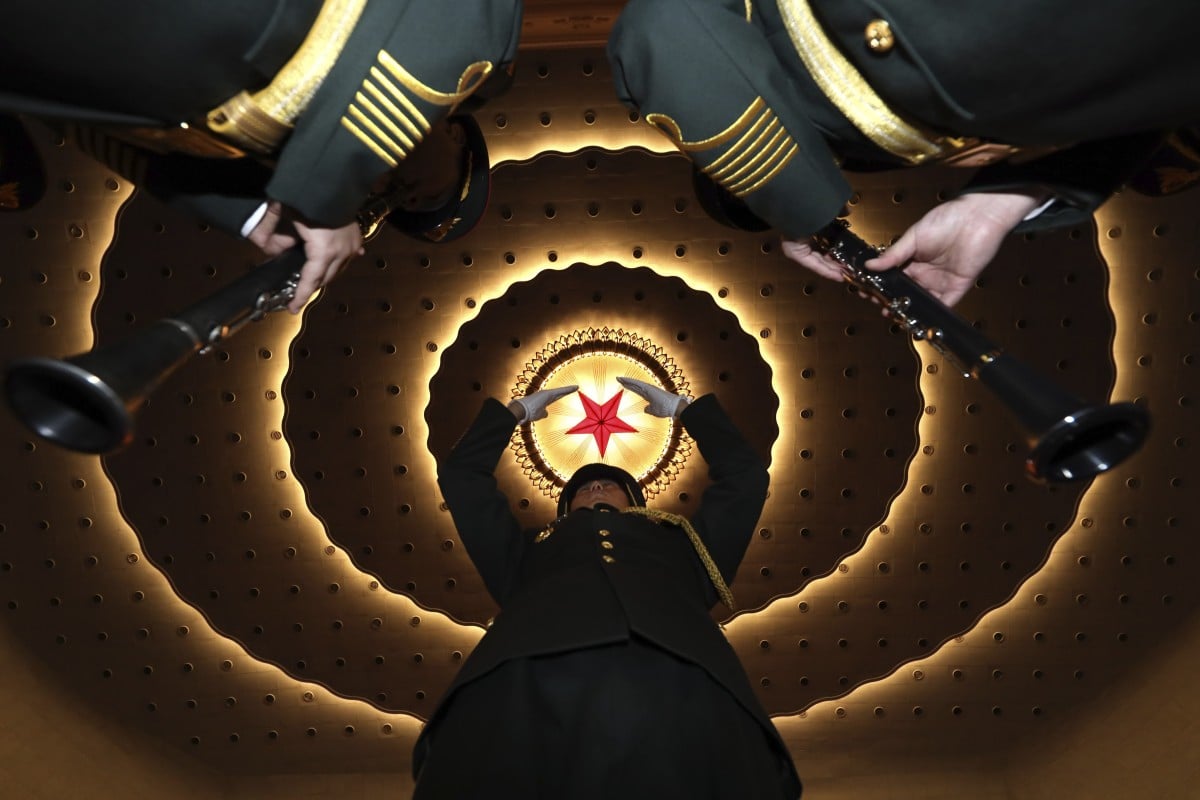
A conductor rehearses the military band on the sidelines of the National People’s Congress in Beijing’s Great Hall of the People in March of last year. China’s legislature is expected to sign off on a massive tech-led stimulus plan. Photo: AP
Beijing is accelerating its bid for global leadership in key technologies, planning to pump more than a trillion dollars into the economy through the roll-out of everything from next-generation wireless networks to artificial intelligence (AI).
In the master plan backed by President Xi Jinping himself, China will invest an estimated 10 trillion yuan (US$1.4 trillion) over six years to 2025, calling on urban governments and private hi-tech giants like Huawei Technologies to help lay 5G wireless networks, install cameras and sensors, and develop AI software that will underpin
to automated factories and mass surveillance.
The new infrastructure initiative is expected to drive mainly local giants, from
and Huawei to SenseTime Group at the expense of US companies.
As tech nationalism mounts, the investment drive will reduce China’s dependence on foreign technology, echoing objectives set forth previously in the “Made in China 2025”
programme. Such initiatives have already drawn fierce criticism from the Trump administration, resulting in moves to block the rise of Chinese tech companies such as Huawei.
How will China’s annual legislative meetings affect the stock investor? Five key industries to watch
“Nothing like this has happened before, this is China’s gambit to win the global tech race,” said Digital China Holdings chief operating officer Maria Kwok, as she sat in a Hong Kong office surrounded by facial recognition cameras and sensors. “Starting this year, we are really beginning to see the money flow through.”
The tech investment push is part of a fiscal package waiting to be signed off by China’s legislature, the
National People’s Congress, which convenes this week. The government is expected to announce infrastructure funding of as much as US$563 billion this year, against the backdrop of the country’s worst economic performance since the Mao era.
The nation’s biggest purveyors of cloud computing and data analysis Alibaba, the parent company of the
South China Morning Post, and
Tencent Holding will be linchpins of the upcoming endeavour. China has already entrusted Huawei, the world’s largest telecommunications equipment supplier, to help galvanise 5G. Tech leaders including Pony Ma Huateng and
Jack Ma are espousing the programme.
Maria Kwok’s company is a government-backed information technology systems integration provider, among many that are jumping at the chance. In the southern city of Guangzhou, Digital China is bringing half a million units of project housing online, including a complex three quarters the size of Central Park in New York City. To find a home, a user just has to log on to an app, scan their face and verify their identity. Leases can be signed digitally via smartphone and the renting authority is automatically flagged if a tenant’s payment is late.
China is no stranger to far-reaching plans with massive price tags that appear to achieve little. There is no guarantee this programme will deliver the economic rejuvenation its proponents promise. Unlike previous efforts to resuscitate the economy with “dumb” bridges and highways, this newly laid digital infrastructure will help national champions develop cutting-edge technologies.
“China’s new stimulus plan will likely lead to a consolidation of
industrial internet
providers, and could lead to the emergence of some larger companies able to compete with global leaders, such as GE and Siemens,” said Nannan Kou, head of research at BloombergNEF, in a report. “One bet is on industrial
internet-of-things (IoT) platforms, as China aims to cultivate three world leading companies in this area by 2025.”
China is not alone in pumping money into the technology sector as a way to get out of the post-coronavirus economic slump. Earlier this month, South Korea said AI and wireless communications would be at the core of it its “New Deal” to create jobs and boost growth.
Nothing like this has happened before, this is China’s gambit to win the global tech raceMaria Kwok, COO at Digital China Holdings
The 10 trillion yuan that China is estimated to spend from now until 2025 encompasses areas typically considered leading edge, such as AI and IoT, as well as items such as ultra-high voltage lines and high-speed rail, according to the government-backed China Centre for Information Industry Development. More than 20 of mainland China’s 31 provinces and regions have announced projects totaling over 1 trillion yuan with active participation from private capital, a state-backed newspaper reported on Wednesday.
Separate estimates by Morgan Stanley put new infrastructure at around US$180 billion each year for the next 11 years – or US$1.98 trillion in total. Those calculations also include power and rail lines. That annual figure would be almost double the past three-year average, the investment bank said in a March report that listed key stock beneficiaries including companies such as China Tower Corp, Alibaba, GDS Holdings, Quanta Computer and Advantech Co.
Beijing’s half-formed vision is already stirring a plethora of stocks, a big reason why five of China’s 10 best-performing stocks this year are tech plays like networking gear maker Dawning Information Industry and Apple supplier GoerTek. The bare outlines of the master plan were enough to drive pundits toward everything from satellite operators to broadband providers.
China’s telecoms carriers push to complete ‘political task’ of 5G network roll-out amid coronavirus crisis
It is unlikely that US companies will benefit much from the tech-led stimulus and in some cases they stand to lose existing business. Earlier this year, when the country’s largest telecoms carrier China Mobile awarded contracts worth 37 billion yuan for 5G base stations, the lion’s share went to Huawei and other Chinese companies. Sweden’s Ericsson got only a little over 10 per cent of the business in the first four months. In one of its projects, Digital China will help the northeastern city of Changchun swap out American cloud computing staples IBM, Oracle and EMC with home-grown technology.
It is in data centres that a considerable chunk of the new infrastructure development will take place. Over 20 provinces have launched policies to support enterprises using cloud computing services, according to a March research note from UBS Group.
Tony Yu, chief executive of Chinese server maker H3C, said that his company was seeing a significant increase in demand for data centre services from some of the country’s top internet companies. “Rapid growth in up-and-coming sectors will bring a new force to China’s economy after the pandemic passes,” he told Bloomberg News.
From there, more investment should flow. Bain Capital-backed data centre operator ChinData Group estimated that for every one dollar spent on data centres another US$5 to US$10 in investment in related sectors would take place, including in networking, power grid and advanced equipment manufacturing. “A whole host of
supply chain companies will benefit,” the company said in a statement.
There is concern about whether this long-term strategy provides much in the way of stimulus now, and where the money will come from. “It’s impossible to prop up China’s economy with new infrastructure alone,” said Zhu Tian, professor of economics at China Europe International Business School in Shanghai. “If you are worried about the government’s added debt levels and their debt servicing abilities right now, of course you wouldn’t do it. But it’s a necessary thing to do at a time of crisis.”
Digital China is confident that follow-up projects from its housing initiative in Guangzhou could generate 30 million yuan in revenue for the company. It is also hoping to replicate those efforts with local governments in the northeastern province of Jilin, where it has 3.3 billion yuan worth of projects approved. These include building a so-called city brain that will for the first time connect databases including traffic, schools and civil matters such as marriage registry. “The concept of smart cities has been touted for years but now we are finally seeing the investment,” said Kwok.
Source: SCMP
Posted in 5G network roll-out, 5G wireless networks, accelerating, Advantech Co, Alibaba Group Holding, American cloud computing, Apple, artificial intelligence (AI), automated factories, autonomous driving, ‘political task’, Bain Capital, Beijing, BloombergNEF, broadband providers, cameras and sensors, Central Park, Changchun, China, China Centre for Information Industry Development, China Europe International Business School, China Mobile, China Tower Corp, civil matters, conductor, coronavirus crisis, cutting-edge technologies, data centres, Dawning Information Industry, dependence, Digital China, Digital China Holdings, digital infrastructure, economic rejuvenation, EMC, Ericsson, everything, facial recognition cameras and sensors, foreign, GDS Holdings, GE, global leadership, GoerTek, Great Hall of the People, Guangzhou, H3C, High-speed rail, Huawei, huawei technologies, IBM, industrial internet, Infrastructure, install, internet-of-things (IoT), Jack Ma, Jilin, key technologies, linchpins, local governments, Made in China 2025, marriage registry, mass surveillance, master plan, military band, national champions, National People’s Congress, networking gear maker, New York City, next-generation wireless networks, northeastern province, Oracle, plan, planning, Pony Ma Huateng, President Xi Jinping, private hi-tech giants, pundits, Quanta Computer, rehearses, roll out, satellite operators, schools, SenseTime Group, Shanghai, Siemens, south china morning post, South Korea, tech crown, Technology, telecommunications equipment supplier, telecoms carriers, Tencent Holding, to pump, to seize, traffic, trillion dollars, UBS Group, ultra-high voltage lines, Uncategorized, urban governments, wireless communications, world’s |
Leave a Comment »
21/05/2020
The third session of the 13th National Committee of the Chinese People’s Political Consultative Conference (CPPCC) opens at the Great Hall of the People in Beijing, capital of China, May 21, 2020. (Xinhua/Li Tao)
BEIJING, May 21 (Xinhua) — China’s top political advisory body started its annual session Thursday afternoon in Beijing.
Xi Jinping and other Chinese leaders attended the opening meeting of the third session of the 13th National Committee of the Chinese People’s Political Consultative Conference (CPPCC), held at the Great Hall of the People.
Attendees at the meeting paid a silent tribute to martyrs who died fighting COVID-19 and compatriots who lost their lives in the epidemic.
The agenda for the session was reviewed and approved at the meeting.
Wang Yang, chairman of the CPPCC National Committee, delivered a work report of the Standing Committee of the CPPCC National Committee to the session.
The report noted the role of political advisors in the fight against the COVID-19 epidemic, saying that they have submitted more than 1,300 reports and suggestions on preventing and controlling the epidemic, resuming work and production, stabilizing public expectations and strengthening law-based governance.
Giving full play to role of the CPPCC as a specialist consultative body, 71 consultation meetings, 97 research trips as well as online consultations were organized in the past year, it said.
The report made arrangements for the CPPCC’s work in 2020 in six aspects, urging political advisors to fulfil their duties around achieving a moderately prosperous society in all respects.
Attendees were also briefed on the handling of proposals submitted since the previous annual session of the top political advisory body.
Source: Xinhua
Posted in advisory body, annual session, Beijing, capital, China, compatriots, COVID-19, died, epidemic, fighting, Great Hall of the People, martyrs, National Committee of the Chinese People's Political Consultative Conference (CPPCC), paid, political, silent tribute, starts, top, Xi JinPing |
Leave a Comment »
16/03/2020
BEIJING (Reuters) – China tentatively plans to hold its delayed annual gathering of parliament in late April or early May, two people involved in preparations told Reuters, as new coronavirus cases in the country drop sharply even as they surge elsewhere.
The annual meetings of the National People’s Congress (NPC) and the Chinese People’s Political Consultative Conference (CPPCC), known as the “two sessions”, were scheduled for early March but were delayed due to the virus outbreak, with no new date announced.
Holding the events, which typically draw a combined 5,000 delegates to Beijing’s Great Hall of the People, would be a major indication that the Chinese leadership sees things as returning to normal.
The State Council Information Office and the media department of the Standing Committee of the NPC did not immediately respond to faxed requests for comment on Monday.
The outbreak that originated in the central city of Wuhan has infected more than 80,000 people in the country, killed 3,200 and wreaked economic havoc, causing factory output to plunge at the sharpest pace in three decades.
The NPC’s timing is not finalised, and one of the people said the number of attendees may be reduced, with those visiting from outside Beijing needing to undergo quarantine.
People now arriving in the capital from elsewhere in China must spend two weeks in quarantine.
“We still have to play it by ear, as the coronavirus rapidly spreads across the world,” said the person, declining to be identified given the sensitivity of the matter.
The NPC, China’s parliament, usually sits for at least 10 days. The CPPCC, a largely ceremonial advisory body, runs in parallel.
During parliament, legislators pass laws and unveil economic targets, defence spending projections and other important policy decisions. It is also an occasion for China’s ruling Communist Party to announce major policy and personnel changes.
This year, the NPC is expected to discuss the recent months of anti-government protests in Hong Kong, with China’s economy also expected to be a key item on the agenda.
Source: Reuters
Posted in Beijing’s, China, Chinese People’s Political Consultative Conference (CPPCC), Communist Party, economic havoc, eyes, Great Hall of the People, Hong Kong, National People’s Congress (NPC), outbreak, parliament, rescheduled, Standing Committee of the NPC, State Council Information Office, Uncategorized, Wuhan |
Leave a Comment »
28/02/2020

Chinese President Xi Jinping holds talks with Mongolian President Khaltmaa Battulga at the Great Hall of the People in Beijing, capital of China, Feb. 27, 2020. (Xinhua/Liu Bin)
BEIJING, Feb. 27 (Xinhua) — Chinese President Xi Jinping Thursday held talks with Mongolian President Khaltmaa Battulga at the Great Hall of the People in Beijing.
Xi said the Chinese government and people are making all-out efforts to fight the novel coronavirus outbreak (COVID-19), during which the Mongolian government and people have offered precious support.
Hailing Battulga as the first foreign head of state to visit China since the outbreak, Xi said the special visit by Battulga to express consolations and support to China fully embodies the high attention he pays to the China-Mongolia ties and the profound friendship between the two peoples.
This vividly shows that China and Mongolia, as neighboring countries, can rely on each other in difficult times, said Xi.
Xi expressed his welcome as Battulga paid the visit only one day after Mongolia’s traditional Tsagaan Sar holiday, and sent festive greetings to the Mongolian people.
Xi said that since the outbreak of COVID-19, the Communist Party of China (CPC) and the Chinese government have attached great importance to the epidemic, activated a national response mechanism and taken the most comprehensive, thorough and rigorous measures.
A leading group of the CPC Central Committee on the prevention and control of the COVID-19 was established immediately and a central government guiding team was sent to Hubei province, said Xi.
After arduous work, the positive trend in the prevention and control work is now expanding, Xi said, adding that the country has full confidence, capability to win this battle against the epidemic.
China has coordinated the prevention and control work with the economic and social development, and tried its best to minimize the impact of the epidemic, he said.
According to Xi, China has adopted a targeted approach in different regions to advance resumption of work and production based on local health risks, ensure timely agriculture work in spring and guarantee people’s basic livelihood.
Noting that China’s economy is resilient with broad domestic demand and a strong industrial basis, Xi said China will strive to meet this year’s economic and social development targets.
Xi said that guided by the vision of a community with a shared future for humanity, China is making every effort not only to protect the life and health of its own people but also to contribute to global public health security.
With an open, transparent and responsible attitude, the Chinese government has actively stepped up international cooperation on fighting the outbreak, said Xi, adding that China’s efforts have been highly affirmed and recognized by the World Health Organization and the international community.
China will continue to work with countries including Mongolia to fight the epidemic and safeguard regional and global public health security, he said.
Noting that China and Mongolia are friendly neighbors linked by waters and mountains, Xi said China has attached high importance to the bilateral relations and always taken Mongolia as an important direction of China’s neighborhood diplomacy.
China is committed to cementing political mutual trust with Mongolia and enhancing Belt and Road cooperation to benefit both peoples, he said.
Battulga expressed consolations to the Chinese people over the outbreak and spoke highly of China’s rapid establishment of a joint prevention and control mechanism and national people-oriented efforts to fight the epidemic.
Stressing that Mongolia and China are comprehensive strategic partners, Battulga said the Mongolian people completely relate to what the Chinese people are going through and would like to stand closely together with the Chinese people in the difficult times.
Mongolia launched fund-raising activities to support China’s fight against the epidemic, and received active responses from all walks of life, he said, adding that Mongolia will send additional 30,000 sheep apart from the previous donations.
Battulga said he believes that the Chinese people will definitely win the battle against the epidemic at an early date and overcome the difficulties to realize the set goals of social and economic development under the strong leadership of President Xi.
Mongolia commends China’s pursuit of neighborhood diplomacy featuring amity, sincerity, mutual benefit and inclusiveness, and stands ready to work with China to deepen mutual trust and support, enhance cooperation to promote greater development of bilateral relations, said Battulga.
Source: Xinhua
Posted in China-Mongolia ties, chinese government, Chinese President Xi Jinping, Communist Party of China (CPC), coronavirus outbreak, COVID-19, Great Hall of the People, Tsagaan Sar holiday, Uncategorized |
Leave a Comment »
18/02/2020
- China was widely expected to announce a gross domestic product (GDP) growth target for 2020 of ‘around 6 per cent’ following 6.1 per cent growth in 2019
- Zhang Yansheng, who is an adviser to China’s economic policymakers, says ‘there will definitely be adjustments’
(190305) — BEIJING, March 5, 2019 (Xinhua) — Xi Jinping (C, front), Li Keqiang (3rd R, front), Wang Yang (3rd L, front), Wang Huning (2nd R, front), Zhao Leji (2nd L, front), Han Zheng (1st R, front) and Wang Qishan (1st L, front) attend the opening meeting of the second session of the 13th National People’s Congress at the Great Hall of the People in Beijing, capital of China, March 5, 2019. (Xinhua/Li Xueren)
China may revise down its annual economic growth target for 2020 in response to the impact of the coronavirus outbreak, but will still not give up the overall target of maintaining economic growth “in a reasonable range”, according to a Chinese government researcher.
The Chinese government has never officially published its goal for 2020, but it is widely expected that the specific gross domestic product (GDP) growth target for 2020
would be “around 6 per cent”, marking a potential slight slowdown from
6.1 per cent growth in 2019 but enough to achieve Beijing’s grand goal of
doubling the size of its economy in 2020 from 2010.
China’s 2020 growth target was originally to be released during Premier Li Keqiang’s government work report at the National People’s Congress, but the March 5 annual parliamentary meeting is set to be postponed due to the coronavirus outbreak.
“There will definitely be adjustments. For the central government, it hasn’t defined what the ‘reasonable range’ should be after the outbreak of coronavirus. People are still watching how the outbreak will develop and influence the economy,” Zhang Yansheng, the chief research fellow at the Beijing-based think tank, the China Centre for
International Economic Exchanges, told the South China Morning Post on Tuesday.
As for the final GDP target figure, we have to be true to facts. The GDP target was not a compulsory requirement but a soft forecast figureZhang Yansheng
“As for the final GDP target figure, we have to be true to facts. The GDP target was not a compulsory requirement but a soft forecast figure – strictly speaking, a forecast figure could be revised three or four times in a year.”
Zhang, though, referenced the fact that 29 of China provincial-level regions, out of a total of 31, had published their 2020 economic growth targets at the Central Economic Work Conference in December.
“The direction and the goals are clear. It’s not the case that people have not known what they should do this year,” added Zhang, who is an adviser to China’s economic policymakers.
has repeatedly said over the last two weeks that China will still strive to achieve its economic and social development goals for 2020 despite the outbreak, which has claimed over 1,800 lives and infected over 70,000 people, and remain on course to build the country into a “comprehensively well-off society”.
China to postpone the year’s biggest political gathering amid coronavirus outbreak
One key aspect of that vision is that China will
double the size of its GDP in 2020 from 2010, which would require a minimum 5.6 per cent growth rate in 2020, although Beijing has never clearly defined the full details of the goal.
On Tuesday, Ren Hongbin, vice-chairman of the State-owned Assets Supervision and Administration Commission of the State Council, said that the annual production goals and reform tasks set earlier in the year for state-owned enterprises would also not change despite the outbreak.
“The impact of the epidemic is temporary and phased, will not change the long-term positive fundamentals of the Chinese economy,” he said.
We should neither view 6 per cent as a red line nor take doubling the GDP size as a bottom line Song Xiaowu
Before the country fell into an economic standstill around the extended Lunar New Year holiday as the
virus spread from the city of Wuhan, economists and analysts have been engaged in a heated debate over whether China needs to keep its growth rate above 6 per cent in 2020.
Song Xiaowu, former president of the China Society of Economic Reform, a state-backed think tank, said at a forum on Saturday that China’s GDP growth rate could drop to 3 per cent in the first quarter and 5 per cent for the whole of 2020.
“We should neither view 6 per cent as a red line nor take doubling the GDP size as a bottom line,” said Song, in a speech published by the China Development Research Foundation, who organised the forum.
Source: SCMP
Posted in 13th National People's Congress (NPC), 2020, adjust, Beijing, capital, China, China Development Research Foundation, China Society of Economic Reform, coronavirus, government policy adviser, Great Hall of the People, Han Zheng, Li Keqiang, Premier Li Keqiang’s, President Xi Jinping, Ren Hongbin, State Council, State-owned Assets Supervision and Administration Commission, target, Uncategorized, Wang Huning, Wang Qishan, wang yang, Wuhan, Xi JinPing, Zhao Leji |
Leave a Comment »
29/01/2020

Chinese President Xi Jinping meets with visiting World Health Organization (WHO) Director-General Tedros Adhanom Ghebreyesus at the Great Hall of the People in Beijing, capital of China, Jan. 28, 2020. (Xinhua/Ju Peng)
BEIJING, Jan. 28 (Xinhua) — Chinese President Xi Jinping said Tuesday that China has full confidence and capability to win the battle against the outbreak of pneumonia caused by the novel coronavirus (2019-nCoV).
Meeting with visiting World Health Organization (WHO) Director-General Tedros Adhanom Ghebreyesus at the Great Hall of the People in Beijing, Xi said the safety of people’s lives and their health always come first, and thus the prevention and control of the novel coronavirus outbreak is the country’s most important work for now.
The WHO is welcome to participate in the epidemic prevention and control, Xi said, stressing that China is ready to work with the WHO as well as the international community to safeguard regional and global public health security.
Source: Xinhua
Posted in Beijing, Chinese President Xi Jinping, coronavirus (2019-nCoV), global public health security, Great Hall of the People, Uncategorized, World Health Organization (WHO) |
Leave a Comment »
23/01/2020
 Chinese President Xi Jinping, also general secretary of the Communist Party of China (CPC) Central Committee and chairman of the Central Military Commission, addresses a Chinese Lunar New Year reception at the Great Hall of the People in Beijing, capital of China, Jan. 23, 2020. The CPC Central Committee and the State Council held the reception on Thursday in Beijing. (Xinhua/Yao Dawei)
BEIJING, Jan. 23 (Xinhua) — Chinese President Xi Jinping on Thursday stressed racing against time and keeping abreast with history to reach the Chinese Dream of national rejuvenation.
“Time and history wait for no one as they are both on the side of hard workers,” said Xi, also general secretary of the Communist Party of China (CPC) Central Committee and chairman of the Central Military Commission.
Xi made the remarks while addressing a Chinese Lunar New Year reception held at the Great Hall of the People in Beijing.
Under the strong leadership of the CPC, all members of the Party, armed forces and people of all ethnic groups must fear no wind or wave, rise up to challenges and keep marching toward the glorious goal of national rejuvenation and the great prospect of building a community with a shared future for humanity, Xi said.
At the reception, held by the CPC Central Committee and the State Council, Xi extended Lunar New Year’s greetings to Chinese people of all ethnic groups, compatriots in Hong Kong, Macao and Taiwan and overseas Chinese.
Party and state leaders Li Keqiang, Li Zhanshu, Wang Yang, Wang Huning, Zhao Leji, Han Zheng and Wang Qishan were among the more than 2,000 people attending the reception. Li Keqiang chaired the event.
Xi noted in his speech that new and significant progress has been made in the past year toward building a moderately prosperous society in all respects.
He mentioned major events during the year, including the fourth plenary session of the 19th CPC Central Committee, celebrations marking the 20th anniversary of Macao’s return to the motherland and resolute efforts to safeguard the prosperity and stability of Hong Kong and Macao, as well as celebrations marking the 70th founding anniversary of the People’s Republic of China.
A campaign themed “staying true to our founding mission” was also carried out to demand the more than 90 million Party members remember to always stay with the people.
“In the new year, we must secure a decisive victory in building a moderately prosperous society in all respects and fighting poverty,” Xi said, adding that achieving this first centenary goal is a milestone in the process of realizing the Chinese Dream of national rejuvenation.
The results, Xi said, must be recognized by the people and stand the test of time.
Xi said the Chinese nation, with a civilization stretching back over 5,000 years, has made indelible contributions to the civilization and progress of mankind. But the nation was held back for too long by various internal and external troubles in modern times.
That is why, Xi said, the Chinese people have always had an extraordinary sense of urgency and appreciation of the underlying trend of the times.
From now to the middle of this century, the Chinese people will strive to build China into a great modern socialist country. It will be a great era in which a new splendid chapter of the Chinese civilization will be written, he said.
Every Chinese person must feel proud of living in such a great era, Xi said.
“We must maintain strategic direction and resolve, stay united, work hard and forge ahead against all odds,” Xi said.
Source: Xinhua
Posted in 70th founding anniversary of the People's Republic of China, all ethnic groups, Beijing, Chairman of the Central Military Commission, Chinese Dream of national rejuvenation, chinese lunar new year, Chinese President Xi Jinping, general secretary of the Communist Party of China (CPC) Central Committee, Great Hall of the People, great modern socialist country, Han Zheng, Hong Kong, Li Keqiang, Li Zhanshu, Macao, Overseas Chinese, Taiwan, Time and history wait for no one, Uncategorized, Wang Huning, Wang Qishan, wang yang, Zhao Leji |
Leave a Comment »
27/12/2019
- As US financial support expires in 2023, Beijing could ‘loosen the screws’ on regional alliance with lucrative development deals
- Independence vote in Micronesia’s Chuuk state in March could raise the stakes, potentially allowing China access to strategically vital waters
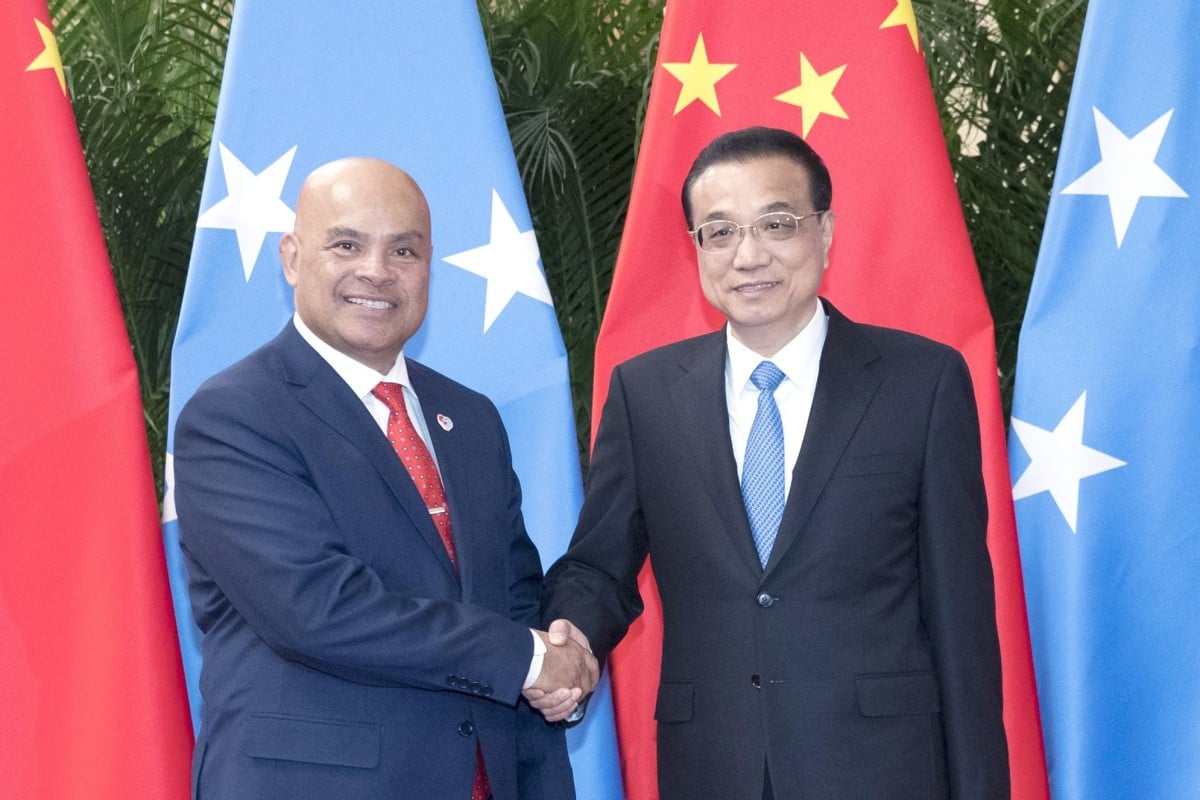
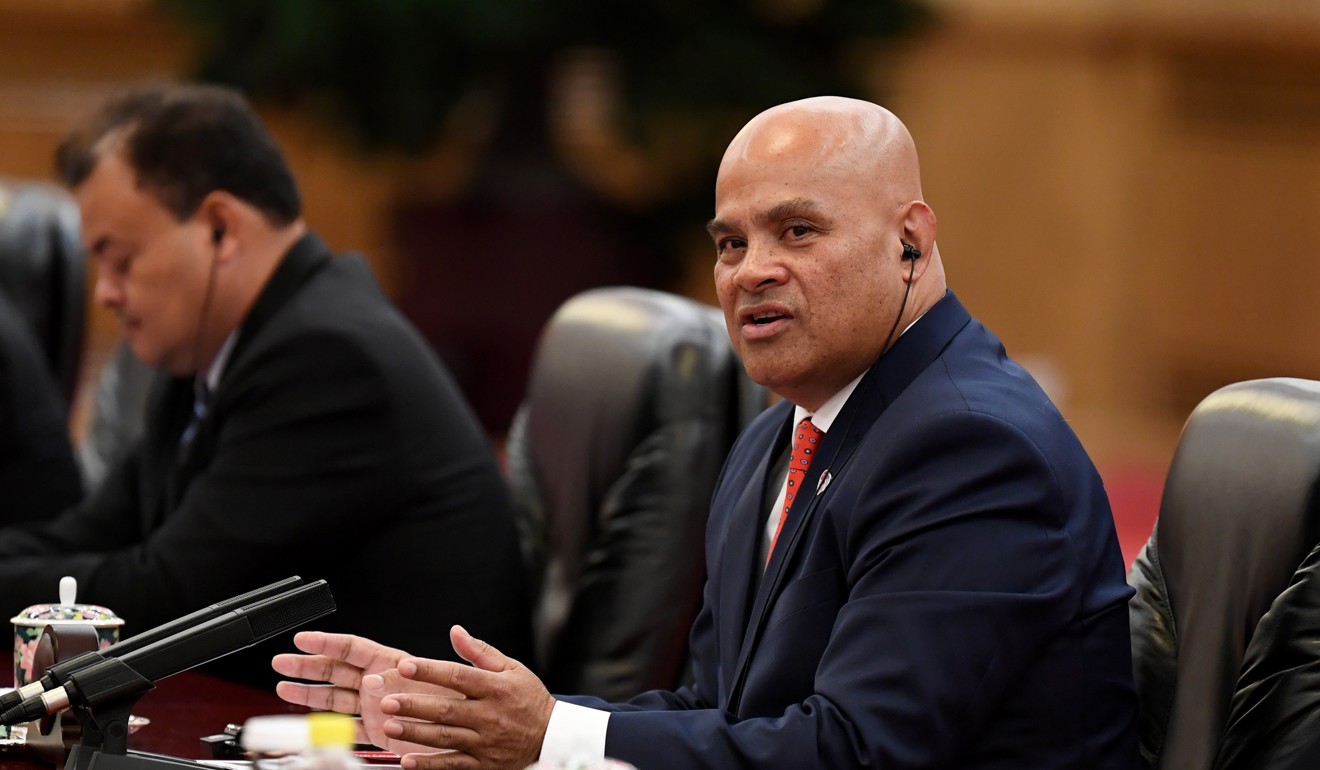
President of the Federated States of Micronesia David Panuelo shakes hands with Chinese Premier Li Keqiang at the Great Hall of the People in Beijing. Photo: Xinhua
In
China earlier this month, David Panuelo, the president of the Federated States of Micronesia, climbed the Badaling section of the Great Wall. And, according to Huang Zheng, Beijing’s ambassador to the
Pacific nation, the countries’ “great friendship rose to even greater heights” during Panuelo’s visit.
Chinese investment in Micronesia reached similarly lofty levels in conjunction with Panuelo’s trip, which marked three decades of diplomatic ties and included meetings with President Xi Jinping and Premier Li Keqiang. Beijing has committed US$72 million in economic development deals, almost as much as its total investment of the previous three decades.
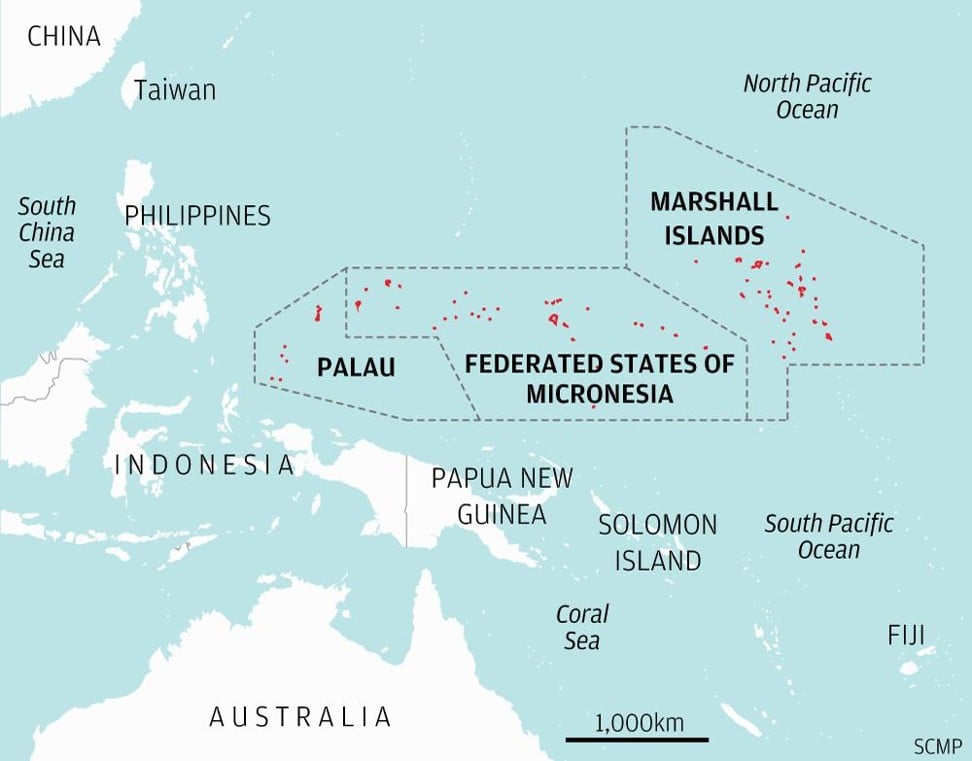
Micronesia is one of three Pacific nations with agreements with Washington, known as the Compact of Free Association (COFA), which allows their citizens to live and work in the US. In exchange, Micronesia, neighbouring Palau and the Marshall Islands grant the US exclusive military and defence access to their territorial waters – more than 2 million square miles of the Pacific that have been an essential element of Washington’s power projection in the region since World War II.
Much of China’s funding has been directed to Micronesia’s Chuuk state, which will in March vote in an independence referendum.
Although Chuuk is home to fewer than 50,000 people, its waters include one of the region’s deepest and most strategically appealing lagoons, creating extra incentive for Beijing and potential concern for Washington as the two countries
How China ‘loosens the screws’
With a population of just 113,000 people, Micronesia relies on remittances sent home by citizens working in the US as well as the financial support from Washington under COFA. That assistance is scheduled to expire in 2023, creating uncertainty about the future of the relationship and making
Chinese investment even more influential.
“Panuelo’s visit to China is a perfect example of how [the Chinese side] just needs to do a little to get a lot,” said Derek Grossman, senior analyst at Rand Corporation, a Washington think tank. “US$100 million is not very much for them and they can essentially loosen the screws [on COFA] with that.”
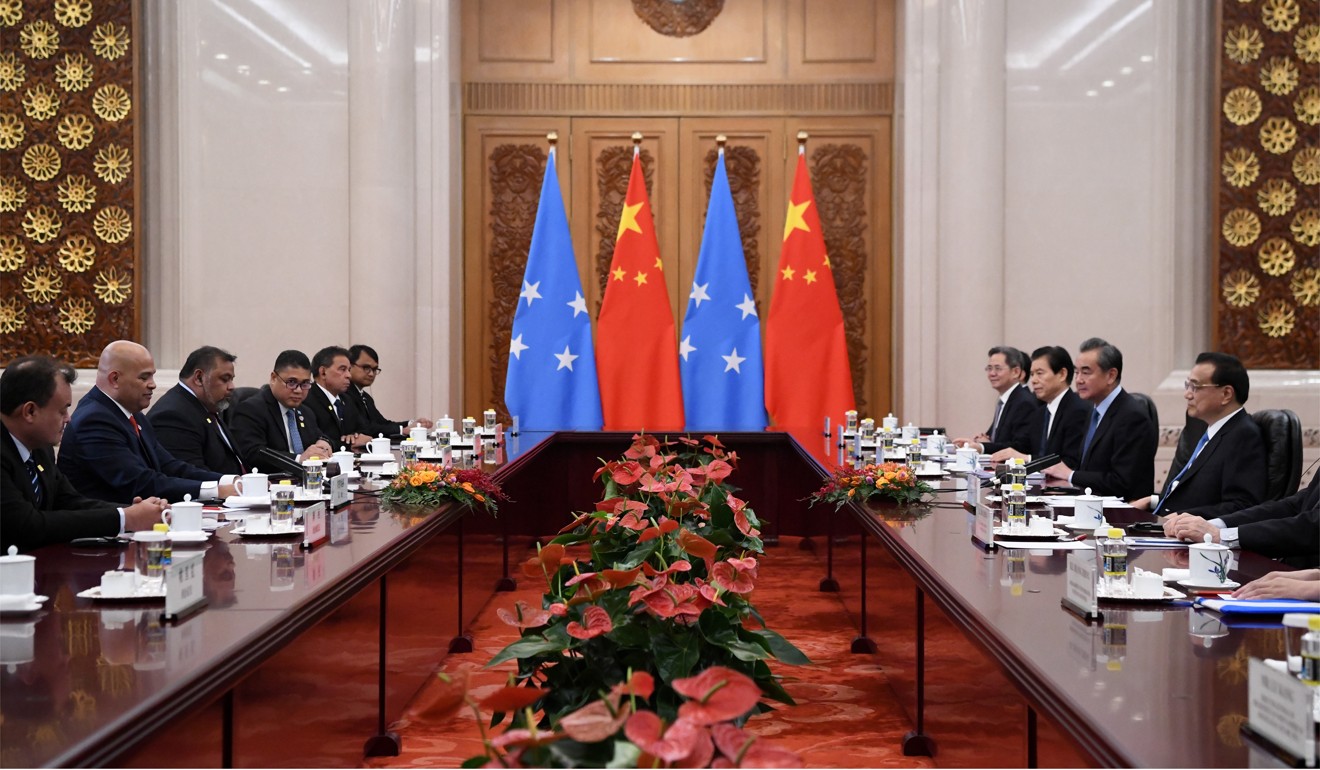
Micronesian President David Panuelo (second on left) and Chinese Premier Li Keqiang (right) during their talks in Beijing. Photo: EPA-EFE
The value of Micronesia’s bilateral trade with China has increased by nearly 30 per cent annually for the past five years, according to Micronesia’s Foreign Ministry. In 2017, the island nation signed onto President Xi’s signature Belt and Road Initiative which aims to build a vast network of strategic investment, trade routes and infrastructure projects across more than 150 countries.
US-China tech war’s new battleground: undersea internet cables14 Dec 2019
In recent years Chinese funding in Micronesia has built office and residential complexes for government officials, a showpiece new convention centre in the capital city Palikir, transport infrastructure and student exchanges, according to a recent report by Rand.
Jian Zhang, associate professor at UNSW Canberra at the Australian Defence Force Academy, said Beijing’s investment reflected a decision to cultivate broader, deeper ties.
Micronesian President David Panuelo during his meeting with Chinese officials in Beijing. Photo: EPA-EFE
“China’s interest in building the relationship with Micronesia is not just about its diplomatic rivalry with Taiwan or economic interests,” he said. “It has elevated the relationship to a comprehensive strategic partnership which encompasses all areas.”
During his recent visit, Panuelo described China as Micronesia’s top economic partner and the US as its top security partner. Pompeo’s visit to Micronesia highlights US anxiety about rising Chinese influence in Pacific 5 Aug 2019
Gerard Finin, professor of regional planning at Cornell University, who previously worked with the US Department of State in the Pacific, said: “China’s leadership consistently accords large ocean states the full protocol that is expected when a head of state visits.
“In contrast, Washington has only had a limited number of meetings and never hosted an official state visit to Washington for the leader of a Pacific Island nation,” said Finin.
US President
Donald Trump in May hosted the leaders of Micronesia, Palau and the Marshall Islands together at the White House. When
Mike Pompeo visited Micronesia
in August, he became the only sitting US secretary of state to have done so.
Pompeo said negotiations to update COFA had begun but no details have been made public. Micronesia has assembled a team to conduct the negotiations but the US has not, the Honolulu Civil Beat website reported.
US Secretary of State Mike Pompeo visited Micronesia in August. Photo: AFP
Breakaway vote could raise the stakes
Panuelo’s team met Micronesian students studying in China and representatives of state-owned China Railway Construction Corporation, which will build the roads in Chuuk, funded in part by US$50 million from Beijing. Construction of the Chuuk government complex was also funded by Beijing and the state’s governor joined Panuelo for his visit.
Should Chuuk vote to separate from Micronesia in March, it could also mean breaking from COFA, jeopardising the US work privileges of thousands of Chuukese and opening the state’s waters to other partners, particularly China.
Chuuk is home to one of the deepest lagoons in the Pacific, a geographic rarity of particular value in strategic military operations and submarine navigation.
US Coast Guard looks to bolster Pacific allegiances as Chinese clout grows
22 Oct 2019
Zhang said Beijing would explore any opportunity to build a port with potential military capability.
“China has a long-term need to gain a strategic foothold in the region,” Zhang said. “That is a key part of the Belt and Road Initiative. At the general level it’s an economic initiative but an important aspect of the maritime Silk Road is to develop a network of strategically located port facilities.”
Sabino Asor, chair of the public education committee for the Chuuk Political Status Commission, told Civil Beat seceding from Micronesia would be the best option for Chuuk’s future.
“There is no encouraging prospect if Chuuk remains within the Federation,” he said.
However, Patrick Buchan, at Washington think tank Centre for Strategic and International Studies, said Chuuk’s dependence on remittances from the US made breaking from COFA unlikely.
China courts Pacific island states in pursuit of ‘foothold’ as US risks losing influence
In the meantime, uncertainty over COFA negotiations persists, although there is a chance it will be renewed with few changes.
“There is circulation with people easily coming and going that provides a level of understanding and friendship that does not exist between too many other countries,” Finin said.
However, China’s most attractive feature may be its willingness to at least discuss the most pressing concern of Pacific Island nations: climate change.
“When the Trump administration talks about how it doesn’t believe in climate change, or can’t even say the words – that is really offensive for Pacific nations,” Grossman said. “China knows that, and is taking full advantage of it.”
Source: SCMP
Posted in Australian Defence Force Academy, ‘great friendship’, Beijing, Belt and Road Initiative, Centre for Strategic and International Studies, China Railway Construction Corporation, China’s, Chinese premier Li Keqiang, Compact of Free Association (COFA), David Panuelo, Great Hall of the People, Great Wall, grows, headache, Honolulu Civil Beat, leaving, Marshall Islands, Micronesia, Mike Pompeo, Pacific, Pompeo’s, President of the Federated States of Micronesia, President Xi Jinping, RAND Corporation, strategic, think tank, Uncategorized, UNSW Canberra, US, US Department of State, US President Donald Trump, warmer, Washington |
Leave a Comment »
26/11/2019
Chinese President Xi Jinping, also general secretary of the Communist Party of China (CPC) Central Committee, meets with a delegation of the United Russia party led by Chairman of the United Russia’s Supreme Council Boris Gryzlov at the Great Hall of the People in Beijing, capital of China, Nov. 25, 2019. (Xinhua/Li Tao)
BEIJING, Nov. 25 (Xinhua) — Chinese President Xi Jinping Monday met with a delegation of the United Russia party at the Great Hall of the People in Beijing.
The delegation, led by Chairman of the United Russia’s Supreme Council Boris Gryzlov, is in Beijing for the seventh meeting of the dialogue mechanism between the ruling parties of China and Russia held Monday.
Xi, also general secretary of the Communist Party of China (CPC) Central Committee, expressed congratulations for the success of the 19th congress of the United Russia party.
This year marks the 70th anniversary of the forging of diplomatic ties between China and Russia, said Xi.
“President Putin and I jointly announced the development of the China-Russia comprehensive strategic partnership of coordination for a new era, agreeing to guide bilateral relations in the direction of mutual support, in-depth integration and innovative cooperation to achieve win-win results,” said Xi.
He said China and Russia have formed strong strategic support for each other, which is of great strategic significance to world peace and development.
Saying that as ruling parties, the CPC and the United Russia party shoulder responsibilities to further promote China-Russia ties, Xi called on delegates to the seventh meeting of the dialogue mechanism to fully exchange views so as to contribute wisdom and strength to bilateral ties as well as world peace and prosperity.
Congratulating China on the fourth plenary session of the 19th CPC Central Committee, Gryzlov said Russia-China ties have reached an unprecedented level as the two countries have sound cooperation in various fields and good coordination in international and regional hotspot issues.
The United Russia party stands ready to enhance cooperation with the CPC to further promote bilateral ties, said Gryzlov.
The dialogue mechanism between the CPC and the United Russia party was launched in June 2009. Its sixth meeting was held in Kazan in March 2017.
Source: Xinhua
Posted in 70th anniversary, Beijing, China alert, China-Russia comprehensive strategic partnership of coordination, Chinese President Xi Jinping, diplomatic ties, general secretary of the Communist Party of China (CPC) Central Committee, Great Hall of the People, Kazan, President Putin, Russia, Uncategorized, United Russia party, United Russia's Supreme Council |
Leave a Comment »
02/11/2019
BEIJING, Nov. 2 (Xinhua) — Chinese President Xi Jinping has sent a congratulatory letter on the 120th anniversary of the discovery and research of oracle bone inscriptions.
Xi, also general secretary of the Communist Party of China (CPC) Central Committee and chairman of the Central Military Commission, stressed enhancing cultural confidence and promoting exchanges and mutual learning among civilizations in the letter.
Xi extended congratulations to experts and scholars who have long been dedicated to the preservation and promotion of fine traditional culture such as oracle bone inscriptions.
The discovery of the oracle bone inscriptions from Yin Ruins is of epoch-making significance in Chinese civilization and even human civilization, Xi said.
Oracle bone inscriptions are considered the origin of Chinese characters and represent the oldest fully-developed system of characters discovered in China so far.
Xi described oracle bone inscriptions as the roots of fine traditional Chinese culture that merits even better preservation and development.
Over the past 70 years, the Party and the state have attached great importance to the preservation and development of fine traditional Chinese culture represented by oracle bone inscriptions, Xi said.
Noting the remarkable progress in the study of oracle bone inscriptions, Xi stressed efforts to continue such research of ancient characters.
He called on researchers to further explore the historic and cultural values of oracle bone inscriptions and promote exchanges and mutual learning among civilizations.
On Friday, a symposium was held at the Great Hall of the People to mark the 120th anniversary of the discovery and research of oracle bone inscriptions. Xi’s letter was read at the symposium.
Vice Premier Sun Chunlan, also a member of the Political Bureau of the CPC Central Committee, addressed the symposium, calling for earnest implementation of Xi’s instructions, and better research and preservation efforts of oracle bone inscriptions.
She spoke of the need to use technologies such as artificial intelligence recognition to push for new breakthroughs in the research.
Discovered in 1899, oracle bone inscriptions are considered one of the world’s four ancient characters and have been included in the UNESCO Memory of the World Register.
Source: Xinhua
Posted in 120th anniversary, Chairman of the Central Military Commission, Chinese civilization, Chinese President Xi Jinping, epoch-making significance, four ancient characters, fully-developed system of characters, general secretary of the Communist Party of China (CPC) Central Committee, Great Hall of the People, human civilization, member of the Political Bureau of the CPC Central Committee, oracle bone inscriptions, Uncategorized, UNESCO Memory of the World Register, Vice Premier Sun Chunlan, Yin Ruins |
Leave a Comment »









 CHINDIA ALERT: You'll be living in their world, very soon