Archive for ‘Group of 20 (G20)’

18/04/2020

China supports G20 action plan to help poorest countries: MOF

BEIJING, April 17 (Xinhua) — China supports the action plan issued by the Group of 20 (G20) to deal with the impact of COVID-19 and will contribute to the G20 efforts to fight the pandemic through its own policy actions, the Ministry of Finance (MOF) said Friday.

G20 finance ministers and central bank governors agreed Wednesday to suspend debt service payments for the world’s poorest countries from May 1 until the end of the year.

China will implement more proactive fiscal policies with higher quality and efficiency, appropriately increase the fiscal deficit ratio, issue special government bonds, increase the scale of special bonds for local governments, and further cut taxes and fees, the MOF said.

In the process, China will strengthen macroeconomic policy coordination with G20 members and jointly support the implementation of the G20 action plan, the MOF said.

China will carry out specific work through bilateral consultations at the request of relevant poor borrowers in accordance with the G20 consensus, the MOF said.

To achieve better results of the action plan, China calls on multilateral creditors and commercial creditors to take appropriate actions as soon as possible to jointly help the poorest countries tide over their difficulties, the MOF said.

China has been providing support to the international community through other bilateral and multilateral channels, including donating 20 million U.S. dollars to the World Health Organization and earmarking 10 million U.S. dollars in its Poverty Reduction and Regional Cooperation Fund under the Asian Development Bank to support outbreak control programs in the region.

Source: Xinhua

22/02/2020

China reports fall in new coronavirus cases but concerns grow over rising global spread

BEIJING (Reuters) – China reported a sharp decrease in new deaths and cases of the coronavirus on Saturday but a doubling of infections in South Korea and 10 new cases in Iran added to unease about its rapid spread and global reach.

Mainland China had 397 new confirmed cases of coronavirus infections on Friday, down from 889 a day earlier, but only 31 cases were outside of the virus epicentre of Hubei province, the lowest number since the National Health Commission started compiling nationwide data a month ago.

But infection numbers continued to rise elsewhere, with outbreaks worsening in South Korea, Italy and Lebanon and Iran, prompting a warning from the World Health Organization that the window of opportunity to contain the international spread was closing..

South Korea saw another spike in infections, with 229 new confirmed cases, taking its tally to 433. Officials warned that could rise substantially as more than 1,000 people who attended a church at the centre of the outbreak had shown flu-like symptoms.

Iran, which had no reported cases earlier this week, saw 10 new cases, one of which had died, taking the number to 28 infections and five deaths.

Concerns about the virus weighed on U.S. stocks on Friday, driven by an earlier spike in cases in China and data showing stalling U.S. business activity in February. [MKTS/GLOB]

It has spread to some 26 countries and territories outside mainland China, killing 13 people, according to a Reuters tally.

WHO director-general Tedros Adhanom Ghebreyesus on Twitter expressed concern on Saturday about cases with no clear link to China and called on all countries to invest urgently in preparedness. He made an appeal for $675 million to support the most vulnerable countries.

On Friday, he said now was the time to act decisively.

“We still have a chance to contain it,” he said. “If we don’t, if we squander the opportunity, then there will be a serious problem on our hands.”

An outbreak in northern Italy worsened with its first two deaths, among 17 confirmed cases including its first known instance of local transmission.

Japan confirmed 14 new coronavirus cases on Saturday, among those a teacher who had shown symptoms while working at her school.

Japan is facing growing questions about whether it is doing enough to contain its spread, and concern about whether it could scupper this year’s Tokyo Olympics. Organisers on Saturday postponed the start of training for volunteers as a precaution.

The Bank of Japan’s governor on Saturday shrugged off talk that the widening epidemic is triggering an outflow of funds from Asia.

Online site for coronavirus news – here

GRAPHIC: Tracking the novel coronavirus – here

NEW COMPLICATIONS

The total number of confirmed cases in mainland China rose to 76,288, with the death toll at 2,345 as of the end of Friday. Hubei reported 106 new deaths, of which 90 were in Wuhan.

But new, albeit isolated findings about the coronavirus could complicate efforts to thwart it, including the Hubei government’s announcement on Saturday that an elderly man took 27 days to show symptoms after infection, almost twice the presumed 14-day incubation period.

That follows Chinese scientists reporting that a woman from Wuhan had travelled 400 miles (675 km) and infected five relatives without showing signs of infection, offering new evidence of asymptomatical spreading.

State television on Saturday showed the arrival in Wuhan of the “blue whale”, the first of seven river cruise ships it is bringing in to house medical workers, tens of thousands of which have been sent to Hubei to contain the virus.

Senior Chinese central bank officials sought to ease global investors’ worries about the potential damage to the world’s second-largest economy from the outbreak, saying interest rates would be guided lower and that the country’s financial system and currency were resilient.

Chen Yulu, a deputy governor of the People’s Bank of China, said policymakers had plenty of tools to support the economy, and were fully confident of winning the war against the epidemic.

“We believe that after this epidemic is over, pent-up demand for consumption and investment will be fully released, and China’s economy will rebound swiftly,” Chen told state television.

China has recently cut several key lending rates, including the benchmark lending rate on Thursday, and has urged banks to extend cheap loans to the worst-hit companies which are struggling to resume production and are running out of cash.

The transport ministry said businesses would resume operations on a larger scale later this month and said more roads, waterways and ports were returning to normal.

Online media and Weibo users posted footage and images on Saturday of some malls reopening, including in the cities of Wuxi, Hangzhou and in Gansu province, with shoppers queuing in near-empty streets outside for mandatory temperature checks as trickles of customers in masks perused luxury goods shops and makeup counters.

Some analysts believe China’s economy could contract in the first quarter from the previous three months due to the combined supply and demand shocks caused by the epidemic and strict government containment measures. On an annual basis, some warn growth could fall by as much as half from 6% in the fourth quarter.

However, transport restrictions remain in many areas and while more firms are reopening, the limited data available suggests manufacturing is still at weak levels, with disruptions starting to spillover into global supply chains.

Samsung Electronics (005930.KS) said on Saturday that one coronavirus case had been confirmed at its mobile device factory complex in Gumi, causing a shutdown of its entire facility.

Finance leaders from the Group of 20 major economies were set to discuss risks to the world economy in Saudi Arabia this weekend.

The WHO’s Tedros on Twitter said 13 priority countries in Africa had been identified for help because of their direct links to China or high travel volume. That would include 30,000 personal protective kits on the way to six countries and 60,000 more for 19 states in the weeks ahead.

Source: Reuters

09/07/2019

‘We need to talk’: call for Chinese and Indian navies to communicate

  • Ambassador to China Vikram Misri says they will be ‘meeting more and more in common waters’, and more exchanges are needed
  • He also says preparations are under way for President Xi Jinping to visit India
The INS Kolkata arrives in Qingdao for PLA Navy 70th anniversary celebrations in April. The Indian ambassador called for more communication between the two navies. Photo: Reuters
The INS Kolkata arrives in Qingdao for PLA Navy 70th anniversary celebrations in April.
The Indian ambassador called for more communication between the two navies. Photo: Reuters
The Chinese and Indian navies should establish communication because they are increasingly operating within close proximity, according to India’s ambassador to China.

While the two nations’ militaries communicated extensively, it was mainly between their land forces, and that should be extended to the navies and air forces, Vikram Misri said.

“We need to talk about the two air forces and the two navies – especially the two navies – because we are operating in the same waters and increasingly in the coming years, we will be meeting more and more in common waters,” Misri said.

“I think it is important for us to develop those levels of understanding and communication,” he said. “There are some [navy and air force] exchanges now, but not as well developed as in the case of the land force.”
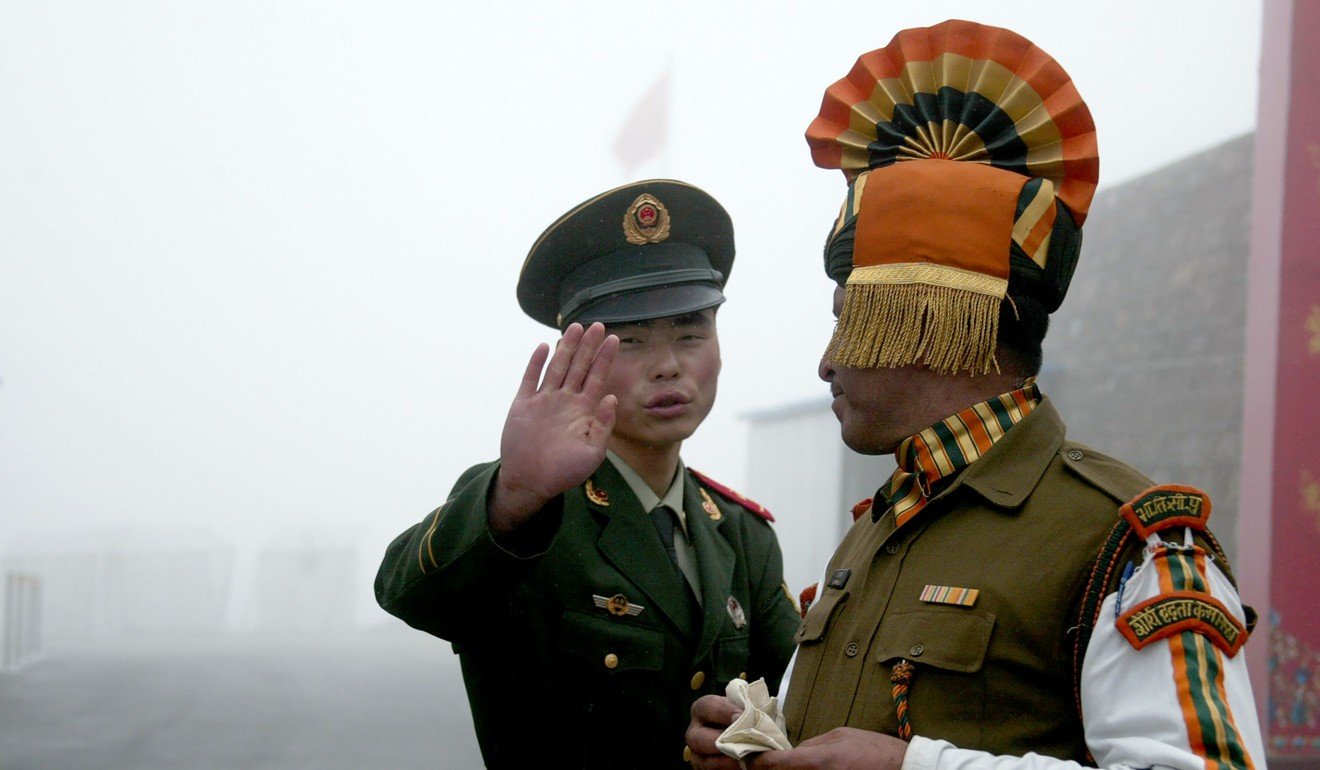
China and India have made efforts to repair their relations since a tense stand-off at the Doklam plateau two years ago, when communications between their forces along the border were seen as inadequate to contain the tension.
China and India have sought to repair relations after a tense stand-off at Doklam. Photo: AFP

Misri said the two nations had made incremental progress, and opened new points where “border personnel can meet and exchange information, or exchange views about any particular situation”.

The ambassador was visiting the Indian consulate in Hong Kong over the weekend, six months after taking up the post and six weeks after Prime Minister Narendra Modi was re-elected.

He said preparations were under way for Chinese President Xi Jinping to visit India, which was expected to happen in the fourth quarter, after they pledged earlier to strengthen cooperation.

Tensions between 

China and India

have periodically flared along their 4,000km (2,485-mile) border, resulting in a brief war in 1962. Relations have also been strained by China’s ties with Pakistan, and India’s concern over China’s growing presence in the Indian Ocean.

India has also not signed on to China’s global trade and infrastructure strategy, the

Belt and Road Initiative

, which has projects that run through the disputed Kashmir region.

“Our concerns with regards to this particular initiative are very clear, and we have continued to share them very, very frankly with our Chinese partners,” Misri said. “I think there is understanding on the part of our Chinese partners with regard to this.”
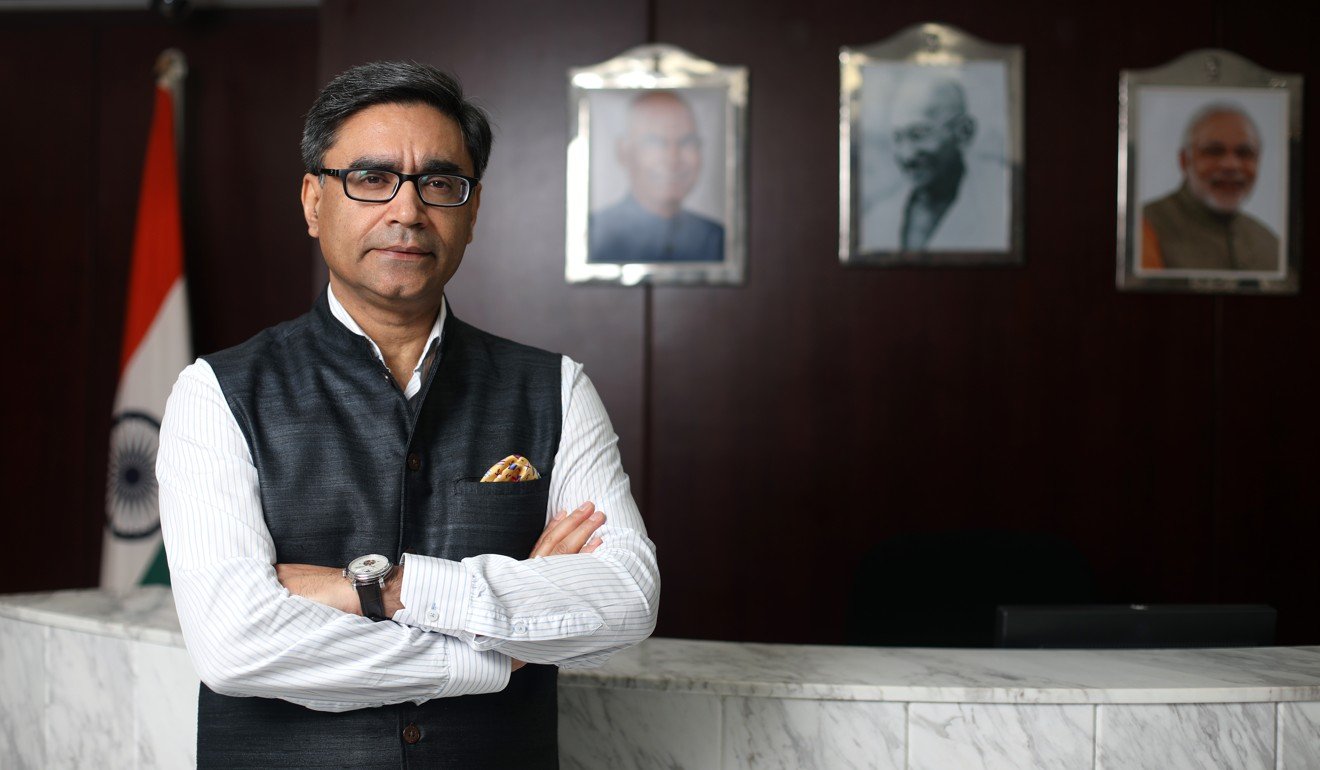
Indian ambassador to China Vikram Misri said New Delhi’s concerns on the Belt and Road Initiative were clear. Photo: Xiaomei Chen

But he said the two nations should not let their differences evolve into disputes, and they should focus on areas where they can cooperate.

One such area was maritime and investment cooperation in the Indo-Pacific region, including infrastructure and disaster response. The US in recent years has focused on the Indo-Pacific region, and has asked its allies to send naval vessels to the area as a counterbalance to Beijing.

“We have made the point that our vision of the Indo-Pacific is not a strategy, which sometimes is a concern on the part of some partners, aimed against any particular country,” Misri said. “It is definitely not a military alliance in any format.

“It is on the other hand a vision that aims at economic and development cooperation with our partners in the Indo-Pacific space,” he said, adding that India was discussing such cooperation with China.

He also said trilateral meetings between China, India and Russia would become more regular after their three leaders met on the sidelines of the 

Group of 20

summit in Osaka, Japan last month, when they vowed to uphold multilateralism.

Those meetings would allow the nations to address challenges facing the international trading system and pushback against globalisation, but Misri said they should not be seen as a bid to counter the US, which is also involved in a trade battle with India.

India also had a trilateral meeting with Japan and the United States during the G20 summit.

“The fact that these countries seek us out also shows that they see value in engaging with India, and we have important issues to discuss in each of these settings,” he said. “None of our individual relationships is going to come at the cost of a relationship with any other partner.”

The ambassador said there could be a broader consensus on counterterrorism. Photo: AP

Misri also said there could be a broader consensus between China and India on counterterrorism. The two nations have clashed over Indian efforts to blacklist Masood Azhar, leader of the Pakistan-based terror group Jaish-e-Mohammed (JeM), at the United Nations, which China objected to for years – a move seen in India as being done at the behest of Islamabad.

Azhar was finally listed as a global terrorist by the UN in May, after JeM claimed responsibility for a deadly terror attack on Indian security forces in Pulwama in February, although the listing did not directly reference the attack.

“It could have happened earlier … but I’m glad that it did happen, and we hope to build on that – that should be taken as progress, and we hope to build on that in the coming years,” Misri said.

“Everybody is aware of the context in which the listing happened, and therefore, I don’t think it’s hidden from anybody as to what this was aimed at or who this was aimed at, or what the motivation for the action might have been.”

As for the tensions between India and Pakistan following the terror strike in Indian-controlled Kashmir, Misri said progress would be “largely dependent on Pakistan” and the actions it needed to take to address the “ecosystem of terror that prevails in different parts of that country”.

Source: SCMP

07/07/2019

Interview: President Xi’s letter inspires more contributions to Japan-China friendship — Japanese youth

TOKYO, July 6 (Xinhua) — “When I wrote the letter, I didn’t expect to receive a reply from President Xi Jinping. I was surprised and honored,” said Daichi Nakashima with excitement.

The 27-year-old Japanese man said he had received the reply from Xi before the Chinese leader attended the Group of 20 summit in Osaka. “When my friend told me on WeChat, I was shocked!” Nakashima said in an exclusive interview with Xinhua.

Nakashima had several times been a winner in the Panda Cup Japan Youth Essay Contest. Founded in 2014, the competition is co-sponsored by People’s China magazine, the Chinese embassy in Japan and the Japan Science Society, aiming to help Japanese youths have a more comprehensive, objective and rational understanding of China.

Nakashima began learning Chinese in college and has participated in several short-term exchange programs in China.

When talking about his original intention of writing a letter to Xi, Nakashima said, “I wanted to convey the warmth and friendship of the Chinese people I felt during my visit to China and the importance of mutual understanding and exchanges between Japanese and Chinese youths.”

Xi, in his reply, said he was glad to see that Nakashima has been studying the Chinese language and literature for a long time and, by participating in essay contests and exchange activities in China, has learned more about China and strengthened his bonds with Chinese friends.

“It’s the best affirmation and recognition of my persistence for so many years. I’m very touched,” Nakashima said.

Born in 1992, Nakashima first learned about China through classics like “Romance of the Three Kingdoms” and “Outlaws of the Marsh,” but it was a two-week trip to Tianjin in 2011 that gave him a glimpse of a vibrant China.

After that, he visited Beijing, Sichuan, Guangdong and other places. Last year, he went to Fudan University in Shanghai and studied for half a year.

Nakashima found that Chinese youth are very familiar with Japanese anime, music and so on, while Japanese youngsters do not know much about China. Their impression of China is restricted to Chinese tourists, “not knowing about Chinese movies and popular music,” he said.

Nakashima said he believes that the friendship between the two peoples needs more bilateral youth exchanges, as President Xi said in the letter.

Noting that China and Japan are close neighbors separated by only a narrow strip of water, Xi said the friendship between the two countries is rooted in the people, and that the future of the friendship between the two peoples is in the hands of the young people.

Xi said he hopes that the youth of China and Japan will strengthen exchanges and mutual learning, enhance mutual understanding, develop long-lasting friendships, and contribute to creating an even brighter future for bilateral relations.

Xi also encouraged Nakashima to continue to promote the China-Japan friendship. Nakashima said this is an encouragement, a mission and also motivation for him to move forward.

Nakashima graduated with a master’s degree in April and has begun to work in a publishing house. He has been determined to introduce excellent works such as Chinese picture books and science fiction to Japan, so that Japanese teenagers can feel the affinity between the two countries.

“I have met many friendly Chinese people and made many friends that are very important to me. In the future, I will continue to make efforts to help Japanese and Chinese youth deepen mutual understanding,” he said.

Source: Xinhua

06/07/2019

China Focus: Peacebuilders in China-Japan friendship

TIANJIN/BEIJING, July 6 (Xinhua) — Even at the age of 100, Yang Enze, one of the founders of China’s optical communication, does not stop his research and teaching as a professor at Tianjin University.

Besides his pioneering achievements as the chief engineer of China’s first optical communication project for practical use in the 1970s, Yang is also known as a survivor and a witness of the war of Japanese aggression against China.

“I was admitted to Wuhan University in 1937, the year when Japanese troops attacked the Lugou Bridge, also known as Marco Polo Bridge, on the outskirts of Beijing, on July 7,” said the senior recalling the start of his academic study.

The incident marked the beginning of Japan’s full-scale war against China during World War II and triggered China’s full-scale resistance against the invasion.

Ahead of the 82nd anniversary of the incident that falls on Sunday, Yang said because of the war, his university in central China’s Hubei Province was relocated to southwestern province of Sichuan to avoid the enemy forces. “Even in Sichuan, there were a lot of Japanese bombings, but none of the students missed any of the classes as long as there was no air-raid siren,” he recalled.

It was at that time he and many of his peers cemented the belief that the country needed advanced science and technology for reconstruction and revival.

“I have always kept in mind late chairman Mao Zedong’s words that it was Japanese militarists’ crime that was to blame for the war, not Japanese civilians, ” Yang said, noting that he still gets in touch with many Japanese scholars.

He established the first optical communication laboratory in Tianjin in 1985, when he was invited to teach at Tianjin University. In Yang’s career, he has made friends with several leading experts from Japan at international conferences and even kept friendship with some of them.

Also in Tianjin, Morita Naomi, a Japanese language teacher in Nankai University, works as a consultant to the school’s research institute of Zhou Enlai-Daisaku Ikeda.

“By involving in the research of the friendship between the late Chinese premier and the Japanese philosopher, I want to search for the core factors that help consolidate the friendship between the two peoples,” said Naomi.

She came to Nankai to pursue a master-degree study in Modern Chinese and Chinese Literature in 2010 and has stayed ever since.

When she first arrived, she had troubles even in learning Chinese phonics. Now she can read and speak Chinese fluently, write beautiful Chinese characters, and study ancient Chinese literature independently.

As a teacher, she feels frustrated that most of her Chinese students are more likely to be attracted by Japanese animation and games rather than Japanese literature.

According to the school’s statistics, nearly half of the undergraduates in the 2019 class of Japanese major chose to work in Japanese-funded enterprises or Japanese-related enterprises after graduation.

Naomi said Japanese visitors to China are more likely to choose destinations like Beijing, Shanghai and Guangzhou. Peking University in Beijing impresses young Japanese most.

According to a report released by the China Tourism Academy, China received 2.69 million Japanese visitors in 2018, making Japan China’s fourth largest source of foreign tourists. In the same year, Chinese made 9.06 million outbound visits to Japan as a direct destination.

The academy released the report at the 2019 China-Japan Tourism Forum Dalian held on May 26, which focused on promoting win-win cooperation on cultural exchanges and tourism between the two countries.

China and Japan agreed to push forward bilateral relations along the right track of peace, friendship and cooperation, at the summit of the Group of 20 (G20) major economies held in Osaka, Japan, in June.

This year marks the 70th anniversary of the founding of the People’s Republic of China, and Japan has also entered the Era of Reiwa. It is also the China-Japan Youth Exchange Promotion Year, for promoting friendship and cooperation in a wide range of areas between the two peoples.

“We keep the wartime memory not because we bear the hatred, but because we want the younger generations to cherish what they own today and move towards a better future,” said 70-year-old Zhen Dong, who on Friday visited an exhibition on Beijing’s past, held in Beijing Municipal Archives.

Zhao Hongwei, a professor with Tokyo-based Hosei University, said when it comes to the bilateral relations between China and Japan, it is very important to promote the free trade agreement and expand the markets of both sides.

Source: Xinhua

29/06/2019

‘Back on track’: China and U.S. agree to restart trade talks

OSAKA (Reuters) – The United States and China agreed on Saturday to restart trade talks with Washington holding off new tariffs on Chinese exports, signalling a pause in the trade hostilities between the world’s two largest economies.

Commenting on a long-running dispute over China’s Huawei, President Donald Trump said U.S. firms would be able to sell components to the world’s biggest telecoms network gear maker where there was no national security problem.
The truce offered relief from a nearly year-long trade standoff in which the countries have slapped tariffs on billions of dollars of each other’s imports, disrupting global supply lines, roiling markets and dragging on global economic growth.
“We’re right back on track and we’ll see what happens,” Trump told reporters after an 80-minute meeting with Chinese President Xi Jinping on the sidelines of a summit of leaders of the Group of 20 (G20) major economies in Osaka, western Japan.
Trump said while he would not lift existing import tariffs, he would refrain from slapping new levies on an additional $300 billion worth of Chinese goods – which would have effectively extended tariffs to everything China exports to the America.
“We’re holding back on tariffs and they’re going to buy farm products,” he said at a news conference, without giving any details of China’s future agricultural product purchases.

“If we make a deal, it will be a very historic event.”

He gave no timeline for what he called a complex deal but said he was not in a rush. “I want to get it right.”

HUAWEI HOPES

On Huawei, Trump said the U.S. commerce department would meet in the next few days on whether to take it off a list of firms banned from buying components and technology from U.S. companies without government approval.

China welcomed the step.

“If the U.S. does what it says, then of course, we welcome it,” said Wang Xiaolong, the Chinese foreign ministry’s envoy for G20 affairs.

U.S. microchip makers also applauded the move.

“We are encouraged the talks are restarting and additional tariffs are on hold and we look forward to getting more detail on the president’s remarks on Huawei,” John Neuffer, president of the U.S. Semiconductor Association, said in a statement.

Huawei has come under mounting scrutiny for over a year, led by U.S. allegations that “back doors” in its routers, switches and other gear could allow China to spy on U.S. communications.

While the company has denied its products pose a security threat, the United States has pressed its allies to shun Huawei in their fifth generation, or 5G, networks and has also suggested it could be a factor in a trade deal.

RELIEF AND SCEPTICISM

In a lengthy statement on the two-way talks, China’s foreign ministry quoted Xi as telling Trump he hoped the United States could treat Chinese companies fairly.

On the issues of sovereignty and respect, China must safeguard its core interests, Xi was cited as saying.

“China is sincere about continuing negotiations with the United States … but negotiations should be equal and show mutual respect,” the foreign ministry quoted Xi as saying.

Trump had threatened to extend existing tariffs to almost all Chinese imports into the United States if the meeting brought no progress on wide-ranging U.S. demands for reforms.

Source: Reuters

Slideshow (4 Images)

Financial markets are likely to breathe a sigh of relief on news of the resumption in U.S.-China trade talks.

“Returning to negotiations is good news for the business community and breathes some much needed certainty into a slowly deteriorating relationship,” said Jacob Parker, a vice-president of China operations at the U.S.-China Business Council.

“Now comes the hard work of finding consensus on the most difficult issues in the relationship, but with a commitment from the top we’re hopeful this will put the two sides on a sustained path to resolution,” he said.

Some, however, warned the pause might not last.

“Even if a truce happens this weekend, a subsequent breakdown of talks followed by further escalation still seems likely,” Capital Economics said in a commentary on Friday.

The United States says China has been stealing American intellectual property for years, forces U.S. firms to share trade secrets as a condition for doing business in China, and subsidizes state-owned firms to dominate industries.

ADVERTISEMENT

China has said the United States is making unreasonable demands and must also make concessions.

Talks collapsed in May after Washington accused Beijing of reneging on reform pledges. Trump raised tariffs to 25% from 10% on $200 billion of Chinese goods, and China retaliated with levies on U.S. imports.

The U.S.-China feud had cast a pall over the two-day G20 gathering, with leaders pointing to the threat to global growth.

In their communique, the leaders warned of growing risks to the world economy but stopped short of denouncing protectionism, calling instead for a free, fair trade environment after talks some members described as difficult.

15/06/2019

Chinese, Turkish presidents vow to promote bilateral cooperation

TAJIKISTAN-DUSHANBE-XI JINPING-TURKISH PRESIDENT-MEETING

Chinese President Xi Jinping (R) meets with his Turkish counterpart Recep Tayyip Erdogan in Dushanbe, Tajikistan, June 15, 2019. (Xinhua/Wang Ye)

DUSHANBE, June 15 (Xinhua) — Chinese President Xi Jinping met his Turkish counterpart, Recep Tayyip Erdogan, here on Saturday, agreeing to promote bilateral cooperation on the sidelines of the fifth summit of the Conference on Interaction and Confidence Building Measures in Asia.

Xi said that he highly values China-Turkey relations and is willing to work with Erdogan to translate bilateral friendship into mutual trust, and constantly open new chapters in promoting the China-Turkey strategic cooperative relationship.

China and Turkey should give each other firm support on issues that touch their respective core interests and major concerns, and step up the anti-terrorism cooperation, Xi said.

Calling Turkey a traditional Silk Road country, Xi said that China stands ready to enhance their mutually beneficial cooperation within the Belt and Road framework.

The Chinese president also called on the two countries, both important members of the Group of 20 (G20), to strengthen their communication and coordination on multilateral arenas such as the G20.

Agreeing with Xi, Erdogan said that Turkey attaches great importance to relations with China, adding that Turkey is willing to strengthen high-level exchanges between the two countries and expand their cooperation in economy, trade, finance, infrastructure construction and other fields.

The Belt and Road Initiative is very important to Turkey, he said, adding that his country is willing to actively participate in its joint construction and cooperation.

Source: Xinhua

Law of Unintended Consequences

continuously updated blog about China & India

ChiaHou's Book Reviews

continuously updated blog about China & India

What's wrong with the world; and its economy

continuously updated blog about China & India