Chindia Alert: You’ll be Living in their World Very Soon
aims to alert you to the threats and opportunities that China and India present. China and India require serious attention; case of ‘hidden dragon and crouching tiger’.
Without this attention, governments, businesses and, indeed, individuals may find themselves at a great disadvantage sooner rather than later.
The POSTs (front webpages) are mainly 'cuttings' from reliable sources, updated continuously.
The PAGEs (see Tabs, above) attempt to make the information more meaningful by putting some structure to the information we have researched and assembled since 2006.
GUWAHATI, India (Reuters) – Heavy monsoon rains in India’s northeast Assam state displaced more than a million people from their homes and flash floods killed at least 10 in the past 72 hours, state authorities said on Saturday, warning the situation could worsen in coming days.
The Brahmaputra river, which flows from the Himalayas into India and then through Bangladesh, has burst its banks, swamping more than 1,800 villages in the state.
“10 people have died in separate incidents of drowning in the past three days and more than one million people (have been) affected, with the flood situation turning grave,” a state government flood bulletin said.
Torrential rains have affected at least 25 of Assam’s 32 districts and the federal water resources body said water levels in the Brahmaputra were expected to rise, with more rains forecast over the next three days.
“The flood situation remains extremely critical,” Assam’s Water Resources Minister Keshab Mahanta told Reuters.
Assam, known for its fine quality teas, has for several years battled floods and heavy rains that have claimed dozens of lives and displaced hundreds of thousands of people.
Assam was on a maximum alert due to heavy rains forecast over the next few days, government officials said.
People in the state were also at threat from Japanese encephalitis, a mosquito-borne viral infection, government officials said. More than 160 people have been killed since January by the infection.
The federal government said it had met on Saturday to review flooding across different parts of the country, and emergency teams had rescued 750 people in Assam and nearby Bihar state, where the Kosi River had risen above the danger mark.
Flash floods and landslides in Nepal also triggered by monsoon rains killed 15 people and injured 12 overnight.
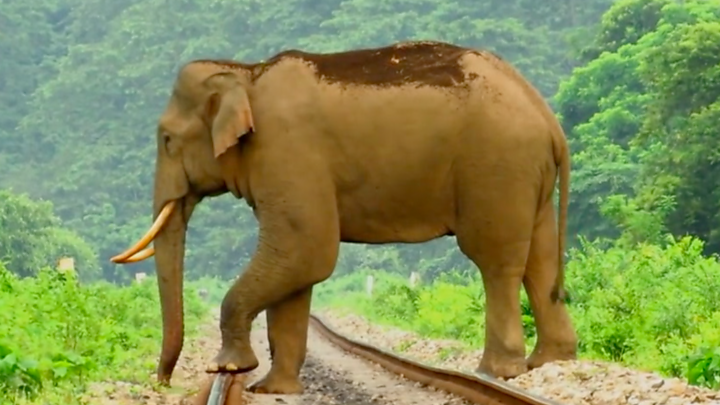
Image copyright AFPImage caption Decorated elephants lead the procession at the Jagannath temple’s annual festival in Ahmedabad
Animal rights activists in India have criticised a plan by the Assam state government to send four elephants on a perilous train journey of more than 3,100km (1,926 miles) to participate in a temple ritual. They say the long journey could be dangerous for the animals and may even kill them, writes the BBC’s Geeta Pandey in Delhi.
The elephants are to be moved from Tinsukia town in the north-eastern state of Assam to the extreme west of the country – Ahmedabad city in Gujarat state.
Reports say the railway authorities in Assam, who have been asked to make travel arrangements for the elephants, are looking for a coach to transport them.
No date is set for their departure yet, but they are expected to reach Ahmedabad before 4 July to participate in the annual Rath Yatra (chariot procession) at the Jagannath temple. The train journey is expected to take three to four days.
In previous years, Prime Minister Narendra Modi, who hails from Gujarat, has participated in the festival and the elephant procession, although temple officials say he’s not expected to attend this year.
Temple trustee Mahendra Jha told BBC Gujarati that they decided to “borrow” the animals from Assam “for two months” because three of their own elephants died from old age last year.
But activists and conservationists say the plan to move the elephants is “cruel and completely inhuman”, especially since temperatures are more than 40C (104F) in many places along the northern Indian route these elephants are expected to take.
Media caption Human-elephant conflict destroying lives in India
“Most of north-western India is reeling under a heatwave. There have been reports of people dying from heat during train journeys,” Kaushik Barua, a wildlife conservationist based in the Assam state capital, Guwahati, told the BBC.
“The wagon in which the elephants will be transported is not climate-controlled. It will be hitched to a passenger train which will be travelling at a speed of 100km/h (62mph), so can you imagine the plight of the animals?”
Mr Barua warns the journey may prove “dangerous” for the animals.
“They can suffer from heatstroke, from shock, and even die.”
Under the law, he says, there’s no problem moving these elephants since all the paperwork is in order, “but where’s the animal welfare?”
Also weighing in on the debate is the opposition Congress party MP from Assam, Gaurav Gogoi, who’s petitioned India’s Environment Minister Prakash Javadekar to intervene.
“Roughly half of the country is struggling through its worst drought in six decades…. These are extreme conditions for the elephants to travel… The elephants may suffer from acute skin infection and dehydration,” Mr Gogoi wrote in his letter on Thursday.
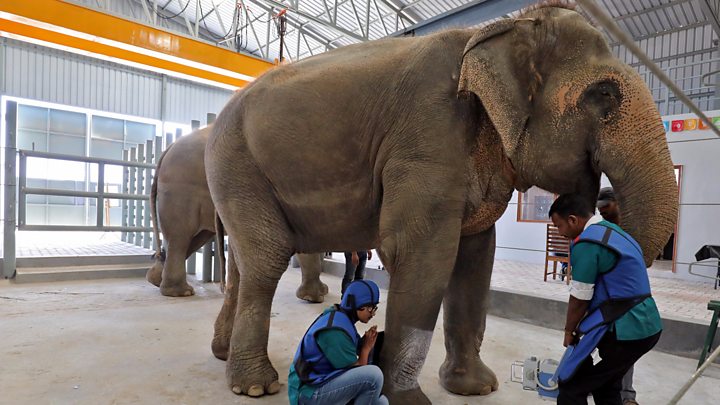
Media caption India’s first elephant hospital is run by the charity Wildlife SOS
“Therefore, I request the central government to intervene and instruct the state government to withdraw the decision as soon as possible.”
Elephants – both wild and captive – are a protected species in India and there are strict guidelines for their transportation, wildlife biologist Dr Bibhuti Prasad Lahkar told the BBC.
According to the rules, no elephant can be made to walk for more than 30km (18 miles) at a stretch or transported for more than six hours in one go.
The state’s wildlife officials, who’ve issued transit permits for the elephants, have so far refused to comment on the controversy. But after protests from activists and conservationists, “they have gone into a huddle, discussing a plan B,” according to a wildlife expert.
Image copyright GETTY IMAGESImage caption Elephants are a protected species in India
“There’s some suggestion that the pachyderms may be moved in trucks to allow them the flexibility to stop if needed and that they could be accompanied by a forest department veterinarian to look after them,” he said.
Mr Barua, however, is blunt.
“Gujarat doesn’t need these elephants,” he says. “Wildlife laws prevent [the] display and exhibition of elephants. Laws ban performances by elephants in circuses, zoos are not allowed to exhibit them, so why should temples be allowed to use them in rituals or processions? Don’t elephants have rights?
“We worship Ganesha, the Elephant God. Why are the Gods then being put through such cruelty by a temple?”
GUWAHATI, India (Reuters) – At least 84 people have died from drinking toxic bootleg liquor in the northeastern Indian state of C, and around 200 others have been hospitalised, a state government minister said on Saturday.
The deaths come less than two weeks after more than 100 people died from drinking tainted alcohol in two northern Indian states, Uttarkhand and Uttar Pradesh.
Police have arrested twelve people in connection with making bootleg alcohol in Assam, a practice local politicians say is rampant in the area’s tea estates, where its is drunk by poorly-paid labourers after a tough day’s work in the plantations.
“Every 10 minutes we are getting reports of casualties from different places. So far about 200 people are in hospital with many of them critical,” Assam Health Minister Himanta Biswa Sarma told Reuters via telephone.
“Doctors from nearby districts and other medical colleges have been rushed in to deal with the crisis,” said Sarma, after visiting patients at Jorhat, located some 300 kilometres east of the state’s financial hub, Guwahati.
Deaths from illegally produced alcohol, known locally as hooch or country liquor, are common in India, where many cannot afford branded spirits.
The death tolls from the two recent incidents, however, are believed to be the deadliest since a similar case killed 172 in West Bengal in 2011.
Dilip Rajbnonshi, a doctor at the government hospital in Golaghat, located some 40 kilometres southwest of Jorhat said the deaths were due to “spurious country liquor”.
A number of women are among the casualties. Many of those that drank the liquor were tea plantation workers who had just received their weekly wages, according to another state government official.
“I asked some of the patients why they consume liquor almost everyday and they said after a hard day’s work in the plantations they drink to relieve stress and tiredness,” health minister Sarma said.
Mrinal Saikia, a local lawmaker from the Bharatiya Janata Party – which is in control of the federal and Assam state governments – said alcohol, often laced with cattle feed and battery acid, is being supplied “in gallons” to tea plantation workers.
“This is a big business in areas surrounding tea gardens where people set up illegal distilleries to make country liquor,” he said.



 CHINDIA ALERT: You'll be living in their world, very soon