Archive for ‘Hail Lord Ram’

10/07/2019

Jai Shri Ram: The Hindu chant that became a murder cry

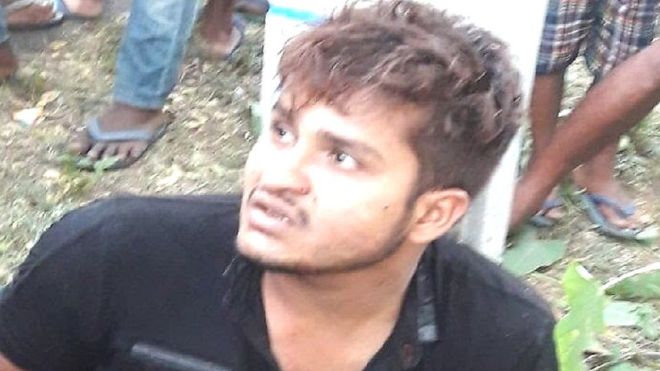
Tabrez AnsariImage copyright BBC HINDI
Image caption A video showing Tabrez Ansari pleading for his life was widely circulated on social media

In many parts of India, Hindus often invoke the popular god Ram’s name as a greeting. But in recent years, Hindu lynch mobs have turned Ram’s name into a murder cry, writes the BBC’s Geeta Pandey in Delhi.

Last month, a video that went viral on social media showed a terrified Muslim man tied to a pole being assaulted by a lynch mob made up of Hindu men in the eastern state of Jharkhand.

In the video, 24-year old Tabrez Ansari is seen pleading for his life, blood and tears streaming down his face.

His attackers force him to repeatedly chant “Jai Shri Ram”, which translates from Hindi to “hail Lord Ram” or “victory to Lord Ram”.

Mr Ansari does as told, and when the mob is finished with him, he is handed over to the police.

The police lock him up and his family is not allowed to see him. He dies four days later from injuries sustained during the attack.

Mr Ansari is not the only one to have been singled out in this manner. June was a particularly bloody month for Indian Muslims, who were targeted in several such attacks.

In Barpeta district in the north-eastern state of Assam, a group of young Muslim men were assaulted and then made to chant slogans like “Jai Shri Ram”, “Bharat Mata ki Jai” (long live Mother India) and “Pakistan murdabad” (death to Pakistan).

In the commercial capital Mumbai, a 25-year-old Muslim taxi driver was abused, beaten up and told to chant “Jai Shri Ram” by a group of men. Faizal Usman Khan said he was attacked when his taxi broke down and he was trying to fix it. His attackers fled after a passenger called the police.

And in the eastern city of Kolkata, Hafeez Mohd Sahrukh Haldar, a 26-year-old Muslim teacher at a madrassa (religious seminary), was heckled while travelling on a train by a group of men chanting “Jai Shri Ram”.

He told reporters that they made fun of his clothes and beard, and then insisted that he also chant the slogans. When he refused, they pushed him out of the moving train. Mr Haldar was injured, but lived to tell the tale.

The slogan-shouting and heckling is no longer restricted to the mob and the streets. Worryingly, it has also entered parliament.

When the newly-elected lower house convened for the first time on 17 June, Muslim and opposition MPs were heckled by members of Prime Minister Narendra Modi’s Bharatiya Janata Party (BJP) when they stood up to take the oath.

The attacks on the minorities have been condemned by opposition politicians. Rahul Gandhi, before he resigned as leader of the main opposition Congress party, described the mob lynching of Tabrez Ansari as a “blot on humanity”.

Many critics, including cartoonist Satish Acharya, have also expressed alarm over the rising number of such incidents.
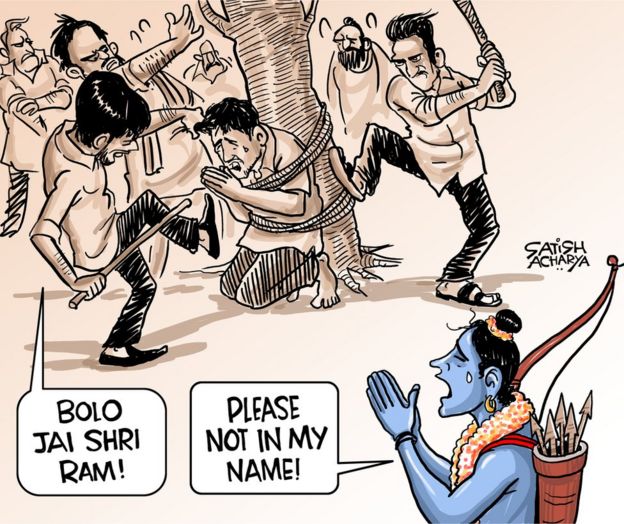
CartoonImage copyright COURTESY: SATISH ACHARYA
Image caption Cartoonist Satish Acharya says using Ram’s name to unleash violence risks widening India’s religious divide

In villages across north India, devout Hindus have traditionally used “Ram Ram”, “Jai Siya Ram” (goddess Siya or Sita is Ram’s consort) or “Jai Ram Ji Ki” as a greeting.

And many feel a sense of unease that these attacks and killings are being carried out in the name of a god revered by millions for his sense of justice and benevolence.

But “Jai Shri Ram” has now been turned into a cry of attack, meant to intimidate and threaten those who worship differently.

The invocation was first used as a political chant in the late 1980s by the BJP to mobilise the Hindu masses during the movement to construct a Ram temple at a disputed siteat Ayodhya.

The party’s then president LK Advani launched a march supporting the construction of the temple and in December 1992 mobs chanting “Jai Shri Ram” marched upon the northern town and tore down the 16th Century Babri mosque.

The BJP believes the mosque was built after the destruction of a temple to Ram that once stood there.

The campaign galvanised Hindu voters in favour of the BJP and helped turn Ram from personal to political. Since then, the party has consistently invoked the deity during elections and the 2019 polls were no exception.

Critics say those who heckle minorities, inside parliament and outside it, see the BJP’s sweeping victory in the April/May elections as sanctioning their behaviour. The party won more than 300 seats in the 543-member lower house, propelling Mr Modi to a second term.

Mr Modi’s first term in power was marked by violence against minorities. There were numerous incidents of Muslims being attacked by so-called “cow vigilantes” over rumours that they had eaten beef, or that they were trying to smuggle cows – an animal many Hindus consider holy – for slaughter.

The prime minister did not condone such attacks, but was criticised for not condemning them either.
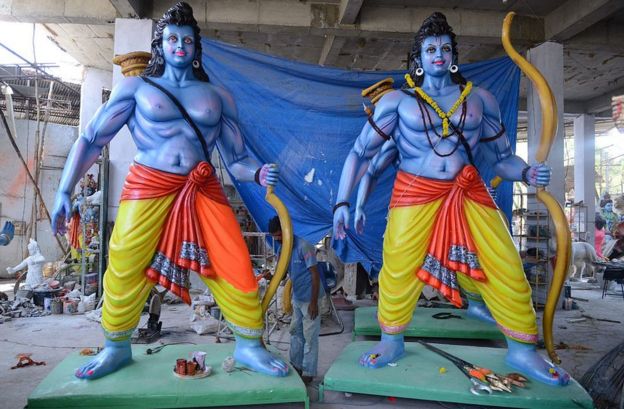
An Indian artist puts final touches to statues of the Hindu God Lord Ram in Hyderabad on April 13, 2016Image copyright GETTY IMAGES
Image caption Millions of Hindus revere the god Ram for his sense of justice and benevolence

But right after the BJP’s stunning victory in May, Mr Modi expanded his earlier slogan of “sabka saath, sabka vikas” (development for all) to include “sabka vishwas” (to win the trust of everyone), giving rise to hopes that this term would be different.

A few days after Tabrez Ansari’s death, he told parliament that he was “pained” by the incident and that “the guilty must be severely punished”.

But many Indians doubt that any serious action will be taken against those who carry out such attacks.

Several dozen people have been killed and hundreds injured since 2014 in mob attacks, but there have been convictions in only a handful of cases.

In others, the accused remain free, often due to a lack of evidence, and some have been seen being feted by Mr Modi’s party’s colleagues.

BJP leaders often downplay such incidents, calling them “minor” and accusing the press of “maligning the image of the government”.

One BJP MP recently told a news website that the popularity of the slogan “Jai Shri Ram” was a sort of protest by Hindus “against a certain bias and tilt of the polity towards minorities”.

“They are also asserting that we are Hindus and we count as Hindus,” he said.

But critics say that there are other – better – ways of doing that.

Source: The BBC
01/05/2019

Why is a 2,500-year-old epic dominating polls in modern India?

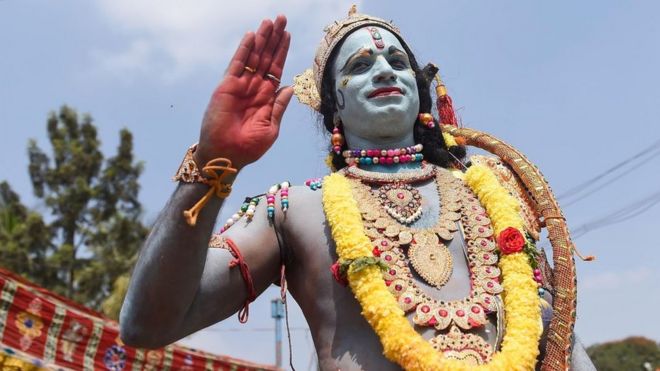
An Indian artist dressed as Lord Rama, a character from a Hindu mythological epic poem entitled Ramayana, gestures during Hanuman Jayanti festival in Bangalore on December 20, 2018.Image copyrightGETTY IMAGES
Image captionMany Hindus see the Ramayana’s protagonist, Ram, as a hero

With the Indian general election under way, the Ramayana, a 2,500-year-old Hindu mythological epic, is back in the spotlight. The BBC’s religious affairs reporter Priyanka Pathak explains why.

This year, like in previous elections, the conversation among many hardline Hindus has returned to the epic Ramayana and its protagonist, Ram.

A longstanding demand to construct a temple in the northern city of Ayodhya – a key point of tension between Hindus and Muslims – which Hindus believe is Ram’s birthplace, has become louder in recent months.

Hardline Hindus want the temple built on the same spot where a 16th Century mosque was demolished by Hindu mobs in 1992. They believe the Babri mosque was built after the destruction of a Hindu temple by a Muslim invader.

India’s Ayodhya site: Masses gather as Hindu-Muslim dispute simmers

The governing Bharatiya Janata Party (BJP) has promised, once again, to reconstruct the Ram Mandir (temple) in its election manifesto.

Like in previous elections, they hope that this pledge will draw in more Hindu voters. They also organised Hindu religious festivals on a grand scale in the lead-up to the polls.

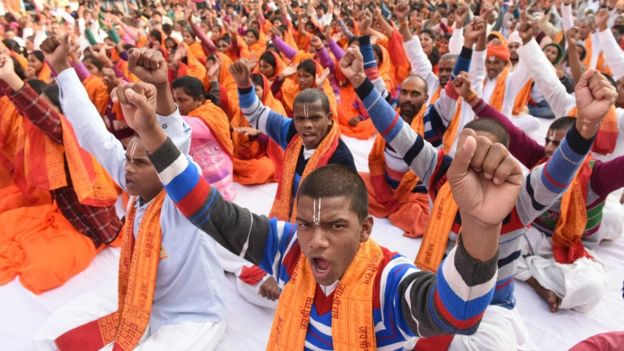
On 12 April, a large gathering of right-wing organisations was held at the iconic Ram Lila Maidan, a sprawling ground named after the god in the centre of the capital, Delhi, to celebrate “Ram’s birthday”.

People dressed in saffron robes wielded swords as they chanted “Jai Shree Ram”, which translates from the Hindi to “Hail Lord Ram”. They shouted slogans, reiterating their promise to Ram that they would reconstruct the temple.

Presentational grey line

What is the story of the Ramayana?

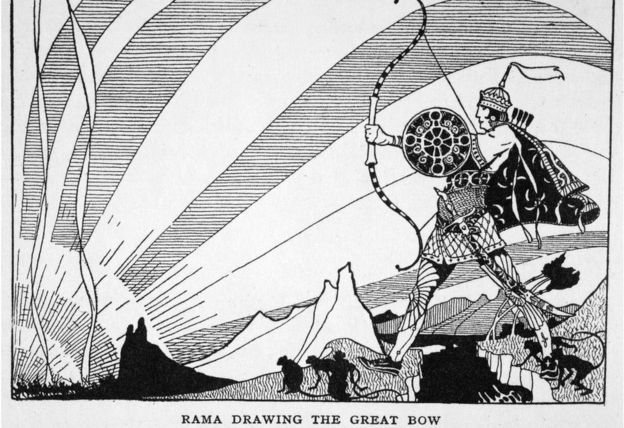
Rama Drawing the Great Bow', 1925. A scene form the Hindu epic poem the Ramayana. Rama preparing to fire the Brahmastra in his final victorious battle with the demon-king Ravana.Image copyrightHERITAGE IMAGES/GETTY
  • The epic tells the story of Ram, a beloved prince who is unaware of his own divinity
  • On the eve of his coronation, he is banished from his kingdom for 14 years by his father at the behest of his stepmother
  • With his wife, Sita, and brother, Lakshman, he wanders through India’s forests – until the 10-headed demon king Ravana abducts Sita
  • Ram then fights and defeats Ravana to rescue Sita after which he establishes a just kingdom
  • The story of Ram’s pursuit of righteousness has made him a symbol of self-sacrifice and heroism for many Hindus
  • He is why this epic remains potent and has dominated India’s political discourse
Presentational grey line

Experts believe that the movement to build the temple, spearheaded by a powerful Hindu nationalist organisation called the Rashtriya Swayamsevak Sangh (RSS), has helped craft some sort of a collective Hindu identity in India.

This idea is something that the RSS, the ideological fountainhead of the BJP, has cultivated since the early 20th Century.

However, the movement found its zeitgeist moment only a century later.

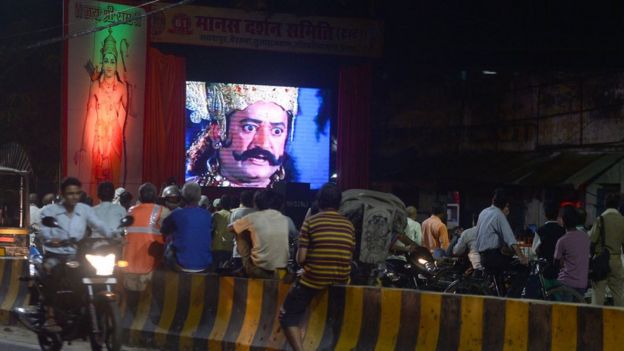
People sit along the road side watching an Indian epic television series of Ramayana, the story of the battle of Hindu god Rama over the demon king Ravana, as they celebrate Navratri (Nine Nights) culminating on the tenth night with the Dusshhra festival depicting the victory of Good over Evil, in Allahabad on September 25, 2017Image copyrightGETTY IMAGES
Image caption People in Ahmedabad city sitting along the road and watching a television series on the Ramayana

Several things happened almost concurrently during the late 1980s. First, a television show on the epic reminded 80 million viewers of the story and rekindled a love for its hero.

The serial broadcast a standardised story of the Ramayana, pulled together from many versions and variants. There is no official version of this sprawling epic although historical scholars consider the version by Valmiki, a sage and Sanskrit poet, to be the most authentic.

But really there are as many as 3,000 retellings of the story in around 22 languages, including some that eulogise Ravana while others say it was actually Ram’s brother Lakshman who killed the demon king.

Presentational grey line

India votes 2019

Presentational grey line

But what the television show did was give India a single narrative of the Ramayana. It also gave a single religion to a country “that was diverse and plural and included many different ways to be Indian”, says Arshia Sattar, a doctorate in south Asian languages, who has translated Valmiki’s Ramayana from Sanskrit into English.

The second big moment came in the late 1980s, when the Congress party led by Rajiv Gandhi – which has always styled itself as secular – decided to lay the foundation stone of the temple in Ayodhya with the help of Vishwa Hindu Parishad (VHP), a right-wing outfit, to woo Hindu votes in a close election.

The plan didn’t work – instead, it paved the way for the BJP, still a young party at the time, to seize what they saw as an opportunity to galvanise Hindu voters.

In September 1989, the party’s then president LK Advani launched a nationwide march for the temple. Bricks began to move from around India for the construction of the temple. The campaign was successful in mobilising communal sentiments and set in motion a series of events that would result in the demolition of the mosque. This, in turn, triggered nationwide riots.

VHP saints at Karsevak Puram taking park in Hindu Swabhiman Sammelan organized by the VHP to mark 25th anniversary Babri Masjid demolition, on December 6, 2017 in AyodhyaImage copyrightGETTY IMAGES
Image captionHindu activists are demanding the construction of the Ram Temple

But in the next elections, the BJP swept the polls. From that moment forward, the party – which was 12 years old at the time – became a national heavyweight.

It took its place as either the party leading the ruling government alliance or as the leading opposition party. For the BJP, the Ayodhya issue became a way to consolidate Hindu votes – something that used to be fragmented along caste lines.

This now well-known version of the epic, championing Ram, also became a convenient point for other Hindu organisations to rally around. This meant that other versions of the epic began to be stamped out.

For instance, in 2011, a Hindu nationalist student union and other affiliated right-wing groups succeeded in forcing Delhi University to drop an essay by the late poet and Ramayana scholar AK Ramanujan, which questioned how many versions of the epic existed, from its history curriculum.

“This may have been part of the general climate of intolerance and the battle over who had the right to tell the country’s history and its myths that was part of the Indian landscape between the 1980s and the 2000s,” literary critic and author Nilanjana Roy wrote of the incident in her blog in 2011.

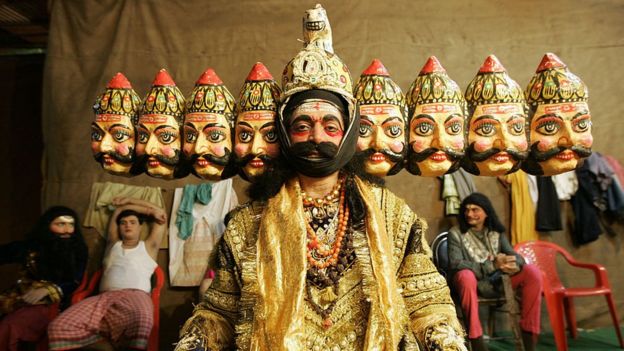
An artist dressed up as th 10 faced Ravana from the mythological Ramayana at Shivaji Park for a Ram Lila show on the occasion of Dassera.Image copyrightGETTY IMAGES
Image captionRam fights and defeats the ten-headed demon Ravana in the Hindu epic

But for hardline Hindus, the cultural loss of other versions is simply collateral damage.

They believe that a sort of Hindu renaissance can be built around the epic, allowing Hindus to band together and revive their religion as a way of life that they believe was lost and can be re-established.

For instance, in September 2017, the Uttarakhand state minister for alternative medicine, proposed spending $3.6m (£2.8m) to find Sanjeevani – a mythical, glow-in-the-dark herb, described in the epic as having saved Ram and Lakshman from certain death.

The deputy chief minister of Uttar Pradesh has also suggested that science was so advanced during the time of the Ramayana that Sita was actually a test-tube baby. And the vice chancellor of an Indian university has claimed that Ravana, had a fleet of airplanes.

A series of such examples from Indian politicians and scholars can be seen as an attempt to bolster pride in the mythological epic. But they also evoke a nostalgia for a grand past, reawakening hope for a future that repeats the great feats of distance ancestors.

Source: The BBC

Law of Unintended Consequences

continuously updated blog about China & India

ChiaHou's Book Reviews

continuously updated blog about China & India

What's wrong with the world; and its economy

continuously updated blog about China & India