

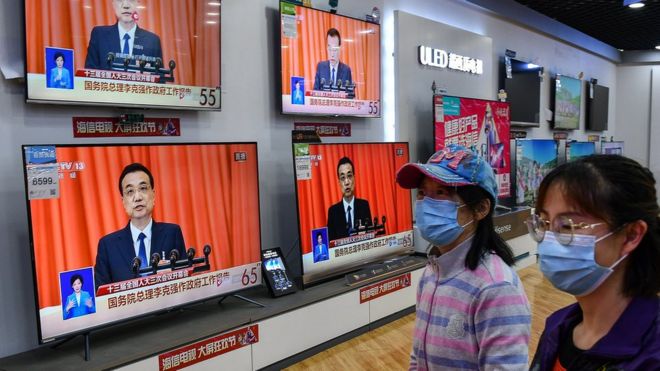
 Image copyright AFP / GETTY
China’s ruling Communist Party has set in motion a controversial national security law for Hong Kong, a move seen as a major blow to the city’s freedoms.
The law to ban “treason, secession, sedition and subversion” could bypass Hong Kong’s lawmakers.
Critics say China is breaking its promise to allow Hong Kong freedoms not seen elsewhere in China.
It is likely to fuel public anger and may even trigger fresh protests and demands for democratic reform.
The plan was submitted at the annual National People’s Congress (NPC), which largely rubber-stamps decisions already taken by the Communist leadership, but is still the most important political event of the year.
Hong Kong, a semi-autonomous region and an economic powerhouse, was always meant to have introduced such laws after the handover from British control to Chinese rule in 1997.
After last year’s wave of sustained and violent protest, Beijing is now attempting to push them through, arguing “law-based and forceful measures” must be taken to “prevent, stop and punish” such protests in the future.
On Friday, Hong Kong’s government said it would co-operate with Beijing to enact the law, adding it would not affect the city’s freedoms.
- How bad are China’s economic woes?
- China’s Congress: Hong Kong, virus and money woes
- China scraps annual growth target for first time
What is in Beijing’s proposed law?
The “draft decision” – as it is known before approval by the NPC – was explained by Wang Chen, vice chairman of the Standing Committee of the NPC.
It consists of an introduction and seven articles. Article 4 may prove the most controversial.
That article says Hong Kong “must improve” national security, before adding: “When needed, relevant national security organs of the Central People’s Government will set up agencies in Hong Kong to fulfil relevant duties to safeguard national security in accordance with the law.”
China could essentially place this law into Annex III of the Basic Law, which covers national laws that must be implemented in Hong Kong – either by legislation, or decree.
Addressing the congress, Premier Li Keqiang spoke of the economic impact of the coronavirus and on Hong Kong and Macau said: “We’ll establish sound legal systems and enforcement mechanisms for safeguarding national security in the two Special Administrative Regions.”
What do opponents say the dangers are?
Hong Kong is what is known as a “special administrative region” of China.
It has observed a “one country, two systems” policy since Britain returned sovereignty in 1997, which has allowed it certain freedoms the rest of China does not have.
Pro-democracy activists fear that China pushing through the law could mean “the end of Hong Kong” – that is, the effective end of its autonomy and these freedoms.
Last year’s mass protests in Hong Kong were sparked by a bill that would have allowed extraditions to mainland China.
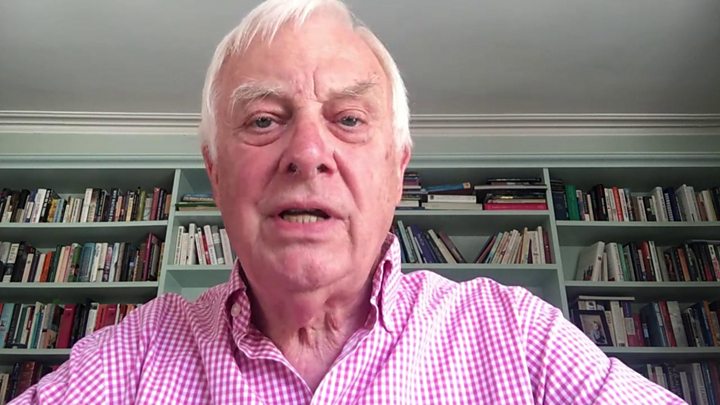
The bill was paused, then withdrawn – but the protests continued until the virus outbreak at the end of the year.
The US has also weighed in, with President Trump saying the US would react strongly if it went through – without giving details.
It is currently considering whether to extend Hong Kong’s preferential trading and investment privileges.
Why is China doing this?
Mr Wang said the security risks had become “increasingly notable” – a reference to last year’s protests.
“Considering Hong Kong’s situation at present, efforts must be made at the state-level to establish and improve the legal system and enforcement mechanisms,” he is quoted as saying in state media.
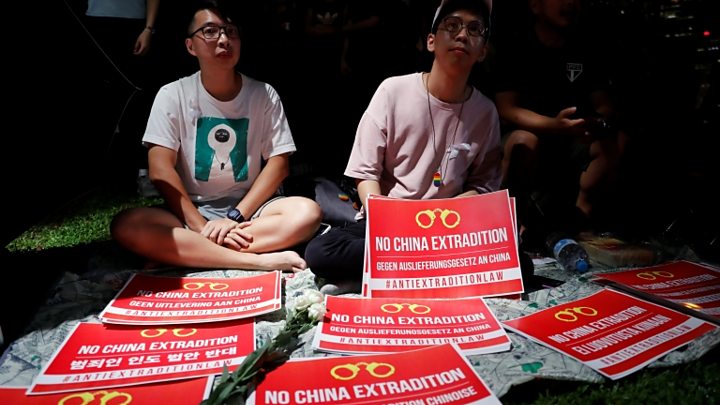
Beijing may also fear September’s elections to Hong Kong’s legislature.
If last year’s success for pro-democracy parties in district elections is repeated, government bills could potentially be blocked.
What is Hong Kong’s legal situation?
Hong Kong was under British control for more than 150 years up to 1997.
The British and Chinese governments signed a treaty – the Sino-British Joint Declaration – that agreed Hong Kong would have “a high degree of autonomy, except in foreign and defence affairs”, for 50 years.
This was enshrined in the Basic Law, which runs out in 2047.
- What is the Basic Law and how does it work?
- Why are there protests in Hong Kong? All the context you need
As a result, Hong Kong’s own legal system, borders, and rights – including freedom of assembly and free speech – are protected.
But Beijing has the ability to veto any changes to the political system and has, for example, ruled out direct election of the chief executive.

 CHINDIA ALERT: You'll be living in their world, very soon