Archive for ‘handsets’

11/09/2019

iPhone 11: Will Apple’s latest phones capture India’s growing market?

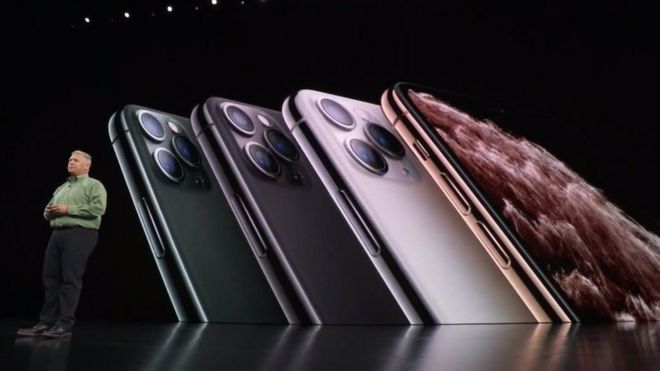
iPhone 11 ProImage copyright APPLE
Image caption The iPhone 11 Pro is said to last four hours more than before, while the Pro Max is said to last five hours longer

Apple has unveiled its iPhone 11 range of handsets, featuring more cameras and more battery life. But will it be enough to capture one of the world’s only growing smartphone markets?

Samsung has traditionally held dominance in the Indian “premium smartphone” segment, which refers to mobiles that cost 40,000 rupees (£451; $558) or more.

But this year, for the first time ever, Apple surged ahead of the Korean electronics giant in India. It swept up 41.2% of the premium smartphone market in the second quarter of 2019, according to research firm International Data Corporation.

“The Indian smartphone market is a game of changing fortunes,” technology journalist Mala Bhargava told the BBC. “There isn’t a company, no matter how dominant a position it commands, that can afford to sit idle.”

Apple’s latest mobile phones – the iPhone 11, 11 Pro and 11 Pro Max – will be available in India from 27 September.

And the iPhone 11, Ms Bhargava added, is primed to find success in the Indian market.

In recent months, Apple dropped its price for the iPhone 11’s predecessor, the iPhone XR, from 73,900 rupees to 53,900 rupees. The 20,000 rupee price drop was significant enough to make an impact.

“Consumers in India are known to be discount and deal-oriented,” Ms Bhargava said. “Seeing the iPhone as an aspirational product, many snapped up the mobile once prices were slashed.”
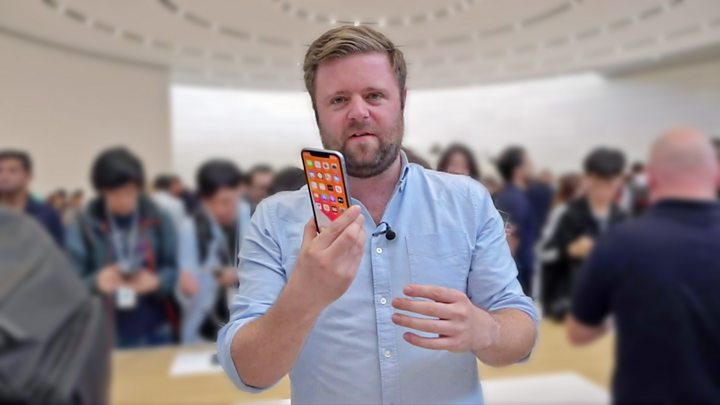
Media caption WATCH: Taking a slowfie with the iPhone 11

This, she said, is also what gave Apple the lead for the first time in India in the smartphone market.

The latest iPhones feature more cameras than before and a processor that has been updated to be faster while consuming less power. There are two Pro models, which the company said would last between four to five hours longer than their XS predecessors.

The entry-level iPhone 11 is the “perfect successor” to the iPhone XR, Ms Bhargava said.

It will start at a price of 64,900 rupees – which is not drastically higher than what the iPhone XR currently sells for.

“The discounted iPhone XR played a big part in bolstering sales in India, so it’s likely that with such a price for the iPhone 11, the company can really extend its market share,” she added.
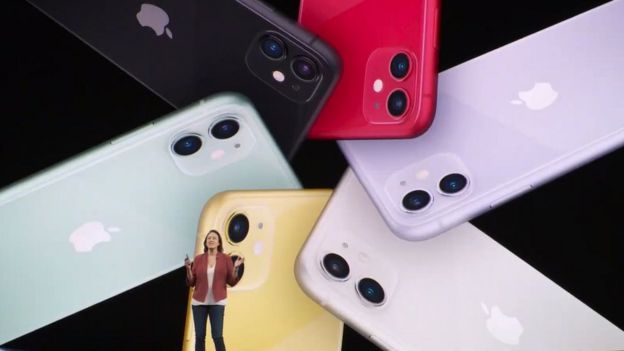
iPhone 11Image copyright APPLE
Image caption The entry-level iPhone 11 is said to last up to one hour longer than the earlier XR

Apple also launched the iPhone 11 Pro and iPhone 11 Pro Max, which at 99,990 rupees and 109,900 rupees a piece, will not be a key attraction as consumers will find that unaffordable.

“But at the same time, this gap could still benefit the company, leaving the field open for older iPhones and for the new iPhone 11 to increase Apple’s share in the country,” Ms Bhargava said.

The company is still selling the iPhone XR, along with the older iPhone 8, which will give consumers more choices and prices to choose from.

“With the sales of smartphones falling in the rest of the world, Apple can’t help but look to consolidate its position in India – it is almost the only market growing at an enthusiastic pace,” she added.

In the second quarter of 2019, 36.9 million handsets were shipped in India – up 9.9% from last year.

In comparison, the premium global smartphone market collapsed 8% in the first quarter this year, with much of the decline pushed by a 20% drop in Apple’s shipments.

“India still has millions of first-time phone buyers,” said Ms Bhargava, “and many of those who have been using budget phones are read to buy something better.”

Source: The BBC

22/05/2019

EE keeps Huawei in first British 5G network but halts handsets

LONDON (Reuters) – Britain’s biggest mobile operator EE said on Wednesday its 5G network would rely on equipment made by China’s Huawei, at least for the first few years, as it announced plans to switch on the next-generation services on May 30.

However, BT-owned EE joined rival Vodafone in pulling a Huawei smartphone from its 5G launch line-up because of uncertainty about support by Google’s Android after a U.S. move to block the Chinese firm’s access to its technology.

The United States has said Huawei is a security risk and open to spying by Beijing, a claim the Chinese company denies.

The government will rule imminently whether Huawei will be allowed to participate in these new networks.

EE Chief Executive Marc Allera said its planned 5G launch was “the start of the UK’s 5G journey and great news for our customers that want and need the best connections”.

Britain had given the green light for the launch, which will see six cities including London, Cardiff and Edinburgh switched on next week and another 10 by the end of the year, he added.

“We do believe it is important for the UK that we are in the pack of the leading nations (for 5G),” he said. “At the moment we have no instructions [from government] to change our plans.”

EE has said it was already removing Huawei networking equipment from it core network. BT Group’s technology chief Howard Watson, however, said 5G would start before Huawei was totally removed from the core of its network.

“We are launching 5G with Huawei in the radio access network and we are using an upgraded version of that existing core, which will then … be migrated away from,” Watson said.

HUAWEI DROPPED

EE and Vodafone have opened orders for 5G phones, for example from Samsung, to be available when their networks launch.

Apple does not yet have a 5G phone and analysts do not expect it to launch one until 2020 at the earliest.

Users were already regularly achieving speed of 500Mbps in tests networks, Allera said, adding that he was confident speeds of 1Gbps would be reached by the end of the year.
Average speeds at launch would be about 200Mbps, five times faster than typical top 4G speeds, while EE said smartphone tariffs would range from 54 pounds ($68) a month for 10GB of data to 74 pounds a month for 120GB.
It aims to have 1,500 5G sites by the end of 2019, targeting the busiest areas of the busiest cities, he said.
Industry analyst Kester Mann from CCS said he “applauded a realistic launch” that did not over-inflate expectations.
“Although being the first UK network to launch 5G will mean little to consumers, EE clearly see it as an important honor,” he said. Vodafone launches on July 3.
Huawei’s Mate 20X (5G) had been expected to be among the devices available on both company’s superfast networks, but EE dropped the company from a launch line-up that includes Samsung’s Galaxy S10 5G, and devices from Oppo, LG and OnePlus.
“We have put the Huawei devices on pause until we have got a bit some more information,” Allera said, adding that EE needed to be sure the devices it supplies are going to be supported.

Vodafone UK took the same step, stopping pre-orders for the handset before the launch of its network.

Huawei, the world’s second-biggest phone maker runs its devices on Google’s Android platform outside China, but the U.S. Commerce Department blocked Huawei from buying U.S. goods last week, throwing future software updates into question.

Britain was set to allow Huawei some participation in the radio part of 5G networks but bar it from the intelligent core. But a decision has not been announced, and the U.S. and some politicians are pushing for a more far-reaching ban.

Source: Reuters

16/05/2019

Trump administration hits China’s Huawei with one-two punch

WASHINGTON/NEW YORK (Reuters) – The Trump administration on Wednesday took aim at China’s Huawei Technologies Co Ltd, banning the firm from buying vital U.S. technology without special approval and effectively barring its equipment from U.S. telecom networks on national security grounds.

Taken together, the two moves threaten Huawei’s ability to continue to sell many products because of its reliance on American suppliers, and represents a significant escalation in the U.S. government’s worldwide campaign against the company.

The steps also come at a delicate time in relations between China and the United States as the world’s two largest economies ratchet up tariffs in a battle over what U.S. officials call China’s unfair trade practices.

Washington believes the handsets and network equipment for telecommunications companies made by Huawei could be used by the Chinese state to spy on Americans.

Huawei, which has repeatedly denied the allegations, said in a statement that “restricting Huawei from doing business in the U.S. will not make the U.S. more secure or stronger; instead, this will only serve to limit the U.S. to inferior yet more expensive alternatives, leaving the U.S. lagging behind in 5G deployment.”

“In addition, unreasonable restrictions will infringe upon Huawei’s rights and raise other serious legal issues.”

The ban on U.S. suppliers, which appears similar to one on Huawei rival ZTE Corp. last year, could hit the shares of Huawei’s biggest U.S. suppliers, including chipmakers Qualcomm Inc and Broadcom Inc (AVGO.O).

In the first action taken on Wednesday, President Donald Trump signed a long-awaited executive order declaring a national emergency and barring U.S. companies from using telecommunications equipment made by firms posing a national security risk.

The order invoked the International Emergency Economic Powers Act, which gives the president the authority to regulate commerce in response to a national emergency that threatens the United States. It directs the Commerce Department, working with other government agencies, to draw up an enforcement plan by October.

Members of Congress said Trump’s order was squarely aimed at Chinese companies like Huawei, which generated $93 billion in revenue last year and is seen as a national champion in China.

“China’s main export is espionage, and the distinction between the Chinese Communist Party and Chinese ‘private-sector’ businesses like Huawei is imaginary,” Republican Senator Ben Sasse said.

ENTITY LIST

Soon after the White House announced the order had been signed, the Commerce Department said it had added Huawei and 70 affiliates to its so-called Entity List – a move that bans the telecom giant from buying parts and components from U.S. companies without U.S. government approval.

U.S. officials told Reuters the decision would make it difficult, if not impossible, for Huawei, the largest telecommunications equipment producer in the world, to sell some products because of its reliance on U.S. suppliers. It will take effect in the coming days.

Commerce Secretary Wilbur Ross said in a statement Trump backed the decision that will “prevent American technology from being used by foreign owned entities in ways that potentially undermine U.S. national security or foreign policy interests.”

With Huawei on the Entity List, U.S. suppliers will need to apply for licenses to provide the Chinese company with anything subject to U.S. export control regulations. Obtaining such licenses will be difficult because they will have to show the transfer of items will not harm U.S. national security, said John Larkin, a former export control officer in Beijing for the Commerce Department.

The United States in January unsealed a 13-count indictment against Huawei accusing the company and its chief financial officer of conspiring to defraud global financial institutions by misrepresenting Huawei’s relationship with a suspected front company that operated in Iran.

The indictment was unsealed a month after CFO Meng Wanzhou was arrested in Canada on a U.S. warrant for her role in the alleged fraud. Meng, who maintains her innocence, is fighting extradition.

5G NETWORKS

Reuters reported on Tuesday that Trump was expected to sign his long-awaited executive order this week. The order does not specifically name any country or company, but U.S. officials have previously labeled Huawei a “threat”.

The United States has been actively pushing other countries not to use the Chinese company’s equipment in next-generation 5G networks that it calls “untrustworthy.” In August, Trump signed a bill that barred the U.S. government from using equipment from Huawei and another Chinese provider, ZTE Corp.

ZTE was added to the Commerce Department’s Entity List in March 2016 over allegations it organised an elaborate scheme to hide its re-export of U.S. items to sanctioned countries in violation of U.S. law.

The restrictions prevented suppliers from providing ZTE with U.S. equipment, potentially freezing the company’s supply chain, but the restrictions were suspended in a series of temporary reprieves, allowing the company to maintain ties to U.S. suppliers until it agreed to a plea deal a year later.

The status of Huawei and ZTE has taken on new urgency as U.S. wireless carriers rollout 5G networks.

While the big wireless companies have already cut ties with Huawei, small rural carriers continue to rely on both Huawei and ZTE switches and other equipment because they tend to be cheaper. Trump’s order applies to future purchases and does not address existing hardware, officials said Wednesday.

Source: Reuters

Law of Unintended Consequences

continuously updated blog about China & India

ChiaHou's Book Reviews

continuously updated blog about China & India

What's wrong with the world; and its economy

continuously updated blog about China & India