Archive for ‘High Court’

26/02/2020

Why Delhi violence has echoes of the Gujarat riots

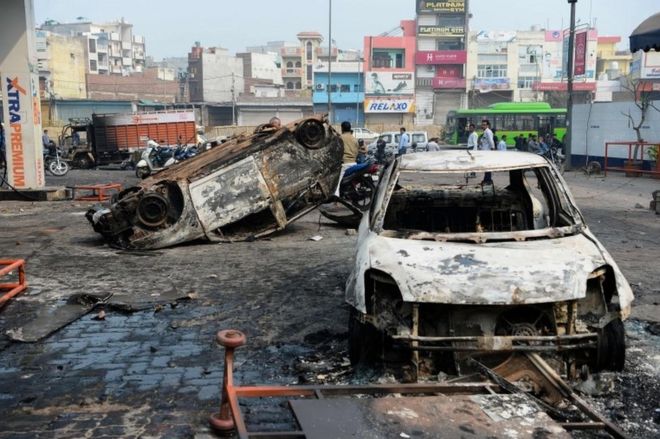
Local residents look at burnt-out vehicles following clashes between people supporting and opposing a contentious amendment to India"s citizenship law, in New Delhi on February 26, 2020Image copyright AFP
Image caption Delhi remains on edge after three days of rioting

The religious violence which has roiled Delhi since the weekend is the deadliest in decades.

What began as small clashes between supporters and opponents of a controversial citizenship law quickly escalated into full-blown religious riots between Hindus and Muslims, in congested working class neighbourhoods on the fringes of the sprawling capital.

Armed Hindu mobs rioted with impunity as the police appeared to look the other way. Mosques and homes and shops of Muslims were attacked, sometimes allegedly with the police in tow. Journalists covering the violence were stopped by the Hindu rioters and asked about their religion. Videos and pictures emerged of the mob forcing wounded Muslim men to recite the national anthem, and mercilessly beating up a young Muslim man. Panicky Muslims began leaving mixed neighbourhoods.

On the other side, Muslim rioters have also been violent – some of them also armed – and a number of Hindus, including security personnel, are among the dead and injured.
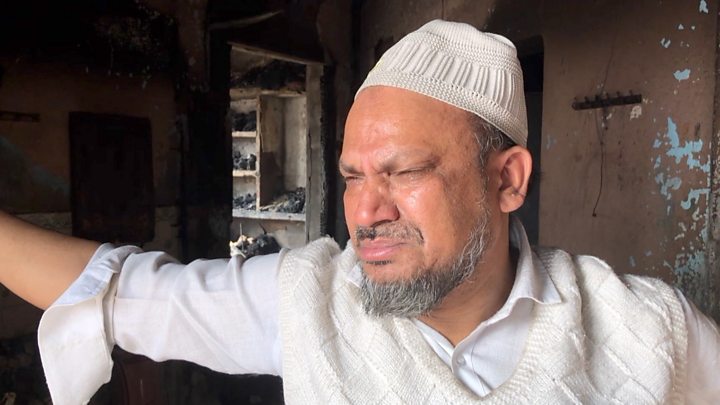
Media caption Delhi religious riots: ‘Mobs set fire to my house and shop’

Three days and 20 deaths later, Prime Minister Narendra Modi tweeted his first appeal for peace. There were no commiserations for the victims. Delhi’s governing Aam Aadmi Party was criticised for not doing much either. Many pointed to the egregious failure of Delhi’s police – the most well-resourced in India – and the inability of opposition parties to rally together, hit the streets and calm tensions. In the end, the rioters operated with impunity, and the victims were left to their fate.
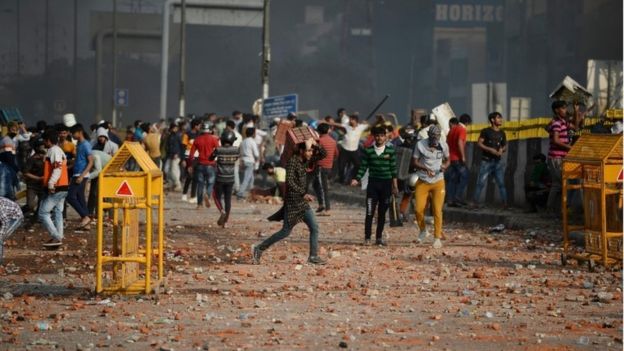
Demonstrators gather along a road scattered with stones following clashes between supporters and opponents of a new citizenship law, at Bhajanpura area of New Delhi on February 24, 2020Image copyright AFP
Image caption More than 20 people have been killed in the rioting

Not surprisingly, the ethnic violence in Delhi has drawn comparisons with two of India’s worst sectarian riots in living memory. Nearly 3,000 people were killed in anti-Sikh riots in the capital in 1984 after the then prime minister Indira Gandhi was assassinated by her Sikh bodyguards. And in 2002, more than 1,000 people, mostly Muslims, died after a train fire killed 60 Hindu pilgrims in Gujarat – Mr Modi was then the chief minister of the state. The police were accused of complicity in both riots. The Delhi High Court, which is hearing petitions about the current violence, has said it cannot let “another 1984” happen on its “watch”.

Ashutosh Varshney, a professor of political science at Brown University who has extensively researched religious violence in India, believes that the Delhi riots are beginning to “look like a pogrom” – much like the ones in 1984 and 2002.

Pogroms happen, according to Prof Varshney, when the police do not act neutrally to stop riots, look on when mobs go on the rampage and sometimes “explicitly” help the perpetrators. Evidence of police apathy in Delhi has surfaced over the past three days. “Of course, the violence thus far has not reached the scale of Gujarat or Delhi. Our energies should now focus on preventing further escalation,” he says.

Political scientist Bhanu Joshi and a team of researchers visited constituencies in Delhi ahead of February’s state elections. They found the BJP’s “perfectly oiled party machinery constantly giving out the message about suspicion, stereotypes and paranoia”. In one neighbourhood, they found a party councillor telling people: “You and your kids have stable jobs, money. So stop thinking of free, free. [She was alluding to free water and electricity being given to people by the incumbent government.] If this nation doesn’t remain, all the free will also vanish.” Such paranoia about the security of the nation at a time when India has been at its most secure has “widened” existing ethnic divisions and “made people suspicious”, Mr Joshi said.
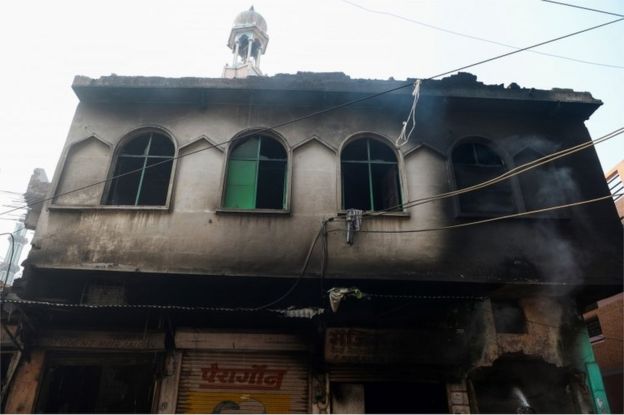
burnt-out mosque and shops are seen following clashes between people supporting and opposing a contentious amendment to India"s citizenship law, in New Delhi on February 26, 2020.Image copyright AFP
Image caption Mosques have been vandalised in the clashes

In the run-up to the Delhi elections Mr Modi’s party embarked on a polarising campaign around a controversial new citizenship law, the stripping of Kashmir’s autonomy and building a grand new Hindu temple on a disputed holy site. Party leaders freely indulged in hate speech, and were censured by poll authorities. A widely reported protest against the citizenship law by women in Shaheen Bagh, a Muslim-dominated neighbourhood in Delhi, was especially targeted by the BJP’s campaign, which sought to show the protesters as “traitors”.

“The repercussion of this campaign machine is the normalisation of suspicion and hate reflected in WhatsApp groups, Facebook pages, and conversations families have among themselves,” says Mr Joshi.

It was only a matter of time before Delhi’s fragile stability would be shaken. On Sunday a BJP leader issued a threat, telling the Delhi police they had three days to clear the sites where people had been protesting against the citizenship law and warned of consequences if they failed to do so. The first reports of clashes emerged later that day. The ethnic violence that followed was a tragedy foretold.

Source: The BBC
17/12/2018

‘Carnage of unbelievable proportions’: Delhi High Court convicts Sajjan Kumar for 1984 riots

Sajjan Kumar,anti-Sikh riots case,1984 anti-sikh riots case
Congress’ Sajjan Kumar was convicted today by Delhi High Court in 1984 riots case(PTI)

The Delhi High Court on Monday called the anti-Sikh riots case of 1984 “communal frenzy” after the then prime minister Indira Gandhi was assassinated by her bodyguards as it sentenced Congress leader Sajjan Kumar to life imprisonment in one of the cases.

As it reversed the trial court’s order acquitting Kumar, the court also directed him to surrender by December 31, 2018, and slapped a fine of Rs 5 lakh on him and Rs 1 lakh on all other accused in the case.

The case relates to the murder of five members of a family during the anti-Sikh riots in the Raj Nagar area in the Delhi Cantonment on November 1, 1984.

“What happened in the aftermath of the assassination of the then Prime Minister was carnage of unbelievable proportions in which over 2,700 Sikhs were murdered in Delhi alone. The law and order machinery clearly broke down and it was literally a ‘free for all’ situation which persisted. The aftershocks of those atrocities are still being felt,” justice S Muralidhar and justice Vinod Goel said while handing the 203-page judgement.

Also watch | Congress’ Sajjan Kumar convicted in 1984 Sikh riots case, gets life term 

The judges also quoted a poem by Amrita Pritam on the violence after the Partition in 1947 in India and Pakistan. She escaped to India with her two children from Pakistan’s Lahore.

“She was moved to pen an “Ode to Waris Shah” in which she spoke of the fertile land of Punjab having “sprouted poisonous weeds far and near” and where “Seeds of hatred have grown high, bloodshed is everywhere/Poisoned breeze in forest turned bamboo flutes into snakes/Their venom has turned the bright and rosy Punjab all blue,” they said.

Also read | Congress’ Sajjan Kumar convicted in 1984 Sikh riots, gets life term

“The killings would continue in the streets of Delhi. Thirty-seven years later, the country was again witness to another enormous human tragedy. Following the assassination of Smt. Indira Gandhi, the then Prime Minister of India, on the morning of 31st October 1984 by two of her Sikh bodyguards, a communal frenzy was unleashed.”

‘Political patronage’

The judges recalled the violence in which thousands of Sikhs were killed, some burnt alive, as their houses were destroyed in Delhi and across the country.

“A majority of the perpetrators of these horrific mass crimes, enjoyed political patronage and were aided by an indifferent law enforcement agency … The criminals escaped prosecution and punishment for over two decades.”

“There was an abject failure by the police to investigate the violence which broke out in the aftermath of the assassination of the then Prime Minister Smt. Indira Gandhi is apparent from the several circumstances highlighted hereinabove.”

There was an “utter failure” to register separate first report information in the case of five deaths in which Congress leader Kumar and others were sentenced.

“The failure to record any incident whatsoever in the DDR and the lack of mention of PW-1’s statement therein, amongst other circumstances, established the apathy of the Delhi Police and their active connivance in the brutal murders being perpetrated.

Here is what they also said in the summary of their judgement:

1. This was an extraordinary case where it was going to be impossible to proceed against A-1 in the normal scheme of things because there appeared to be ongoing large-scale efforts to suppress the cases against him by not even recording or registering them. Even if they were registered they were not investigated properly and even the investigations which saw any progress were not carried to the logical end of a charge sheet actually being filed. Even the defence does not dispute that as far as FIR No.416/1984 is concerned, a closure report had been prepared and filed but was yet to be considered by the learned MM.

2. The trial Court completely omitted to address the charge of conspiracy despite detailed arguments submitted by the CBI in that regard. There was a two-pronged strategy adopted by the attackers. First was to liquidate all Sikh males and the other was to destroy their Crl.A. 1099/2013 & Connected Matters Page 200 of 203 residential houses leaving the women and children utterly destitute. The attack on the Raj Nagar Gurudwara was clearly a part of the communal agenda of the perpetrators.

Read | ‘Will pay for sins’: Arun Jaitley targets Congress after Sajjan Kumar conviction

3. The mass killings of Sikhs between 1st and 4th November 1984 in Delhi and the rest of the country, engineered by political actors with the assistance of the law enforcement agencies, answer the description of “crimes against humanity”. Cases like the present are to be viewed in the larger context of mass crimes that require a different approach and much can be learnt from similar experiences elsewhere.

4. Common to the instances of mass crimes are the targeting of minorities and the attacks spearheaded by the dominant political actors facilitated by the law enforcement agencies. The criminals responsible for the mass crimes have enjoyed political patronage and managed to evade prosecution and punishment. Bringing such criminals to justice poses a serious challenge to our legal system. Decades pass by before they can be made answerable. This calls for strengthening the legal system. Neither “crimes against humanity‟ nor genocide‟ is part of our domestic law of crime. This loophole needs to be addressed urgently.

5. The acquittal of A-1 by the trial Court is set aside. He is convicted of the offence of criminal conspiracy punishable under Section 120B read with Sections 302, 436, 295, and 153A (1) (a) and (b) IPC; for the offence punishable under Section 109 IPC of abetting the commission of the aforementioned offences; and for the offence of delivering provocative speeches instigating violence against Sikhs Crl.A. 1099/2013 & Connected Matters Page 201 of 203 punishable under Section 153A (1) (a) and (b) IPC.

Law of Unintended Consequences

continuously updated blog about China & India

ChiaHou's Book Reviews

continuously updated blog about China & India

What's wrong with the world; and its economy

continuously updated blog about China & India
