22/05/2020
- The tech investment push is part of a fiscal package waiting to be signed off by the National People’s Congress, which convenes this week
- This initiative will reduce China’s dependence on foreign technology, echoing objectives set forth previously in the ‘Made in China 2025’ programme
A conductor rehearses the military band on the sidelines of the National People’s Congress in Beijing’s Great Hall of the People in March of last year. China’s legislature is expected to sign off on a massive tech-led stimulus plan. Photo: AP
Beijing is accelerating its bid for global leadership in key technologies, planning to pump more than a trillion dollars into the economy through the roll-out of everything from next-generation wireless networks to artificial intelligence (AI).
In the master plan backed by President Xi Jinping himself, China will invest an estimated 10 trillion yuan (US$1.4 trillion) over six years to 2025, calling on urban governments and private hi-tech giants like Huawei Technologies to help lay 5G wireless networks, install cameras and sensors, and develop AI software that will underpin
to automated factories and mass surveillance.
The new infrastructure initiative is expected to drive mainly local giants, from
and Huawei to SenseTime Group at the expense of US companies.
As tech nationalism mounts, the investment drive will reduce China’s dependence on foreign technology, echoing objectives set forth previously in the “Made in China 2025”
programme. Such initiatives have already drawn fierce criticism from the Trump administration, resulting in moves to block the rise of Chinese tech companies such as Huawei.
How will China’s annual legislative meetings affect the stock investor? Five key industries to watch
“Nothing like this has happened before, this is China’s gambit to win the global tech race,” said Digital China Holdings chief operating officer Maria Kwok, as she sat in a Hong Kong office surrounded by facial recognition cameras and sensors. “Starting this year, we are really beginning to see the money flow through.”
The tech investment push is part of a fiscal package waiting to be signed off by China’s legislature, the
National People’s Congress, which convenes this week. The government is expected to announce infrastructure funding of as much as US$563 billion this year, against the backdrop of the country’s worst economic performance since the Mao era.
The nation’s biggest purveyors of cloud computing and data analysis Alibaba, the parent company of the
South China Morning Post, and
Tencent Holding will be linchpins of the upcoming endeavour. China has already entrusted Huawei, the world’s largest telecommunications equipment supplier, to help galvanise 5G. Tech leaders including Pony Ma Huateng and
Jack Ma are espousing the programme.
Maria Kwok’s company is a government-backed information technology systems integration provider, among many that are jumping at the chance. In the southern city of Guangzhou, Digital China is bringing half a million units of project housing online, including a complex three quarters the size of Central Park in New York City. To find a home, a user just has to log on to an app, scan their face and verify their identity. Leases can be signed digitally via smartphone and the renting authority is automatically flagged if a tenant’s payment is late.
China is no stranger to far-reaching plans with massive price tags that appear to achieve little. There is no guarantee this programme will deliver the economic rejuvenation its proponents promise. Unlike previous efforts to resuscitate the economy with “dumb” bridges and highways, this newly laid digital infrastructure will help national champions develop cutting-edge technologies.
“China’s new stimulus plan will likely lead to a consolidation of
industrial internet
providers, and could lead to the emergence of some larger companies able to compete with global leaders, such as GE and Siemens,” said Nannan Kou, head of research at BloombergNEF, in a report. “One bet is on industrial
internet-of-things (IoT) platforms, as China aims to cultivate three world leading companies in this area by 2025.”
China is not alone in pumping money into the technology sector as a way to get out of the post-coronavirus economic slump. Earlier this month, South Korea said AI and wireless communications would be at the core of it its “New Deal” to create jobs and boost growth.
Nothing like this has happened before, this is China’s gambit to win the global tech raceMaria Kwok, COO at Digital China Holdings
The 10 trillion yuan that China is estimated to spend from now until 2025 encompasses areas typically considered leading edge, such as AI and IoT, as well as items such as ultra-high voltage lines and high-speed rail, according to the government-backed China Centre for Information Industry Development. More than 20 of mainland China’s 31 provinces and regions have announced projects totaling over 1 trillion yuan with active participation from private capital, a state-backed newspaper reported on Wednesday.
Separate estimates by Morgan Stanley put new infrastructure at around US$180 billion each year for the next 11 years – or US$1.98 trillion in total. Those calculations also include power and rail lines. That annual figure would be almost double the past three-year average, the investment bank said in a March report that listed key stock beneficiaries including companies such as China Tower Corp, Alibaba, GDS Holdings, Quanta Computer and Advantech Co.
Beijing’s half-formed vision is already stirring a plethora of stocks, a big reason why five of China’s 10 best-performing stocks this year are tech plays like networking gear maker Dawning Information Industry and Apple supplier GoerTek. The bare outlines of the master plan were enough to drive pundits toward everything from satellite operators to broadband providers.
China’s telecoms carriers push to complete ‘political task’ of 5G network roll-out amid coronavirus crisis
It is unlikely that US companies will benefit much from the tech-led stimulus and in some cases they stand to lose existing business. Earlier this year, when the country’s largest telecoms carrier China Mobile awarded contracts worth 37 billion yuan for 5G base stations, the lion’s share went to Huawei and other Chinese companies. Sweden’s Ericsson got only a little over 10 per cent of the business in the first four months. In one of its projects, Digital China will help the northeastern city of Changchun swap out American cloud computing staples IBM, Oracle and EMC with home-grown technology.
It is in data centres that a considerable chunk of the new infrastructure development will take place. Over 20 provinces have launched policies to support enterprises using cloud computing services, according to a March research note from UBS Group.
Tony Yu, chief executive of Chinese server maker H3C, said that his company was seeing a significant increase in demand for data centre services from some of the country’s top internet companies. “Rapid growth in up-and-coming sectors will bring a new force to China’s economy after the pandemic passes,” he told Bloomberg News.
From there, more investment should flow. Bain Capital-backed data centre operator ChinData Group estimated that for every one dollar spent on data centres another US$5 to US$10 in investment in related sectors would take place, including in networking, power grid and advanced equipment manufacturing. “A whole host of
supply chain companies will benefit,” the company said in a statement.
There is concern about whether this long-term strategy provides much in the way of stimulus now, and where the money will come from. “It’s impossible to prop up China’s economy with new infrastructure alone,” said Zhu Tian, professor of economics at China Europe International Business School in Shanghai. “If you are worried about the government’s added debt levels and their debt servicing abilities right now, of course you wouldn’t do it. But it’s a necessary thing to do at a time of crisis.”
Digital China is confident that follow-up projects from its housing initiative in Guangzhou could generate 30 million yuan in revenue for the company. It is also hoping to replicate those efforts with local governments in the northeastern province of Jilin, where it has 3.3 billion yuan worth of projects approved. These include building a so-called city brain that will for the first time connect databases including traffic, schools and civil matters such as marriage registry. “The concept of smart cities has been touted for years but now we are finally seeing the investment,” said Kwok.
Source: SCMP
Posted in 5G network roll-out, 5G wireless networks, accelerating, Advantech Co, Alibaba Group Holding, American cloud computing, Apple, artificial intelligence (AI), automated factories, autonomous driving, ‘political task’, Bain Capital, Beijing, BloombergNEF, broadband providers, cameras and sensors, Central Park, Changchun, China, China Centre for Information Industry Development, China Europe International Business School, China Mobile, China Tower Corp, civil matters, conductor, coronavirus crisis, cutting-edge technologies, data centres, Dawning Information Industry, dependence, Digital China, Digital China Holdings, digital infrastructure, economic rejuvenation, EMC, Ericsson, everything, facial recognition cameras and sensors, foreign, GDS Holdings, GE, global leadership, GoerTek, Great Hall of the People, Guangzhou, H3C, High-speed rail, Huawei, huawei technologies, IBM, industrial internet, Infrastructure, install, internet-of-things (IoT), Jack Ma, Jilin, key technologies, linchpins, local governments, Made in China 2025, marriage registry, mass surveillance, master plan, military band, national champions, National People’s Congress, networking gear maker, New York City, next-generation wireless networks, northeastern province, Oracle, plan, planning, Pony Ma Huateng, President Xi Jinping, private hi-tech giants, pundits, Quanta Computer, rehearses, roll out, satellite operators, schools, SenseTime Group, Shanghai, Siemens, south china morning post, South Korea, tech crown, Technology, telecommunications equipment supplier, telecoms carriers, Tencent Holding, to pump, to seize, traffic, trillion dollars, UBS Group, ultra-high voltage lines, Uncategorized, urban governments, wireless communications, world’s |
Leave a Comment »
13/02/2020
- The Eyes of Darkness features a Chinese military lab in Wuhan that creates a virus as a bioweapon; civilians soon become sick after accidentally contracting it
- In fact, the one lab in China able to handle the deadliest viruses is in Wuhan and helped sequence the novel coronavirus the world is currently battling
The opening of the maximum-security lab was covered in a 2017 story in the journal Nature, which warned of safety risks in a culture where hierarchy trumps an open culture.
Koontz has written more than 80 novels and 74 works of short fiction. Photo: Douglas Sonders
Fringe conspiracy theories that the coronavirus involved in the current outbreak appears to be man-made and likely escaped from the Wuhan virology lab have been circulated, but have been widely debunked. In fact the lab was one of the first to sequence the coronavirus.
In Koontz’s thriller, the virus is considered the “perfect weapon” because it only affects humans and, since it cannot survive outside the human body for longer than a minute, it does not demand expensive decontamination once a population is wiped out, allowing the victors to roll in and claim a conquered territory.
It’s no exaggeration to call Koontz a prolific writer. His first book, Star Quest, was published in 1968 and he has been churning out suspense fiction at a phenomenal rate since with more than 80 novels and 74 works of short fiction under his belt. The 74-year-old, a devout Catholic, lives in California with his wife. But what are the odds of him so closely predicting the future?
Albert Wan, who runs the Bleak House Books store in San Po Kong, says Wuhan has historically been the site of numerous scientific research facilities, including ones dealing with microbiology and virology. “Smart, savvy writers like Koontz would have known all this and used this bit of factual information to craft a story that is both convincing and unsettling. Hence the Wuhan-400,” says Wan.
British writer Paul French, who specialises in books about China, says many of the elements around viruses in China relate back to the second world war, which may have been a factor in Koontz’s thinking.
The Eyes of Darkness, by Koontz.
“The Japanese definitely did do chemical weapons research in China, which we mostly associate with Unit 731 in Harbin and northern China. But they also stored chemical weapons in Wuhan – which Japan admitted,” says French.
Publisher Pete Spurrier, who runs Hong Kong publishing house Blacksmith Books, muses that for a fiction writer mapping out a thriller about a virus outbreak set in China, Wuhan is a good choice.
“It’s on the Yangtze River that goes east-west; it’s on the high-speed rail [line] that goes north-south; it’s right at the crossroads of transport networks in the centre of the country. Where better to start a fictional epidemic, or indeed a real one?” says Spurrier. (Spurrier works part-time as a subeditor for the Post.)
Albert Wan runs the Bleak House Books store in San Po Kong, Hong Kong.
Hong Kong crime author Chan Ho-kei believes that this kind of “fiction-prophecy” is not uncommon.
“If you look really hard, I bet you can spot prophecies for almost all events. It makes me think about the ‘infinite monkey’ theorem,” he says, referring to the theory that a monkey hitting keys at random on a typewriter keyboard for an infinite amount of time will almost surely type any given text.
“The probability is low, but not impossible.”
British writer Paul French.
Chan points to the 1898 novella Futility, which told the story of a huge ocean liner that sank in the North Atlantic after striking an iceberg. Many uncanny similarities were noted between the fictional ship – called Titan – and the real-life passenger ship RMS Titanic, which sank 14 years later. Following the sinking of the Titanic, the book was reissued with some changes, particularly in the ship’s gross tonnage.
“Fiction writers always try to imagine what the reality would be, so it’s very likely to write something like a prediction. Of course, it’s bizarre when the details collide, but I think it’s just a matter of mathematics,” says Chan.
Many of Koontz’s books have been adapted for television or the big screen, but The Eyes of Darkness never achieved such glory. This bizarre coincidence will thrust it into the spotlight and may see sales of this otherwise forgotten thriller jump.
Hong Kong crime author Chan Ho-kei.
Amazon is currently offering it on Kindle for just US$1. Perhaps, like Futility, it will also be reissued with some updates to make it really echo the current outbreak.
Source: SCMP
Posted in 1981, appear, bioweapon, Blacksmith Books, chemical weapons research, Chinese military lab, civilians, Dean Koontz, epicentre, events, Futility, Harbin, High-speed rail, Hong Kong, Japan, Japanese, nature, outbreak, prophesy, publishing house, RMS Titanic, second world war, some books, The Eyes of Darkness, thriller, Uncategorized, Unit 731, Virus, Wuhan, Wuhan Institute of Virology, Wuhan-400, Yangtze River |
Leave a Comment »
09/07/2019
BEIJING, July 8 (Xinhua) — China’s high-speed railway (HSR) has registered rapid growth and offered many viable practices for other countries considering HSR investment, according to a World Bank report released Monday.
Key factors enabling the growth include the development of a comprehensive long-term plan and the standardization of designs and procedures, said the report, which summarizes China’s HSR development.
China’s Medium- and Long-Term Railway Plan, which looks up to 15 years ahead, provides a clear framework for the development of the system, according to the World Bank.
Meanwhile, the construction cost of the Chinese HSR network stood at about two-thirds of the cost in other countries, the report said, citing an average of 17 million U. S. dollars to 21 million U. S. dollars per km.
“China has built the largest high-speed rail network in the world. The impacts go well beyond the railway sector and include changed patterns of urban development, increases in tourism, and promotion of regional economic growth,” said Martin Raiser, World Bank director of China.
By the end of 2018, the total railway operation mileage reached 131,000 km, five times higher than 1949, while the high-speed railway exceeded 29,000 km, accounting for more than 60 percent of the world’s total, according to a recent report by the National Bureau of Statistics.
In China, high-speed rail service is competitive with road and air transport for distances of up to about 1,200 km, while fares are about one-fourth the base fares in other countries, which allows HSR trains to attract passengers from all income groups, the report said.
“Large numbers of people are now able to travel more easily and reliably than ever before, and the network has laid the groundwork for future reductions in greenhouse gas emissions,” Raiser said.
Source: Xinhua
Posted in air transport, greenhouse gas emissions, High-speed rail, high-speed railway (HSR), Medium- and Long-Term Railway Plan, National Bureau of Statistics (NBS), passengers, Road transport, Uncategorized, World Bank |
Leave a Comment »
16/06/2019
BEIJING, June 15 (Xinhua) — Self-driving trains for the subway line connecting downtown Beijing with its new international airport started trial run Saturday, according to local authorities.
Stretching 41.4 kilometers, the new line supports autopilot system and can run at a speed of 160 km per hour, with as many as 448 passengers, according to Beijing Major Projects Construction Headquarters Office.
It runs through Daxing and Fentai, two districts in the southern part of Beijing, and will take only 19 minutes to get from the Caoqiao station in Beijing’s south third ring road to the new airport after it starts operation by the end of September.
The line is part of an integrated transport network that will combine subways, expressways, intercity rail and high-speed rail with the airport at the center.
Beijing Daxing International Airport, located 46 kilometers south of downtown Beijing, is designed to take pressure off overcrowded Beijing Capital International Airport in the northeastern suburbs. It sits at the junction of Beijing’s Daxing District and Langfang, a city in neighboring Hebei Province.
Source: Xinhua
Posted in airport subway line, Beijing, Beijing Capital International Airport, Caoqiao station, center, Daxing, Daxing International Airport, expressways, Fentai, Hebei, High-speed rail, intercity rail, Langfang, Major Projects Construction Headquarters Office, new international airport, Self-driving trains, subways, Uncategorized |
Leave a Comment »
04/06/2019
- Unveiled in Shandong, prototype will be a first step towards ground-breaking high-speed travel that will rival passenger jets, project engineer says
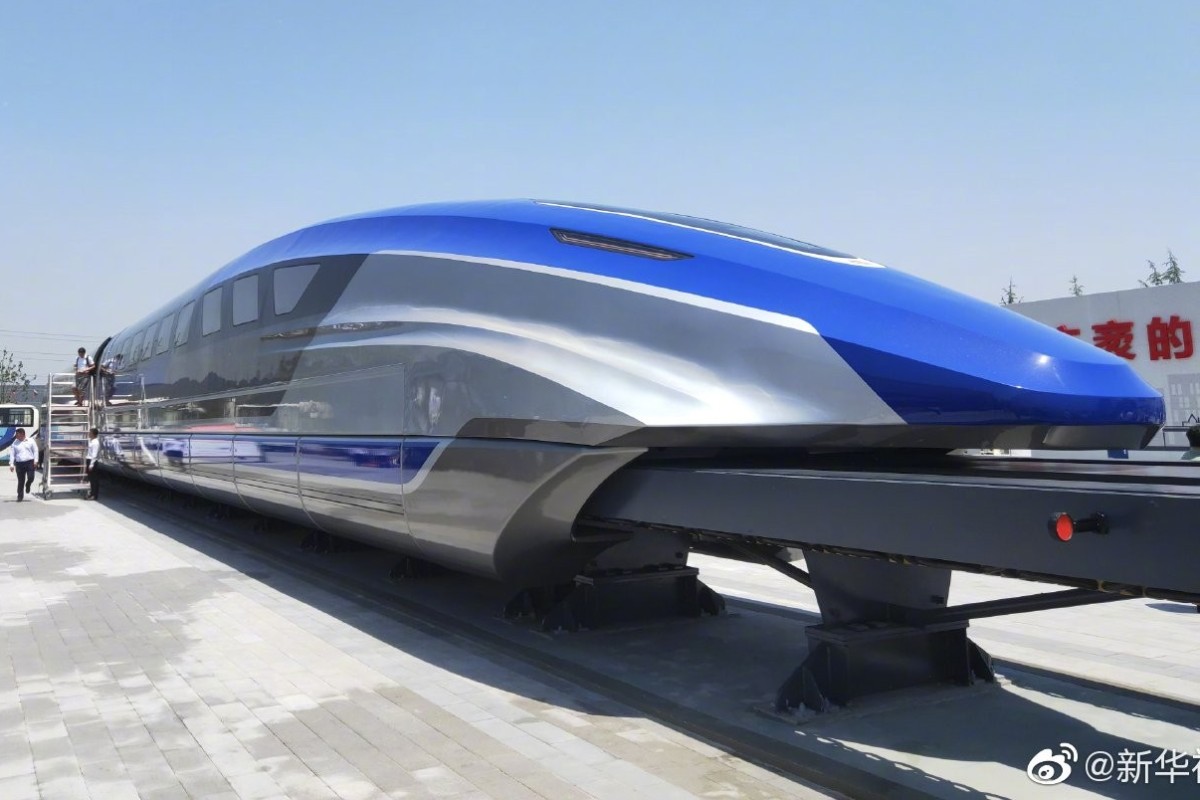
One possible future for rapid transport in China is unveiled in the form of a magnetic levitation train at Qingdao in Shandong province. Photo: Weibo
An experimental magnetic levitation train capable of travelling at 600km/h went on show at Qingdao in eastern Shandong province on Thursday, state media said.
Powerful electromagnets hold the Qingdao prototype at a thumb’s width from the rail, giving a quiet, smooth ride at speeds close to those involved in air travel, developers said.
While China operates the world’s fastest conventional train service, which can reach a speed of 350km/h, the Shanghai Maglev has been in commercial operation since the end of 2002 and can reach a top speed of 430km/h. It operates on one 30-kilometre (19-mile) line between two stations.
Ding Sansan, deputy chief engineer with developer the CRRC Sifang Corporation, said China achieved breakthroughs in maglev technology during the “three-year-battle” to build the new train that involved cooperation between more than 30 enterprises, universities and government research institutes.
The construction of a train body with ultra-lightweight, high-strength materials was a challenge, Ding said. Complex physical problems created by high speeds also needed to be solved in new ways if the Qingdao prototype was to reach peak performance.
China was a leader in technologies that included suspension, guidance, control and high-powered traction, Ding told Qingdao Daily.
“The test vehicle has been powered up and is in good order,” Ding was quoted by the newspaper as saying.
Chinese maglev train capable of travelling at 600km/h on track for 2020 test run as design completed
The prototype promised to eliminate the advantages jet passenger planes had over ground vehicles over a distance of 1,500km, he said.
Taking Beijing-to-Shanghai by plane as an example, Ding suggested: “It takes about four-and-a-half hours by plane including preparation time for the journey; about five-and-a-half hours by high-speed rail, and [would] only [take] about three-and-a-half hours by maglev.”
While earlier reports suggested the prototype was expected to begin full-scale testing by 2020, it was unclear what Thursday’s unveiling meant for this timetable.
China’s latest prototype high-speed maglev train factors the comfort of paying customers into its test operations. Photo: Weibo
More maglevs would join the development project in the coming months, the team leader was quoted as saying, while mass production of the technology was likely by 2021.
In contrast to the optimism of the team at Qingdao, Chen Peihong, professor of economics at Beijing Jiaotong University and a transport analyst, was more circumspect about the future of maglev trains.
“The market has to be bigger. Technology alone cannot make [the concept] a success,” she said.
Plane or train: as high-speed rail link connects Hong Kong to 44 mainland Chinese cities, what are cheapest and fastest ways to get where you are going?
Public transport relied heavily on economies of scale, Chen said. Chinese cities including Jinan, Hangzhou and Chongqing were considering maglev lines, but even the longest – from Jinan to Taian – would not exceed 50 kilometres.
Chen said that electromagnetic fields from maglevs were greater than those from the lines that powered high-speed trains, while environmental worries might keep maglevs out of densely-populated areas.
There was a debate in China in the early 2000s about the benefits of a developing a maglev compared to high-speed rail, researchers on that project said. Rail was preferred by the government because it was an established technology and one that was cheaper to realise.
By the end of last year, China’s high-speed rail network extended to most of the country at a distance in excess of 29,000 kilometres, according to government figures, twice as long as the rest of the world’s high-speed rail lines combined. Spain’s high-speed AVE network was the second-longest at 3,100km.
Elsewhere, researchers in Chengdu, Sichuan province, said a vehicle inside a vacuum tube powered by a superconductor coil from a maglev train – a hyperlink – was in development. They expected the vehicle to reach speeds in excess of 1,000km/h as air was pumped from the tube and resistance to the speeding object gradually eliminated.
Source: SCMP
Posted in air travellers, AVE network, Beijing Jiaotong University, Beijing-to-Shanghai, Chengdu, Chongqing, CRRC Sifang Corporation, down to earth, Hangzhou, High-speed rail, Hong Kong, Jinan, Jinan to Taian, maglev train, professor of economics, Qingdao, Qingdao Daily, shandong province, Shanghai Maglev, sichuan province, Spain, Uncategorized |
Leave a Comment »












 CHINDIA ALERT: You'll be living in their world, very soon