Archive for ‘Hindu pilgrims’

09/10/2019

Kashmir conflict: Woes deepen as lockdown stifles economy

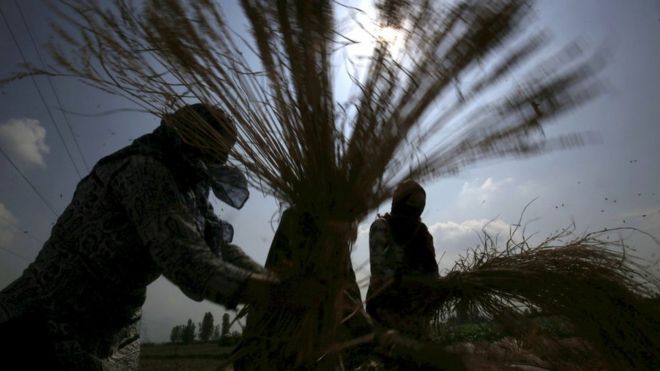
Farmers thresh paddy, separating grain from chaff, during the harvest season on October 2, 2019 on the outskirts of Srinagar, India.Image copyright GETTY IMAGES

The lockdown in Indian-administered Kashmir has cost the region’s economy more than $1bn in two months, according to industry experts. BBC Hindi’s Vineet Khare reports.

Mushtaq Chai recalls the afternoon of 2 August when he received a “security advisory” from the administration. A prominent local businessman, he owns several hotels across the Muslim-majority valley in Indian-administered Kashmir.

The note warned of “terror threats” and advised that tourists and Hindu pilgrims should “curtail their visit… and return as soon as possible”.

Mr Chai, like many others, took the advisory seriously. Two years before, seven Hindu pilgrims were killed in a militant attack while returning from the Amarnath cave, a major Hindu shrine in Kashmir’s Anantnag district.

“This was the first time in Kashmir’s history that tourists and pilgrims were asked to leave,” Mr Chai says.
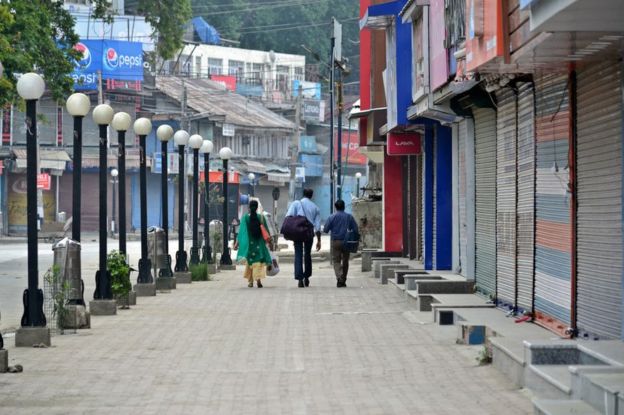
Indian tourists seen leaving the City during the curfew in Srinagar on 16 August 2019.Image copyright GETTY IMAGES
Image caption Tourists left Kashmir amid a curfew in August

Soon officials arrived to enforce the order, and Mr Chai and his staff made arrangements for all of the guests to leave immediately.

Days later, on 5 August, the federal government stripped the region of its special status and placed it under a communications lockdown.

Two months on, the situation is far from normal. Internet and mobile phone connections remain suspended, public transport is not easily available, and most businesses are shut – some in protest against the government, and others for fear of reprisals from militants opposed to Indian rule.

There is also a shortage of skilled labour, as some 400,000 migrants have left since the lockdown began.

What’s more, the streets are deserted and devoid of the tourist business which had supported up to 700,000 people.

Presentational grey line

Read more about Kashmir

Presentational grey line

The lockdown has not come cheap.

A government official, who did not wish to be named, says they are “awaiting a financial package” from the federal government. But the Kashmir Chamber of Commerce and Industry estimates the shutdown has already cost the region more than $1.4bn (£1.13bn), and thousands of jobs have been lost.

“There are around 3,000 hotels in the valley and they are all empty. They have loans to pay off and daily expenses to bear,” says Mr Chai, sitting in his mostly empty hotel in the capital, Srinagar.

Only a handful of his 125 staff are at work. Many haven’t returned because of lack of transport – or fear. Tensions have been high in the region, and there have been a number of protests in the city.

But the situation may improve in the coming days as the government has announced that tourists will allowed in the state from Thursday.
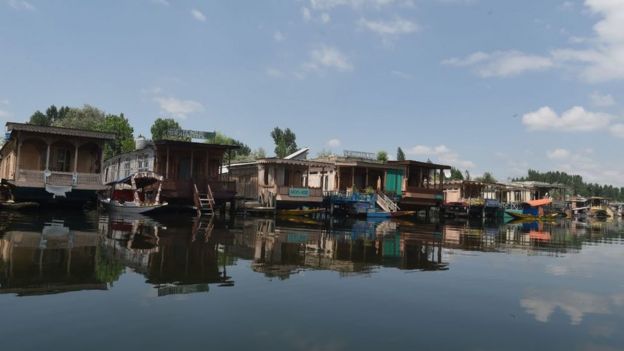
Empty houseboats on Srinagar's Dal lake.Image copyright GETTY IMAGES
Image caption Hundreds of houseboats have been lying vacant

But it isn’t just the hotels which have suffered.

“No internet has meant more than 5,000 travel agents have lost work,” says Javed Ahmed, a travel agent himself. “The government says give jobs to the youth. We are young but jobless. We have nothing to do with politics. We want jobs.”

Srinagar’s almost 1,000 iconic houseboats have also been running empty.

“Every houseboat needs up to $7,000 a year for maintenance,” says Hamid Wangnoo from the Kashmir Houseboats Owners Association. “For many, this is the only source of livelihood.”

And it isn’t just tourism.

“More than 50,000 jobs have been lost in the carpet industry alone,” according to Shiekh Ashiq, president of the chamber of industry.

He says July to September is when carpet makers usually receive orders for export – especially overseas, so they can deliver by Christmas.

But they are unable to contact importers, or even their own employees, because of the communications lockdown.
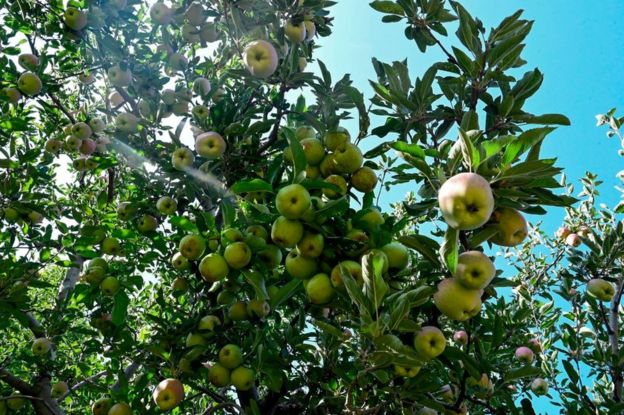
Apples are ready to be harvested in an orchard in Shopian district of southern Kashmir valley.Image copyright GETTY IMAGES
Image caption Kashmir’s famous apple orchards have also been hit hard

In southern Kashmir, the region’s famous apples are still waiting to be plucked from the trees. But shops and cold storage units are shut, and the main apple market is empty. Last year, it did business worth $197m, local farmers say.

“I feel so much pain seeing my apples hanging from the trees that I don’t go to the orchard anymore,” says a worried apple grower, who did not wish to be named.

“Apples account for 12–15% of Kashmir’s economy, but more than half of this year’s produce has not been plucked,” says economic journalist Masood Hussain. “If this continues through October, it will have devastating consequences.”

In Srinagar, some shop owners wait outside their stores and open them for a customer before closing them hurriedly – until the next customer arrives.

One such owner says he is unhappy with the government’s decision, but he is also scared of angry locals who want him to keep his business closed.

“But how do I survive without my daily earnings?” he asked.
Media caption Two wars, a 60-year dispute – a history of the Kashmir conflict

Source: The BBC

03/08/2019

India accuses Pakistan-backed militants of targeting Hindu pilgrims in Kashmir

SRINAGAR/NEW DELHI (Reuters) – Indian security officials said on Friday they had found evidence of attacks planned by Pakistani military-backed militants on a major Hindu pilgrimage in the disputed Muslim-dominated region of Kashmir.

Tension has run high in the mountainous region since a vehicle laden with explosives rammed into an Indian police convoy on Feb. 14, killing 40 paramilitary policemen, and leading to aerial clashes between the two nations.

Indian officials said a mine with Pakistan ordinance marking was among caches of ammunition, explosives and weapons retrieved following intelligence reports of likely attacks on routes used by hundreds of thousands of devout Hindus who trek to the region’s holy Amarnath cave every year.

In an order issued on Friday, the government in the Indian state of Jammu and Kashmir effectively called off the pilgrimage and asked the gathered pilgrims to return home, citing the intelligence reports.

“The Pakistan ordinance factory markings (on the mine)…clearly indicate (the) Pakistan army is involved in terrorism in Kashmir,” Indian military commander Lieutenant-General K.J.S. Dhillon told a news conference in Srinagar.

There was no immediate comment from spokesmen for Pakistan’s military and its foreign ministry.

Muslim-majority Kashmir has been the site of decades of hostility between nuclear arch-rivals India and Pakistan. Both countries claim it in full but rule it in part.

India accuses Pakistan of funding armed militants, along with separatist groups in India’s portion of the region considered non-violent by international observers.

Islamabad denies the Indian accusation, saying it provides only diplomatic and moral support to the separatist movement.

In recent months, Pakistan says it has cracked down on Islamic militant groups, including arresting Hafiz Saeed, the alleged mastermind of the militant attack on India’s financial capital of Mumbai in 2008 that left 166 people dead.

Pakistani Prime Minister Imran Khan, who is battling an economic crisis at home, said in April that his country had nothing to gain from allowing armed militants to infiltrate into Indian-controlled Kashmir, and that Pakistan was doing its best to stop such incursions.

Khan is also working on rebuilding Pakistan’s image in Washington after an extended period of acrimony. The United States is relying on Islamabad’s support to seal a deal with the Taliban in Afghanistan that would allow U.S. troops to be pulled out after a protracted war lasting almost 18 years.


PANIC BUYING

Dhillon said security forces in Kashmir, where more than 300 people have died in just the last six months, were still being targeted with improvised explosive devices.

“All these things are an indication that Pakistan and the Pakistani army is desperate to disrupt peace in Kashmir Valley,” he said.

Police had received intelligence reports there could be an increase in militant-led violence, Kashmir police chief Dilbagh Singh told the briefing in the region’s main city of Srinagar.

India has moved an additional 10,000 paramilitary troops into the restive region because of the security situation, training requirements and the need for rotation, a home ministry official said on Friday.

The influx swells an estimated 40,000 troops already in the region to provide security for the Amarnath pilgrimage. The new deployment has caused concern among residents that Indian security forces planned another major crackdown.

They are fearful that a curfew may be imposed, affecting their ability to go out, and supplies coming in. There has been some panic buying at grocery stores in the past week and long queues at petrol stations.

Regional leaders indicated they are worried that Indian Prime Minister Narendra Modi’s government will now try to remove decades-old special rights for the people of the state, including an amendment to the Indian constitution made in 1954 known as Article 35A. That amendment prevents people from outside the state from buying property there.

“Various speculations are rife including removal of 35A to change the demography of the state and its Muslim majority character,” separatist leader Mirwaiz Umar Farooq told Reuters.

“As in the past, people and the leadership have to be ready to resist every attempt to undo it,” said Farooq, who is the chairman of Hurriyat, a political movement that wants independence from India.

Source: Reuters

Law of Unintended Consequences

continuously updated blog about China & India

ChiaHou's Book Reviews

continuously updated blog about China & India

What's wrong with the world; and its economy

continuously updated blog about China & India