Archive for ‘Foreign invasion’

18/09/2014

After Modi-Xi meeting, China agrees to quickly settle border dispute, demarcate LAC – Hindustan Times

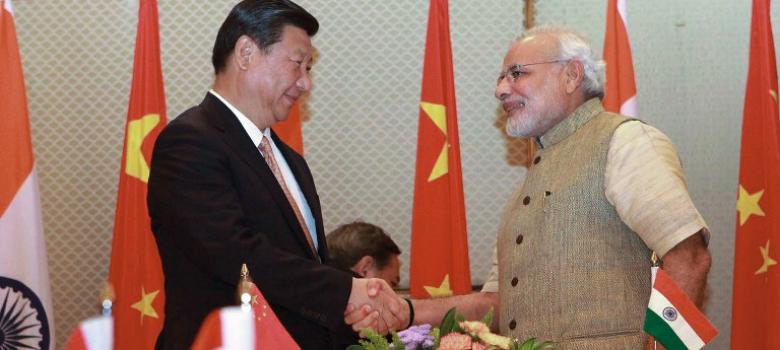
Prime Minister Narendra Modi and Chinese President Xi Jinping on Thursday agreed to quickly resolve the border dispute and demarcate the Line of Actual Control to improve peace and cooperation between both countries.

Addressing the media after the conclusion of one-on-one meeting with visiting Chinese President Xi Jinping, Modi said India is concerned about the frequent incursions along the border. The Line of Actual Control should be demarcated soon to ensure peace and tranquility in the area, he said.

President Xi, in response, said that China will work to settle the border issue at the earliest date. Since the border is not demarcated there will be some incidents, but both countries are capable of settling it at various levels without causing a bigger impact, he said.

President Xi said both countries would be respectful and sensitive to each others concerns. “We also have the sincerity to work with India to maintain peace and tranquility in the border areas before we are finally able to settle the border question,”he said.

The latest incident India was referring to was the  fresh incursion by the Chinese army in Chumar area, even as talks were on between both the leaders.

via After Modi-Xi meeting, China agrees to quickly settle border dispute, demarcate LAC – Hindustan Times.

18/09/2014

Despite the Xi-Modi bromance, Indians and Chinese don’t actually like each other

One in two Indians thinks China is a major threat.

In the last two days alone, Chinese President Xi Jinping has called India an ancient, magic, enchanting, and beautiful land. And Indian Prime Minister Narendra Modi has reciprocated with syrupy adjectives, reminding visiting journalists how ancient Chinese technology was responsible for sugar being called cheeni in India.

The pictures of the two leaders’ bonhomie on Wednesday went even further. By the time you get to the sight of Modi and Xi sitting on a swing by the Sabarmati, most would imagine that India and China are steadfast allies who support each other through thick and thin.

Which is why it might be worth pointing out that we don’t actually like each other very much, and that Indians and Chinese people have very different intentions for the bilateral relationship. And it’s not just about the trade deficit and the border disputes. Ordinary Indians and Chinese people simply aren’t sure whether they like each other.

via Scroll.in – News. Politics. Culture..

17/09/2014

Is China Ready to Step Up and Invest in India? – India Real Time – WSJ

While Chinese companies have been great at peddling their products in India, they have been surprisingly reluctant to invest here. China has invested less in India than even Poland, Malaysia or Canada have.

President Xi Jinping’s three-day visit to India starting Wednesday is likely to include some massive pledges to try to remedy this imbalance.

When Prime Minister Narendra Modi visited Japan recently, Japan pledged to invest $35 billion in India. President Xi is expected to try to eclipse Japan’s promises, possibly pledging $100 billion in investment according to some local reports. His meetings with Mr. Modi are predicted to lay the groundwork for a wave of Chinese money to build industrial parks and bullet trains.

Annual trade between India and China has galloped to $66 billion from $3 billion 14 years ago, something that underscores the rise of Beijing as the global manufacturing hub and India’s growing appetite for everything from phones to machinery from China.

While the trade relationship between the two countries has bloomed, foreign direct investment from China has not. According to Indian government statistics, the country has received a total of around $400 million from China in investment in the last 14 years. Even if you add the $1.2 billion of direct investment India received from Hong Kong, China is still well behind the $22 billion in foreign direct investment from the United Kingdom, $17 billion from Japan, $13 billion from the Netherlands and $1.9 billion from Spain.

It’s not that China doesn’t invest abroad. According to data from United Nations Conference on Trade and Development, China was the third biggest source of foreign direct investment last year, having invested more than $100 billion in other countries. In the seven years to 2012, it invested more than $25 billion in the 10 members of the Association of Southeast Asian Nations alone.

Chinese investment has tended to focus on the resources sector to power its economy. Much of it has gone into getting control of oil, natural gas and coal in Africa, Australia, Indonesia and elsewhere. India has not attracted much of this investment as it is a net importer of resources and has a heavily regulated energy sector, said Rajiv Biswas, economist for IHS.

“China wants to increase investment in India and wants Chinese companies on the ground there,” Mr. Biswas said. “Most of it will be in manufacturing and infrastructure space.”

Chinese companies may also be looking to move some of their manufacturing to India as they struggle with rising wages at home, said Ajay Sahai, director general and chief executive at Federation of India Export Organization.

If India can’t find better ways to fix its trade imbalance with China, New Delhi may want to increase taxes on some imports such as auto-components and pharmaceuticals to encourage Chinese companies to set up factories in India, he said.

“This will not only raise Chinese investment in India but also help in fixing the trade imbalance,” said Mr. Sahai.

via Is China Ready to Step Up and Invest in India? – India Real Time – WSJ.

17/09/2014

5 Things to Look Out for During Xi Jinping’s Visit to India – WSJ

Manan Vatsyayana/Agence France-Presse/Getty Images

1 INFRASTRUCTURE

Prime Minister Narendra Modi is looking for foreign capital and expertise to build “smart cities”, high-speed trains and modern airports of the kind that China has built for itself in the past decade. The two leaders are expected to sign a deal to bring bullet trains to India and may also reach an agreement for the building of world-class railway stations and airports.

2 INDUSTRIAL PARKS

The two countries laid the groundwork for Chinese investment in industrial parks in India when Indian Vice-President Hamid Ansari visited Beijing in June. Indian officials say they expect to ink deals worth $5 billion for two parks – one in the western state of Gujarat, Mr. Modi’s home state, and the other in Maharashtra. The idea is to make it easier for Chinese companies to set up shop in India.

3 BORDER TROUBLES

Territorial disputes that have long dogged Sino-Indian ties aren’t the focus of this visit, but are sure to come up. Two reports this week – one about an alleged incursion by Chinese troops in Ladakh and another about protests by Chinese civilians and troops against the construction of an Indian canal along the disputed border – have highlighted the unresolved issues. Even after 17 rounds of talks, no solution has emerged – don’t expect one during this visit either.

4 COMPETITION WITH JAPAN

Indian newspapers have been filled with anticipation about whether China will outdo its Asian rival, Japan, in promising investments for India. Earlier this month, Japan pledged to pour $35 billion into India over five years; China is expected to go further. Expect reams of analysis of Mr. Xi’s rapport with Mr. Modi. When Japanese Premier Shinzo Abe met Mr. Modi, they bear hugged.

5 BREAKING OUT OF THE MOLD

Officials have raised hopes of a “directional change” and an “orbital jump” in Sino-Indian ties, which have long been bogged down by bureaucratic mistrust. Trade relations have flourished in the past decade, but are skewed in China’s favor– and investments have remained very low. Experts are hoping Mr. Modi – who worked with Chinese as chief minister of Gujarat – will adopt a pragmatic approach to push for Chinese money. If he succeeds, the visit may set the stage for an era of economic collaboration between the two Asian giants.

via 5 Things to Look Out for During Xi Jinping’s Visit to India – WSJ.

17/09/2014

Project Mausam, India’s answer to China’s maritime might: Explained – News Oneindia

In a significant move, the Narendra Modi Government will soon launch ‘Project Mausam’ for countering Beijing’s growing influence in the Indian Ocean region. This transnational program is aimed at restoring India’s ancient maritime routes and cultural links with republics in the region.

'Mausam' to check China’s maritime might

Project Mausam: India’s answer to China’s ‘Maritime Silk Road

It is Narendra Modi Government’s most significant foreign policy initiative to counter-balance the maritime silk route of China.

The project emphasises on the natural wind phenomenon, mainly the monsoon winds used by Indian sailors in ancient times for maritime trade.

This initiative will enable India re-connect and re-establish communications with its ancient friends in the Indian Ocean region.

It would lead to an enhanced understanding of cultural values and concerns.

The project purposes to determine the Indian Ocean “world” – expanding from East Africa, the Arabian Peninsula, the Indian subcontinent and Sri Lanka to the Southeast Asian archipelago.

What is China’s maritime silk route?

It an initiative to develop regions along an ancient route connecting Western China with South and Central Asia.

The aim of this initiative is to strengthen China’s economic ties with various nations, including those within Asia and Europe.

It proposes China to work with partners to develop maritime infrastructure, especially ports.

Originally, the “maritime silk road” was proposed to foster cooperation and goodwill between China and the ASEAN countries.

The “maritime silk road” is parallel to the land-based “new silk road,” which runs westward from China through the Central Asian states.

The route is likely to see China further intensify its naval activities in the region.

It extends from its naval base in Hainan Island (South China Sea) to Bagamayo in Tanzania, Africa, with several of the ports encircling mainland India.

Hambantota (Sri Lanka), Gwadar (Pakistan), Chittagong (Bangladesh) and Marao Atoll (Maldives) are the ports being built by China as per the initiative.

What is Silk Route?

It is a series of trade and cultural transmission routes.

It connected the West and East by linking traders, merchants and other persons from China to the Mediterranean Sea.

It derives its name from lucrative Chinese silk trade, a major reason for the connection of trade routes into an extensive transcontinental network.

via Project Mausam, India’s answer to China’s maritime might: Explained – News Oneindia.

17/09/2014

Will Chinese President Xi be able to compete with Japan’s Abe for India’s affections?

Any adjustments in the India-China-Japan triangle will have an impact all across Asia.

East Asia has eagerly set out to court New Delhi’s new government. That’s obvious from the spate of state visits that have taken place of late between India, China and Japan. Earlier this fortnight, Prime Minister Narendra Modi visited Japan. Today, Chinese President Xi Jinping’s begins his first official state visit to India. Trade, investment and infrastructure are the buzzwords on the road towards deepening ties.

The complexities of the India-China-Japan triangle are far too intricate to be spelt out in a simplistic fashion. Will trade and investment become the motive force that will fashion ties, more so at the cost of pressing strategic realities that appear conflicting at times? Going by the school of interdependent liberalism, states will be propelled to adopt a cooperative framework by economic symbiosis and the web of multilateral international institutions and frameworks.

In the case of China, India and Japan, while investments  have taken precedence, the competitive race is far too obvious. Last fortnight, Japanese Prime Minister Shinzo Abe announced that this country’s private and public investment in India will double to $34 billion over the next five years. Within a fortnight comes Xi Jinping with his administration’s plans to invest around $500 billion overseas in the next five years, with big-ticket investments coming India’s way likely to exceed $200 billion. It is being suggested that China could spend $35 billion merely on power and highway projects ‒ almost the same amount as Japan’s total investment in India.

Growing trade deficit

It is apparent that cooperation through economic considerations has its share of hidden problems. India continues to be hurt by  the growing trade deficit with China, which stood at a record $ 36 billion in 2013-’14. In fact, China accounted for more than 50% of India’s current account deficit in 2012-’13. Indian exports to its neighbour fell nearly 10% during that period.

By seeking economic and military clout, could China reject the liberal regional order and seek to replace it with its own Sino-centric Asian order? China’s much-debated rise is always under scrutiny, given its role as Asia’s largest economy and the fact that it is the No. 1 trading partner for almost 120 economies around the world.

More so, in the strategic sphere, are Asian nations, including India and Japan, prepared to recognise such an order? So profound is the presence, rise and status of the People’s Republic of China that one is often confronted with a debate whether a potential Asian century could actually become a Chinese century.

The Chinese government chose to downplay Modi’s earlier indirect reference to China during his visit to Japan, where he took a swipe at the “18th century expansionist mindset of some countries”. But the reaction of state-controlled Chinese media over Modi’s remark was noticeably irate. Chinese media fervently cautioned against any attempt by Tokyo to structure a united front against Beijing with New Delhi as its pivot. All this very palpably falls into the realist paradigm of international relations, which posits that states often find themselves in a zero-sum contest for power and influence, where the prevailing international power balance remains a key determinant of the region’s future stability and strategic order.

Geo-strategic realities

Realignments in any part of the India-China-Japan security triangle will have far-reaching impact all across Asia. It should be remembered that Xi Jinping’s address at the 18th Party Congress of the Chinese Communist Party in 2012 contained a reference to “rejuvenating China”, which has been interpreted as an oblique reference to “reclaiming lost historical territories”. This approach could well have a direct bearing on Japan and India, with whom China contests territories and borders.

On another level, the camaraderie between Modi and Shinzo Abe speaks volumes. Systemic conditions present a favourable platform for the duo to guide their countries to “… the dawn of a new era in India-Japan relations”, as they agreed to in the Tokyo Declaration last fortnight. Moreover, providing cement for this approach, Modi underlined the significance of India and Japan being democracies, which affords them a solid basis to converge at various levels on the Asian stage. As for the ties between China and Japan, there could not have been a worse time for relations between them, with the bitter contest over the East China Sea amidst a rising tide of nationalist sentiment against one another in both countries.

Whether Xi Jinping will manage to find success in making inroads into Delhi and buying a sizeable share of Indian attention is too early to say. However, one thing is for sure ‒ it will not happen at the cost of Japan.

via Scroll.in – News. Politics. Culture..

17/09/2014

Is China’s promised $100 billion India investment more dangerous than its border policy?

Experts believe that China deliberately uses trade as part of its geo-strategic arsenal.

The script is almost predictable. Right before meetings of Indian and Chinese heads of state, something happens on the border to remind everyone that sentiment between the two countries is not exactly neighbourly. Last year it was a standoff in Daulat Beg Oldi about infiltration by the Chinese army. This year, with everyone excited at China’s promise to pump $100 billion into India, there’s another incursion by the Chinese into Demchok in Ladhak.

Chinese President Xi Jinping arrives in India today and will visit Ahmedabad on Prime Minister Narendra Modi’s birthday. But Chinese troops have also been reported to have moved 500 meters into Indian territory.

Beijing’s approach seems to be sweet-talking – this time taking the form of foreign direct investment – coupled with regular pinpricks that remind India that they have the stronger position on the border.

But could the proposed investment be as much of a threat to India as the border dispute?

Trading places

India’s total trade with China was around $65 billion in 2013-’14. Of that, only $14 billion were Indian exports heading into China, leaving India with a trade deficit of $36 billion. If oil imports are included, Chinese imports are responsible for nearly half of India’s overall trade deficit. This is a great many Indian eggs in one Chinese basket.

For many economists, this isn’t a problem. It’s simply the way efficient markets ought to function, with India buying the goods it needs from the most competitive seller. “The more competitive the trading partner, the more India should buy from it, and the bigger should be the bilateral trade deficit,” wrote commentator Swaminathan Aiyar last year. “China is the most competitive exporter of all, so India should run its biggest trade deficit with this country.”

Yet India does feel the need to reduce the trade deficit with China. Answering a question in the Lok Sabha earlier this year, minister of state for commerce Nirmala Sitharaman admitted that the balance of trade was heavily in China’s favour and that India was taking steps to address this.

“With a view to reducing the trade deficit with China, efforts are being made to diversify the export basket,” Sitharaman said.

via Scroll.in – News. Politics. Culture..

16/09/2014

India says to defend China border after standoff ahead of Xi visit | Reuters

More than 200 soldiers of the People’s Liberation Army crossed into what India considers its territory in Ladakh in the western Himalayas last week, and used cranes, bulldozers and a Hummer vehicle to build a 2-km (1.2-mile) road within it, the Hindustan Times said.

A dog rests on the Indian side of the Indo-China border at Bumla, in the northeastern Indian state of Arunachal Pradesh, November 11, 2009. REUTERS/Adnan Abidi

Indian soldiers challenged the Chinese troops and asked them to withdraw, the newspaper said. Then, on the night of September 10, soldiers demolished a temporary track built by Chinese forces.

There was no immediate comment by India’s defense ministry.

Both China and India are trying to put a positive spin on Xi’s first summit meeting with Indian Prime Minister Narendra Modi since the Indian leader took office in May. He arrives on Wednesday after touring the Maldives and Sri Lanka.

The two countries are expected to ramp up commercial ties and open the way for Chinese investment in Indian infrastructure, including railways, but the contested border remains a stumbling block to better political ties.

via India says to defend China border after standoff ahead of Xi visit | Reuters.

22/08/2014

India and China: Strangers by choice | The Economist

For those readers really interested in China AND India, this is a ‘must-read’ article.  I’ve only extracted the first part.  For full article go to – India and China: Strangers by choice | The Economist.

FEW subjects can matter more in the long term than how India and China, with nearly 40% of the world’s population between them, manage to get along. In the years before they fought a short border war, in 1962, relations had been rosy. Many in China, for example, were deeply impressed by the peaceful and successful campaign led by Mohandas Gandhi to persuade the British to quit India. A few elderly people in China yet talk of their admiration for Rabindranath Tagore, the Bengali writer who won the Nobel prize for literature in 1913. And though Nehru, India’s first prime minister, was resented as arrogant and patronising by some Chinese leaders, the early post-war years saw friendship persist and some popular respect for him too. In China, for example, books on India were then easily available—unlike today.

The past half-century has produced mostly squabbles, resentment and periodic antagonism. India felt humiliated by its utter defeat at the hands of Mao’s army in the 1962 war. China’s long-running close ties to Pakistan look designed to antagonise India. In return India is developing ever warmer relations with the likes of Vietnam and Japan. An unsettled border in the Himalayas, periodic incursions by soldiers into territory claimed by the other side and China’s claim—for example—that India’s Arunachal Pradesh is really a part of Tibet, all suggest that happier relations will be slow in coming. Even a booming bilateral trade relationship is as much a bone of contention as a source of friendlier ties, given India’s annoyance at a yawning deficit.

One glimmer of hope, in theory, is that ordinary people of the two countries might start to understand each other better as levels of education, wealth and interest in the outside world all grow. As tourists, students and business types visit each other’s countries, perhaps they will find that they have more in common than they believed. In fact, judging by a sharp and well-crafted memoir by an Indian journalist who was posted in Beijing for four years, ignorance and bafflement are likelier to persist.

Reshma Patil was sent by the Hindustan Times, a large Indian newspaper, to Beijing in 2008, one of only four Indian print journalists in the country (by contrast Chinese media groups had 16 correspondents in India). Her account of time there, “Strangers across the border; Indian encounters in boomtown China”, is revealing for its detail and anecdote, but also for its broadly damning conclusion about the state of ties between the countries: “extreme ignorance and nationalism illustrate their mutual relations”, she says.

Most entertaining, from an Indian point of view at least, are her accounts of Chinese ignorance about India. She visits a centre in Beijing devoted to learning cricket in case it ever becomes an Olympic sport (it is called shenshi yundong, or “the noble game”), whose players have never heard of Indian stars, or of the cricket world cup, and who appear to prefer playing ping pong. During numerous forays to universities she finds students learning foreign languages who routinely dismiss India as dirty, poor and irrelevant. A wide misapprehension, she says, is a belief that India is Buddhist. Officials and journalists tell her that India suffers from an “inferiority complex”, that it is so backward (“naked…children piss on the streets”) that there can be “nothing to learn” from the country. She suggests that one Indian drink, the mango lassi, has become popular in China, but otherwise the Chinese she meets mostly have little interest in Indian products or culture. Indian traders are famously stingy. Its brands, such as those of big outsourcing firms, are poorly understood or assumed to be of low quality. Persistent racism towards dark-skinned Indians is broken in only one case, by the head of a Chinese modelling agency who says he is fond of Indians who can pull off a “Western look”.

India meanwhile makes pitifully little effort to correct Chinese misunderstandings. As well as few journalists, India had only 15 diplomats based in Beijing during Ms Patil’s time, most of them inactive. Only two had any economic expertise, and most only started learning Mandarin after their arrival in the country. A big Indian business lobby group had a single representative based in Shanghai. She estimates that only a few hundred Indian businesses, in any case, are active in China (with even fewer Chinese ones in India), and few of the Indian ventures are led by Mandarin-speakers or local hires. As an example of ignorance, she mentions a Chinese business reporter who has never heard of Infosys, a $33 billion Indian IT firm. India’s low profile in China, she argues, “prolongs the shelf-life of anti-India propaganda”. For if most Chinese are merely ignorant, many are troublingly nationalistic where their neighbour is concerned.Ms Patil dismisses annual exchanges of a few hundred students each as a hopeless affair.  Sometimes India ships a low-cost dance troupe to China. Most such exchanges of students, journalists and others end up in mutual frustration; a failure to communicate; and terrible hunger among vegetarian Indians horrified by Chinese cuisine.

via India and China: Strangers by choice | The Economist.

22/08/2014

India to Unveil First Warship to Deter Chinese Submarines – Businessweek

India will unveil its first home-built anti-submarine warship tomorrow in a move to deter China from conducting underwater patrols near its shores.

CHINA-MILITARY-NAVY-ANNIVER

Defense Minister Arun Jaitley will commission the 3,300-ton INS Kamorta at the southeastern Vishakapatnam port. The move comes a week after Prime Minister Narendra Modi introduced the largest indigenously built guided-missile destroyer and vowed to bolster the country’s defenses so “no one dares to cast an evil glance at India.”

India is playing catch-up to China, which built 20 such warships in the past two years and sent a nuclear submarine to the Indian Ocean in December for a two-month anti-piracy patrol. The waters are home to shipping lanes carrying about 80 percent of the world’s seaborne oil, mostly headed to China and Japan.

“As China grows into a naval, maritime power, it will be more and more active in the Indian Ocean,” Taylor Fravel, a professor at Massachusetts Institute of Technology who studies China’s ties with its neighbors, said by phone. “Of course, it will not be due to some hostility or targeted at India, but because of its economic interests in the Indian Ocean, as a lot of trade passes through. Such a presence will certainly raise questions in India, but it need not necessarily be a cause of major conflict.”

Warship Plans

India has lacked anti-submarine corvettes in its 135-warship fleet for more than a decade now, with the decommissioning of the last of the 10-ship Petya-class of 1960s-vintage Soviet corvettes in December 2003. It plans to build 42 more warships, including three more anti-submarine corvettes, over the next decade, according to Rear Admiral A.B. Singh, an Indian navy official.

About 90 percent of Kamorta’s components are local, with the hull developed by Steel Authority of India Ltd., medium-range guns by Bharat Heavy Electricals Ltd. (BHEL) and torpedo launchers by Larsen & Toubro Ltd, India’s largest engineering company. The ship is two years behind schedule, according to Commodore B.B. Nagpal, the navy’s principal director for naval design.

via India to Unveil First Warship to Deter Chinese Submarines – Businessweek.

Law of Unintended Consequences

continuously updated blog about China & India

ChiaHou's Book Reviews

continuously updated blog about China & India

What's wrong with the world; and its economy

continuously updated blog about China & India