Archive for ‘Neighbour conflict’

05/10/2012

* Diaoyu islands dispute hammers Japanese car sales in China

If the September drop in sales continues, the future for Japanese cars in China is very bleak indeed. There are lots of competitors both indigenous and foreign that can take up the slack. If Japanese car factories close as a result, the impact on Chinese employment will be non-trivial. So the anti-Japanese sentiment cuts both ways.

South China Morning Post: “Toyota’s sales in China halved last month from August levels, damaged by anti-Japanese sentiment in a row over disputed islands in the East China Sea, the Yomiuri newspaper reported on Friday, citing the carmaker.

Photo

Showroom traffic and sales have plunged at Japanese automakers since violent protests and calls for boycotts of Japanese products broke out across China in mid-September over Japan’s acquisition of a group of disputed islands.

A prolonged sales hit of this scale could threaten profit forecasts at Toyota, Nissan and others as China, the world’s biggest car market, makes up a bigger portion of their global sales. Toyota sold about 75,300 cars in China in August.

As demand evaporates, Toyota, Nissan, Honda and others have been forced to cut back production in recent weeks in a slowing, but still promising Chinese market.

A source told reporters late last month that Toyota’s production cutbacks could extend through November, a move that would almost certainly put the company’s goal of selling 1 million cars in China this year out of reach.

A Toyota spokeswoman in Tokyo declined to confirm the newspaper report, saying the company would announce its Chinese sales for September on Tuesday.

On Thursday, Mazda said its China sales tumbled by more than a third last month from a year earlier, providing the first concrete numbers to point to Japanese automakers’ troubles in China.

via Diaoyus dispute hammers Japanese car sales in China | South China Morning Post.

02/09/2012

* Asian giants seek better ties; China defence minister in India

The Times of India: “A rare visit to India by China’s defence minister should help avoid flare-ups along the border between the nuclear-armed Asian giants at a time when Beijing is grappling with a change of leadership and friction in the South China Sea.

Chinese Minister of National Defense General Liang Guanglie stands on a balcony overlooking the campus of the U.S. Military Academy in West Point, New York, May 10, 2012. REUTERS/Mike Segar

But General Liang Guanglie‘s trip — the first by a Chinese defence minister in eight years — also highlights growing competition between the two emerging powers as they jostle for influence and resources across Asia.

Liang is due to arrive in Mumbai on Sunday afternoon after stopping in Sri Lanka, the island nation off the south coast of India that sits on vital ocean trade routes.

There he sought to play down Indian fears that China is threading a “string of pearls” — or encircling it by financing infrastructure and military strength in neighbours stretching from Pakistan to the Maldives.

“China attaches great importance to its relations with the South Asian nations, and commits itself to forging harmonious co-existence and mutually beneficial and win-win cooperation with them,” he said in speech to Sri Lankan soldiers.

“The PLA’s (People’s Liberation Army) efforts in conducting friendly exchanges and cooperation with its counterparts in the South Asian nations are intended for maintaining regional security and stability and not targeted at any third party.”

As neighbours and emerging superpowers, India and China have a complex relationship. Trade has grown at a dizzying rate but Beijing is wary of India’s close ties to Washington and memories of a border war with China half a century ago are still fresh in New Delhi.

Despite 15 rounds of high level talks to resolve the dispute about where their Himalayan border lies, neither side is close to giving up any territory. Liang is not expected to broach the territorial issue on his trip.

Analysts say Liang’s India tour will demonstrate that Beijing is managing the often twitchy relations with its neighour just ahead of its once-in-a-decade leadership transition.”

via Asian giants seek better ties; China defence minister in India – The Times of India.

See also: 

12/08/2012

* Pakistani Hindu pilgrims allowed to cross into India after detention

BBC News: “Pakistan officials have allowed a group of Hindu pilgrims who were detained at the border to cross into India.

More than 200 Pakistani Hindus were held at the Wagah crossing near Lahore after local media reported that they intended to emigrate.

Although the group had valid pilgrimage visas, it was rumoured they planned to remain in India because of growing attacks against minorities in Pakistan.

They were allowed to pass after they assured officials they would return.

A spokesperson for the pilgrims, Santosh Puri, told the BBC the group had assured the authorities that “this is a pilgrimage” and no one intends to emigrate.

Pakistani rights activists say dozens of Pakistani Hindu families have moved to India to escape killings, abductions and forced conversions in recent years.

According to Indian officials, Pakistani Hindus have often entered India on visit visas, only to settle there permanently.”

via BBC News – Pakistani Hindu pilgrims allowed to cross into India after detention.

12/08/2012

* Beijing Reasserts Its Claims in South China Sea

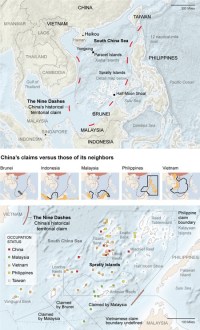
NY Times: “China does not want to control all of the South China Sea, says Wu Shicun, the president of a government-sponsored research institute here devoted to that strategic waterway, whose seabed is believed to be rich in oil and natural gas. It wants only 80 percent.

Mr. Wu is a silver-haired politician with a taste for European oil paintings and fine furniture. He is also an effective, aggressive advocate for Beijing’s longstanding claim over much of the South China Sea in an increasingly fractious dispute with several other countries in the region that is drawing the United States deeper into the conflict.

China recently established a larger army garrison and expanded the size of an ostensible legislature to govern a speck of land, known as Yongxing Island, more than 200 miles southeast of Hainan. The goal of that move, Mr. Wu said, is to allow Beijing to “exercise sovereignty over all land features inside the South China Sea,” including more than 40 islands “now occupied illegally” by Vietnam, the Philippines and Malaysia.

In the past several weeks, China has steadily increased its pressure, sending patrols with bigger ships and issuing persistent warnings in government-controlled newspapers for Washington to stop supporting its Asian friends against China.

The leadership in Beijing appears to have fastened on to the South China Sea as a way of showing its domestic audience that China is now a regional power, able to get its way in an area it has long considered rightfully its own. Some analysts view the stepped-up actions as a diversion from the coming once-a-decade leadership transition, letting the government show strength at a potentially vulnerable moment.

The Obama administration, alarmed at Beijing’s push, contends that the disputes should be settled by negotiation, and that as one of the most important trade corridors in the world, the South China Sea must enjoy freedom of navigation. The State Department, in an unusually strong statement issued this month intended to warn China that it should moderate its behavior, said that Washington believed the claims should be settled “without coercion, without intimidation, without threats and without the use of force.”

Washington was reacting to what it saw as a continuing campaign on the South China Sea after Beijing prevented the Association of Southeast Asian Nations, at its summit meeting in Cambodia in July, from releasing a communiqué outlining a common approach to the South China Sea.

The dispute keeps escalating. On July 31, the 85th anniversary of the founding of the People’s Liberation Army, the Chinese Defense Ministry heralded the occasion by announcing “a regular combat-readiness patrol system” for the waters in the sea under China’s jurisdiction.

The government then said it had launched its newest patrol vessel: a 5,400-ton ship. It was specifically designed to maintain “marine sovereignty,” said People’s Daily, the Communist Party’s leading newspaper.””

via Beijing Reasserts Its Claims in South China Sea – NYTimes.com.

Law of Unintended Consequences

continuously updated blog about China & India

ChiaHou's Book Reviews

continuously updated blog about China & India

What's wrong with the world; and its economy

continuously updated blog about China & India