Archive for ‘Neighbour conflict’

31/01/2017

The Chinese man trapped in India for half a century – BBC News

In 1963 a Chinese army surveyor crossed into India and was captured, weeks after a war between the countries. Wang Qi has been unable to leave India ever since – and longs to see his family in China.

BBC Hindi’s Vineet Khare met him.

Tirodi village is a nearly five-hour drive from the nearest airport in Nagpur in central India.

I am here to meet Wang Qi, a Chinese army surveyor who entered India in 1963 but could never go back. For over five decades, he has been longing to see his family back home.

Sporting cropped white hair, black trainers and a body warmer, Mr Wang, who is now in his eighties, hugs me when we meet. We are about to try and make video contact with his family more than 3,000km (1,864 miles) away in China.

Together we go to the government office, which is the only centre equipped with internet for miles around.

He watches in anticipation as I dial and then his eyes light up as the image of his elder brother Wang Zhiyuan, 82, appears on the screen, seated on a sofa in Xianyang, a city in China’s Shaanxi province.
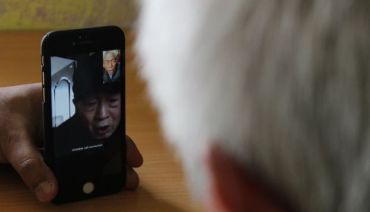
The two brothers are seeing each other after more than 50 years. The conversation in Mandarin lasts 17 minutes.

“I couldn’t recognise him. He looked so old. He said he was alive just for me,” Wang Qi, also known by his Indian name Raj Bahadur, tells me in strongly accented Hindi as his three Indian-born children gather around to comfort him.

Mr Wang’s story is a long and sad one.

Born to a farmer family in Shaanxi with four brothers and two sisters, he studied surveying and joined China’s People’s Liberation Army in 1960.

Mr Wang says he was “tasked with building roads for the Chinese army” and was captured when he “strayed erroneously” inside India’s territory in January 1963.

“I had gone out of my camp for a stroll but lost my way. I was tired and hungry. I saw a Red Cross vehicle and asked them to help me. They handed me over to the Indian army,” he said.
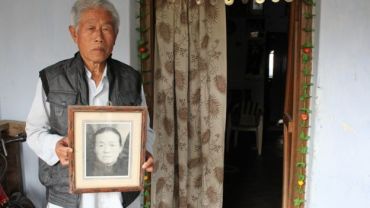
Mr Wang’s mother died in 2006 before he could go back and see her

Indian officials said Mr Wang “intruded into India” and gave “false background and the circumstances” about his whereabouts to the authorities.

He spent the next seven years in a number of different jails before a court ordered his release in 1969.

Police took him to Tirodi, a far-flung village in the central state of Madhya Pradesh. He has not been allowed to leave the country ever since.

It’s still not clear whether Mr Wang is a prisoner of war. But he has been denied official Indian documents or citizenship and also been denied permission to travel back. His family says Mr Wang needs a document to exit India.

Senior local official Bharat Yadav agrees that there have been “deficiencies” and a “lack of interest” in the case.

“There are no suspicions about his actions. If he wants to go back, we will try and help him,” he said.

An official at the Chinese embassy, which helped him secure a passport in 2013, acknowledged he was aware of the issue. A response to questions sent to India’s federal home ministry is still awaited.

It has been a long, excruciating wait for Mr Wang.
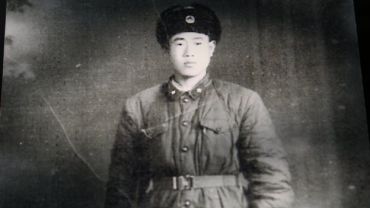
Wang Qi joined China’s People’s Liberation Army in 1960

Be it language, food or a vastly different society, Mr Wang has had to adapt every step of the way.

“I began by working in a flour mill. But I cried in the night as I longed for my family. I missed my mother,” he said.

“I wondered what I had got into.”

Mr Wang married a local girl, Sushila, under “pressure from friends” in 1975.

“I was livid with my parents for marrying me off to an outsider. I had trouble understanding his language. I tolerated him for a few months. Then I got used to him,” she says with a smile.

Mr Wang tried his hand at business but his undefined legal status meant visits by local police.

Mr Wang married a local girl, Sushila, under “pressure from friends” in 1975

“I remember Mr Wang being beaten by the police for not bribing them. He was an honest man,” says BB Singh, his neighbour for many years.

“He always talked about his home in China. His family lived in utter poverty. He would cycle for miles with no break,” another former neighbour Jayanti Lal Waghela says.

Mr Wang wrote letters home but received his first reply only in the 1980s. Family pictures were exchanged.

He spoke to his mother for the first time in more than 40 years on the phone in 2002.

“She said she wanted to see me as her last days were near. I said I was trying to return. I wrote letters to everyone who mattered to provide me with exit documents but nothing moved.”

She died in 2006.

Mr Wang’s family in ChinaMr Wang’s nephew met him when he came to India as a tourist in 2009.

It was he who helped him to get the necessary documents for his passport.It is still not clear whether Wang Qi will be able to go to China – and if he did, would he want to return to India?

“My family is here. Where would I go?” he says, playing with his granddaughter in his lap.

Sushila is worried though. “I hope he comes back.”

Mr Wang with his family
Image captionIt is not clear whether Mr Wang will leave his family and return to China
16/12/2016

China upset as Dalai Lama meets President Pranab Mukherjee | Reuters

China expressed dissatisfaction on Friday after exiled Tibetan spiritual leader the Dalai Lama met President Pranab Mukherjee, saying it hoped India would recognise the Nobel Peace Prize winning monk as a separatist in religious guise.

Mukherjee hosted the Dalai Lama and other Nobel Peace laureates at a conference on children’s rights at the presidential palace on Sunday.

Those who attended, and spoke, included Princess Charlene of Monaco and the former president of East Timor, Jose Ramos-Horta.

The Indian government had ignored China’s “strong opposition and insisted” on arranging for the Dalai Lama to share the stage with Mukherjee, and meet him, Foreign Ministry spokesman Geng Shuang told a daily news briefing in the Chinese capital.

“China is strongly dissatisfied and resolutely opposed to this,” he said, adding that the Dalai Lama used the guise of religion to engage in separatist activities and China opposed any form of official contacts with him.China wanted India to recognise the “anti-China, separatist essence of the Dalai Lama clique and take steps to banish the negative impact of this incident” to avoid disrupting ties between the Asian giants, Geng said.

While the Dalai Lama has had private meetings with Indian leaders, Sunday’s conference was the first public event, said the political head of the Tibetan government in exile based in the hill town of Dharamsala.

“There are many European governments shying away from hosting His Holiness,” he told Reuters. “Here you have the president of India hosting His Holiness. I think is a powerful message to the world, and particularly to Beijing.”

China regards the Dalai Lama as a separatist, though he says he merely seeks genuine autonomy for his Himalayan homeland Tibet, which Communist Chinese troops “peacefully liberated” in 1950.

The Dalai Lama fled into exile in India in 1959 after a failed uprising against Chinese rule.

China also expressed displeasure with India this month over the visit to a sensitive border region of another senior Tibetan religious figure, the Karmapa Lama, Tibetan Buddhism‘s third-most-senior monk, who fled into exile in India in 2000.India is home to a large exiled Tibetan community.

Source: China upset as Dalai Lama meets President Pranab Mukherjee | Reuters

23/09/2016

Guns and ghee | The Economist

TO MANY Indians, their country’s strategic position looks alarming. Its two biggest neighbours are China and Pakistan. It has fought wars with both, and border issues still fester. Both are nuclear-armed, and are allies with one another to boot. China, a rising superpower with five times India’s GDP, is quietly encroaching on India’s traditional sphere of influence, tying a “string of pearls” of alliances around the subcontinent. Relatively weak but safe behind its nuclear shield, Pakistan harbours Islamist guerrillas who have repeatedly struck Indian targets; regional security wonks have long feared that another such incident might spark a conflagration.

So when four heavily armed infiltrators attacked an Indian army base on September 18th, killing 18 soldiers before being shot dead themselves, jitters inevitably spread. The base nestles in mountains close to the “line of control”, as the border between the Indian and Pakistani-administered parts of the disputed territory of Kashmir is known. Indian officials reflexively blamed Pakistan; politicians and pundits vied in demanding a punchy response. “Every Pakistan post through which infiltration takes place should be reduced to rubble by artillery fire,” blustered a retired brigadier who now mans a think-tank in New Delhi, India’s capital.

Yet despite electoral promises to be tough on Pakistan, the Hindu-nationalist government of Narendra Modi has trodden as softly as its predecessors. On September 21st it summoned Pakistan’s envoy for a wrist-slap, citing evidence that the attackers had indeed slipped across the border, and noting that India has stopped 17 such incursions since the beginning of the year. Much to the chagrin of India’s armchair warriors, such polite reprimands are likely to be the limit of India’s response.

There are good reasons for this. India gains diplomatic stature by behaving more responsibly than Pakistan. It is keenly aware of the danger of nuclear escalation, and of the risks of brinkmanship to its economy. Indian intelligence agencies also understand that they face an unusual adversary in Pakistan: such is its political frailty that any Indian belligerence tends to strengthen exactly the elements in Pakistan’s power structure that are most inimical to India’s own interests.

But there is another, less obvious reason for reticence. India is not as strong militarily as the numbers might suggest. Puzzlingly, given how its international ambitions are growing along with its economy, and how alarming its strategic position looks, India has proved strangely unable to build serious military muscle.

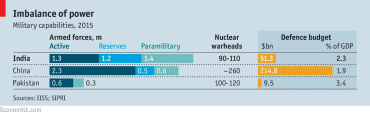
India’s armed forces look good on paper. It fields the world’s second-biggest standing army, after China, with long fighting experience in a variety of terrains and situations (see chart).

It has topped the list of global arms importers since 2010, sucking in a formidable array of top-of-the-line weaponry, including Russian warplanes, Israeli missiles, American transport aircraft and French submarines. State-owned Indian firms churn out some impressive gear, too, including fighter jets, cruise missiles and the 40,000-tonne aircraft-carrier under construction in a shipyard in Kochi, in the south of the country.

Yet there are serious chinks in India’s armour. Much of its weaponry is, in fact, outdated or ill maintained. “Our air defence is in a shocking state,” says Ajai Shukla, a commentator on military affairs. “What’s in place is mostly 1970s vintage, and it may take ten years to install the fancy new gear.” On paper, India’s air force is the world’s fourth largest, with around 2,000 aircraft in service. But an internal report seen in 2014 by IHS Jane’s, a defence publication, revealed that only 60% were typically fit to fly. A report earlier this year by a government accounting agency estimated that the “serviceability” of the 45 MiG 29K jets that are the pride of the Indian navy’s air arm ranged between 16% and 38%. They were intended to fly from the carrier currently under construction, which was ordered more than 15 years ago and was meant to have been launched in 2010. According to the government’s auditors the ship, after some 1,150 modifications, now looks unlikely to sail before 2023.

Such delays are far from unusual. India’s army, for instance, has been seeking a new standard assault rifle since 1982; torn between demands for local production and the temptation of fancy imports, and between doctrines calling for heavier firepower or more versatility, it has flip-flopped ever since. India’s air force has spent 16 years perusing fighter aircraft to replace ageing Soviet-era models. By demanding over-ambitious specifications, bargain prices, hard-to-meet local-content quotas and so on, it has left foreign manufacturers “banging heads against the wall”, in the words of one Indian military analyst. Four years ago France appeared to have clinched a deal to sell 126 of its Rafale fighters. The order has since been whittled to 36, but is at least about to be finalised.

India’s military is also scandal-prone. Corruption has been a problem in the past, and observers rightly wonder how guerrillas manage to penetrate heavily guarded bases repeatedly. Lately the Indian public has been treated to legal battles between generals over promotions, loud disputes over pay and orders for officers to lose weight. In July a military transport plane vanished into the Bay of Bengal with 29 people aboard; no trace of it has been found. In August an Australian newspaper leaked extensive technical details of India’s new French submarines.

The deeper problem with India’s military is structural. The three services are each reasonably competent, say security experts; the trouble is that they function as separate fiefdoms. “No service talks to the others, and the civilians in the Ministry of Defence don’t talk to them,” says Mr Shukla. Bizarrely, there are no military men inside the ministry at all. Like India’s other ministries, defence is run by rotating civil servants and political appointees more focused on ballot boxes than ballistics. “They seem to think a general practitioner can perform surgery,” says Abhijit Iyer-Mitra, who has worked as a consultant for the ministry. Despite their growing brawn, India’s armed forces still lack a brain.

Source: Guns and ghee | The Economist

23/09/2016

India signs deal for 36 French fighter jets to counter China, Pakistan squadrons | Reuters

India signed a deal to buy 36 Rafale fighter jets from France on Friday for around $8.7 billion, the country’s first major acquisition of combat planes in two decades and a boost for Prime Minister Narendra Modi‘s plan to rebuild an ageing fleet.

The air force is down to 33 squadrons, against its requirement of 45 to face both China, with which it has a festering border dispute, and nuclear-armed rival Pakistan.

French Defence Minister Jean-Yves Le Drian signed the agreement with his Indian counterpart, Manohar Parrikar, in New Delhi, ending almost 18 months of wrangling over terms between New Delhi and manufacturer Dassault Aviation.

India’s defence ministry said it would confirm the exact price later on Friday, but a ministry official said it was 7.8 billion euros ($8.7 billion).

Air force officials have warned for years about a major capability gap opening up with China and Pakistan without new state-of-the-art planes, as India’s outdated and largely Russian-made fleet retires and production of a locally made plane was delayed.

India had originally awarded Dassault with an order for 126 Rafales in 2012 after the twin-engine fourth-generation fighter beat rivals in a decade-long selection process, but subsequent talks collapsed.

Modi, who has vowed to modernise India’s armed forces with a $150 billion spending spree, personally intervened in April 2015 to agree on the smaller order of 36 and give the air force a near-term boost as he weighed options for a more fundamental overhaul.

The first ready-to-fly Rafales are expected to arrive by 2019 and India is set to have all 36 within six years.

Dassault Aviation said in a statement it welcomed the contract signing.

($1 = 0.8920 euros)

Source: India signs deal for 36 French fighter jets to counter China, Pakistan squadrons | Reuters

04/09/2016

China says should constructively handle disputes with India | Reuters

Chinese President Xi Jinping told Indian Prime Minister Narendra Modi on Sunday that the two countries should respect each other’s concerns and constructively handle their differences.

The two nuclear-armed neighbours have been moving to gradually ease long-existing tensions between them.

Leaders of Asia’s two giants pledged last year to cool a festering border dispute, which dates back to a brief border war in 1962, though the disagreement remains unresolved.

Meeting on the sidelines of the G20 summit in the eastern Chinese city of Hangzhou, Xi said relations had maintained a steady, healthy momentum, and should continue to increase mutual understanding and trust.

“We ought to respect and give consideration to each other’s concerns, and use constructive methods to appropriately handle questions on which there are disputes,” Xi said, in comments carried by China’s Foreign Ministry.

“China is willing to work hard with India the maintain the hard-won good position of Sino-India relations,” Xi added.

China’s Defence Ministry said last month that it hoped India could put more efforts into regional peace and stability rather than the opposite, in response to Indian plans to put advanced cruise missiles along the disputed border with China.

Indian military officials say the plan is to equip regiments deployed on the China border with the BrahMos missile, made by an Indo-Russian joint venture, as part of ongoing efforts to build up military and civilian infrastructure capabilities there.

China lays claim to more than 90,000 sq km (35,000 sq miles) ruled by New Delhi in the eastern sector of the Himalayas. India says China occupies 38,000 sq km (14,600 sq miles) of its territory on the Aksai Chin plateau in the west.

India is also suspicious of China’s support for its arch-rival, Pakistan.Modi arrived in China from Vietnam, which is involved in its own dispute with China over the South China Sea, where he offered Vietnam a credit line of half a billion dollars for defence cooperation.Modi’s government has ordered BrahMos Aerospace, which produces the BrahMos missiles, to accelerate sales to a list of five countries topped by Vietnam, according to a government note viewed by Reuters and previously unreported.

Source: China says should constructively handle disputes with India | Reuters

26/08/2016

The Economist explains: Why Kashmir is erupting again | The Economist

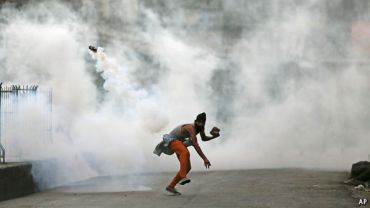
TODAY marks the 48th consecutive day of protests in Jammu & Kashmir, India’s only Muslim-majority state. Young Kashmiri men have been on the streets calling for independence from India and throwing stones at security forces. Indian security forces have responded with tear gas and shotguns that fire small-bore pellets instead of buckshot.

A strict curfew has also been imposed across the Kashmir valley, which includes Srinagar, the region’s largest city. So far, 66 civilians and two police officers have been killed in the violence. Why are Kashmiris protesting?

The region has been disputed since the partition of India and Pakistan in 1947. Both sides claim the territory and have fought three wars over it. Kashmir has been living under India’s Armed Forces (Special Powers) Act, which gives special powers to the army, since the eruption in 1990 of an armed insurgency that was covertly supported by Pakistan. Some 40,000 people have been killed since. Even in the relatively peaceful past decade, unrest has flared up, most notably in the summers of 2008 and 2010. The current protests started on July 9th after Indian security forces killed Burhan Wani, a young and charismatic Islamist militant. Resentment had been building for months. Kashmiris worried when Narendra Modi’s Hindu-nationalist Bharatiya Janata Party (BJP) came to power in 2014 that his national government would make life difficult for Muslims. At state elections later that year, the local Peoples Democratic Party formed a coalition with the BJP, leaving them feeling betrayed. Wani’s killing has mobilised a generation that had grown up under what it sees as an illegitimate Indian occupation.

The result has been a seven-week cycle of violent protests and retaliatory action by the police and paramilitary forces. Their supposedly non-lethal pellets have blinded dozens and injured hundreds. Shops and businesses have remained closed since the protests started, either under curfew orders or because of calls for strikes from separatist leaders. Many Kashmiris have not left their homes for weeks. Few expect the situation to improve any time soon, despite soothing words this week from Mr Modi and a visit to the region by India’s home minister.An obstacle to any lasting solution is India’s insistence on seeing Kashmir through the prism of its rivalry with Pakistan. The Indian government’s immediate reaction to this summer’s unrest was to accuse its neighbour of meddling. In fact, Wani was a home-grown insurgent; the young men on the streets are locals. Unemployment is widespread and economic opportunities are few. The state was also promised special status, guaranteeing autonomy, in India’s constitution. And many Kashmiris now want more: a survey in 2010 by Chatham House, a think-tank, found overwhelming support for independence. Kashmiris are at best ambivalent about their attachment to India. Until the government recognises their demands, the anger is unlikely to dissipate.

Source: The Economist explains: Why Kashmir is erupting again | The Economist

18/08/2016

India ready for Pakistan talks; U.N. alarmed by Kashmir violence | Reuters

India is ready to send its top diplomat to Pakistan for talks focused on fighting cross-border terrorism, sources at foreign ministry said on Wednesday, after a spike in tension in the disputed northernmost region of Kashmir.

Foreign Secretary Subrahmanyam Jaishankar was willing to attend talks on the invitation of his Pakistani counterpart, the sources said, stressing cross-border terrorism was central to the situation in Jammu and Kashmir state.

The olive branch comes after 40 days of violent protests in Indian-ruled Kashmir set off by the killing by security forces of a field commander of Pakistan-based Islamic militant group Hizbul Mujahideen who enjoyed wide support.

At least 64 people have died and thousands injured in clashes with security forces, denounced by Pakistan, which also claims the right to rule Jammu & Kashmir in a territorial dispute that dates back to partition in 1947.

The Indian sources, who declined to be identified, made it clear, however, that India “rejects in their entirety the self-serving allegations regarding the situation in J&K, which is an integral part of India.”Jammu and Kashmir (J&K) is the name of India’s only Muslim-majority state that includes the disputed Kashmir region.

A spokesman for Pakistan’s foreign ministry declined to comment late on Wednesday, saying the government was preparing a response to the proposed Indian visit.

A U.N. human rights official expressed “deep regret” at the failure of both the Indian and Pakistani authorities to grant access to the separate parts of Kashmir that each run to investigate allegations of serious human rights violations.

U.N. High Commissioner for Human Rights Zeid Ra’ad Al Hussein said in a statement issued in Geneva it was unfortunate that sincere attempts by the United Nations to independently assess the facts in relation to reports of human rights violations had failed.

“Without access, we can only fear the worst,” said Zeid.

The nuclear-armed neighbours, which have fought three wars since independence in 1947, both claim Kashmir in full but rule it in part.

In the latest violence on Wednesday, militants killed three members of the security forces when they ambushed an army convoy and then fired on a police jeep that came to the scene.

In a worrying escalation the previous day, security forces fired live rounds at a crowd of stone-throwing protesters in Baramulla district, killing five and wounding 10.

Earlier, police and troops trying to control crowds had resorted to the use of shotguns, whose pellets are meant to incapacitate but not kill.

But residents of Kashmir say the shotguns have inflicted severe injuries and even blinded hundreds of people including bystanders.

Prime Minister Narendra Modi ratcheted up tensions in his annual Independence Day speech on Monday, accusing Pakistan of glorifying terrorism.

In a tit-for-tat escalation in the war of words between the neighbours, Modi said he had received messages of support from leaders in restive regions of Pakistan, in particular the troubled southwestern province of Baluchistan.

India accuses Muslim Pakistan of supporting Kashmiri fighters while Pakistan accuses India of meddling in Pakistani trouble spots, in particular of helping separatists fighting the Pakistani state in resource-rich Baluchistan.

Both sides deny the accusations.

Source: India ready for Pakistan talks; U.N. alarmed by Kashmir violence | Reuters

29/07/2016

Why India Is Spending $1 Billion on Boeing Jets – The Short Answer – WSJ

India is beefing up its maritime patrol and anti-submarine warfare capabilities with an order for four Boeing Co.-made P-8I aircraft.

The order is the latest evidence of booming defense ties between India and the U.S. The South Asian nation’s arms imports from the U.S. in the five years through 2015 were 11 times the amount in the previous five years, according to the Stockholm International Peace Research Institute.

India imported 14% of its weapons from the U.S. in the same period, although its longstanding supplier Russia continued to dominate its defense market with a 70% share, according to the think tank.

India spent how much?

India will pay about $1 billion for the four P-8I planes. That is about half the amount the country spent in 2009 for eight of the aircraft. That order had an option for India to acquire four more jets at the 2009 price, something it is exercising now.

What can the planes do?

The P-8I—a military variant of Boeing 737-800 commercial jetliner—is fitted with state-of-the-art sensors and radars for maritime surveillance and reconnaissance, and to snoop on submarines. It can also be fitted with the Harpoon all-weather anti-ship missiles made by Boeing.

The aircraft–a variant of the U.S. navy’s P-8A Poseidon plane–can also be used for anti-piracy and other intelligence operations. It was deployed in 2014 when India joined the multinational search for the missing Malaysia Airlines Flight 370. It is currently being used in the search for an Indian air force AN-32 aircraft that went missing on Friday over the Bay of Bengal.

Why does India want the jets?

The latest acquisition of the P-8I is a milestone in India’s strategy to replace its aging equipment, much of which was bought from Russia during the Soviet era. The twin-engine jet has a range of about 2,222 kilometers, or more than 1,200 nautical miles, which allows the Indian navy to monitor the country’s vast coastline.

Has this got anything to do with China?

India’s expansion of the P-8I fleet comes as China increases its naval presence in the Indian Ocean, alarming New Delhi.

In recent years, China has been improving its submarine power with a nuclear-powered sub travelling all the way to the Persian Gulf via Sri Lanka. China and India are also locked in a long-running land-border dispute.

The new planes will bolster India’s capabilities to keep an eye on movement on Chinese warships and submarines in the region.

What else is on the shopping list?

India’s government, led by Prime Minister Narendra Modi, has promised to upgrade the country’s military capabilities. But a long-delayed deal to buy 36 Rafale fighter jets from Dassault Aviation S.A. of France is still being negotiated–more than a year after it was announced.

India also has plans to buy howitzers, warships, submarines, as well as to acquire fighter jets.

Source: Why India Is Spending $1 Billion on Boeing Jets – The Short Answer – WSJ

25/07/2016

India urges security forces to exercise restraint in Kashmir | Reuters

India has asked its security forces to exercise restraint in responding to protests in disputed Kashmir and replace pellet guns with non-lethal weapons, its home affairs minister said on Sunday.

Forty six people have been killed and more than 5,000 wounded, including security forces, since protests erupted after the killing of Hizbul Mujahideen commander Burhan Wani on July 8.

Normal life remains paralysed because of the curfew imposed by the government and calls for a shutdown by separatist leaders.

“I appeal to the youth not to resort to stone pelting and I also want to appeal to the security forces not to use pellets. I have told security forces to use maximum possible restraint,” Rajnath Singh said, winding up his two-day visit to Kashmir.

Kashmir has been at the centre of a tussle between New Delhi and Islamabad for decades, as both claim the region in full but rule it in part.

“We don’t need the involvement of a third party to address the situation in Jammu and Kashmir. I want to tell my neighbour that you are yourself a victim of terrorism,” said Singh.

Since they split some 67 years ago, India and Pakistan have fought each other in three wars, two over Kashmir. There has not been a full-blown war since they both tested nuclear weapons in 1998.

Singh on Thursday told lawmakers that India would set up a panel to look for an alternative to pellet guns.More than 300 people have suffered because of pellet guns, including 171 with eye injuries, Kaisar Ahmad, principal of the Government Medical College in Srinagar, told Reuters.

Source: India urges security forces to exercise restraint in Kashmir | Reuters

16/06/2016

U.S., India and Japan Begin to Shape a New Order on Asia’s High Seas – India Real Time – WSJ

From the waters of the Philippine Sea this week emerged a partial outline of Washington’s vision for a new Asian maritime-security order that unites democratic powers to contend with a more-assertive and well-armed China.

A U.S. Navy aircraft-carrier strike group along with warships from India and Japan jointly practiced anti-submarine warfare and air-defense and search-and-rescue drills in one of the largest and most complex exercises held by the three countries.

The maneuvers were being tracked by a Chinese surveillance vessel, a U.S. Navy officer aboard the carrier USS John C. Stennis said on Wednesday. Last week, China’s Foreign Ministry spokesman Hong Lei said Beijing hoped the training “will be conducive to regional peace, security and stability.

”Washington and Tokyo have long cooperated closely on defense. And the U.S. has been working to deepen strategic ties with India and to encourage New Delhi to play a more active role, not just in the Indian Ocean but also in the Pacific, as China’s rise shifts the regional balance of power.

Americans are looking for those who can share the burden,” said C. Raja Mohan, director of the Carnegie Endowment for International Peace’s India center. A strengthened three-way partnership among the U.S., Japan and India is “an important strategic shift.”

Source: U.S., India and Japan Begin to Shape a New Order on Asia’s High Seas – India Real Time – WSJ

Law of Unintended Consequences

continuously updated blog about China & India

ChiaHou's Book Reviews

continuously updated blog about China & India

What's wrong with the world; and its economy

continuously updated blog about China & India