Archive for ‘History’

13/01/2013

* China-wary Army for mountain strike corps

Times of India: “The Army has come up with a fresh proposal for the new mountain strike corps, apart from two “independent” infantry brigades and two “independent” armoured brigades, to plug operational gaps along the LAC (line of actual control) as well as to acquire “some offensive capabilities” against China.

The raising of the new formations will cost around Rs 81,000 crore, spread primarily over the 12th Plan period (2012-17), with a little spillover into the 13th Plan if necessary, say sources.

“The approved 12th Army Plan, as part of the LTIPP (long-term integrated perspective plan), already ca-ters Rs 62,000 crore for the corps. The Army is now asking for another Rs 19,000 crore,” said a source.

With additional armoured regiments and infantry units based in Ladakh, Sikkim and Uttarakhand, the new mountain corps (around 40,000 soldiers) will for the first time give India the capability to also launch a counter-offensive into TAR (Tibet Autonomous Region) in the event of a Chinese attack, say sources.

As with the development of the over 5,000-km Agni-V and 3,500-km Agni-IV ballistic missiles — coupled with the ongoing progressive deployment of Sukhoi-30MKI fighters, spy drones, helicopters and missile squadrons in the northeast — the overall aim is to have “strategic deterrence” in place to dissuade China from embarking on any “misadventure”.”

via China-wary Army for mountain strike corps – The Times of India.

09/01/2013

* Pak’s action highly objectionable: Defence minister

Following from the death of a Pakistani soldier, this retaliation – if proven to be accurate – is not acceptable of any national army in the 21st century.

Times of India: “Defence minister A K Antony on Wednesday blasted Pakistan for the gruesome way in which an Indian soldier was beheaded by its troops who intruded into Indian territory in the Mendhar sector of J&K on Tuesday.

Indian soldiers carry coffin reported to contain body of colleague killed by Pakistani soldiers (9 January)

“The Pakistan Army’s action is highly objectionable and also the way they treated the body of the Indian soldier is inhuman,” said Antony.

“We will take it up with the Pakistan government and our ​Director General of Military Operations (DGMO) will talk to his counterpart in Pakistan. We are closely monitoring the situation,” he added.

As reported by TOI, an Indian soldier was beheaded and another’s body mutilated by Pakistani troops after they crossed over into Indian territory in Mendhar at about 11 am on Tuesday, in a grim reminder of the barbarism exhibited in the Captain Saurabh Kalia case during the bloody Kargil conflict in 1999.”

via Pak’s action highly objectionable: Defence minister – The Times of India.

See also: https://chindia-alert.org/political-factors/indian-tensions/


18/11/2012

* Southeast Asia calls for talks with China on sea dispute

S E Asia may be joining hands to call China to the discussion table; but China really dislikes being pressured and much prefers one-to-one dialogue and bi-lateral agreements.

Reuters: “Southeast Asian nations displayed a rare show of unity on Sunday against China’s sweeping maritime claims, calling for the first formal talks with Beijing over a sea dispute that has raised tensions and exposed deep divisions in the region.

(L - R)Singapore Prime Minister Lee Hsien Loong, Thailand Prime Minister Yingluck Shinawatra, Vietnam Prime Minister Nguyen Tan Dung, Cambodia Prime Minister Hun Sen and the Sultan of Brunei Hassanal Bolkiah hold hands during the opening ceremony of the 21st ASEAN (Association of Southeast Asian Nations) and East Asia summits in Phnom Penh November 18, 2012. REUTERS-Samrang Pring

As Chinese Premier Wen Jiabao arrived in Cambodia for meetings with Southeast Asian leaders, the 10-member Association of Southeast Asian Nations (ASEAN) appeared determined to avoid a repeat of an embarrassing breakdown of talks in July over competing claims in the mineral-rich South China Sea, its biggest security challenge.

Cambodia’s Prime Minister Hun Sen will tell Wen that ASEAN wants to begin talks on a binding Code of Conduct, aimed at reducing the chance of naval flashpoints, as soon as possible, ASEAN Secretary General Surin Pitsuwan told reporters.

“Prime Minister Hun Sen himself will be discussing with the PM of China tonight and delivering this consensus on the ASEAN side,” Surin said.

“They would like to see the commencement of the discussion as soon as possible because this is an issue of interest, concern and worry of the international community.”

China’s assertive claims in the South China Sea have sown deep divisions within the bloc at a time when military spending in the region is surging and the United States refocuses attention on Asia – a “pivot” that President Barack Obama will reinforce on his visit to the summit on Monday in Cambodia’s capital, Phnom Penh.

Chinese ally Cambodia has used its powers as ASEAN chair this year to restrict discussion of the issue, in line with Beijing’s view that the disputes should be discussed on a bilateral basis. China has said it is willing to discuss the Code of Conduct when the “time is right.”

Diplomats said the Philippines, a close U.S. ally, had invited fellow Southeast Asian claimant states Vietnam, Brunei, and Malaysia to separate talks in Manila to be held later this year or early next year.

“We are trying to make that happen, hopefully in Manila,” Philippine Foreign Secretary Albert del Rosario told reporters.

The other members of ASEAN include Cambodia, Laos, Myanmar, Thailand, Singapore and Indonesia, none of which have claims on the South China Sea.

One Philippine diplomat said the meeting was aimed at resolving issues among the claimant states, such as overlapping economic zones. He voiced frustration with China for delaying the start of talks with ASEAN over the Code of Conduct.

“ASEAN has done its part,” the diplomat said. “Now it is up to China to also come up with its own because when we formally sit down we will present our position to them. In fact we have already written it.””

via Southeast Asia calls for talks with China on sea dispute | Reuters.

See also: 


05/11/2012

* ‘Looted’ Chinese antiques pulled from UK auction

SCMP: “Two Chinese antiques have been withdrawn from auction in Britain, the auctioneer said, after the proposed sale sparked fury in China amid claims they were looted from Beijing in the 19th century.

Bonhams issued an apology as it confirmed the two jade carvings would not be sold after the owner withdrew them from a planned auction on Thursday to “avoid any possible offence”.

Picture: Looting of Old Summer Palace by British & French troops.

The planned sale had sparked a furious reaction from Tan Ping, an official at China’s State Administration of Cultural Heritage, who labelled it “against the spirit of international conventions”.

“Bonhams is very sorry to read reports in the Chinese press that offence has been caused in China by the proposed sale of two jade carvings,” Bonhams said in a statement received by AFP on Monday.

“There was never in any way an intention to cause offence, and Bonhams regrets that this interpretation has been published.”

Ping previously told state media: “Cultural relics should be returned to their country of origin. We’ll keep a close eye on the matter.”

In its online description of the Qing dynasty jade disc and jade hanging vase, Bonhams said they were “retrieved from the abandoned Summer Palace in Beijing” in 1860.

The Old Summer Palace, or Yuanmingyuan, was pillaged by British and French military forces in 1860, when Beijing says 1.5 million relics were looted, though it is likely some antiques were sold off by local dealers.

The event is seen in China as a national humiliation at the hands of Western armies. Sales of antiques looted from the palace are widely resented in China.”

via ‘Looted’ Chinese antiques pulled from UK auction | South China Morning Post.

See also: 

20/10/2012

* India pays homage to 1962 martyrs for first time

The Hindu: “Paying homage to soldiers who fought in the 1962 Indo-China war, Defence Minister A.K. Antony on Saturday ruled out any possibility of the repeat of the war and said armed forces were confident of protecting the country against any such threat.

(From Left) Defence Minister A.K.Antony, Marshal of the Indian Air Force Arjan Singh, Chief of Army Staff Gen. Bikram Singh, Naval Chief Admiral D.K. Joshi, Chief of Air Staff Air Chief Marshal N.A.K.Browne pay homage at Amar Jawan Jyoti to mark the 50th anniversary of India-China war, in New Delhi on Saturday. Photo: Sandeep Saxena

This is the first time that the Indian defence establishment has honoured the dead and participants of the 1962 war officially.

“I would like to assure the nation that India of today is not the India of 1962. Over the years, successive governments learning lessons from the past strengthened our capabilities and modernised our armed forces… we are confident armed forces will be able to protect the border in event of any threat,” he said on the sidelines of an event to honour the soldiers of the 1962 war on its 50th anniversary.

The Defence Minister was asked to assess the threat from China and India’s preparation to tackle it.

In the war, India suffered defeat at the hands of the Chinese Army which went to capture large portion of Indian territory.

The Defence Minister, who along with Minister of State for Defence M.M. Pallam Raju, Marshal of the Air Force Arjan Singh and the three services chiefs paid homage to the 1962 war heroes and laid wreaths at Amar Jawan Jyoti, said successive governments have learnt lessons from the war and strengthened military capabilities and developed infrastructure.

“We will vigorously continue to strengthen our capabilities,” the Defence Minister said.

Mr. Antony also noted that India was holding dialogue with China to find a solution to the long-pending border dispute and has established a mechanism to “immediately settle” any tensions on the border.”

via The Hindu : News / National : Nation pays homage to 1962 martyrs for first time.

05/10/2012

* Diaoyu islands dispute hammers Japanese car sales in China

If the September drop in sales continues, the future for Japanese cars in China is very bleak indeed. There are lots of competitors both indigenous and foreign that can take up the slack. If Japanese car factories close as a result, the impact on Chinese employment will be non-trivial. So the anti-Japanese sentiment cuts both ways.

South China Morning Post: “Toyota’s sales in China halved last month from August levels, damaged by anti-Japanese sentiment in a row over disputed islands in the East China Sea, the Yomiuri newspaper reported on Friday, citing the carmaker.

Photo

Showroom traffic and sales have plunged at Japanese automakers since violent protests and calls for boycotts of Japanese products broke out across China in mid-September over Japan’s acquisition of a group of disputed islands.

A prolonged sales hit of this scale could threaten profit forecasts at Toyota, Nissan and others as China, the world’s biggest car market, makes up a bigger portion of their global sales. Toyota sold about 75,300 cars in China in August.

As demand evaporates, Toyota, Nissan, Honda and others have been forced to cut back production in recent weeks in a slowing, but still promising Chinese market.

A source told reporters late last month that Toyota’s production cutbacks could extend through November, a move that would almost certainly put the company’s goal of selling 1 million cars in China this year out of reach.

A Toyota spokeswoman in Tokyo declined to confirm the newspaper report, saying the company would announce its Chinese sales for September on Tuesday.

On Thursday, Mazda said its China sales tumbled by more than a third last month from a year earlier, providing the first concrete numbers to point to Japanese automakers’ troubles in China.

via Diaoyus dispute hammers Japanese car sales in China | South China Morning Post.

17/09/2012

* China past and present: review

UK Telegraph: “China past and present: review

By Rana Mitter7:00AM BST 10 Sep 2012Comment

Two books on China explain why the country’s rise to superpower status is still far from inevitable

A vision of the Chinese future in a 1982 propaganda posterA vision of the Chinese future in a 1982 propaganda poster Photo: Alamy
Some time this autumn, the Chinese Communist Party will announce the date of the 18th Party Congress. Among the Party’s priorities will be two major issues: the need to project Chinese power more widely in the world, and the consolidation of a system of welfare that will prevent the country’s social discontent from spilling over into outright rebellion. These themes are at the centre of these two important books which, taken together, illustrate why the rise of China is far from inexorable.

Odd Arne Westad’s Restless Empire has two main purposes. The first is to provide an overview of China’s engagement with the world over the past three centuries. Westad starts with an important piece of myth-busting, arguing strongly against the idea that China has been an inward-looking society closed to the rest of the world. Whether it was the trade in silks and porcelains that made China part of a global trading network during the Ming and Qing dynasties that lasted from the 14th century to the 20th, or the forced engagement with the West that came with imperialism, China has always been connected with the wider world. Westad is particularly acute on the Cold War period, using impressive documentation to argue that China’s relationship to the rest of East Asia was not just communist, but Confucian in the ties that Mao nurtured with his ideological “younger brothers” such as Kim Il-sung and Ho Chi Minh (even if the family quickly became dysfunctional).

The second aim emerges in the last two chapters, which concern the foreign policy crises facing China today. Westad firmly rejects the received wisdom that China is set to become a global superpower, dominating policy on everything from international intervention to energy resources. Despite its rhetoric, China has in practice been almost entirely passive or reactive in the past few decades. China shows pleasure in being treated as a global player, but shows little sign of knowing what to do with that power other than criticising the United States. “China has to learn,” he says drily, “that sticking it in the eye of the world’s hyperpower may bring short-term gratification, but it does not amount to a grand strategy in international politics.”

Some of the reasons that China’s leadership may be distracted from visions of world domination are made clear in Gerard Lemos’s The End of the Chinese Dream. Lemos spent four years working in Chongqing, the city that has become notorious for the Bo Xilai murder scandal, but his account is of a less lurid but equally troubling failing in Chinese government. He examines the model of welfarist authoritarianism with which the Chinese Communist Party is attempting to gain the “performance legitimacy” that might keep it in power, and finds it seriously wanting. When the Maoist “iron rice bowl” of guaranteed employment, pensions and health care broke down as China privatised its economy in the Nineties, millions of urban and rural Chinese found themselves left behind as others got rich. Figures tell part of the story: food inflation ran at over 18 per cent in 2008, and some analysts expect that health care costs will rise by 11 per cent annually into the middle of the next decade. But the participants in the surveys that Lemos organised add human voices to the statistics: one among the hundreds he records is the 39-year-old woman who declares “Losing my job [changed my life]. I have no money to see the doctor.” She tells Lemos that she fears she’ll be unable to find “the education fee for my children’s education”. The “Chinese dream” of a middle-class existence with a flat, car, and high-quality education for the next generation has only become a reality in the last decade or two. Now it looks as if it may be slipping out of the grasp of millions even before they have had a chance to aspire to it.

Both writers make poignantly clear the obstacles to China becoming a global leader. At bottom, China does not have a vision of what a Chinese-led world would look like. Nor does its domestic political model of party-led authoritarianism export well to the rest of the world. African and Latin American nations may welcome Chinese investment and on occasion find it expedient to use the threat of Beijing to squeeze concessions from Washington. But however shaky these countries’ engagement with democratisation, they do not seriously tout the “Chinese model” as an alternative, because it is clear that China has not solved its most pressing problems: a demographic crisis exacerbated by the one-child policy, a creaking welfare system, and slowing growth.”

via China past and present: review – Telegraph.

See also:

02/09/2012

* Asian giants seek better ties; China defence minister in India

The Times of India: “A rare visit to India by China’s defence minister should help avoid flare-ups along the border between the nuclear-armed Asian giants at a time when Beijing is grappling with a change of leadership and friction in the South China Sea.

Chinese Minister of National Defense General Liang Guanglie stands on a balcony overlooking the campus of the U.S. Military Academy in West Point, New York, May 10, 2012. REUTERS/Mike Segar

But General Liang Guanglie‘s trip — the first by a Chinese defence minister in eight years — also highlights growing competition between the two emerging powers as they jostle for influence and resources across Asia.

Liang is due to arrive in Mumbai on Sunday afternoon after stopping in Sri Lanka, the island nation off the south coast of India that sits on vital ocean trade routes.

There he sought to play down Indian fears that China is threading a “string of pearls” — or encircling it by financing infrastructure and military strength in neighbours stretching from Pakistan to the Maldives.

“China attaches great importance to its relations with the South Asian nations, and commits itself to forging harmonious co-existence and mutually beneficial and win-win cooperation with them,” he said in speech to Sri Lankan soldiers.

“The PLA’s (People’s Liberation Army) efforts in conducting friendly exchanges and cooperation with its counterparts in the South Asian nations are intended for maintaining regional security and stability and not targeted at any third party.”

As neighbours and emerging superpowers, India and China have a complex relationship. Trade has grown at a dizzying rate but Beijing is wary of India’s close ties to Washington and memories of a border war with China half a century ago are still fresh in New Delhi.

Despite 15 rounds of high level talks to resolve the dispute about where their Himalayan border lies, neither side is close to giving up any territory. Liang is not expected to broach the territorial issue on his trip.

Analysts say Liang’s India tour will demonstrate that Beijing is managing the often twitchy relations with its neighour just ahead of its once-in-a-decade leadership transition.”

via Asian giants seek better ties; China defence minister in India – The Times of India.

See also: 

12/08/2012

* Pakistani Hindu pilgrims allowed to cross into India after detention

BBC News: “Pakistan officials have allowed a group of Hindu pilgrims who were detained at the border to cross into India.

More than 200 Pakistani Hindus were held at the Wagah crossing near Lahore after local media reported that they intended to emigrate.

Although the group had valid pilgrimage visas, it was rumoured they planned to remain in India because of growing attacks against minorities in Pakistan.

They were allowed to pass after they assured officials they would return.

A spokesperson for the pilgrims, Santosh Puri, told the BBC the group had assured the authorities that “this is a pilgrimage” and no one intends to emigrate.

Pakistani rights activists say dozens of Pakistani Hindu families have moved to India to escape killings, abductions and forced conversions in recent years.

According to Indian officials, Pakistani Hindus have often entered India on visit visas, only to settle there permanently.”

via BBC News – Pakistani Hindu pilgrims allowed to cross into India after detention.

12/08/2012

* Beijing Reasserts Its Claims in South China Sea

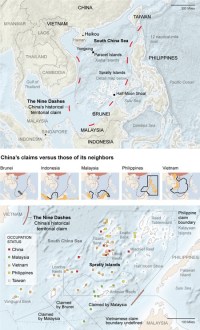
NY Times: “China does not want to control all of the South China Sea, says Wu Shicun, the president of a government-sponsored research institute here devoted to that strategic waterway, whose seabed is believed to be rich in oil and natural gas. It wants only 80 percent.

Mr. Wu is a silver-haired politician with a taste for European oil paintings and fine furniture. He is also an effective, aggressive advocate for Beijing’s longstanding claim over much of the South China Sea in an increasingly fractious dispute with several other countries in the region that is drawing the United States deeper into the conflict.

China recently established a larger army garrison and expanded the size of an ostensible legislature to govern a speck of land, known as Yongxing Island, more than 200 miles southeast of Hainan. The goal of that move, Mr. Wu said, is to allow Beijing to “exercise sovereignty over all land features inside the South China Sea,” including more than 40 islands “now occupied illegally” by Vietnam, the Philippines and Malaysia.

In the past several weeks, China has steadily increased its pressure, sending patrols with bigger ships and issuing persistent warnings in government-controlled newspapers for Washington to stop supporting its Asian friends against China.

The leadership in Beijing appears to have fastened on to the South China Sea as a way of showing its domestic audience that China is now a regional power, able to get its way in an area it has long considered rightfully its own. Some analysts view the stepped-up actions as a diversion from the coming once-a-decade leadership transition, letting the government show strength at a potentially vulnerable moment.

The Obama administration, alarmed at Beijing’s push, contends that the disputes should be settled by negotiation, and that as one of the most important trade corridors in the world, the South China Sea must enjoy freedom of navigation. The State Department, in an unusually strong statement issued this month intended to warn China that it should moderate its behavior, said that Washington believed the claims should be settled “without coercion, without intimidation, without threats and without the use of force.”

Washington was reacting to what it saw as a continuing campaign on the South China Sea after Beijing prevented the Association of Southeast Asian Nations, at its summit meeting in Cambodia in July, from releasing a communiqué outlining a common approach to the South China Sea.

The dispute keeps escalating. On July 31, the 85th anniversary of the founding of the People’s Liberation Army, the Chinese Defense Ministry heralded the occasion by announcing “a regular combat-readiness patrol system” for the waters in the sea under China’s jurisdiction.

The government then said it had launched its newest patrol vessel: a 5,400-ton ship. It was specifically designed to maintain “marine sovereignty,” said People’s Daily, the Communist Party’s leading newspaper.””

via Beijing Reasserts Its Claims in South China Sea – NYTimes.com.

Law of Unintended Consequences

continuously updated blog about China & India

ChiaHou's Book Reviews

continuously updated blog about China & India

What's wrong with the world; and its economy

continuously updated blog about China & India