Archive for ‘History’

23/09/2016

India signs deal for 36 French fighter jets to counter China, Pakistan squadrons | Reuters

India signed a deal to buy 36 Rafale fighter jets from France on Friday for around $8.7 billion, the country’s first major acquisition of combat planes in two decades and a boost for Prime Minister Narendra Modi‘s plan to rebuild an ageing fleet.

The air force is down to 33 squadrons, against its requirement of 45 to face both China, with which it has a festering border dispute, and nuclear-armed rival Pakistan.

French Defence Minister Jean-Yves Le Drian signed the agreement with his Indian counterpart, Manohar Parrikar, in New Delhi, ending almost 18 months of wrangling over terms between New Delhi and manufacturer Dassault Aviation.

India’s defence ministry said it would confirm the exact price later on Friday, but a ministry official said it was 7.8 billion euros ($8.7 billion).

Air force officials have warned for years about a major capability gap opening up with China and Pakistan without new state-of-the-art planes, as India’s outdated and largely Russian-made fleet retires and production of a locally made plane was delayed.

India had originally awarded Dassault with an order for 126 Rafales in 2012 after the twin-engine fourth-generation fighter beat rivals in a decade-long selection process, but subsequent talks collapsed.

Modi, who has vowed to modernise India’s armed forces with a $150 billion spending spree, personally intervened in April 2015 to agree on the smaller order of 36 and give the air force a near-term boost as he weighed options for a more fundamental overhaul.

The first ready-to-fly Rafales are expected to arrive by 2019 and India is set to have all 36 within six years.

Dassault Aviation said in a statement it welcomed the contract signing.

($1 = 0.8920 euros)

Source: India signs deal for 36 French fighter jets to counter China, Pakistan squadrons | Reuters

04/09/2016

China says should constructively handle disputes with India | Reuters

Chinese President Xi Jinping told Indian Prime Minister Narendra Modi on Sunday that the two countries should respect each other’s concerns and constructively handle their differences.

The two nuclear-armed neighbours have been moving to gradually ease long-existing tensions between them.

Leaders of Asia’s two giants pledged last year to cool a festering border dispute, which dates back to a brief border war in 1962, though the disagreement remains unresolved.

Meeting on the sidelines of the G20 summit in the eastern Chinese city of Hangzhou, Xi said relations had maintained a steady, healthy momentum, and should continue to increase mutual understanding and trust.

“We ought to respect and give consideration to each other’s concerns, and use constructive methods to appropriately handle questions on which there are disputes,” Xi said, in comments carried by China’s Foreign Ministry.

“China is willing to work hard with India the maintain the hard-won good position of Sino-India relations,” Xi added.

China’s Defence Ministry said last month that it hoped India could put more efforts into regional peace and stability rather than the opposite, in response to Indian plans to put advanced cruise missiles along the disputed border with China.

Indian military officials say the plan is to equip regiments deployed on the China border with the BrahMos missile, made by an Indo-Russian joint venture, as part of ongoing efforts to build up military and civilian infrastructure capabilities there.

China lays claim to more than 90,000 sq km (35,000 sq miles) ruled by New Delhi in the eastern sector of the Himalayas. India says China occupies 38,000 sq km (14,600 sq miles) of its territory on the Aksai Chin plateau in the west.

India is also suspicious of China’s support for its arch-rival, Pakistan.Modi arrived in China from Vietnam, which is involved in its own dispute with China over the South China Sea, where he offered Vietnam a credit line of half a billion dollars for defence cooperation.Modi’s government has ordered BrahMos Aerospace, which produces the BrahMos missiles, to accelerate sales to a list of five countries topped by Vietnam, according to a government note viewed by Reuters and previously unreported.

Source: China says should constructively handle disputes with India | Reuters

26/08/2016

The Economist explains: Why Kashmir is erupting again | The Economist

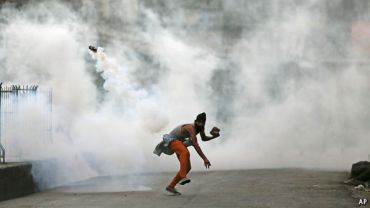
TODAY marks the 48th consecutive day of protests in Jammu & Kashmir, India’s only Muslim-majority state. Young Kashmiri men have been on the streets calling for independence from India and throwing stones at security forces. Indian security forces have responded with tear gas and shotguns that fire small-bore pellets instead of buckshot.

A strict curfew has also been imposed across the Kashmir valley, which includes Srinagar, the region’s largest city. So far, 66 civilians and two police officers have been killed in the violence. Why are Kashmiris protesting?

The region has been disputed since the partition of India and Pakistan in 1947. Both sides claim the territory and have fought three wars over it. Kashmir has been living under India’s Armed Forces (Special Powers) Act, which gives special powers to the army, since the eruption in 1990 of an armed insurgency that was covertly supported by Pakistan. Some 40,000 people have been killed since. Even in the relatively peaceful past decade, unrest has flared up, most notably in the summers of 2008 and 2010. The current protests started on July 9th after Indian security forces killed Burhan Wani, a young and charismatic Islamist militant. Resentment had been building for months. Kashmiris worried when Narendra Modi’s Hindu-nationalist Bharatiya Janata Party (BJP) came to power in 2014 that his national government would make life difficult for Muslims. At state elections later that year, the local Peoples Democratic Party formed a coalition with the BJP, leaving them feeling betrayed. Wani’s killing has mobilised a generation that had grown up under what it sees as an illegitimate Indian occupation.

The result has been a seven-week cycle of violent protests and retaliatory action by the police and paramilitary forces. Their supposedly non-lethal pellets have blinded dozens and injured hundreds. Shops and businesses have remained closed since the protests started, either under curfew orders or because of calls for strikes from separatist leaders. Many Kashmiris have not left their homes for weeks. Few expect the situation to improve any time soon, despite soothing words this week from Mr Modi and a visit to the region by India’s home minister.An obstacle to any lasting solution is India’s insistence on seeing Kashmir through the prism of its rivalry with Pakistan. The Indian government’s immediate reaction to this summer’s unrest was to accuse its neighbour of meddling. In fact, Wani was a home-grown insurgent; the young men on the streets are locals. Unemployment is widespread and economic opportunities are few. The state was also promised special status, guaranteeing autonomy, in India’s constitution. And many Kashmiris now want more: a survey in 2010 by Chatham House, a think-tank, found overwhelming support for independence. Kashmiris are at best ambivalent about their attachment to India. Until the government recognises their demands, the anger is unlikely to dissipate.

Source: The Economist explains: Why Kashmir is erupting again | The Economist

20/08/2016

The Chinese admiral who spread Islam across Southeast Asia | South China Morning Post

Near my childhood home in Kunming (昆明), Yunnan (雲南) province, is a park dedicated to its most famous son: Admiral Zheng He.

Our teacher would take us to pay tribute to the great eunuch of the Ming dynasty, recounting his legendary seven expeditions that brought glory to the motherland.

The marble bust of Zheng He shows the face of a typical Chinese, with a square chin, brushy eyebrows and a flat nose. My father joked it more resembled comrade Lei Feng than the admiral. Not until years later did I realise how true this was.

A statue of Zheng He in Nanjing, where his armada was built. File photo

The statue was erected in 1979 – a year after Deng Xiaoping (鄧小平) launched his open-door policy. Zheng, barely mentioned during the Cultural Revolution, was plucked from obscurity and hailed as a national hero who embodied China’s open spirit. A park near his ancestral home was dedicated to him. The same craftsmen who churned out revolutionary statues were employed to build his.

In real life, Zheng probably looked very different. My school textbook mentioned only that he was a Hui minority (Muslim Chinese). In fact, the admiral was a descendent of a powerful Persian family. Records discovered in 1913 trace his lineage to Sayyid Ajall, who was sent by Kublai Khan to conquer Yunnan and became its first governor. In 2014, Chinese scientists at Fudan University in Shanghai put the theory to test. They examined DNA samples collected from descendents of the admiral’s close kin and found they originated from Persia, modern-day Iran. In addition to Zheng He, most senior officers of the storied Ming armada were also Muslims.

Beijing follows the route well travelled by Admiral Zheng He in its belt and road initiative

Over the past decades, researchers have concluded Zhang and his armada were the key force behind Islam’s spread in Southeast Asia. The Arabs established settlements in Southeast Asia from the eighth century. But Islam did not become dominant there until the 15th century – around the time Admiral Zheng began to sail in the South China Sea. Historians found evidence of Zheng’s missionary work in documents discovered in Semarang, Indonesia, by Dutch officials in 1925. This prompted Indonesian religious leader Hamka to write in 1961: “The development of Islam in Indonesia and Malaysia is intimately related to a Chinese Muslim, Admiral Zheng He.

”A crowning moment of Zheng’s expedition was converting the King of Malacca, Parameswara, to Islam shortly after he paid homage to the Yongle Emperor in Beijing in 1411. The conversion played a crucial role in the spread of Islam in Southeast Asia, according to Professor Xiao Xian of Yunnan University.
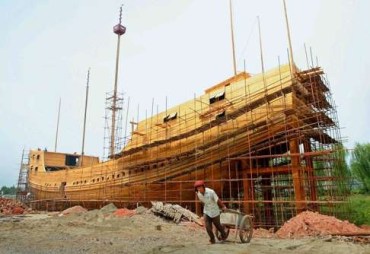
A replica of a ship used by Ming Dynasty eunuch explorer Zheng He, in Nanjing. Photo: Reuters

Xiao was one of the scholars who presented research work on Zheng He at an international symposium in 2005. They painted a vivid picture of the Ming armada, which had all the elements of a multinational enterprise.

The 300 ships – many twice as big as the largest European vessels of the time – were constructed in dry docks in Nanjing ( 南京 ), Jiangsu ( 江蘇 ) province. Building materials were sourced from across the Ming Empire. The 27,000-strong crew included Han Chinese, Muslim Hui, Arabs, Persians, and peoples from Central and East Asia. The lingua franca was Persian or Sogdian – a language used for centuries by merchants of the ancient Silk Road, according to Professor Liu Yingsheng of Nanjing University.

Size was not the only difference between Zheng’s fleet and that of Christopher Columbus 70 years later. The Europeans aboard the Santa Maria were exclusively Catholic – the Ming fleet was culturally and religiously diverse. Zheng was a Muslim but he was fluent in the teachings of Confucius, Buddhism and classic Chinese philosophy. The fleet included many Buddhist missionaries. Many regard his expeditions as the high-water mark of Chinese civilization. The Ming armada’s true greatness lay not in its size or sophistication but in its diversity and tolerance.

A statue of famed Chinese navigator Zheng He overlooks the city of Nanjing, Jiangsu province. Photo: AFP

After the Yongle Emperor’s death, the Ming court lost its global vision. Power was in the hands of the Confucius gentry-class, who jealously guarded against other schools of thoughts. China became increasingly introspective and insulated. The court stopped further expeditions and banned seafaring. The Chinese civilization gradually lost its vigour and started a long decline.

Today as the new “Silk Road” and “soft power” become China’s new catchphrases, it is important to remember what makes the Chinese civilization unique in the first place. Its greatest strength lies in its people’s amazing ability to absorb, adopt and assimilate different cultures.

Buddhism, which originated in India, flourished in China. The Zen school – a hybrid of Indian Buddhism and Chinese Taoism – spread to East Asia by monks in the Tang dynasty and became mainstream. Islam arrived from Central Asia and the Middle East during the Yuan and Ming dynasties. It took root in western China before spreading to Southeast Asia with Zhang’s fleet. We should remember that until 100 years ago, China was not a nation state in the Westphalian sense. Narrow-minded nationalism and xenophobia are the exception rather than the norm of the world’s oldest surviving civilization.

Source: The Chinese admiral who spread Islam across Southeast Asia | South China Morning Post

19/08/2016

The return of the Xia | The Economist

CHINA’S leaders are immensely proud of their country’s ancient origins. President Xi Jinping peppers his speeches with references to China’s “5,000 years of history”. The problem is that archaeological evidence of a political entity in China going back that far is scant.

There is some, including engravings on animal bones, that shows the second dynasty, the Shang, really did control an area in the Yellow river basin about 3,500 years ago. But no such confirmation exists for the legendary first ruling house, the Xia. Even inside China, some historians have long suspected that the country’s founding story—in which Emperor Yu tames flooding on the Yellow river (with the help of a magic black-shelled turtle, pictured), earns for himself the “mandate of heaven” and establishes the first dynasty—was either a Noah’s-Ark flood-myth or perhaps propaganda invented later to justify centralised state power. This month, however, state-controlled media have been crowing over newly published evidence in Science, an American journal, that at least the flooding was real. This, they say, has made it more credible that the Xia was, too. Not everyone is so convinced.

Catastrophic floods leave their mark on soil and rocks. Qinglong Wu of Peking University and others have examined the geology of the upper reaches of the Yellow river. In the journal, they conclude that a vast flood did take place in the right area and not long after the right time for the supposed founding of the Xia. Although their evidence does not prove the existence of an Emperor Yu or of the dynasty he founded, it does provide a historical context in which someone might have gained power with the help of flood-taming exploits.

According to Mr Wu, a vast landslide, probably caused by an earthquake, blocked the course of the Yellow river as it flowed through the Jishi gorge on the edge of the Tibetan plateau. For six to nine months as much as 16 cubic kilometres (3.8 cubic miles) of water built up behind the accidental dam, which, when it finally burst, produced one of the biggest floods ever. At its peak, the authors calculate, the flow was 500 times the normal discharge at Jishi Gorge. Mr Wu reckons the ancient flood could easily have been felt 2,000km downstream in the area of the Yellow river said by Chinese historians to have been the realm of the Xia.

At about this time, either coincidentally or (more probably) because of the flood, the river changed its course, carving out its vast loop across the north China plain. The significance is that, while the river was finding its new course, it would have flooded repeatedly. This is consistent with old folk tales about Emperor Yu taming the river not through one dramatic action, but by decades of dredging.

The ancient flood can be dated because the earthquake that set the catastrophic events in motion also destroyed a settlement in the Jishi gorge. Radiocarbon dating of inhabitants’ bones puts the earthquake at about 1920BC—not 5,000 years ago but close-ish. Xinhua, a state news agency, lauded the study as “important support” for the Xia’s existence. Xu Hong of the Chinese Academy of Social Sciences challenged this, saying the scholars’ findings had not proved their conclusions. The first dynasty has gone from myth to controversy.

Source: The return of the Xia | The Economist

18/08/2016

India ready for Pakistan talks; U.N. alarmed by Kashmir violence | Reuters

India is ready to send its top diplomat to Pakistan for talks focused on fighting cross-border terrorism, sources at foreign ministry said on Wednesday, after a spike in tension in the disputed northernmost region of Kashmir.

Foreign Secretary Subrahmanyam Jaishankar was willing to attend talks on the invitation of his Pakistani counterpart, the sources said, stressing cross-border terrorism was central to the situation in Jammu and Kashmir state.

The olive branch comes after 40 days of violent protests in Indian-ruled Kashmir set off by the killing by security forces of a field commander of Pakistan-based Islamic militant group Hizbul Mujahideen who enjoyed wide support.

At least 64 people have died and thousands injured in clashes with security forces, denounced by Pakistan, which also claims the right to rule Jammu & Kashmir in a territorial dispute that dates back to partition in 1947.

The Indian sources, who declined to be identified, made it clear, however, that India “rejects in their entirety the self-serving allegations regarding the situation in J&K, which is an integral part of India.”Jammu and Kashmir (J&K) is the name of India’s only Muslim-majority state that includes the disputed Kashmir region.

A spokesman for Pakistan’s foreign ministry declined to comment late on Wednesday, saying the government was preparing a response to the proposed Indian visit.

A U.N. human rights official expressed “deep regret” at the failure of both the Indian and Pakistani authorities to grant access to the separate parts of Kashmir that each run to investigate allegations of serious human rights violations.

U.N. High Commissioner for Human Rights Zeid Ra’ad Al Hussein said in a statement issued in Geneva it was unfortunate that sincere attempts by the United Nations to independently assess the facts in relation to reports of human rights violations had failed.

“Without access, we can only fear the worst,” said Zeid.

The nuclear-armed neighbours, which have fought three wars since independence in 1947, both claim Kashmir in full but rule it in part.

In the latest violence on Wednesday, militants killed three members of the security forces when they ambushed an army convoy and then fired on a police jeep that came to the scene.

In a worrying escalation the previous day, security forces fired live rounds at a crowd of stone-throwing protesters in Baramulla district, killing five and wounding 10.

Earlier, police and troops trying to control crowds had resorted to the use of shotguns, whose pellets are meant to incapacitate but not kill.

But residents of Kashmir say the shotguns have inflicted severe injuries and even blinded hundreds of people including bystanders.

Prime Minister Narendra Modi ratcheted up tensions in his annual Independence Day speech on Monday, accusing Pakistan of glorifying terrorism.

In a tit-for-tat escalation in the war of words between the neighbours, Modi said he had received messages of support from leaders in restive regions of Pakistan, in particular the troubled southwestern province of Baluchistan.

India accuses Muslim Pakistan of supporting Kashmiri fighters while Pakistan accuses India of meddling in Pakistani trouble spots, in particular of helping separatists fighting the Pakistani state in resource-rich Baluchistan.

Both sides deny the accusations.

Source: India ready for Pakistan talks; U.N. alarmed by Kashmir violence | Reuters

06/08/2016

Science and History Align to Hint at China’s Founding Legend – China Real Time Report – WSJ

Like Noah and his animal-laden ark, China has its own creation legends. Thousands of years ago, one story goes, a man named Yu tamed the country’s terrible flooding with the assistance of a dragon and was ultimately named emperor.

Now the authors of a new paper published in the U.S. journal Science say they’ve found evidence of an ancient, cataclysmic flood that helps to underpin at least part of that legend. In a bigger leap, they also say their research helps offer evidence for the existence of what some describe as China’s first dynasty, the Xia, long seen in some quarters as a myth.

The team found that a massive flood took place around 1920 B.C., a time that coincides with when many scholars believe the Xia dynasty first emerged. The flood finding is notable, they say, because annals that mention the Xia dynasty say that Yu went on to found the dynasty and become its emperor after successfully dispelling flooding along the Yellow River.

“Many foreigners haven’t heard of the Xia dynasty or don’t believe it existed,” says Wu Qinglong, who led the team’s work during a recent post-doctorate stint at Peking University. “But in China, it’s different, this is a story passed down by tradition.

”According to their findings, an earthquake triggered a landslide that in turn swallowed up a large gorge located in Qinghai province traversed by the Yellow River. That landslide created a “huge cork” and a natural dam 200 meters tall that caused water to build up for six to nine months before breaking free, causing some 16 cubic kilometers of water to surge forth, says David Cohen, assistant professor in anthropology at National Taiwan University and a co-author on the paper.

The precise date determined by researchers was derived from the analysis of findings at a village downstream from the dam destroyed by the earthquake. A test of bones of children killed in the quake found they died around 1920 B.C. The presence of sediment from the flood found in fissures caused by the quake helped establish the flood’s timing, Mr. Cohen said.

Still, scholars caution against too hastily connecting the dots between the existence of a flood, however sizable, and that of the Xia. James T. Williams, an assistant professor at Renmin University who studies the economy of Bronze Age societies in China, notes that written records invoking the Xia dynasty weren’t produced until hundreds of years later. While the flood evidence may be persuasive, he notes, “a one-to-one correlation” with the existence of the Xia is a harder case to make.Mr. Cohen acknowledges such skepticism. “A number of assumptions have to be made,” he says. “First, you have to accept that there was a Xia dynasty, and you have to accept that its founding was somehow related to a massive flood of the Yellow River.”

But for China, he says, “It’s a story of the foundation of civilization and how it came into being.

”Flooding remains a massive problem in China, with torrential rains leading to widespread urban flooding that has killed hundreds this year.

For its lead author, producing the report wasn’t easy. After completing his post-doctorate and leaving Peking University in 2012, Mr. Wu spent several years unemployed as he sought to complete his research. At times, he relied on loans from friends, he said. In Beijing, he lived in various subdivided apartments, including a three-room place shared among 10 for which he paid 600 yuan ($90) a month.

Still, he says he is gratified by his team’s findings. “We’ve found existence of a big flood. We think it’s very possible it’s the one from our legends and it helps support the history of the Xia dynasty,” he says. “The evidence supports the veracity of it all.”

Source: Science and History Align to Hint at China’s Founding Legend – China Real Time Report – WSJ

05/08/2016

Yellow River yields clues to Chinese legend of ancient ‘Great Flood’ | Reuters

A view of the Yellow river near the Lajia site, hit by a flood 4,000 years ago, in Qinghai province, China in this undated handout photo. Wu Qinglong/Science/Handout via REUTERS

The crushed skeletons of children point to an earthquake and catastrophic flood on China’s Yellow River 4,000 years ago that could be the source of a legendary “Great Flood” at the dawn of Chinese civilization, scientists say.

A Chinese-led team found remnants of a vast landslide, caused by an earthquake, big enough to block the Yellow River in what is now Qinghai province near Tibet.

Ancient sediments indicated that the pent-up river formed a vast lake over several months that eventually breached the dam, unleashing a cataclysm powerful enough to flood land 2,000 km (1,200 miles) downstream, the scientists wrote in the journal Science.

The authors put the Yellow River flood at around 1920 BC by carbon-dating the skeletons of children in a group of 14 victims found crushed downstream, apparently when their home collapsed in the earthquake. Deep cracks in the ground opened by the quake were filled by mud typical of a flood and indicated that it struck less than a year after the quake.

The flood on Asia’s third-longest river would have been among the worst anywhere in the world in the last 10,000 years and matches tales of a “Great Flood” that marks the start of Chinese civilization with the Xia dynasty.

“No scientific evidence has been discovered before” for the legendary flood, lead author Wu Qinglong of Nanjing Normal University told a telephone news conference.

In traditional histories, a hero called Yu eventually tamed the waters by dredging, “earning him the divine mandate to establish the Xia dynasty, the first in Chinese history,” the scientists wrote.

Their finds around the Jishi Gorge from about 1900 B.C. would place the start of the Xia dynasty several centuries later than traditionally thought, around the time of a shift to the Bronze Age from the Stone Age along the Yellow River.

Some historians doubt the Xia dynasty existed, reckoning it part of myth-making centuries later to prop up imperial rule. Written records date only from 450 BC.

The evidence of a massive flood in line with the legend “provides us with a tantalizing hint that the Xia dynasty might really have existed,” said David Cohen of National Taiwan University, one of the authors.

Deluges feature in many traditions, from Hindu texts to the Biblical story of Noah. In pre-history, floods were probably frequent as ice sheets melted after the last Ice Age ended about 10,000 years ago, raising world sea levels.

Source: Yellow River yields clues to Chinese legend of ancient ‘Great Flood’ | Reuters

29/07/2016

Why India Is Spending $1 Billion on Boeing Jets – The Short Answer – WSJ

India is beefing up its maritime patrol and anti-submarine warfare capabilities with an order for four Boeing Co.-made P-8I aircraft.

The order is the latest evidence of booming defense ties between India and the U.S. The South Asian nation’s arms imports from the U.S. in the five years through 2015 were 11 times the amount in the previous five years, according to the Stockholm International Peace Research Institute.

India imported 14% of its weapons from the U.S. in the same period, although its longstanding supplier Russia continued to dominate its defense market with a 70% share, according to the think tank.

India spent how much?

India will pay about $1 billion for the four P-8I planes. That is about half the amount the country spent in 2009 for eight of the aircraft. That order had an option for India to acquire four more jets at the 2009 price, something it is exercising now.

What can the planes do?

The P-8I—a military variant of Boeing 737-800 commercial jetliner—is fitted with state-of-the-art sensors and radars for maritime surveillance and reconnaissance, and to snoop on submarines. It can also be fitted with the Harpoon all-weather anti-ship missiles made by Boeing.

The aircraft–a variant of the U.S. navy’s P-8A Poseidon plane–can also be used for anti-piracy and other intelligence operations. It was deployed in 2014 when India joined the multinational search for the missing Malaysia Airlines Flight 370. It is currently being used in the search for an Indian air force AN-32 aircraft that went missing on Friday over the Bay of Bengal.

Why does India want the jets?

The latest acquisition of the P-8I is a milestone in India’s strategy to replace its aging equipment, much of which was bought from Russia during the Soviet era. The twin-engine jet has a range of about 2,222 kilometers, or more than 1,200 nautical miles, which allows the Indian navy to monitor the country’s vast coastline.

Has this got anything to do with China?

India’s expansion of the P-8I fleet comes as China increases its naval presence in the Indian Ocean, alarming New Delhi.

In recent years, China has been improving its submarine power with a nuclear-powered sub travelling all the way to the Persian Gulf via Sri Lanka. China and India are also locked in a long-running land-border dispute.

The new planes will bolster India’s capabilities to keep an eye on movement on Chinese warships and submarines in the region.

What else is on the shopping list?

India’s government, led by Prime Minister Narendra Modi, has promised to upgrade the country’s military capabilities. But a long-delayed deal to buy 36 Rafale fighter jets from Dassault Aviation S.A. of France is still being negotiated–more than a year after it was announced.

India also has plans to buy howitzers, warships, submarines, as well as to acquire fighter jets.

Source: Why India Is Spending $1 Billion on Boeing Jets – The Short Answer – WSJ

25/07/2016

India urges security forces to exercise restraint in Kashmir | Reuters

India has asked its security forces to exercise restraint in responding to protests in disputed Kashmir and replace pellet guns with non-lethal weapons, its home affairs minister said on Sunday.

Forty six people have been killed and more than 5,000 wounded, including security forces, since protests erupted after the killing of Hizbul Mujahideen commander Burhan Wani on July 8.

Normal life remains paralysed because of the curfew imposed by the government and calls for a shutdown by separatist leaders.

“I appeal to the youth not to resort to stone pelting and I also want to appeal to the security forces not to use pellets. I have told security forces to use maximum possible restraint,” Rajnath Singh said, winding up his two-day visit to Kashmir.

Kashmir has been at the centre of a tussle between New Delhi and Islamabad for decades, as both claim the region in full but rule it in part.

“We don’t need the involvement of a third party to address the situation in Jammu and Kashmir. I want to tell my neighbour that you are yourself a victim of terrorism,” said Singh.

Since they split some 67 years ago, India and Pakistan have fought each other in three wars, two over Kashmir. There has not been a full-blown war since they both tested nuclear weapons in 1998.

Singh on Thursday told lawmakers that India would set up a panel to look for an alternative to pellet guns.More than 300 people have suffered because of pellet guns, including 171 with eye injuries, Kaisar Ahmad, principal of the Government Medical College in Srinagar, told Reuters.

Source: India urges security forces to exercise restraint in Kashmir | Reuters

Law of Unintended Consequences

continuously updated blog about China & India

ChiaHou's Book Reviews

continuously updated blog about China & India

What's wrong with the world; and its economy

continuously updated blog about China & India