Chindia Alert: You’ll be Living in their World Very Soon
aims to alert you to the threats and opportunities that China and India present. China and India require serious attention; case of ‘hidden dragon and crouching tiger’.
Without this attention, governments, businesses and, indeed, individuals may find themselves at a great disadvantage sooner rather than later.
The POSTs (front webpages) are mainly 'cuttings' from reliable sources, updated continuously.
The PAGEs (see Tabs, above) attempt to make the information more meaningful by putting some structure to the information we have researched and assembled since 2006.
Prime Minister Narendra Modi addresses Pravasi Bhartiya representatives at Pravasi Bhartiya Kendra in New Delhi on February 23, 2019. (Photo: IANS/PIB)
Prime Minister Narendra Modi will be paying a visit to the ongoing Kumbh Mela at Prayagraj on Sunday where he will take a holy dip at the Triveni Sangam, the confluence of rivers Ganga, Yamuna, and the mythical Saraswati, considered the centre of the earth according to Hindu scriptures.
At Prayagraj, PM Modi will participate in the Swachh Kumbh Swachh Aabhaar event and interact with the “Safai Karmacharis”.
He will later address a gathering and distribute the Swachh Kumbh Swachh Aabhaar awards to safai karmacharis, swachhagrahis, police personnel, and naviks.
The Swachh Kumbh Swachh Aabhaar event is being organized by the Ministry of Drinking Water & Sanitation.
The Kumbh Mela commenced on January 15 (Makar Sankranti) and will conclude on March 4 (Mahashivratri).
Over a period of 49 days of the mega celebration, more than 22 crore devotees have visited the Kumbh Mela.
On Friday, Minister of State for External Affairs General VK Singh led a delegation of around 200 delegates of more than 185 countries to the Kumbh Mela 2019. The foreign representatives took a holy bath at Sangam and witnessed cultural programmes at Sanskriti Gram.
Singh told reporters that the idea behind the visit was to make “them see that Kumbh is not just confluence of rivers but also of different religions and faiths”.
Earlier on Saturday, PM Modi interacted with foreign delegates from 185 countries at Pravasi Bharatiya Kendra in New Delhi where he said that there is a huge potential for tourism in the country.
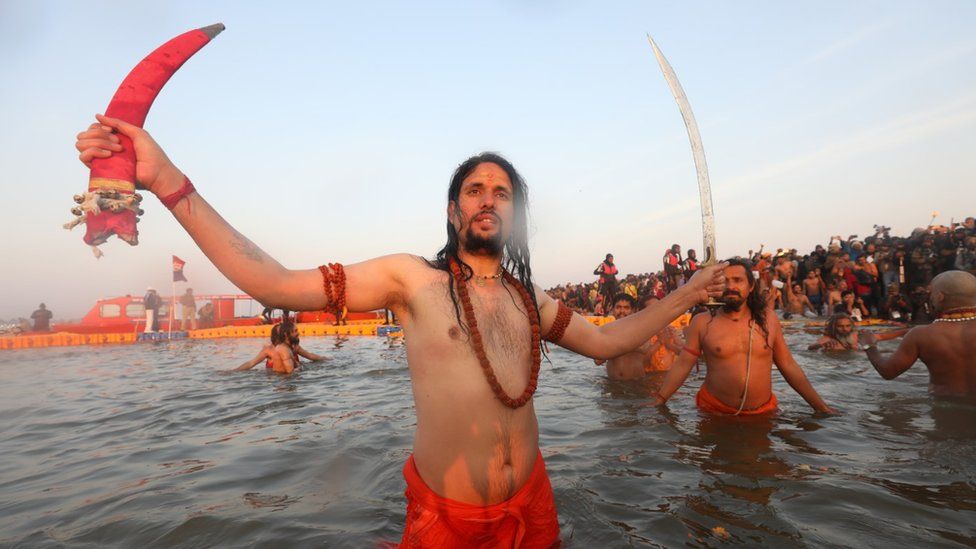
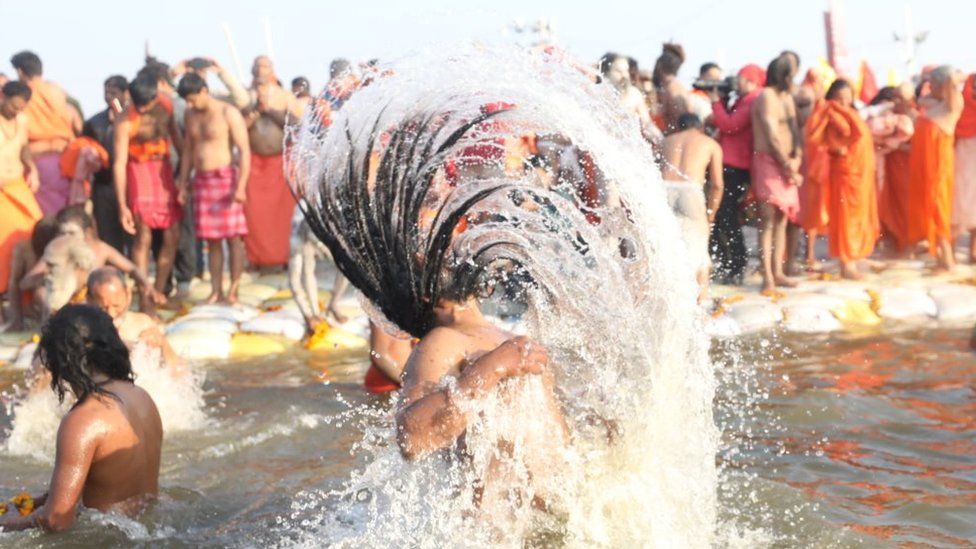
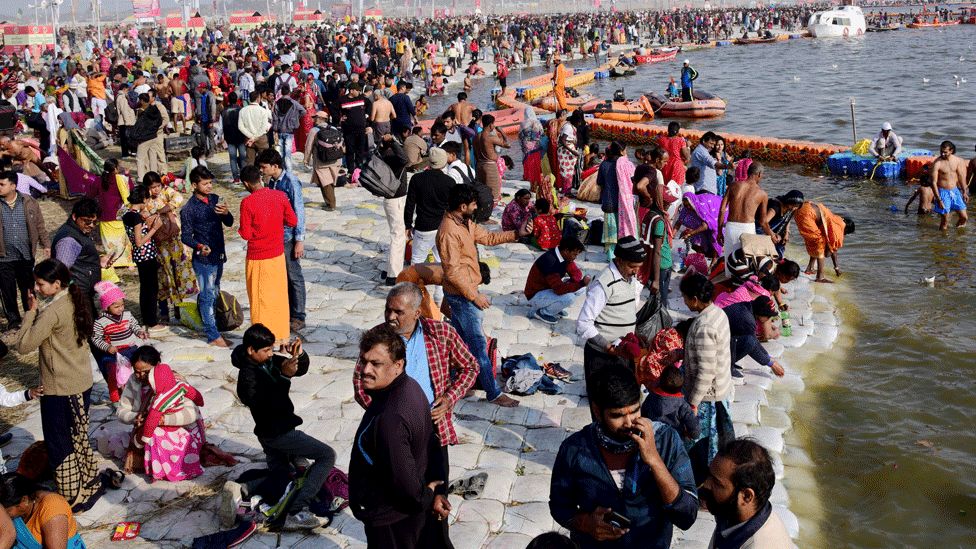
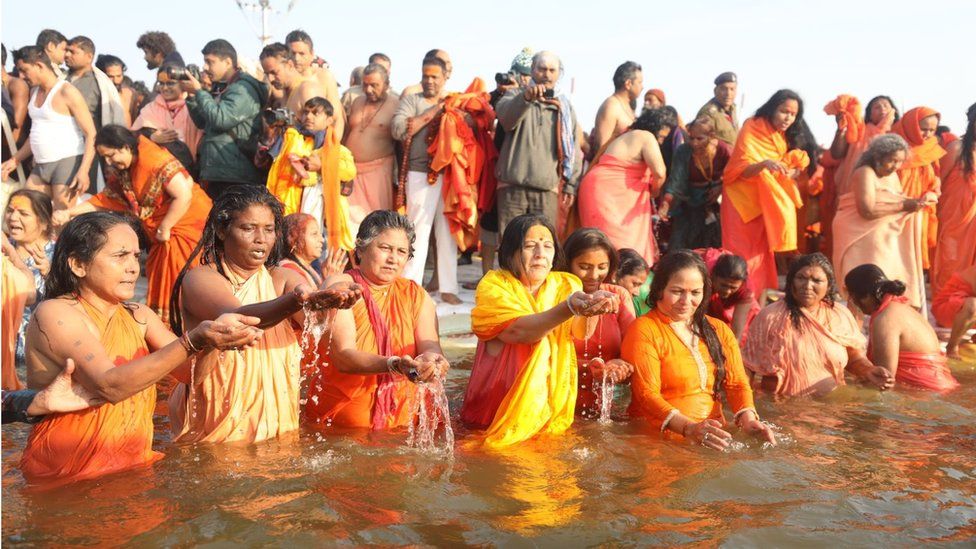
Millions of people have taken to the waters at the confluence of India’s sacred Ganges and Yamuna rivers at the Kumbh Mela festival – humanity’s largest gathering.
At least 15m people are expected on the first day alone. Officials project about 120m visitors over 49 days.
Hindus believe bathing at the rivers will cleanse their sins and bring salvation.
The holy men were among the first procession to arrive early Tuesday.
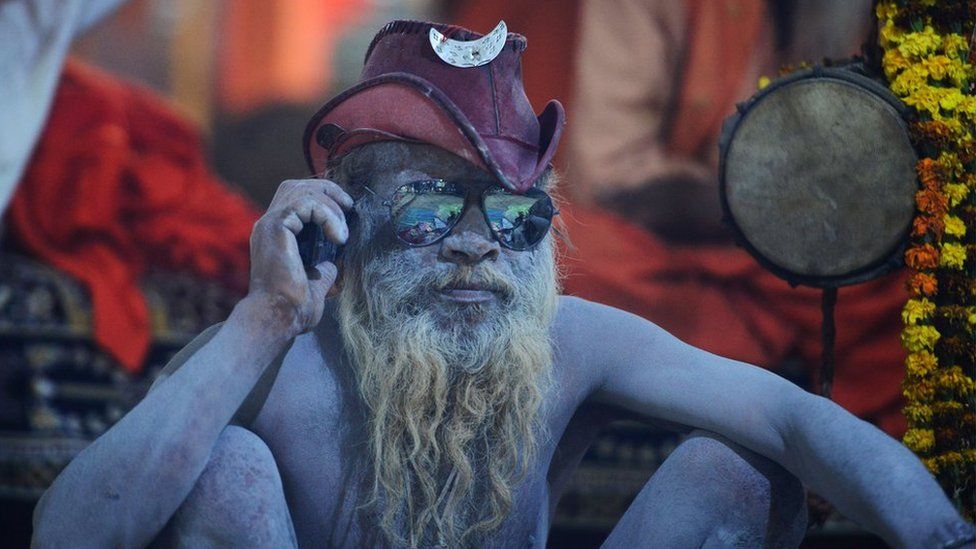
Sadhus – or ascetics – smeared ash on their bodies as they came out of the water and chanted “Har Har Gange”, or “Mother Ganges”, and danced while posing for photographers.
Image copyrightANKIT SRINIVAS
The Naga sadhus are the biggest draw of the festival – held in the northern city of Allahabad, recently renamed Prayagraj – and can be counted on to arrive in massive colourful processions.
At the last Kumbh in 2013, female ascetics were allowed to bathe at the confluence of the rivers – known as the Sangam – for the first time. A few hundred transgender people already bathed on Tuesday morning.
More than a million foreign pilgrims will also take part in the festival, senior administration official Rajeev Rai told the BBC.
He and other organisers have been preparing for more than a year for the event, which dwarfs the annual Hajj pilgrimage to Islam’s holiest sites in Saudi Arabia.
“Last minute preparations are on. All the religious sects have been allocated time for their processions and bathing rituals,” Mr Rai said. “We have devised a traffic plan to ensure there’s no overcrowding. The mela area is open only to pedestrians,”
The mela (meaning “fair” in Hindi) has been held in Allahabad for centuries now, but it has grown into a mega event in the past two decades.
Image copyrightGETTY IMAGES
This year the gathering will be particularly huge and many believe India’s Hindu nationalist government has organised it with an eye on key general elections due in the summer.
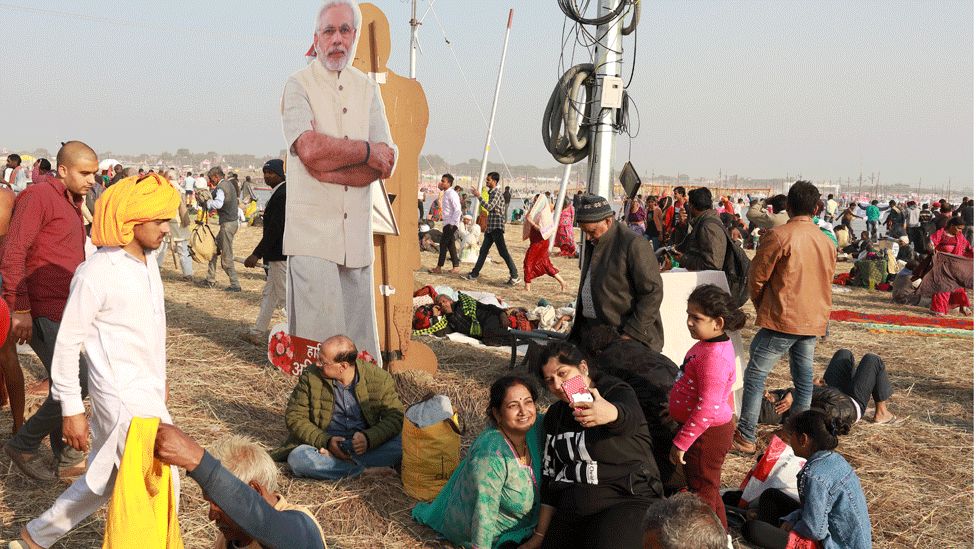
Massive billboards of Prime Minister Narendra Modi dot Allahabad city and the mela ground. Huge cardboard cut-outs have been placed strategically at the bathing areas.
Image copyrightANKIT SRINIVAS
A temporary tent city, spread over 32 sq km (12 sq miles) has been set up to accommodate the masses, complete with hundreds of kilometres of new roads. Hospitals, banks and fire services have been set up just for the festival, along with 120,000 toilets.
Hundreds of new train services are running to and from Allahabad to tackle the rush of pilgrims and more than 30,000 police and paramilitaries have been deployed to provide security and manage the crowds.
In the run up to the festival, religious sects have held daily processions marked by much pomp and show.
Image copyrightANKIT SRINIVAS
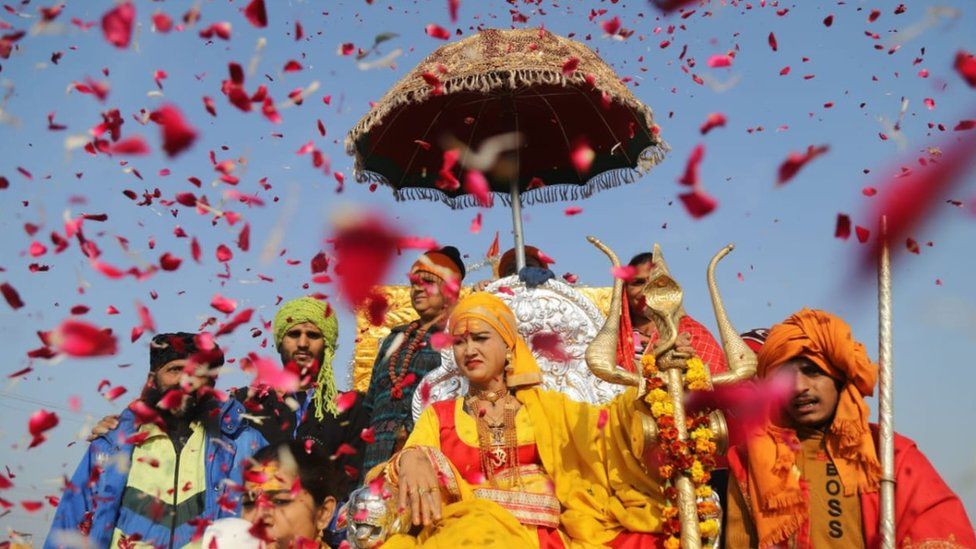
At one such procession on Sunday night, there were elephants, camels and horses. Brass bands and drummers played, as religious leaders sitting atop several vehicles threw marigold flowers to thousands of devotees.
On Monday – a day before the official start of the festival – tens of thousands of pilgrims bathed at the Sangam. Some then lit clay lamps and floated them along with flowers in the Ganges.
The atmosphere at the mela is festive, and the authorities have announced a calendar of music and dance performances. But there’s plenty of impromptu entertainment taking place by the roadside, with children performing rope tricks and shows by drummers and ballad singers.
Most pilgrims, however, say they are here to “answer the call of Mother Ganges”.
“We believe that bathing here will destroy our sins,” farmer Pramod Sharma said.
“The waters here have regenerative properties. Bathing here can cure your ailments. It also removes obstacles from your way,” Shahbji Raja said.




 CHINDIA ALERT: You'll be living in their world, very soon