Archive for ‘Hong Kong University of Science and Technology’

05/04/2020

Coronavirus: from China to the US, consumer behaviour radically altered as world retreats into ‘survival mode’

  • The coronavirus pandemic has completely changed patterns of consumer psychology across the world, experts say
  • Complexity of the crisis, the number of variables and its magnitude make a consumer recovery unprecedented and difficult to predict
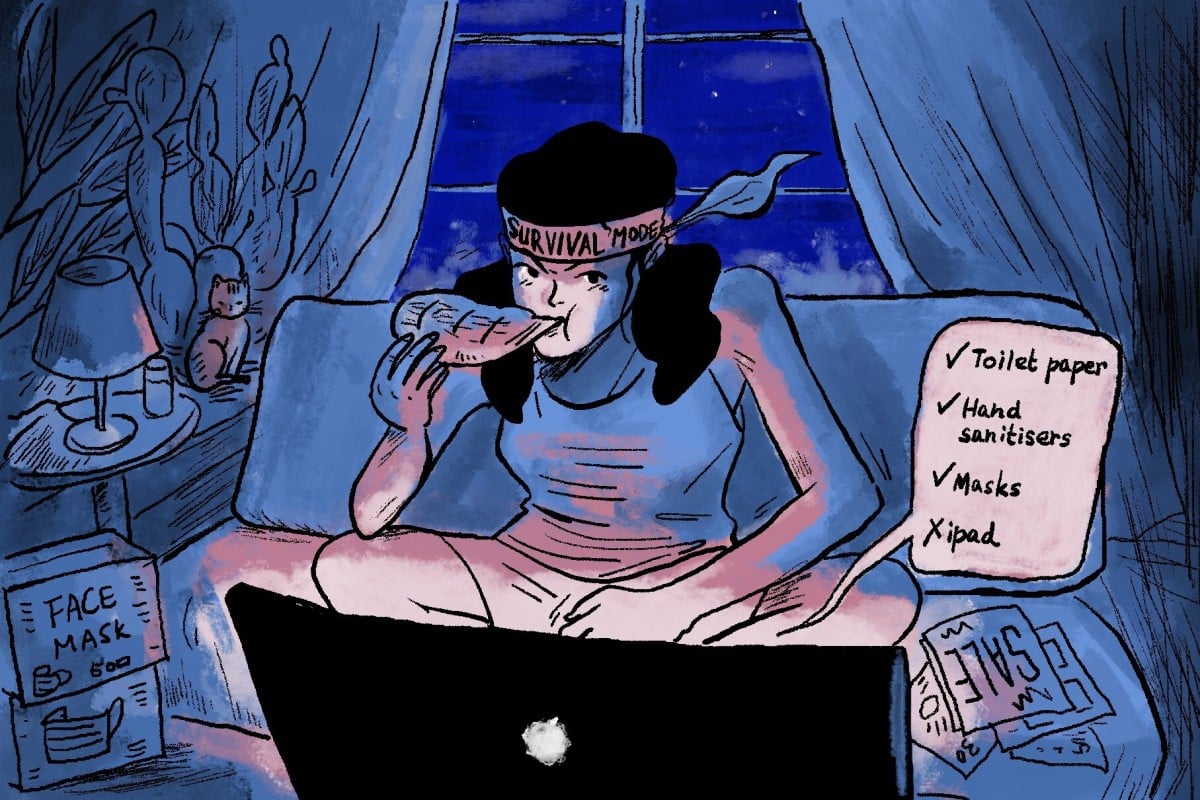
The coronavirus has caused panic buying around the world as consumers frantically stockpile of goods such as toilet paper, hand sanitisers and masks. Illustration: Brian Wang

Before the coronavirus crisis began rippling through the global economy, Susan Wang had big plans for 2020.

Not only was she going to buy a new Apple MacBook and iPad, plus a projector so she could host friends for movies at home, but she was set on making a career move.

“I was planning to change my job, but my headhunter told me that all recruitment has been postponed to the second quarter,” said the 27-year-old who works for a British company in Hong Kong.

“Our headquarters in London has a plan for redundancy, too. It is better to save some money in case I get laid off.”

As Covid-19 spreads across the world, sending stock markets reeling and prompting big companies to slash jobs, Wang has become increasingly frugal like scores of other consumers from China to the United States.

She has stopped eating at restaurants and now tries to keep her weekly food bill under HK$500 (US$64), whereas in the past she wouldn’t think twice about spending HK$100 per meal.

Amid mounting uncertainty, the coronavirus pandemic – which has claimed the lives of more than 41,000 people and infected at least 842,000 worldwide – is fundamentally changing consumer behaviour in Asia, Europe and North America.

Consumer experts said the 2009 global financial crisis, the Great Depression that started in 1929 and the September 11 terrorist attacks give some clues about how and when global consumption might recover. But the complexity of this crisis, the number of variables and its magnitude make this consumer recovery unprecedented and difficult to predict, they added.

Coronavirus: What impact will the economic fallout from the Covid-19 pandemic have on you?
“The coronavirus pandemic has completely changed patterns of consumer behaviour all over the world. People are afraid, and when people are afraid, they go into survival mode,” said Jesse Garcia, a Los Angeles-based consumer psychologist, who is also the CEO of market consulting firm My Marketing Auditors.
Hong Kong’s retail sales

plummeted a record 44 per cent in February and those figures are only expected to get worse, with sales forecast to slump between 30 and 40 per cent in the first half of the year, according to the Hong Kong Retail Management Association.

In the US, retail sales dropped by 0.5 per cent in February, even before many states had issued stay-at-home orders to protect the world’s largest economy. The decline was the biggest fall since December 2018.

Experts say non-essential products and services are set to be worst affected by the coronavirus pandemic, while goods and services that can be consumed at home will see a spike in sales.

The coronavirus pandemic has completely changed patterns of consumer behaviour all over the world. People are afraid, and when people are afraid, they go into survival mode – Jesse Garcia

“Online consumer behaviour is frenetic,” said Ross Steinman, a professor of psychology at Widener University in the US state of Pennsylvania. “Consumers are refreshing and refreshing and refreshing websites to secure grocery delivery times, purchase paper towels from their usual big box retailer and scavenge for rice and canned soup from third party sellers on Amazon.

“A pronounced spike in coronavirus cases will only amplify the freneticism.”

So far, one of the biggest shortages for consumers is toilet paper. Television stations across the globe have beamed images of empty supermarket shelves and huge queues as people hoard toilet paper rolls, masks and hand sanitiser.
The frantic stockpiling can be explained by a psychological concept called informational conformity, said Vicki Yeung, associate professor at the Department of Applied Psychology at Lingnan University in Hong Kong.

A pronounced spike in coronavirus cases will only amplify the freneticism – Ross Steinman

“When people lack knowledge and are in an uncertain situation, they tend to follow the group’s behaviour and blindly conform, but once they obtain more information, and digest and process the situation, the panic gradually fades away,” she said.
“During this Covid-19 pandemic, people generally feel jittery and anxious because they feel their sense of control has disappeared.”
Unlike other recent global crises such as the September 11 attacks, the coronavirus is less a one-time sharp shock to the system and more of a rolling source of anxiety that could retreat and resurface repeatedly, consumer behaviour experts said.
This was the pattern with the Black Death plague that hit Europe in 1347 and returned episodically over many years, ultimately killing millions of people.

During this Covid-19 pandemic, people generally feel jittery and anxious because they feel their sense of control has disappeared – Vicki Yeung

“It may be we’ll have to shut down things again in October or August. And this could go on for years,” said Charley Ballard, an economist with Michigan State University in the US. “The more that happens, the more damage it does to buoyant consumer psychology.”

Furthermore, relative to the 2009 financial crisis and even the Great Depression, when much of the damage was concentrated at least initially in the financial sector, this crisis has seen virtually the entire economy grind to a halt all at the same time, devastating employment and consumption.

Last week, a record 3.3 million Americans applied for unemployment benefits within one week, as restaurants, hotels, barber shops, gyms and retail outlets shut down in a nationwide bid to stem the pandemic. The previous record of 695,000 was set in 1982.

On Tuesday, Goldman Sachs predicted the US jobless rate will hit 15 per cent in the second quarter of this year from the coronavirus economic freeze, and could rise further beyond that to near the historic peak of 24.9 per cent seen in 1933 during the Great Depression. Economists at the St. Louis district of the US Federal Reserve projected unemployment could cost as many as 47 million jobs in the US this year, sending the unemployment rate past 32 per cent before making a sharp recovery.

US now has world’s most coronavirus cases, surpassing China
China’s unemployment rate jumped to 6.2 per cent for January and February from 5.2 per cent in December and 5.3 per cent a year earlier. It was the highest level since records began in 2016, but did not include China’s estimated 291 million migrant workers.
Consumer spending accounts for more than 60 per cent of the Chinese economy and drives 70 per cent of the US economy. But with the pandemic causing many people to go into hibernation and likely to lead to cycles of job cuts, economists have predicted a consumer-led global recession by the second quarter of this year.
Just how long it will take for consumer behaviour to return to normal depends on each person’s psychological resilience, including how quickly they can adapt to change, how optimistic they are and whether they can adopt strategies to regain a sense of control, Yeung said.
Anirban Mukhopadhyay, chair professor of marketing at  Hong Kong University of Science and Technology said as long as the coronavirus threat was still present, people would remain fearful to some extent. But he added that people were resilient.
Satellite images show world sites deserted amid coronavirus pandemic
“Human beings adapt to events and stimuli over time,” Mukhopadhyay said. “Research has shown that even people who win lotteries tend to return to their earlier levels of life satisfaction after some months, as do people who have to have amputations.
“So even if the source of the fear does not go away, we learn to live with it.”

Ballard, from Michigan State University, estimated it could take upwards of two years for American consumers to feel secure enough in their jobs and gain enough confidence to fully open their wallets. A longer and more episodic duration for the disease could push that higher, he added.

Further complicating the consumer picture, he said, is that many supply chains are at risk of breaking. And consumers will be wary of spending for a while in many traditional areas, including crowded sporting events and concerts, restaurants and flights.
A new phase of coronavirus blame game: what is the legacy of Covid-19 on global supply chains?
Some experts have even suggested that consumer behaviour may be permanently changed as a result of the pandemic.
“It seems very unlikely that people will get back to life as it was before, once the coronavirus is over,” said Andreas Kappes, a lecturer in psychology at City University of London.
“People’s behaviour is extremely orthodox, often referred to as the status quo bias and captured in expressions like ‘past behaviour best predicts future behaviour.’ Now, the crisis forces us to change our behaviour, radically, and we might discover that new way suits us better.”
Source: SCMP
28/03/2020

Why China’s digital divide, exposed by coronavirus crisis, is not going away any time soon

  • Mainland China’s coronavirus outbreak exposed a huge digital divide, with some students from poorer regions lacking resources for online learning
  • Access to the internet is not considered a daily necessity at China’s policy level, unlike in European countries such as Norway and Iceland
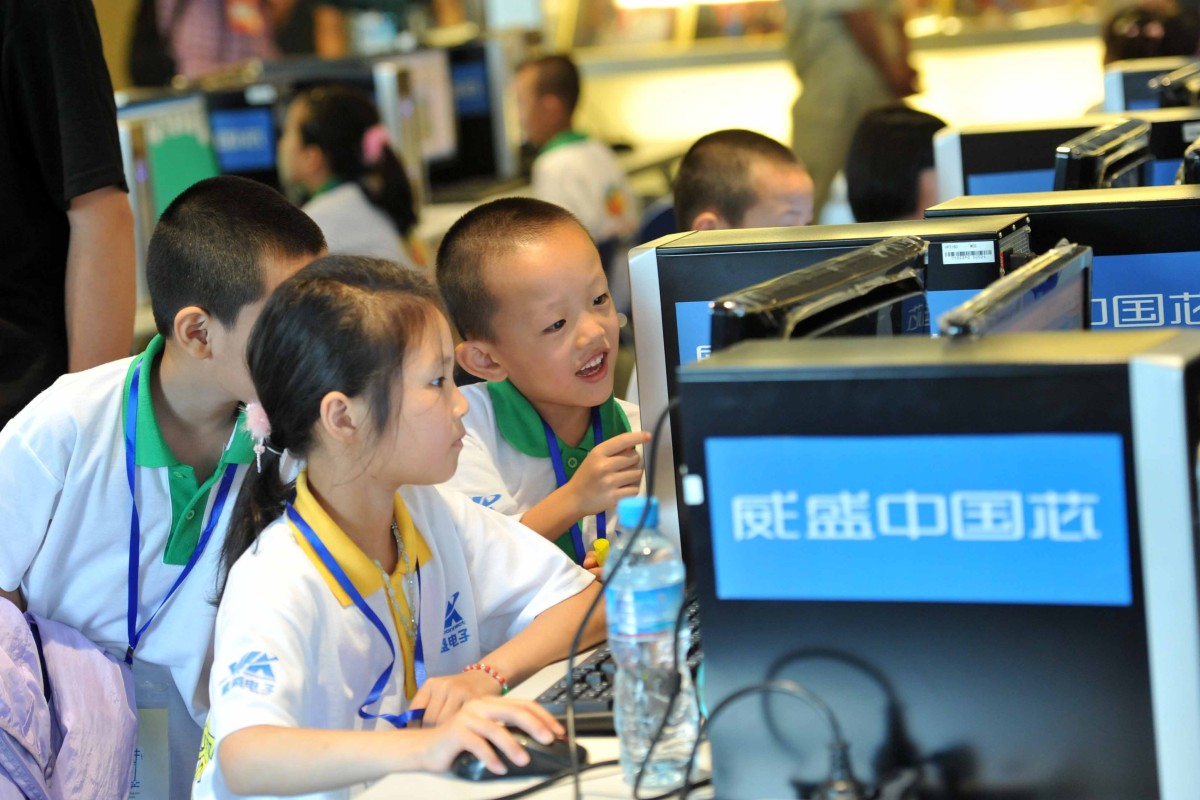
Chinese children attend a computer class in Beijing to learn how to properly use the internet. Those in poorer parts of the country lack sufficient access to the internet, as the switch to online teaching during the coronavirus outbreak in China showed. Photo: AFP

The coronavirus outbreak in mainland China highlighted the huge digital divide that exists between richer and poorer regions.

When schools shut and online learning was made compulsory, many students living in remote areas found they didn’t have sufficient internet access.

There were 1.6 billion mobile phone subscribers in China in 2019, with many people having more than one subscription, and optical fibre and 4G covered 98 per cent of the population, according to official data.

These figures fail to show the large regional disparity between the country’s rich and poor provinces, says Jack Chan Wing-kit, associate professor of the school of government at Sun Yat-sen University in Guangzhou province.

“In poor areas, a family [often] has to share one mobile phone among all members,” says Chan, who has done extensive research on China’s social problems.

It is easier for service providers to offer blanket coverage in densely populated cities where most people live in high-rise buildings, Chan explains.

“In rural areas, people live in bungalows that are widely spread out. It is not economically efficient for phone service providers like China Mobile to install transmission stations there, which explain their spotty coverage,” he says.

While the universal social security net in China covers people including the old and disabled, access to the internet is not considered a daily necessity at the policy level. That’s unlike European countries such as Norway and Iceland, who see the internet as a basic human right and ensure their entire populations have proper access to it.

Though some wealthier coastal cities within the Pearl River Delta recently conducted local surveys to identify less-well-off households and handed out tablet computers, inland provinces in central and western China cannot afford these measures, Chan says.

The Chinese government does not encourage [the setting up of] charities – Erwin Huang, founder of WebOrganic and EdFuture

Philanthropic efforts could help address this problem, as shown by Hong Kong’s experience in tackling the digital divide.

About 900,000 kindergarten, primary and secondary students in the city have been affected by school suspensions that are likely to last until at least April 20.

While families of disadvantaged students have received support from the government through Comprehensive Social Security Assistance and other welfare schemes, many children still lack digital resources as their parents don’t see it as a priority, says Erwin Huang, founder of both WebOrganic, a charity promoting computer access to such youngsters, and education alliance EdFuture.

That has left it up to charities to make sure all students have enough resources at home for online learning, Huang says. For instance, this month EdFuture worked with local mobile service provider SmarTone to give out free phone data SIM cards lasting two months to 10,000 students.

“It’s for those who live in subdivided flats and those who have to go to McDonald’s for Wi-fi access,” says Huang, who is also associate professor of engineering at the Hong Kong University of Science and Technology.

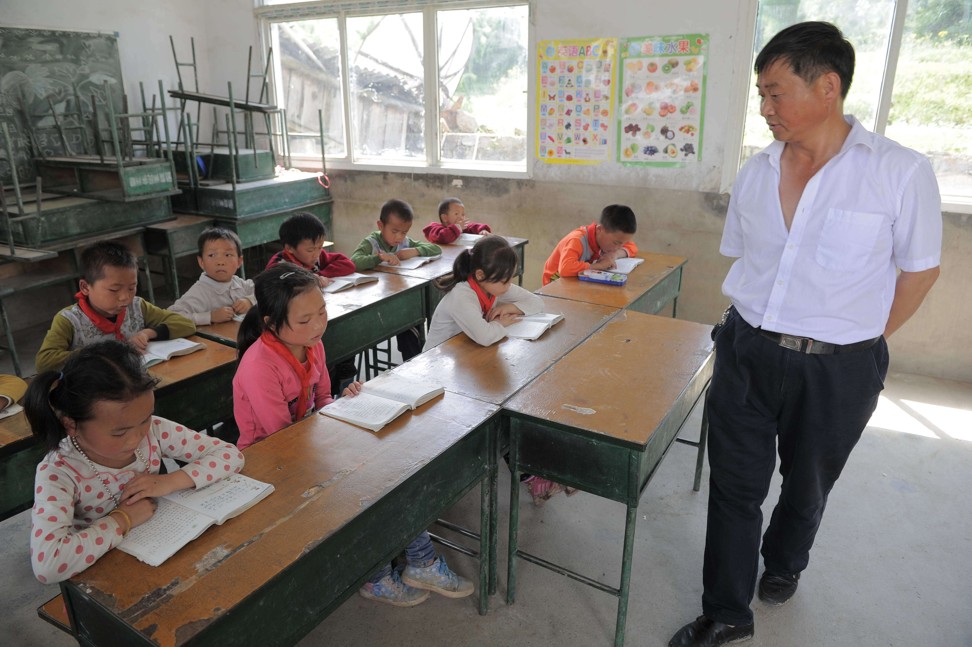
Many students in China’s poorer regions have been left at a disadvantage by the shift to online learning. Photo: Getty Images
The Hong Kong Jockey Club also recently launched a HK$42 million (US$5.4 million) scheme to provide free mobile internet data to 100,000 underprivileged primary- and secondary-school students to help with online learning while schools are closed.

Huang says while such charities help fill gaps in the provision of digital resources in Hong Kong, a similar philanthropic culture is lacking in China.

“The Chinese government does not encourage [the setting up of] charities,” he says.

Huang initiated several digital resources projects in China after the Sichuan earthquake in 2008, but says frequent media reports of scandals involving charities such as China’s Red Cross have made it harder for NGOs to operate in the country, with the government preferring to provide social services through its own departments.

Source: SCMP

02/11/2019

China’s Nobel ambitions on show as dozens of science laureates meet in Shanghai

  • Chinese academics and young scientists join global scientific elite to explore frontiers of research
  • International joint laboratory announced at Shanghai forum
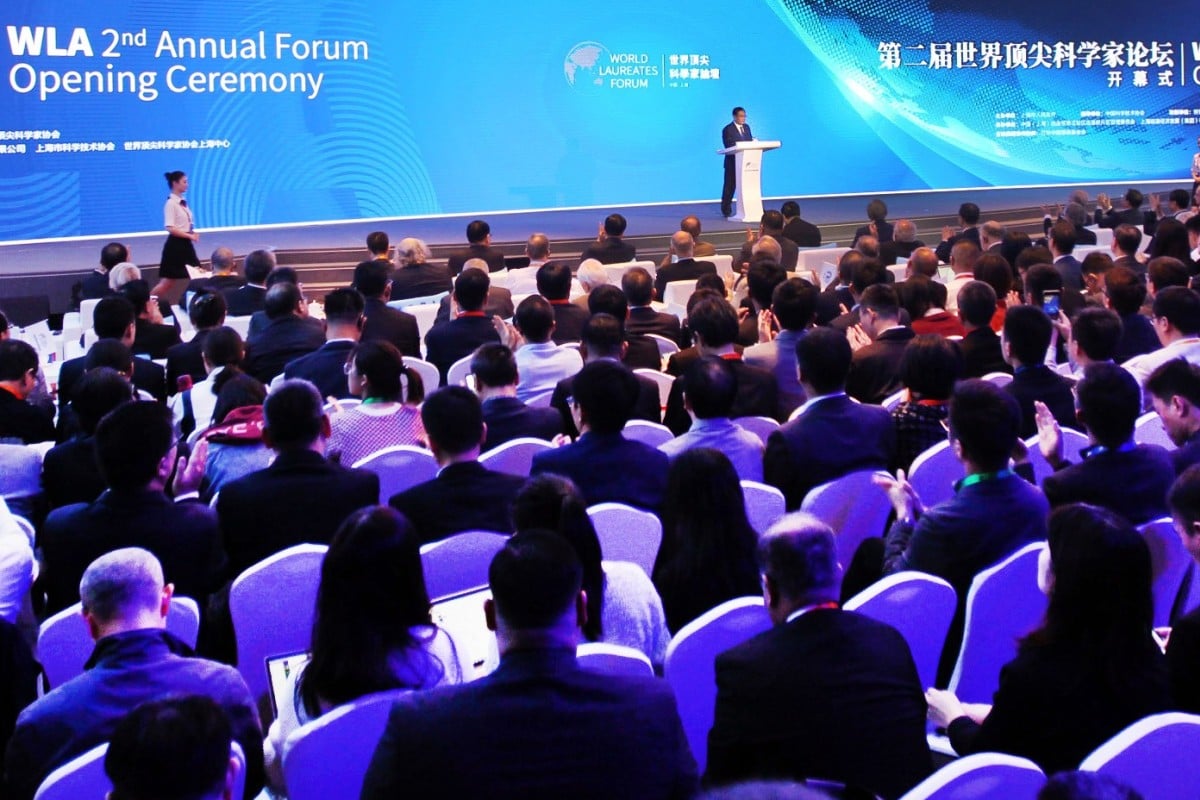
More than three dozen Nobel Prize winners for science were among the gathering in Shanghai for the second annual forum of the World Laureates Association. Photo: Xinhua

Shanghai hosted one of the largest gatherings of Nobel laureates in the world last week, with 44 Nobel Prize-winning scientists in the city for a government-sponsored forum with the lofty goal of discussing science and technology for the “common destiny of mankind”.

The four-day forum, which brought together young Chinese scientists and the cream of the international scientific crop, was a signal of China’s ambitions for its own researchers to take their place at the forefront of development and bring home their own prizes.

Experts agreed the event – the second in an annual “World Laureates Forum” – was hardly a public relations stunt, but a testament to China’s deep-seated, steadfast desire to learn from the world’s top scientists and join them, and their home countries, as leaders on the frontier of science and produce regular home-grown contenders for top prizes.

“The Nobel Prize is the holy grail for China, and it is still quite elusive for Chinese indigenous scientists to be awarded this prestigious recognition,” said Chengxin Pan, an associate professor of international relations at Australia’s Deakin University. “You could say China has a Nobel Prize complex.”

China says US tech ban is a barrier but will not halt scientific advance
Becoming a leader in the sciences was more than just an issue of driving economic expansion through technology and innovation, it was a matter of national preservation with deep roots in Chinese history, Pan said.

“China sees the lack of power, lack of scientific achievements and modern technology as largely responsible for the backwardness and humiliation it suffered during much of the 19th century and early 20th century,” he said.

“They need to make up for lagging behind by engaging with the top leading scientists in the world, wherever they are from.”

To that end, celebrated theoretical physicists, organic chemists, neuroscientists and biologists joined Chinese academics and youth scientists for the conference organised by the Shanghai city government and an association of top global scientists known as the World Laureates Association.

Among them were 2019 Nobel Prize for physics laureates Michel Mayor and Didier Queloz, as well as winners of other top prizes including the Wolf Prize, Lasker Award, and Fields Medal for mathematics. Discussions included the latest breakthroughs in disease prevention and drug development, sustainability and new energy, aerospace and black holes, as well as what drives their scientific curiosity.

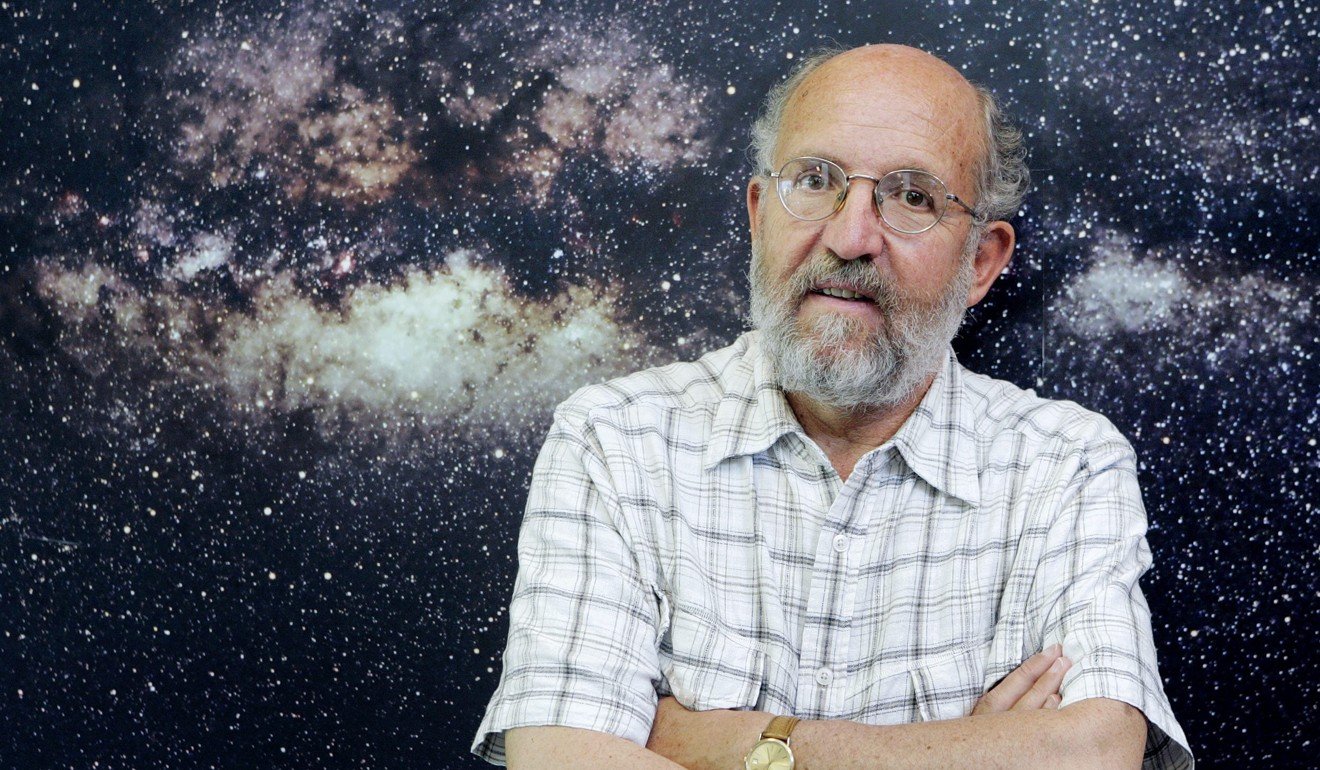
Swiss professor Michel Mayor, astrophysicist and director of the Geneva Observatory, was one of the co-winners of the 2019 Nobel Prize in physics and among the attendees at the forum in Shanghai. Photo: EPA-EFE

The event, which culminated with the announcement of an international joint research laboratory for the world’s top scientists, to be established in Shanghai, was lauded by President Xi Jinping in an open letter to the attendees.

“China attaches great importance to the development of the frontier fields of science and technology,” Xi said, stressing China’s willingness to “work with all countries of the world” to “address the challenges of our age”.

The high calibre meeting was a rare opportunity for China to broadcast its message of commitment to scientific advancement, at a time when the reputation of its universities, academics and hi-tech companies have been taking a broad hit as part of a blowback from the US-China trade and tech wars, as well as suspicion among Western countries of China’s geopolitical aims.

In the past year, a number of major global Chinese tech companies, including Huawei and Hikvision, have been blacklisted in the US, while US tech giants like Google and Apple noticeably skipped out on China’s annual state-run World Internet Conference last month. Academic ties between Chinese and Western universities have also been called into question over suspicions of espionage, fraud, and intellectual property theft.

“China is saying we are still open for business and, at this juncture, we more warmly welcome foreign scientists and collaboration between countries in science and technology,” said Zhu Tian, an economics professor at the Chinese Europe International Business School in Shanghai.

60 science groups demand US end crackdown on foreign-born researchers

The past decade has seen China advance rapidly in the sciences. A surge in government funding, along with successive top level strategies to build up science and tech – including the Made in China 2025 innovation blueprint – and a significant uptick in international collaborations, have propelled the nation on to the global scientific stage.

Recent developments, like the first successful landing of a probe on the far side of the moon earlier this year, the dominance of the 5G network technology created by China’s Huawei, and the opening of the world’s largest radio telescope in Guizhou in 2017, have also raised the country’s profile in emerging tech and science.

But, so far, China’s rising visibility as a scientific powerhouse has been largely driven by scale. A June report by the journal Nature found researchers affiliated with the Chinese Academy of Sciences contributed the greatest number of “high-quality natural sciences research” to international journals compared with their peers at other institutions, while last month the journal found the top four “fastest rising” new universities for research output were all from mainland China.

“To some in the outside world, China is already a powerhouse in innovation … but in terms of the quality of innovations or scientific research, China still lags behind developed countries like the US, UK or Switzerland,” Zhu said.

Despite “making the fastest progress among all countries”, and significant leaps as a developing nation, “China is not at the frontier of technology or science yet,” he said, which is why international engagement, like the recent summit, is key to China’s growth.

“In order to catch up you have to know what is the frontier, you have to learn from those who are at the frontier.”

It is a point further underlined by the numerous blog posts and widely circulated articles in Chinese media about China’s meagre Nobel track record. Apart from one celebrated exception – 2015 Nobel laureate for medicine Tu Youyou – Chinese-born scientists who have won the prize did so for their work in overseas laboratories, or after changing citizenship.

Nobel Prize winner may have found solution to malaria drug resistance

Tu was the People’s Republic of China’s first Nobel Prize winner in the sciences and the country’s first woman to win the prize in any category.

Among China’s other Nobel laureates in the sciences are 1957 physics prizewinners Li Zhengdao and Yang Chen-ning, who won their award while in the US, having left China before the Communist Party takeover in 1949. Both later became US citizens. In 2017, 

Yang returned to China,

relinquishing his US citizenship to become a Chinese citizen.

China has worked hard to reverse the damage of brain drain, for example with its flagship “Thousand Talents” programme, a high-profile, state-backed recruitment drive set up in 2008 to attract overseas Chinese students and academics back to China with generous funding.
But reaching the frontiers of science, and making Nobel-worthy advancements, will also require China to do some reshuffling of its domestic priorities, which have been heavy on producing innovations in applied sciences and tech, but lighter on the basics – like physics, chemistry, and biology – whose mysteries are probed by the leading labs around the developed world.
Chinese scientists turn black coal by-product into gleaming white paper
“China in the past has been known as a place for incremental innovation, and not the place where really radical innovation and big breakthroughs have come from, but they don’t want to be tinkering at the margins, they want to be a major innovation powerhouse,” said Andrew Kennedy, an associate professor in the policy and governance programme at the Australian National University.
To change this, China has begun to raise investment in basic sciences, Kennedy said, pointing to National Bureau of Statistics figures which indicate an average spending increase of more than 20 per cent each year between 1995 to 2016. Even so, spending at the end of that period – some US$11.9 billion at market rates – still lagged well below the figure cited for the US in 2015, which rang up US$83.5 billion, he said.
Chinese scientists develop laser that could track submarines
The gathering of science laureates itself was further indication of that shift to place more emphasis on basic sciences, the kinds of disciplines the laureates lead, and could be a major boost to that agenda, according to Naubahar Sharif, associate professor of social science and public policy at Hong Kong University of Science and Technology.
“This [event] is a rocket-propelled, massive injection of scientific power into one place, and China has ambitions to gear up their own scientists to this level,” Sharif said, “and I’m sure the local Chinese scientists have been prepped to take advantage of it.”
While China has work to do in pushing back on criticism of questionable practices in intellectual property transfer, or the extent to which they share their own advances with others, collaboration with leading scientists is a crucial part of China’s “long-haul” vision in the sciences, Sharif said.
“If you rub shoulders with the most prestigious scientists of your era, your local scientists will learn something, and there’s going to be knowledge exchange and making linkages and a start to partnerships,” he said.
“This is the way that getting to that frontier can be achieved.”
Source: SCMP
22/08/2019

Chinese armed police truck convoy rolls into Shenzhen as Hong Kong enters another week of protests

  • State media says presence is part of preparations for major drill, but analyst calls it a ‘psychological warfare tactic’
  • Fears that the armed presence was a show of power to Hong Kong
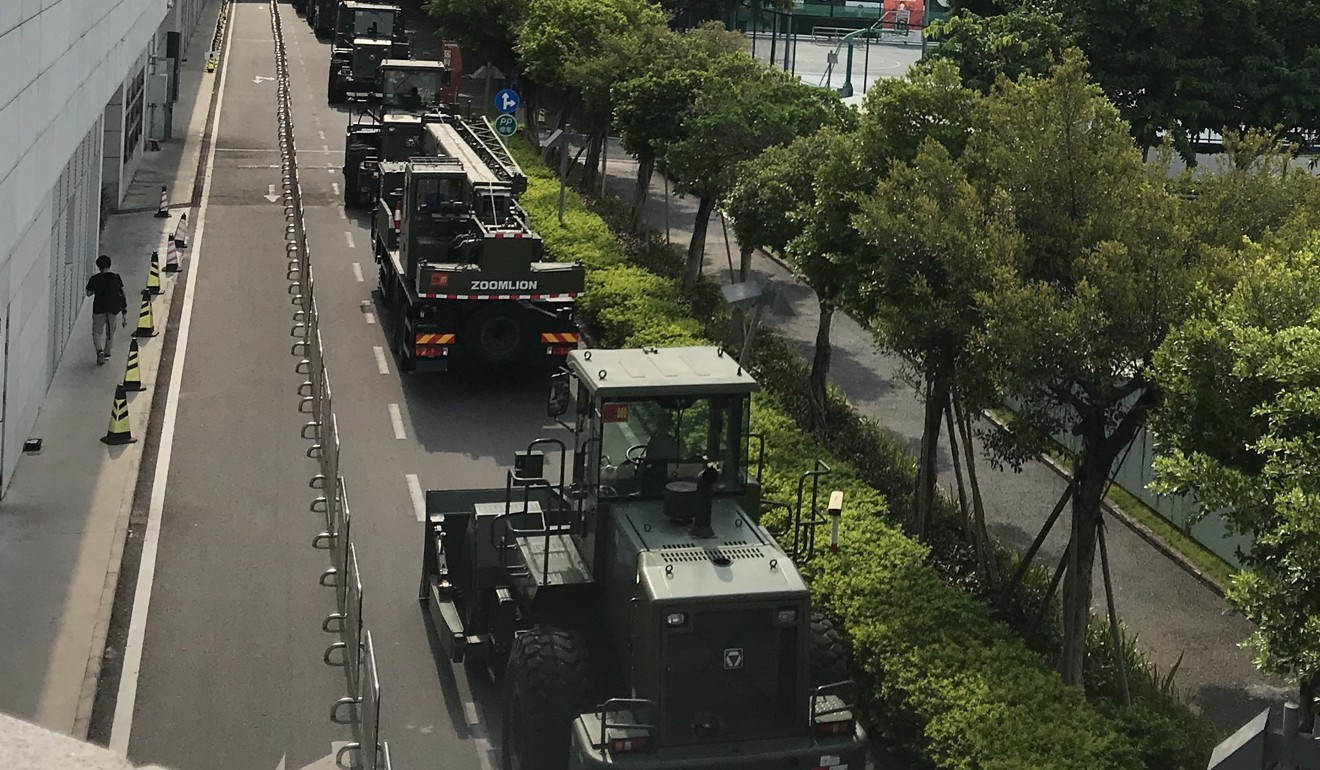
Dozens of trucks line a street next to the entrance of the Shenzhen Bay Sports Centre in Shenzhen on Monday. Photo: SCMP
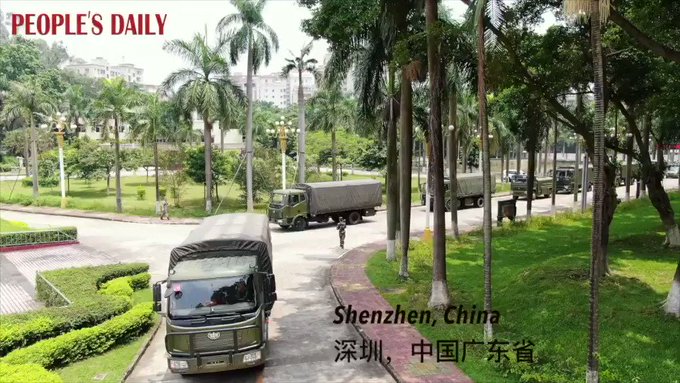
A convoy of armed police trucks has been stationed at a sports centre in a mainland Chinese city bordering Hong Kong, adding to speculation online that Beijing could be preparing to intervene directly in the protests roiling the special administrative region.
But a Beijing-based military expert said the movements were part of regular exercises and not cause for concern.
Footage of the trucks rolling into Shenzhen in the southern province of Guangdong began circulating online on Saturday.

On Monday, Communist Party mouthpiece People’s Daily and Global Times posted videos of the convoy in the city, saying the police were there to prepare for large-scale drills.

Dozens of the trucks as well as excavators lined a pavement next to the entrance of the Shenzhen Bay Sports Centre in Nanshan district on Monday, across the harbour from Hong Kong.

Personnel in camouflage uniforms stood at the entrances of the sports centre, but did not block access to civilians.

Asked whether they were in Shenzhen for a drill and what time they had arrived, the personnel shook their heads and said nothing.

Also on Monday, the Hong Kong and Macau Affairs Office released a stern statement, calling attacks on police “signs of terrorism”.

Online, internet users speculated that the armed presence was a show of power to Hong Kong.

Excavators are among the heavy equipment stationed near the entrance of the Shenzhen Bay Sports Centre on Monday. Photo: SCMP

“They are just waiting for an order before they’ll drive to Hong Kong to calm the riots. We hope the armed forces can enter Hong Kong and beat the hell out of these idiotic youth,” one commenter said on Weibo, China’s Twitter-like social media platform.

Beijing-based military specialist Zhou Chenming said that the armed police were taking part in regular drills and that people should not feel nervous.

“The central government has repeatedly stated it will only interfere if there are large-scale riots and the Hong Kong government has applied voluntarily for support,” Zhou said.

Hong Kong policeman filmed aiming gun at protesters hailed as a hero by Chinese state media

“If the situation does not reach that point, then this is only a deterrence measure, to deter these [small group of people] from stepping over the line.”

Dixon Sing Ming, a political-science professor at the Hong Kong University of Science and Technology, said the move was a “psychological warfare tactic”.

“The drill is part and parcel of a well-coordinated attempt by Beijing to pressure the protesters and the general public to give up their five demands, including the one for universal suffrage immediately,” Sing said.

Hong Kong has been engulfed in protests since early June, at first to oppose the now-shelved extradition bill that would have allowed Hong Kong to send suspects to other jurisdictions, including mainland China.

Chinese police mass 12,000 anti-riot officers in Shenzhen for drill

But protesters now have five demands, including a complete withdrawal of the extradition bill and an independent investigation into the police’s use of force in handling the protests.

As the confrontations have escalated, public opinion in the mainland has grown steadily tougher, with many calling for more stern measures to restore order.

On August 6, 12,000 police officers gathered in Shenzhen for a drill, which included anti-riot measures similar to those seen on the streets of Hong Kong.

Although the police said the drill was part of security preparations for the 70th anniversary of the People’s Republic on October 1, internet users saw it as a show of power and warning to Hong Kong.

Source: SCMP

Law of Unintended Consequences

continuously updated blog about China & India

ChiaHou's Book Reviews

continuously updated blog about China & India

What's wrong with the world; and its economy

continuously updated blog about China & India