
Aerial photo taken on Feb. 13, 2019 shows job seekers at a job fair in Fancheng District of Xiangyang City, central China’s Hubei Province. (Xinhua/Yang Dong)
continuously updated blog about China & India

You will be living in their world, very soon

Beware the Waking Dragon
Aerial photo taken on Feb. 13, 2019 shows job seekers at a job fair in Fancheng District of Xiangyang City, central China’s Hubei Province. (Xinhua/Yang Dong)
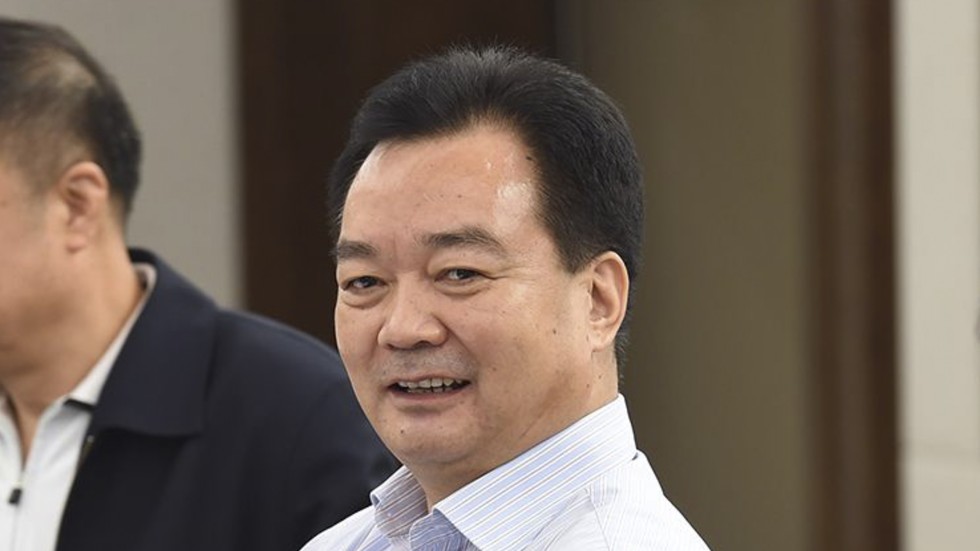
Beijing has sent a trusted senior cadre – with a track record of versatility and economic development – to join the highest decision-making body of China’s highly sensitive Xinjiang Uygur autonomous region.
Analysts said he was expected to assume a leadership role in the party’s regional political and legal affairs commission – a critical body in the implementation of China’s “stabilising measures” in Xinjiang, which include the controversial “re-education camps” where up to 1 million people from the Muslim ethnic minority group are reportedly being held.
In a move that may have paved the way for such a role for Wang, the incumbent head of Xinjiang’s political and legal affairs commission – Zhu Hailun, 61 – was elected deputy head of Xinjiang’s People’s Congress in January. It is standard practice in China for deputy provincial level cadres to step down and take up such positions on reaching 60.
Dr Alfred Wu, an associate professor at Singapore’s Lee Kuan Yew School of Public Policy, said that while there were other vacancies in both Xinjiang’s political and legal affairs commission and its united front work department, Wong’s legal experience made it likely he would take up the role vacated by Zhu.
A source familiar with Wang told the South China Morning Post he was among a group of cadres who had won the trust of President Xi Jinping.
He moves to Xinjiang from the northeastern province of Jilin, where he was a member of the provincial party standing committee and party chief of Changchun, the provincial capital.
It was not all smooth sailing for Wang in Jilin, where his career was tainted by last year’s Changchun Changsheng vaccine scandal.
National outrage followed the revelation that one of China’s biggest vaccine makers, Changsheng Bio-tech, had systematically forged data in its production of rabies vaccines and had sold ineffective vaccines for diphtheria, whooping cough and tetanus that were given to hundreds of thousands of babies – some as young as three months old.
Heads rolled. Sackings included Jilin vice-governor Jin Yuhui, who had overseen food and drug regulation; Li Jinxiu, a former Jilin food and drug chief; Changchun mayor Liu Changlong; and Bi Jingquan, deputy director of the State Market Regulatory Administration in Beijing.
In a farewell speech published in People’s Daily on Monday, Wang apparently made a veiled reference to the scandal and admitted some shortcomings.
“Because of my constraints, I could have done better on some issues … and have failed to meet the expectations of the Party and people,” he said.
Alfred Wu said the Xinjiang posting showed Wang’s career had not been tainted by the Changchun vaccine scandal.
“Going to Xinjiang is both an opportunity and a challenge for Wang. If he can prove himself in stabilising Xinjiang, he will go further [in his career],” Wu said.
Xinjiang is Wang’s fourth provincial posting. He began his political career in Yunnan, southwestern China, where he spent nearly two decades working with many ethnic minority groups.
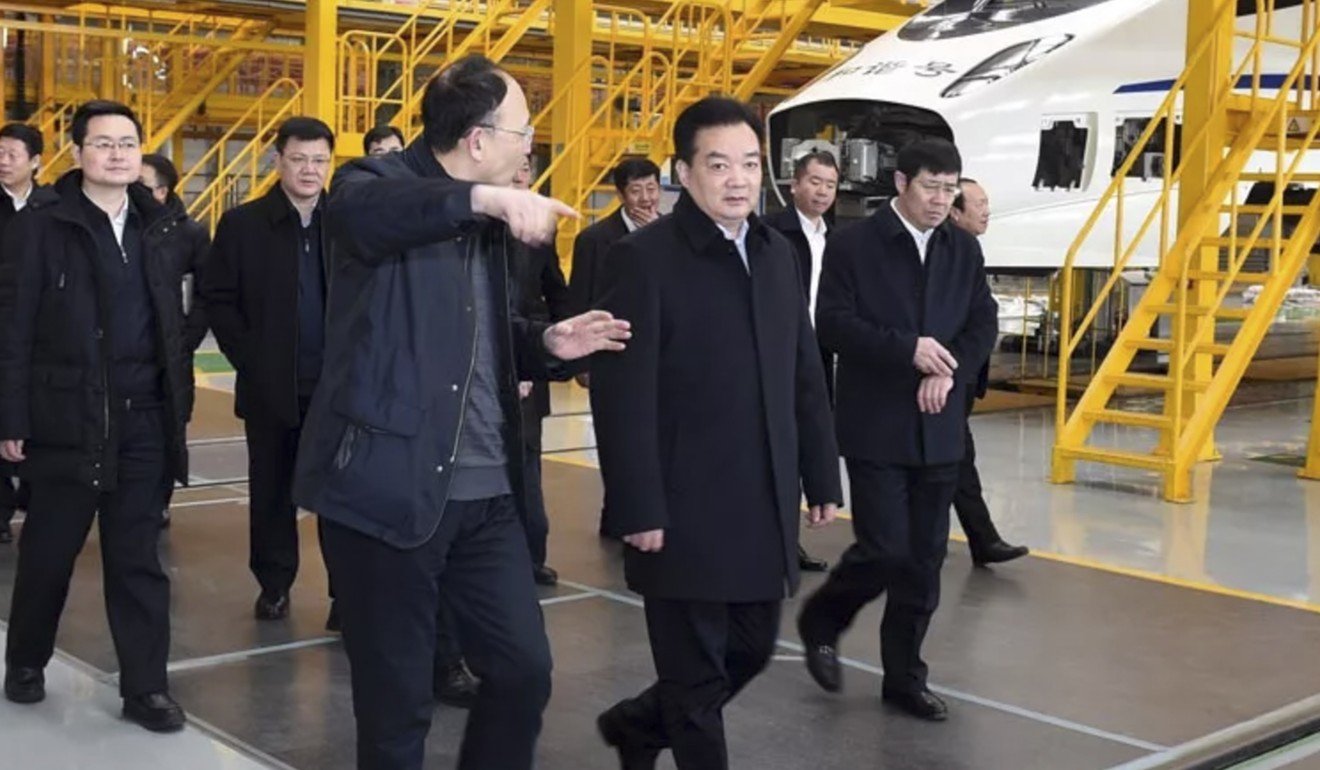
He was the legal chief of Kunming, the provincial capital of Yunnan, from 1988 to 2000 and also served as vice-president of the Yunnan Higher People’s Court from 2005 to 2007.
In 2009 Wang became party chief of Lijiang, a tourist city in Yunnan where the economy thrived under his watch.
“More importantly, he struck a balance between tourism development and environmental conservation and was noticed by the leadership,” a source said.
Wang left Yunnan in 2012 when he was promoted to provincial vice-governor of Hubei in central China. He later became party chief of the city of Xiangyang in Hubei province and was promoted to provincial party standing committee member in 2013.
After three years in Hubei, Wang headed north to Jilin, becoming Changchun party chief in January 2016.
Wang was born in the eastern province of Shandong. He graduated from Shandong University with a bachelor’s degree in socialism studies and a master’s in the same subject from Renmin University in Beijing in the 1980s. He attained his doctorate in management from Tsinghua University in 2006.
Source: SCMP

Hubei province has banned female hosts from wearing revealing clothes as part of new guidelines for live-streaming broadcasts, making it the first authority in China to do so.
“The law may be too vague, but our standards are more detailed in terms of what to wear from bottom to top,” Xie Qiuqi, head of Gaoxin branch of the Hubei Standardisation and Quality Institution, told Hubei TV.
“Clothes showing the national flag and emblem and other unlawful content are also banned,” he said.
Under the new rules, minors are required to provide live stream platforms with an identity card, the household registration of their guardians and a signed application form before going live online by themselves.
Live-streaming platforms should install an around-the-clock system for reporting abuses and a means of shutting down accounts or online posts in 90 seconds, the latest rules said.
The new standards in Hubei followed live-streaming platform operator Wuhan Douyu Network Technology’s announcement that it had drafted broadcast rules in conjunction with research institutes and media associations including the Wuhan Software Industry Association, Wuhan University, and Wuhan New Media Industry Association.
Live streaming is hugely popular in China, helping companies to popularise their products, while individuals can earn an income with unique online offerings. These range from something as simple and innocuous as glimpses of the life of a farmer to scantily-clad women performing dance routines.
The industry has been under intense scrutiny after a string of scandals and mishaps, including minors who stripped online and the death of Wu Yongning, a “rooftopping” star who was killed in a fall from a tall building in Changsa, Hunan province, in November 2017.
In October, Yang Kaili, a 21-year-old, self-made online celebrity, was detained for five days after singing part of the national anthem in a “disrespectful” manner.
Also last year, China conducted checks on more than 5,000 live-streaming apps and shut 370 streams for illegal programming such as pornography or “content that instigates crime”, state media reported.
Chinese live-streaming star locked up for ‘disrespecting’ anthem
“Everyone had seen unhealthy, dangerous and inappropriate content in the past that may cause others to feel uneasy. We hope that through our official announcement of the policies, we can minimise or get rid of such phenomenon,” Yuan Gang, vice-president of Douyu TV, told Hubei TV.
“Where the industry is heading is what we are worried about. We want to launch these standards before 5G is rolled out,” he said.

Female live-streamers have become very high profile. By broadcasting themselves singing, dancing, applying make-up or everyday, mundane activities like eating, some hosts can make more than 100,000 yuan (US$14,300) a month from members of a mostly male Chinese audience from an estimated 456 million viewers nationwide.
With 42 million more men than women in China, according to World Bank figures from 2017, live-streaming platforms have become a major source of entertainment for single men, helping to make it a thriving business for many enterprising women who are not averse to using sex appeal to cash in on their fan following.
Teen bankrupts parents by spending US$37,000 on live-stream ‘girlfriend’
In November, a 19-year-old man surnamed Lee, from eastern China, was reported to have spent more than US$37,000 on a live-stream host he claimed was his girlfriend. The money included 260,000 yuan (US$3,871) drawn from his parents’ savings for a new home. Lee was diagnosed with depression.
The Hubei government’s latest policy sparked debate on Weibo, China’s microblogging service.
“This rule is controlling too much. What is considered revealing? You can set swimsuits as the standard or black robes as the standard,” one user wrote.
“All men should wear monotone Chinese tunic suits, and all women should wear qipao,” another user said.
Source: SCMP

continuously updated blog about China & India
continuously updated blog about China & India
continuously updated blog about China & India
 CHINDIA ALERT: You'll be living in their world, very soon

COMMENTS: 1