Archive for ‘Human Rights Watch (HRW)’

06/12/2019

Indian police kill four men suspected of rape, murder, drawing applause and concern

HYDERABAD, India (Reuters) – Indian police shot dead four men on Friday who were suspected of raping and killing a 27-year-old veterinarian near Hyderabad city, an action applauded by her family and many citizens outraged over sexual violence against women.

However, some rights groups and politicians criticised the killings, saying they were concerned the judicial process had been sidestepped.

The men had been in police custody and were shot dead near the scene of last week’s crime after they snatched weapons from two of the 10 policemen accompanying them, said police commissioner V.C. Sajjanar.

Thousands of Indians have protested in several cities over the past week following the veterinarian’s death, the latest in a series of horrific cases of sexual assault in the country.

The woman had left home for an appointment on her motor-scooter and later called her sister to say she had a flat tyre. She said a lorry driver had offered to help and that she was waiting near a toll plaza.

Police said she was abducted, raped and asphyxiated and her body was then set alight on the outskirts of Hyderabad. Four men were arrested.

Sajjanar, the police officer, said the men – two truck drivers and two truck cleaners, aged between 20 and 26 years – had been taken to the spot to help recover the victim’s mobile phone and other personal belongings on Friday morning.

“As the party approached this area today (during the) early hours, all the four accused got together. They started attacking the police party with stones, sticks and other materials,” he told reporters near the site of the shootings.

The men, who were not handcuffed, then snatched weapons away from the police and started firing at them, but were killed after the police retaliated. He did not say how the accused were able to overpower their escorts.

“Law has done its duty, that’s all I can say,” Sajjanar said.

The National Human Rights Commission, a government-funded watchdog, said it had ordered an investigation. “Death of four persons in alleged encounter with the police personnel when they were in their custody, is a matter of concern for the Commission,” it said in a statement.

Indian police have frequently been accused of extra-judicial killings, called “encounters”, especially in gangland wars in Mumbai and insurrections in the state of Punjab and in disputed Kashmir. Police officers involved in such killings were called “encounter specialists” and were the subject of several movies.

Graphic – Police Custody Deaths in India: here

People shout slogans as they celebrate after police shot dead four men suspected of raping and killing a 27-year-old veterinarian in Telangana, in a residential area in Ahmedabad, India, December 6, 2019. REUTERS/Amit Dave
Reuters Graphic

‘LONG LIVE POLICE’

The victim’s family welcomed the news the alleged perpetrators had been killed.

“I express my gratitude towards the police & govt for this. My daughter’s soul must be at peace now,” Reuters partner ANI quoted her father as saying.

A Reuters reporter saw the four men’s bodies lying in an open field, all of them face up and barefoot, with their clothes stained with blood, surrounded by policemen.

A large crowd gathered at the site and threw flower petals at police vans in support of the action. Some shouted “Long live police”, while others hoisted police officials onto their shoulders and burst firecrackers.

There was no immediate word from Prime Minister Narendra Modi’s government on the incident, but Maneka Gandhi, a lawmaker from his ruling Bharatiya Janata Party, said the police appeared to have over-reached.

“You can’t take the law in your own hands. The courts would’ve ordered them (the accused) to be hanged anyway. If you’re going to shoot them with guns before due process is followed, then what’s the point of having courts, police and law?” she said.

Tough laws were enacted after the 2012 gang rape and murder of a woman in a bus in New Delhi that led to an outpouring of anger across the country, but crimes against women have continued unabated.

Graphic – Rape cases in India: here

Slideshow (9 Images)
Reuters Graphic

SLOW JUSTICE

Fast track courts have been set up but cases have moved slowly, for lack of witnesses and the inability of many families to go through the long legal process. Some victims and their families have ended up being attacked for pursuing cases against powerful men, often local politicians.

Many Indians applauded the killings.

“Great work #hyderabadpolice ..we salute u,” badminton star Saina Nehwal wrote on Twitter.

In Uttar Pradesh state, where a rape victim was set ablaze on Thursday while she was on her way to court, opposition politician Mayawati said the police there should take “inspiration” from what happened in Hyderabad.

“Culprits should be punished, and if they are not punished then whatever happened in Hyderabad should happen,” the victim’s brother said in hospital.

She was on life support, hospital authorities said, news that could further inflame passions in a country where public anger over crimes against women has grown in recent weeks.

Indian police registered more than 32,500 cases of rape in 2017, according to the most recent government data. But courts completed only about 18,300 cases related to rape that year, leaving more than 127,800 cases pending at the end of 2017.

But some people said the lack of progress in the courts did not mean the police had a free hand to dispense justice.

“We now have to trust that a police force that managed to let unarmed suspects escape their custody, and needed to shoot them dead because they could not catch them alive, is somehow competent enough to have identified and arrested the real culprits?,” Meenakshi Ganguly, South Asia Director at Human Rights Watch, told Reuters from London.

Source: reuters
05/06/2019

Xinjiang’s vanishing mosques highlight pressure on China’s Muslims as Ramadan ends with a whimper

  • Few signs of Eid celebrations after crackdown that has seen a reported million Uygurs and other minorities interned in camps
  • Muslims in far western Chinese region say they are now ‘too scared’ to practise their faith in public
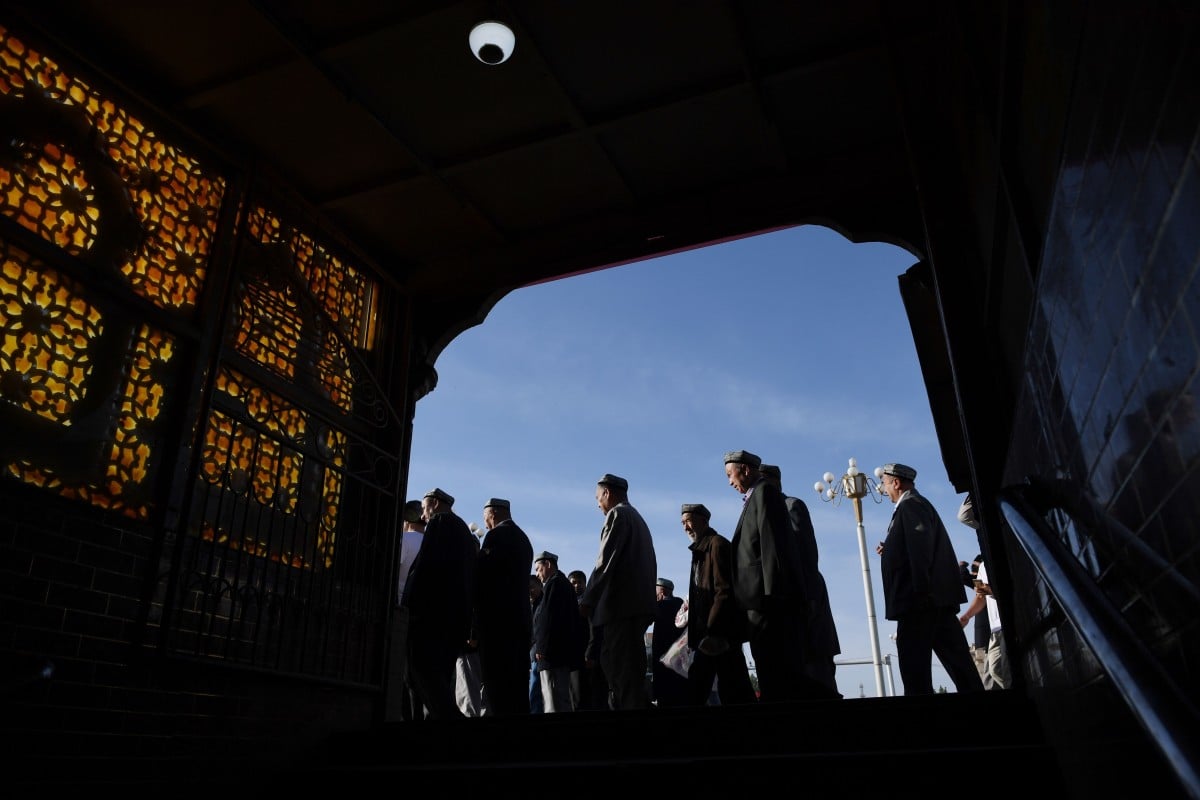
Worshippers leave a mosque in Kasghar after prayers on Wednesday. Photo: AFP
The corner where Heyitkah mosque in China’s far western region of Xinjiang once hummed with life is now a car park where all traces of the tall, domed building have been erased.
While Muslims around the world celebrated the end of Ramadan with prayers and festivities this week, the recent destruction of dozens of mosques in Xinjiang highlights the increasing pressure Uygurs and other ethnic minorities face in the heavily policed region.
Behind the car park in the city of Hotan, the slogan “Educate the people for the party” is emblazoned in red on the wall of a primary school where students must scan their faces upon entering the razor-wired gates.
The mosque “was beautiful,” recalled a vendor at a nearby bazaar. “There were a lot of people there.”
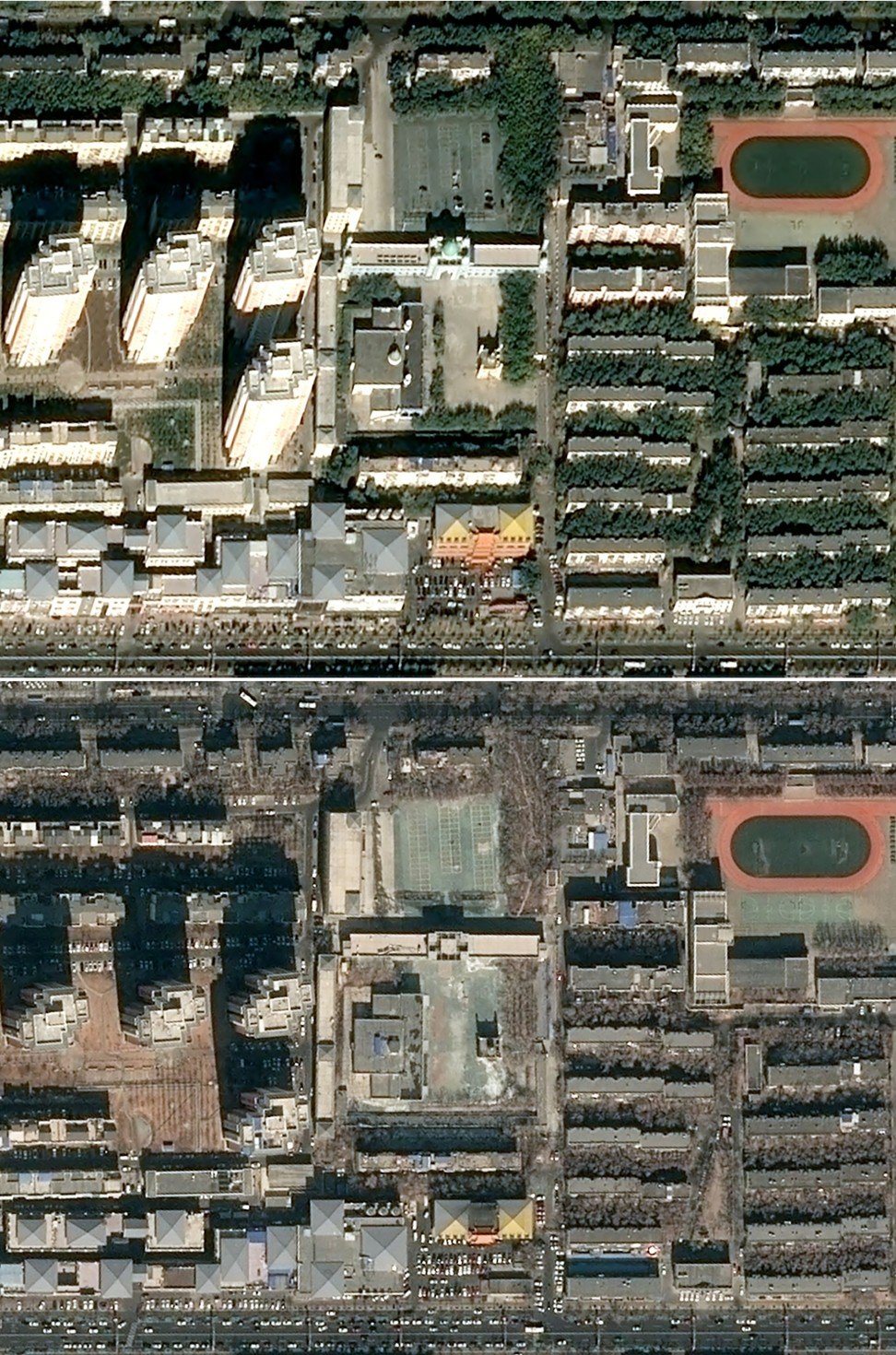
Satellite images reviewed by AFP and visual analysis non-profit Earthrise Alliance show that 36 mosques and religious sites have been torn down or had their domes and corner spires removed since 2017.
Satellite images from 2014 (top) and March this year show the disappearance of the dome of the Karamay West Mosque in Xinjiang. Photo: AFP/ Distribution Airbus Defence and Space/ CNES 2019/ Produced By Earthrise

In the mosques that are open, worshippers go through metal detectors while surveillance cameras monitor them inside.

“The situation here is very strict, it takes a toll on my heart,” said one Uygur, who requested anonymity for fear of reprisals. “I don’t go any more,” he added, referring to mosques. “I’m scared.”

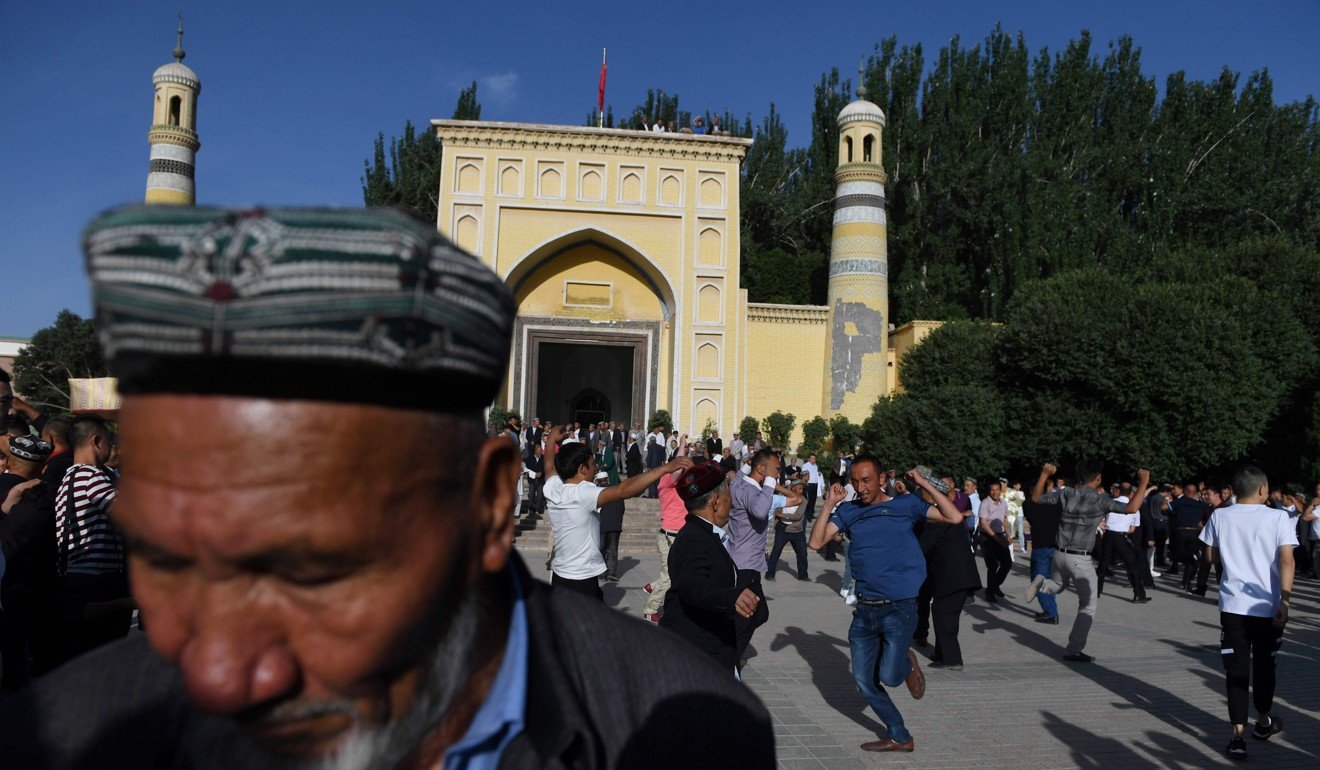
In the ancient Silk Road city of Kashgar, no longer does the sunrise call for prayer echo throughout the city – a ritual the manager of the city’s central mosque once proudly shared with touristsOn Wednesday, locals celebrating Eid al-Fitr quietly filed into the entrance of state-approved Idkah Mosque – one of the largest in China – as police and officials fenced off the wide square surrounding the building and plain clothes men monitored every person’s actions.

It was another low-key Ramadan for Muslims in Xinjiang, where restaurants were busy serving food to customers throughout the day, a time when practising Muslims fast.

In Hotan on Friday – a holy day for believers – the only mosque in the city was empty after sundown, an important prayer session when Muslim families typically break their daily Ramadan fast.

Earlier in the day, at least 100 people attended a midday session but the vast majority were elderly men.

Human Rights Watch decodes surveillance app used to classify people in China’s Xinjiang region

The ruling Communist Party “sees religion as this existential threat”, said James Leibold, an expert on ethnic relations and policy in China at La Trobe University.

Over the long term, the Chinese government wants to achieve “the secularisation of Chinese society,” he told AFP.

The Xinjiang government told AFP that it “protects religious freedoms” and citizens can celebrate Ramadan “within the scope permitted by law”, without elaborating.

The authorities have thrown a hi-tech security net across the region, installing cameras, mobile police stations and checkpoints in seemingly every street in response to a spate of deadly attacks blamed on Islamic extremists and separatists in recent years.

An estimated one million Uygurs and other Turkic-speaking ethnic groups are held in a vast network of internment camps.

After initially denying their existence, Chinese authorities last year acknowledged that they run “vocational education centres” aimed at steering people clear of religious extremism by teaching them Mandarin and China’s laws.

In those centres, it was a different Ramadan.

The Xinjiang government told AFP that people in the centres are not allowed to hold religious activities because Chinese law forbids it within education facilities, but they are free to do so “when they return home on weekends”.

Uygur men dance after Eid al-Fitr prayers in Kashgar. Photo: Greg Baker/ AFP

In recent years, Chinese authorities have ramped up controls on public displays of religion and Islamic traditions in Xinjiang.

AFP reporters did not see any veiled women and few men sporting long beards during a week-long visit to the region. Former internment camp inmates have said they were incarcerated for these outward signs of their religion.

Places of worship too have become targets of Beijing’s draconian security measures.

Human Rights Watch decodes surveillance app used to classify people in China’s Xinjiang region

In the satellite images analysed by AFP and Earthrise Alliance, 30 religious sites were completely demolished while six had their domes and corner spires removed.

AFP reporters visited about half a dozen sites, and found that some mosques had been repurposed into public spaces.

Police officers blocked journalists from entering Artux, just north of Kashgar, where the town’s grand mosque and dozens of other community mosques were destroyed.

The area is some 22 kilometres (14 miles) away from an enormous complex believed to be a re-education centre. Visible from a nearby village, the facility has razor-wired walls, watchtowers and imposing block buildings.In Kashgar, two cameras perched on the columns of a former mosque point at its entrance. There is no minaret or dome – instead, a shop selling dresses lies to its right alongside houses.

A demolished mosque in Hotan has been converted into a garden, paved with concrete walkways and sparsely planted trees.

On the outskirts of town, situated between a cemetery and sand dunes, two white flags and a pile of burned refuse and debris was all that was left of an old shrine named Imam Asim.

China’s top Xinjiang official Chen Quanguo should face sanctions over alleged abuses, US lawmakers say

Uygurs consider these mosques and shrines “their ancestral heritage,” said Omer Kanat, director of the Uygur Human Rights Project.

“The Chinese government just wants to erase everything … that is different from Han, everything which belongs to Uygur culture or Islamic culture in the region,” he said.

Juma Maimaiti, the official imam of Idkah Mosque, told AFP in an interview arranged by the propaganda department that the demolition of mosques “has never happened here”.

“But our government has proceeded to protect some key mosques,” he added, and said that the city of Kashgar has over 150 mosques.

A propaganda slogan and surveillance camera at a mosque in Yangisar, south of Kashgar. Photo: AFP

Though Beijing’s restrictions on religious piety, such as fasting, are not new, observers say conditions have deteriorated to the point where celebrations for the holy month in Xinjiang are reduced or largely invisible.

Islamic greetings and openly fasting in public are no longer permitted, said Darren Byler, a lecturer at the University of Washington who focuses on Uygur culture.

While there are Uygurs who continue to practise their faith, they are “internalising it at this moment – they’re not expressing it openly,” he said.

EU calls out Beijing on human rights but activists want harder line against China’s Xinjiang and Tibet policy

At state-backed mosques, religious activity is controlled as Beijing pursues a five-year plan to “Sinicise” Islam as the “only way for a healthy development of Islam” in the country, said Yang Faming, president.

Source: SCMP

09/05/2019

China’s Xinjiang citizens monitored with police app, says rights group

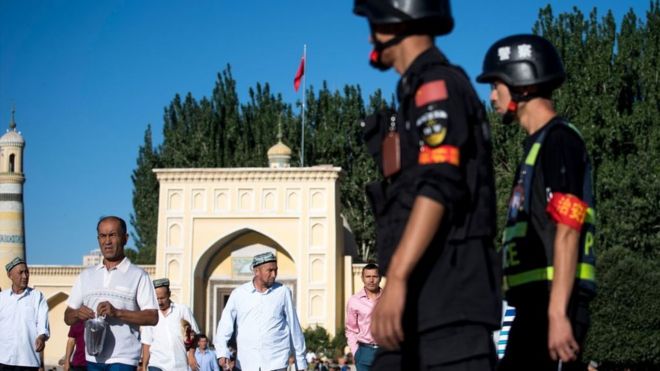
Police patrolling as Muslims leave the Id Kah Mosque in the old town of Kashgar in China's XinjiangImage copyright GETTY IMAGES
Image caption Police in Xinjiang now have one more way to record data about its citizens

Chinese police are using a mobile app to keep data on millions of ethnic Uighurs in Xinjiang province, according to Human Rights Watch (HRW).

In a report released on Thursday, HRW said it had reverse engineered the app to see how mass surveillance worked.

The app is used to closely monitor behaviours, it said, including lack of socialising, using too much electricity or having acquaintances abroad.

Rights groups say Uighur Muslims are being severely persecuted in China.

The UN has said there are credible reports up to a million Uighurs are being held in detention in Xinjiang, in what China says are “re-education centres”.

‘Most intrusive surveillance system’

According to the rights group’s report, the app is used by officials to record and file away information about people.

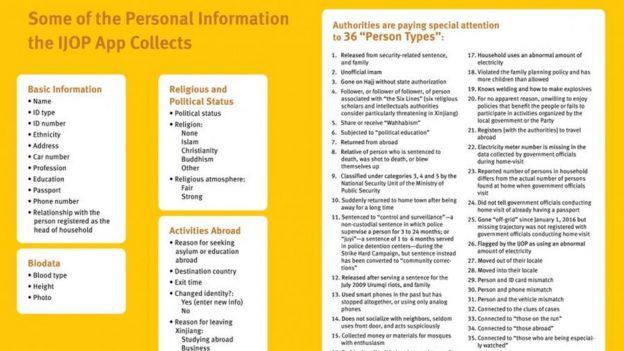
In particular, it targets “36 person types” that authorities should pay attention to.

These include people who seldom use their front door, use an abnormal amount of electricity and those that have gone on Hajj – an Islamic pilgrimage – without state authorisation.

The report does not make explicit mention of any ethnic groups specifically targeted, but the “36 person types” include “unofficial” imams – Islamic leaders – and those who follow Wahhabism, an Islamic doctrine.

Graphic by HRWImage copyrightHRW
Image captionThe 36 person types listed in the HRW report

The information taken from the app will be fed into the central system of the Integrated Joint Operations Platform (IJOP) – the main system for mass surveillance in Xinjiang, says HRW.

HRW senior China researcher Maya Wang said IJOP was “one of the world’s most intrusive mass surveillance systems”.

“It gathers information from checkpoints on the street, gas stations, schools… pulls information from these facilities and monitors them for ‘unusual’ behaviour that triggers alerts [to the]authorities.”

The app was obtained and analysed by HRW in partnership with Cure53, a Berlin-based security firm.

Media caption In your face: China’s all-seeing surveillance system

As well as its Xinjiang operations, China has 170 million CCTV cameras in place across the country and by the end of 2020, an estimated 400 million new ones will be installed.

All this is part of China’s aim to build what it calls “the world’s biggest camera surveillance network”.

China’s also setting up a “social credit” system that is meant to keep score of the conduct and public interactions of all its citizens.

The aim is that by 2020, everyone in China will be enrolled in a vast national database that compiles fiscal and government information, including minor traffic violations, and distils it into a single number – ranking each citizen.

China’s detention camps

Xinjiang is a semi-autonomous region and in theory at least, has a degree of self-governance away from Beijing.

The Uighurs, a mostly Muslim ethnic minority, make up around 45% of its population.

HRW’s report comes as China faces increasing scrutiny over its treatment of them and other minorities in Xinjiang.

Up to one million Uighurs are being held in detention camps across Xinjiang, a UN human rights committee heard last year.

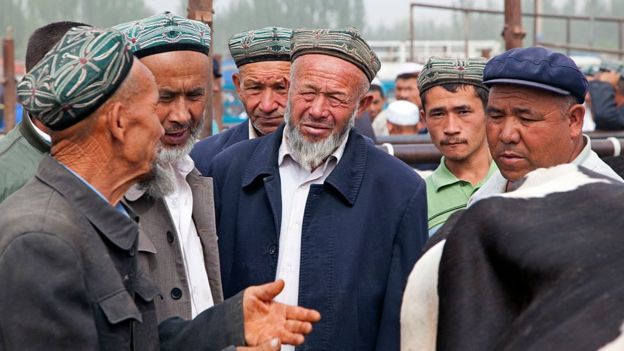
Uyghur farmers wearing doppas, trading cows at the cattle market in KashgarImage copyright GETTY IMAGES
Image caption Uighurs make up around 45% of Xinjiang’s population

One member said she was concerned by reports that Beijing had “turned the Uighur autonomous region into something that resembles a massive internment camp”.

A BBC investigation last year revealed that what appear to be “large prison-type structures” have been built across Xinjiang in the past few years.

China says these buildings are “vocational training centres” used to educate and integrate Muslim Uighurs and steer them away from separatism and extremism.

A Chinese Foreign Ministry spokeswoman, Hua Chunying, said, “everyone can see that people of all ethnicities in Xinjiang live and work in peace and contentment and enjoy peaceful and progressing lives”.

Source: The BBC

Law of Unintended Consequences

continuously updated blog about China & India

ChiaHou's Book Reviews

continuously updated blog about China & India

What's wrong with the world; and its economy

continuously updated blog about China & India