Chindia Alert: You’ll be Living in their World Very Soon
aims to alert you to the threats and opportunities that China and India present. China and India require serious attention; case of ‘hidden dragon and crouching tiger’.
Without this attention, governments, businesses and, indeed, individuals may find themselves at a great disadvantage sooner rather than later.
The POSTs (front webpages) are mainly 'cuttings' from reliable sources, updated continuously.
The PAGEs (see Tabs, above) attempt to make the information more meaningful by putting some structure to the information we have researched and assembled since 2006.
Defence spending could show the effect of economic headwinds but is still expected to increase
PLA’s modernisation and strategic priorities demand spending is maintained even after GDP’s first contraction since records began, observers say
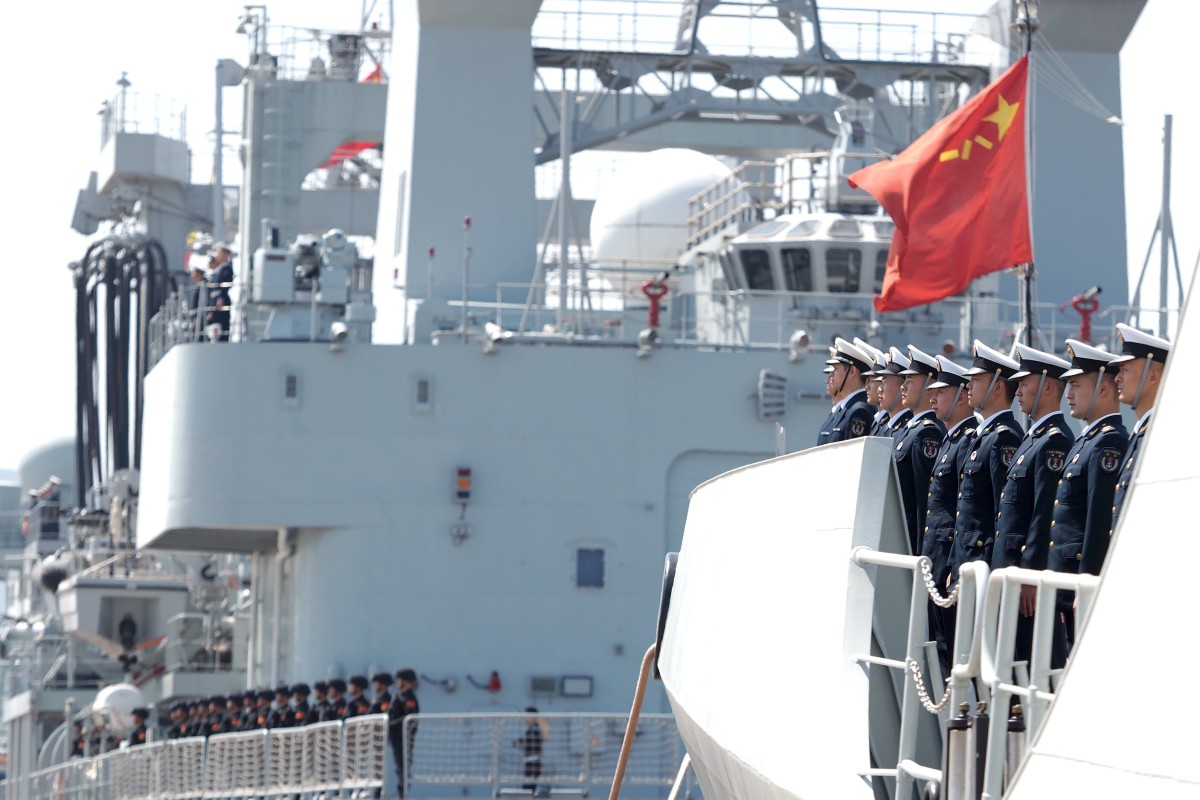
China has made modernising its military and expanding its weaponry a priority. Photo: Xinhua
China’s upcoming defence budget will be only slightly hit by the economic downturn that followed the coronavirus outbreak, and a modest increase is still expected as it continues to develop its military capability, analysts said.
The government’s military budget is expected to be revealed, as is the norm, at this year’s session of the National People’s Congress (NPC), China’s legislative body. Delayed by over two months because of the pandemic, it will finally be convened on May 22.
Last year the defence expenditure announced at the NPC session was
China has said its military expenditure has always been kept below 2 per cent of its GDP over the past 30 years, although its official figures have long been described by Western observers as opaque, with significant omissions of important items.
The South China Sea dispute explained
In a report earlier this week, the Stockholm International Peace Research Institute estimated that China’s actual military spending in 2019 was US$261 billion, the world’s second highest, after the United States’ US$732 billion.
John Lee, adjunct professor at the University of Sydney and senior fellow at the Hudson Institute in Washington, estimated that this year the Chinese defence budget would remain roughly the same or increase modestly, in line with growth levels of recent years.
“In the current environment, Beijing is keen to emphasise that China has recovered substantially from Covid-19 and that its power trajectory is unaffected by recent events,” Lee said. “At the same time, it would be aware of the anger towards the Communist Party for allowing the virus to become a pandemic.
“Regardless of what the reality might be, I would be surprised if there were a dramatic increase or a significant cut.”
First made-in-China aircraft carrier, the Shandong, enters service
China’s GDP suffered a 6.8 per cent decline in the first quarter, the first contraction since quarterly records began in 1992, after an extensive shutdown while it contained its coronavirus outbreak. However, the official increases in the military budget have since 2011 always exceeded overall GDP growth.
The Chinese government may focus more on job creation, social welfare and poverty alleviation, but not at the expense of military investment, according to Collin Koh, research fellow from the S Rajaratnam School of International Studies at Singapore’s Nanyang Technological University in Singapore.
“I tend to think it will be more or less the same,” Koh said. “To reduce [the budget] may send the wrong signal to would-be adversaries, both domestic and external: that Beijing has lost the will to keep up its military modernisation to assert core national interests.”
PLA flexes military muscle near Taiwan ‘in show of Covid-19 control’
15 Apr 2020
The People’s Liberation Army (PLA) began a massive – and costly – reform in 2015, with a personnel reshuffle, change in structure, upgraded equipment and enhanced training to better resemble battle scenarios. That was supposed to be complete this year.
Given the deteriorating relationship with the United States and rising tensions in the Taiwan Strait and South China Sea, the PLA faces challenges requiring a steady increase in investment, according to Hong Kong-based military commentator Song Zhongping.
Taiwan shows off its military power after presidential election
Macau-based military expert Antony Wong Dong predicted there would still be about 6-7 per cent growth in the budget “no matter what”.
“The PLA played an important role in the fight against the contagion, so a decrease in spending would not be accepted,” Wong said.
That role included the deployment of more than 4,000 military medics to help treat Covid-19 patients, and helping to transport medical supplies.
Wong said it would be a crucial year for the PLA in completing its preparation for potential military action against Taiwan, which would be so strategically important that “[President] Xi Jinping himself would never allow it to be affected by a shortage of funding”.
China’s military draws on 6G dream to modernise its fighting forces
18 Apr 2020
But a slight increase in budget would be sufficient to meet defence needs and maintain a deterrence against potential threats, including preventing self-ruled Taiwan taking the opportunity to declare independence, naval expert Li Jie said.
Beijing views Taiwan as a breakaway province to be reunified with the mainland, by force if necessary. Its relationship with Taipei has been strained, and dialogue halted, since Tsai Ing-wen, of the pro-independence Democratic Progressive Party, was elected the island’s president in 2016. Tsai was re-elected for a second term in January.
Li estimated that the budget would probably be kept at the same level or show a “slight” increase from last year.
“It would feed the ‘China threat’ theory and raise international concerns if the Chinese government expands military spending too much,” he said.
Carrier targets return of daily services to major Asian cities and more frequent long-haul services
Airline to monitor global situation and adjustments may be made ‘as necessary’
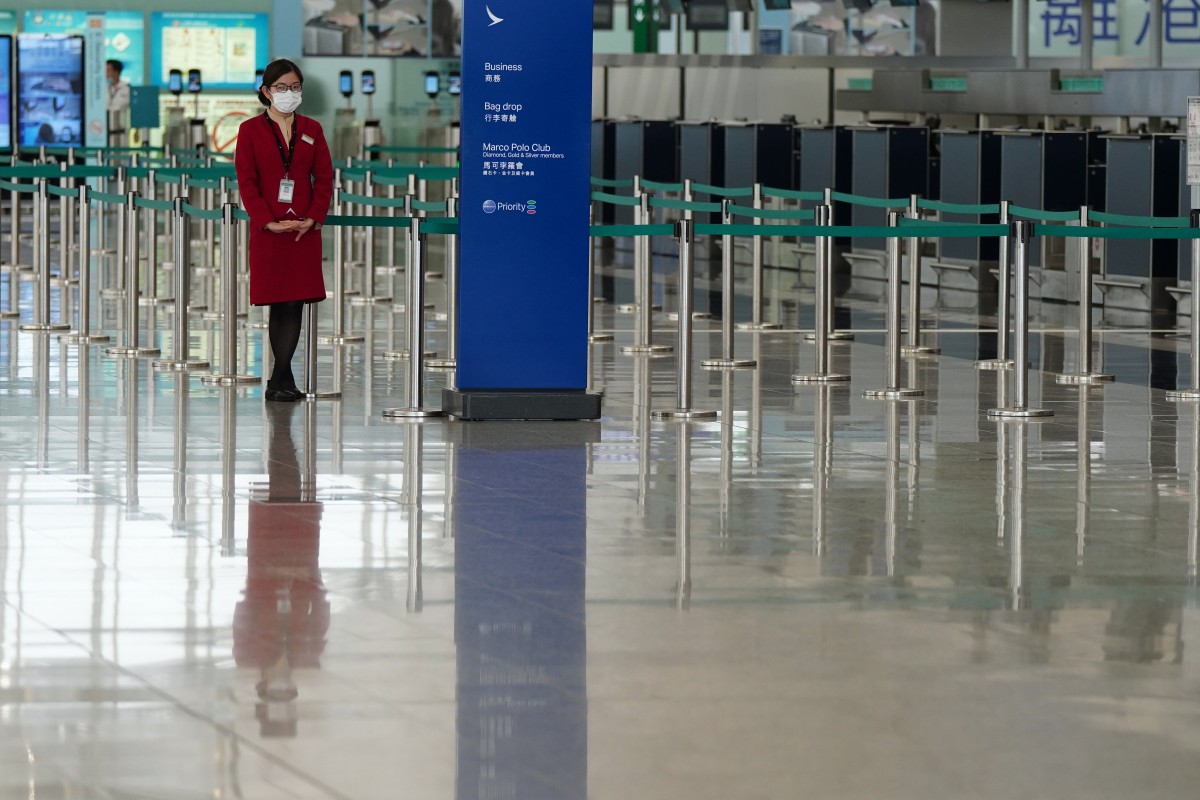
A Cathay Pacific employee stands near the check-in desks at a virtually deserted Hong Kong International Airport. Photo: Sam Tsang
Cathay Pacific Airways has signalled its intent to start reversing its near-total grounding of aircraft because of the coronavirus pandemic, and plans to start increasing its number of passenger flights in the last week of June.
The airline said it hoped to add more long-haul destinations, make flights more frequent, and reinstate some major Asian cities to its daily schedule for the first time in several months, “subject to government travel restrictions”.
Cathay scaled its operations back to a skeleton schedule of 3 per cent of services in early April, and that was extended until June 20. The newly announced increases would take that up to 5 per cent.
Tracking the massive impact of the Covid-19 pandemic on the world’s airline industry in early 2020 Singapore Airlines, another of Asia’s major carriers, said last week it would maintain a 96 per cent reduction in flights until the end of June.
Cathay, which has 236 aircraft, currently operates long-haul flights to London Heathrow, Los Angeles, Vancouver and Sydney twice a week, but will increase that to five times a week.
On top of that, Amsterdam, Frankfurt, San Francisco and Melbourne are among the long-haul destinations set to return three times a week.
With regional routes currently operating three times a week, including Tokyo Narita, Taipei, Beijing and Singapore, Asian routes will increase to a daily service. Osaka and Seoul would also return to the network, too.
“We will continue to monitor the developing situation and further adjustments may be made as necessary,” the airline said.
Coronavirus: ban on non-residents leaves Hong Kong airport virtually deserted
Earlier this month, Cathay’s budget unit HK Express extended its total grounding until June 18, having been on hiatus since March 23.
Meanwhile, Boeing has added to warnings of a very slow recovery in air travel, with Dave Calhoun, its CEO, saying demand may not return to 2019 levels for two to three years.
Cathay Pacific’s daily passenger volume has collapsed from regular previous peaks of 100,000 to less than 1,000 in April. Over the past two months, the company has been running more than 250 extra pairs of cargo-only passenger flights to maintain air freight capacity, much of which is accounted for by passenger services.
In a bid to cut costs, most of the Cathay Pacific Group’s 34,200 staff have taken three weeks of unpaid leave. Also, 433 cabin crew in the US and Canada were told they would be laid off, while about 200 pilots in the UK, Australia have been furloughed.
The International Air Transport Association, which revised down pandemic-related revenue losses for the global sector to US$314 billion (HK$2.4 trillion) two weeks ago, said last week the Hong Kong aviation market would take a US$7.5 billion hit this year, a 27 per cent increase on the previous estimate. That equates to a 59 per cent decline in air travel demand, or a loss of almost 31 million passengers, in 2020.
BOCOM International, a financial services company, forecast in a report on Monday that the city’s aviation sector would lose HK$65.2 billion in revenue in 2020, yet Cathay Pacific could emerge as a winner if it survived largely unscathed, given the weakness of rivals at home and in the region plus its dominant position in Hong Kong.
“Hong Kong aviation is at the most critical juncture in its history. Though calamitous, Covid-19 is set to reshape Hong Kong’s aviation industry for the years, possibly decades, to come,” said transportation analyst Luya You.
“Covid-19’s sweeping blows now offer a blank slate for remaining players to regain lost leadership or gain new markets. If [Cathay Pacific] can survive intact from Covid, the carrier could enjoy winner-takes-all growth trajectory in the years following [2020].”
Fu Chengyu, the former chairman of China National Offshore Oil Corporation (CNOOC), says hostility towards Beijing will increase after the coronavirus
US will try to ‘thwart China’s rise’ and economic fallout from Covid-19 will be worse than the global financial crisis, says Fu
Former Sinopec chairman Fu Chengyu says China will face a more hostile world post coronavirus. Photo: EPA
The world is set to become more hostile for China after the coronavirus as the risk of “black swan” events gathers for Beijing, a heavyweight in China’s state oil industry has warned, reflecting growing wariness about the geopolitical environment among political and business elites.
Fu Chengyu, the former chairman of both China National Offshore Oil Corporation (CNOOC) and Sinopec Group, painted an ominous picture of increasing antagonism from the United States and damaging unforeseen events, known as black swans, like Covid-19
at an online symposium organised by business magazine Caijing.
The US would “mercilessly” suppress China in the fields of economics, trade, finance and technology, and Washington was set on taking advantage of the coronavirus pandemic to “forge a less favourable international environment for” the nation, Fu said this week.
“We’ve smelled the odours and new plots against China are in formation,” he said.
After the epidemic, the external environment for our survival will be more severe – Fu Chengyu
“After the epidemic, the external environment for our survival will be more severe … we must prepare for the worst and do our best to achieve the best possible results.”
While Fu has retired from his posts at state companies, he is an influential voice in
with decades of experience and contacts in the US petroleum sector.
Fu was a counterpart of Rex Tillerson, who was chairman of ExxonMobil from 2006 to 2017, and served as US State Secretary under President Donald Trump until March 2018.
While at the helm of CNOOC in the early 2000s, he felt political heat from Washington over a US$18.5 billion takeover bid for the American oil company Unocal in 2005, which the company was subsequently forced to withdraw.
China says no evidence to suggest coronavirus virus came from Wuhan’s lab
Speaking at the event in Beijing, Fu said that the coronavirus, which has heightened tensions between Beijing and Washington, will have impacts on global value chains and the world trade landscape for years to come.
“The crisis stemming from the coronavirus pandemic won’t be over in just one or two years … the impact will last longer than the 2008 global financial crisis,” he said.
He added that China would face numerous “black swan” risks in the future.
President Xi Jinping warned in 2019 that China must be on guard for black swan risks as well as “grey rhino” events, referring to an obvious threat that is often neglected.
Geopolitics is getting worse and worse, and we need to be very careful. The US will try various ways to thwart China’s rise, and energy is an important area
To respond to the economic fallout from the coronavirus, China must do more to create a self-sustaining domestic economy, Fu said, and in particular reduce input prices for gas and electricity and boost public services such as health care and education.
“Geopolitics is getting worse and worse, and we need to be very careful,” Fu said. “The US will try various ways to thwart China’s rise, and energy is an important area.”
The US could potentially form a new oil export alliance with Saudi Arabia and Russia to make it possible to cut oil supplies to China, he said.
“China must be prepared for such a scenario, and even when supplies are cut off, we can have some basic self-protection.”





 CHINDIA ALERT: You'll be living in their world, very soon