Archive for ‘Indian village’

22/05/2019

In an Indian village, Muslims talk of leaving as divide with Hindus widens

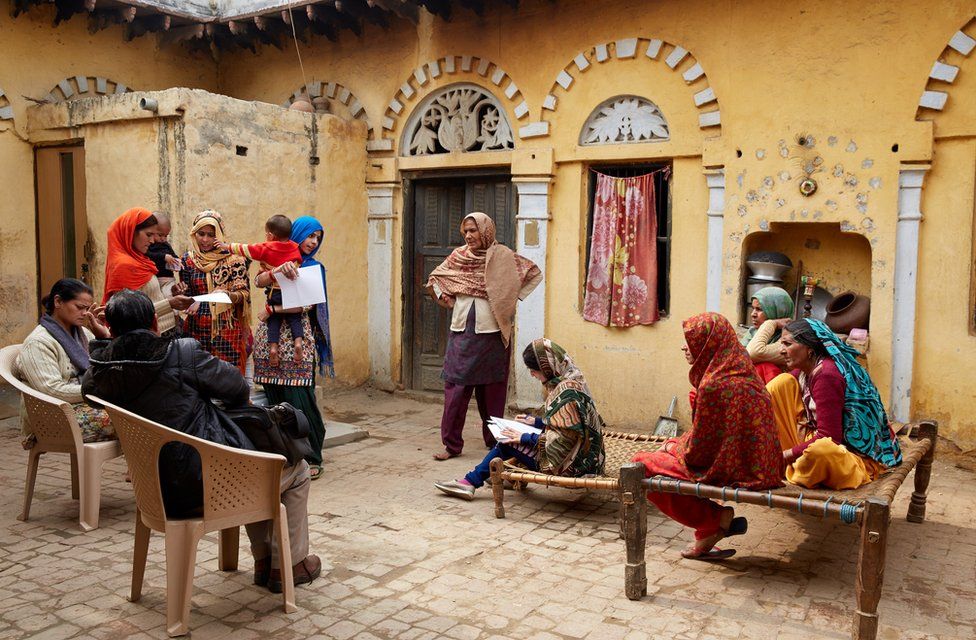
NAYABANS, India (Reuters) – Muslims in Nayabans, an unremarkable village in northern India, say they remember a time when their children played with Hindu youths, and people from either faith chatted when they frequented each other’s shops and went to festivals together.

Such interactions no longer happen, many say, because of how polarized the two communities have become in the past two years, and some are frightened and thinking of moving away – if they can afford it.

Muslim residents who spoke to Reuters said they thought tensions would only worsen if Prime Minister Narendra Modi’s Hindu nationalist Bharatiya Janata Party (BJP) wins a second term in the current general election, as exit polls released on Sunday indicate is likely. Votes will be counted Thursday.

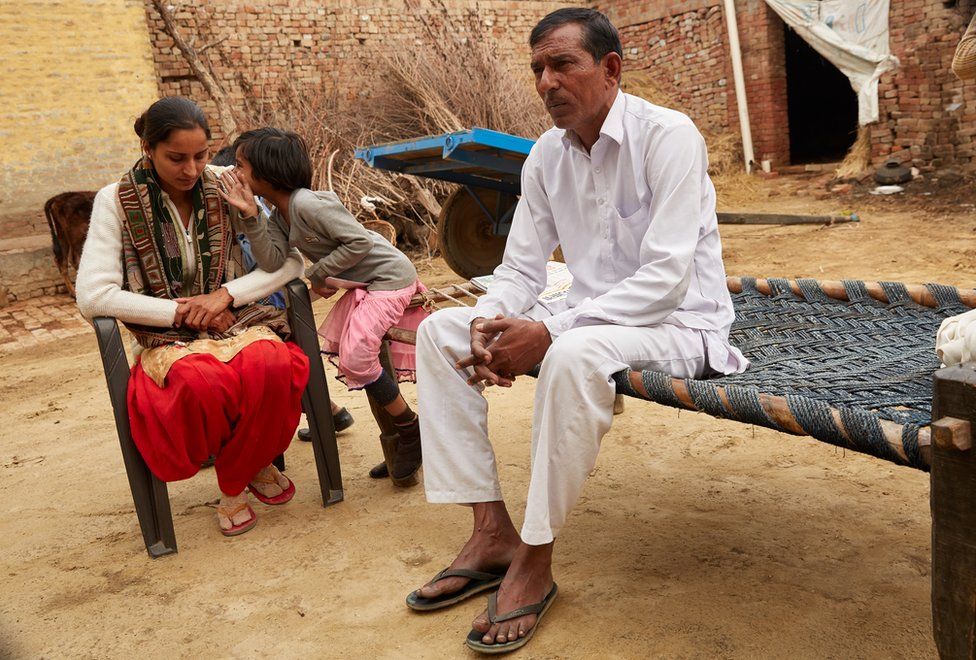
“Things were very good earlier. Muslims and Hindus were together in good and bad times, weddings to deaths. Now we live our separate ways despite living in the same village,” said Gulfam Ali, who runs a small shop selling bread and tobacco.

Modi came to power in 2014 and the BJP took control of Uttar Pradesh state, which includes Nayabans, in 2017, partly on the back of a Hindu-first message. The state’s chief minister, Yogi Adityanath, is a hardline Hindu priest and senior BJP figure.

“Modi and Yogi have messed it up,” said Ali. “Dividing Hindus and Muslims is their main agenda, only agenda. It was never like this earlier. We want to leave this place but can’t really do that.”

He says about a dozen Muslim families have left in the past two years, including his uncle.

The BJP denies its policies have stoked community divisions.

COW KILLING

At the end of last year, Nayabans, a village of wheatfields, narrow cemented streets, bullock carts and loitering cows, became a symbol of India’s deepening divide as some Hindu men from the area complained they had seen a group of Muslims slaughtering cows, which Hindus regard as sacred.

Angry Hindus accused police of failing to stop an illegal practice, and a Hindu mob blocked a highway, threw stones and burned vehicles. Two people were shot and killed – including a police officer.

Five months later many Muslims, who only number about 400 of the village’s population of more than 4,000, say the wounds haven’t healed.

And in a country where 14 percent of the population are Muslim and 80 percent Hindu, Nayabans reflects wider tensions in places where Muslim residents are heavily outnumbered by Hindu neighbours.

The BJP denies it is seeking to make Muslims second-class citizens or is anti-Muslim.

“There have been no riots in the country under this government. It’s wrong to label criminal incidents, which we denounce, as Hindu-Muslim issues,” BJP spokesman Gopal Krishna Agarwal said.

“The opposition has been playing communal politics but we believe in neutrality of governance. Neither appeasement of any, nor denouncement of any. Some people may be finding that they are not being appeased anymore.”

CALL TO PRAYER

To be sure, villagers say Nayabans was not free of conflict in the past – attempts to build a mosque in 1977 led to communal riots in which two people were killed. But for the 40 years after that there had been relative harmony, villagers say.

Some Muslim residents said Hindu hardliners started asserting themselves more in the village after Yogi took office in March 2017.

The atmosphere worsened around the Muslim holy month of Ramadan in 2017 – Hindu activists demanded Muslims stop using a microphone in their madrasa, which also acts as a mosque, to call people to prayer, arguing it disturbed the whole community.

The Muslims reluctantly agreed to stop using the mike and speaker – even though they say it had been operating for many years – to keep the peace, but the move created deep resentment.

Some Hindus were unsympathetic.

“God knows what they are moaning about,” said Hindu elder Om Prakash, a 63-year-old tailor. “There’s peace here but we won’t tolerate any mike there. That’s a madrasa, not a mosque.”

Islam requires the faithful to pray five times a day. Without the reminder of hearing the call, some Muslim residents say they risk missing prayer times.

“We can’t express our religion in any way here, but they are free to do whatever they want,” said Muslim law student Aisha, 21.

She said that Hindu men from the village often shouted anti-Muslim slogans during festival processions. At least a dozen Hindus in the village denied that was the case.

Aisha remembers when relations were better.

“Earlier they would speak very nicely to us, but now they don’t,” said Aisha. “If there was any problem at all, or someone was sick in the family, all the neighbours would come over and help – whether Hindus or Muslims. Now that doesn’t happen.”

“EMPTY OUT”

Sharfuddin Saifi, 38, who runs a cloth shop at a nearby market, was named in a complaint filed with the police by local Hindus over the cow incident last year.

After 16 days in jail, he was released as the police found he had nothing to do with the suspected slaughter, but said he found much had changed.

Hindus now shun his business. The money he spent on lawyers meant he had to stop going to Delhi to buy stock for the shop, which is largely empty. And he withdrew his 13-year-old son from a private school because he could no longer afford it.

“For someone who had never seen the inside of a police station or even dreamt of committing a crime, it’s a big thing,” he said of the trauma of his detention.

He often thinks about leaving the village, he says, but tells himself: “I have not done anything wrong, why should I leave?”

Carpenter Jabbar Ali, 55, moved to a Muslim-dominated area in Masuri, closer to Delhi, buying a house with money he saved from working in Saudi Arabia.

“If Hindus could kill a Hindu police inspector, in front of a police outpost, with armed guards alongside him, then who are we Muslims?” Ali said, recalling the December incident.

He still keeps his house in Nayabans and visits occasionally but said he feels much safer in his new home, where all his immediate neighbours are Muslims.

“I’m fearful here,” he said. “Muslims may have to empty out this place if Modi gets another term, and Yogi continues here.”

Junaid, a round-faced 22-year-old with a goatee, comes from one of the most affluent Muslim families in the village. His father runs a gold shop in a town nearby.

Seated outside his home, he recalled playing sport together with Hindus.

“When we were young all the Hindus and Muslims used to play together, especially cricket – I played it a lot,” he said. “Now we haven’t played in at least a year.”

He said he wanted to move to New Delhi soon to study at a university there. “Things are not good here,” he said.
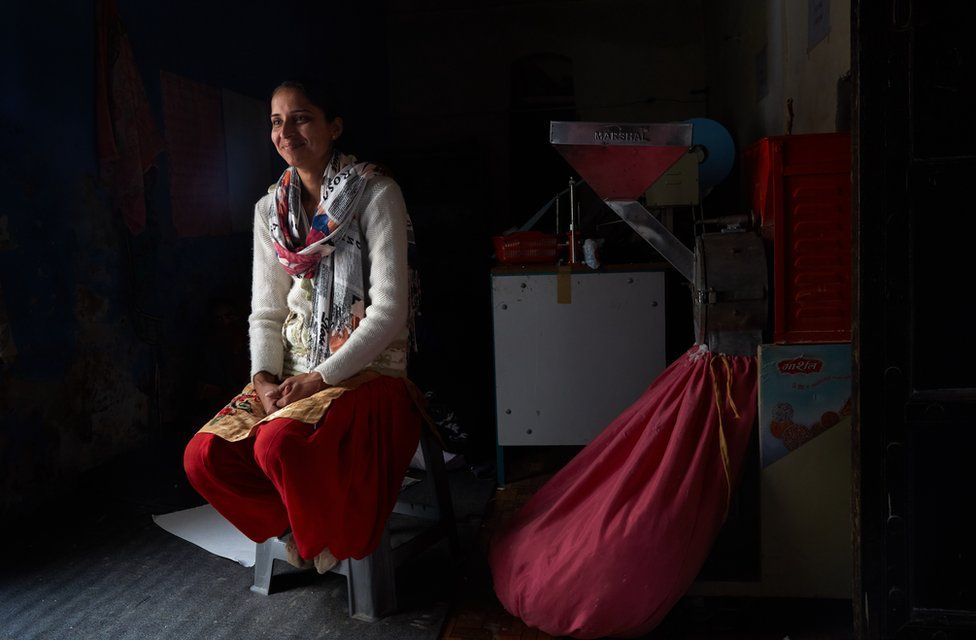

Some Muslims, however, say they are committed to remaining. Aas Mohammed, 42, the owner of a flourishing tiles and bathroom fixtures business in a nearby town, has decided to stay in the village, though he has a house on Delhi’s outskirts.
Mohammed helped arrange a lawyer for Saifi after his arrest over the cow incident. He is now lobbying to have the microphone brought back and fighting a legal battle to get a new mosque built.
“I will fight on,” he said. “I am not scared, but another term for Modi will make it very difficult for many other people to live here.”
Source: Reuters
25/02/2019

Oscars 2019: The Indian sanitary pad makers’ story wins award

Sneh
Image captionSneh, 22, attended the awards ceremony where the film won an Oscar
Presentational white space

A film based on young women in an Indian village who make sanitary pads has won an Oscar for best documentary short. The BBC’s Geeta Pandey met with the women in their village before the ceremony.

Sneh was 15 when she started menstruating. The first time she bled, she had no idea what was happening to her.

“I was very scared. I thought I was sick with something very serious and began crying,” she told me when I visited her home in Kathikhera village not far from Delhi earlier this week.

“I didn’t have the courage to tell my mother so I confided in my aunt. She said: ‘You’re a grown woman now, don’t cry, it’s normal.’ It was her who told my mother.”

Sneh, now 22, has travelled a long way from that point. She works in a small factory in her village that makes sanitary pads and is the protagonist of Period. End of Sentence., a documentary that has been nominated for an Oscar. She will be attending Sunday’s ceremony in Los Angeles.

The film came about after a student group in North Hollywood used crowdfunding to send a pad-making machine – and Iranian-American filmmaker Rayka Zehtabchi – to Sneh’s village.

Just 115km (71 miles) from Delhi, Kathikhera village in Hapur district is a world far removed from the glitzy malls and high-rises of the Indian capital. Normally, it’s a two-and-a-half-hour drive from Delhi, but construction work on the highway slows it down to four hours for us. And the final 7.5km drive to the village from Hapur town is a crawl, on narrow winding roads lined with open drains on both sides.

The documentary is filmed in the farms and fields – and classrooms – of Kathikhera. Like in the rest of India, periods are a taboo topic; menstruating women are considered impure and barred from entering religious places and often excluded from social events too.

Presentational white space
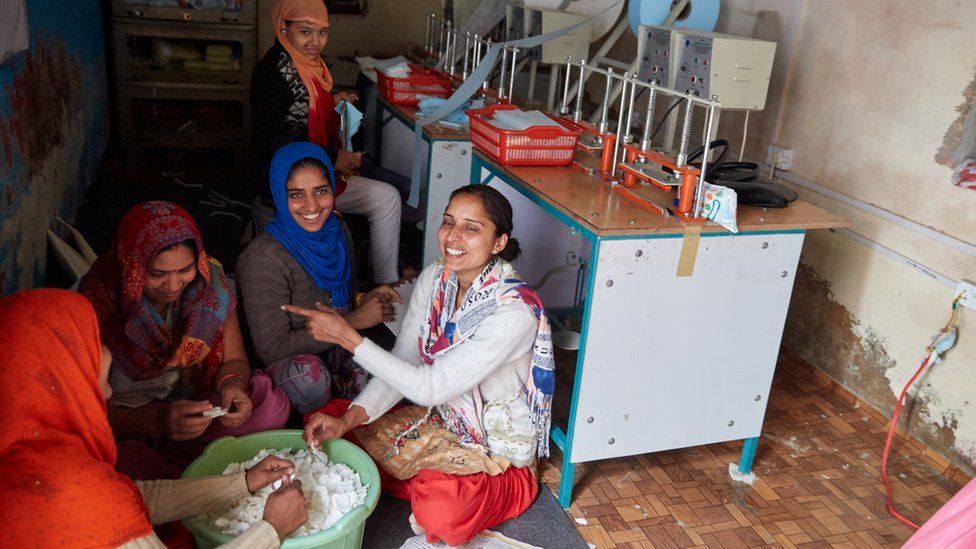
Women making sanitary pads
Image captionSneh says that previously, menstruation was not discussed – even among girls
Presentational white space

With so much stigma surrounding the issue, it’s no surprise that Sneh had never heard of periods before she started getting them herself.

“It was not a topic that was discussed – even among girls,” she says.

But things began to change when Action India, a charity that works on reproductive health issues, set up a sanitary napkin manufacturing unit in Kathikhera.

Presentational white space
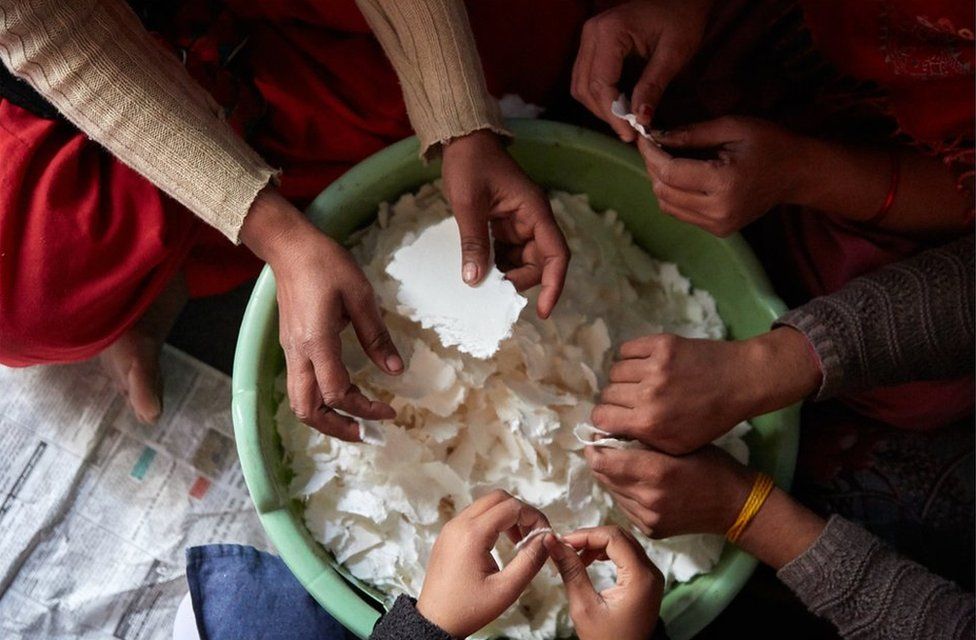
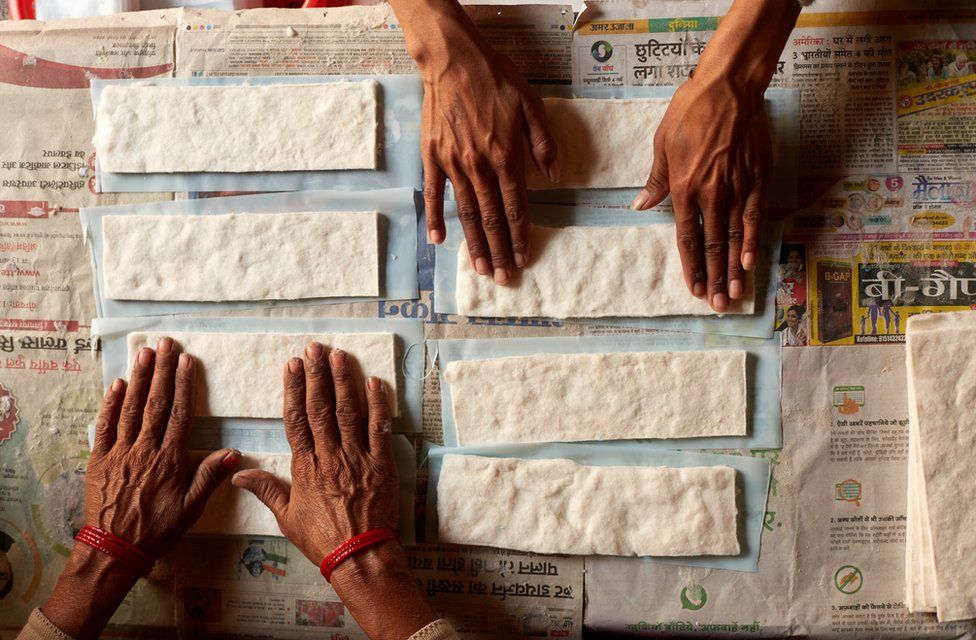
Women prepare the material for making sanitary napkins
Image captionThe women employees work from 9-5 six days a week
Presentational white space
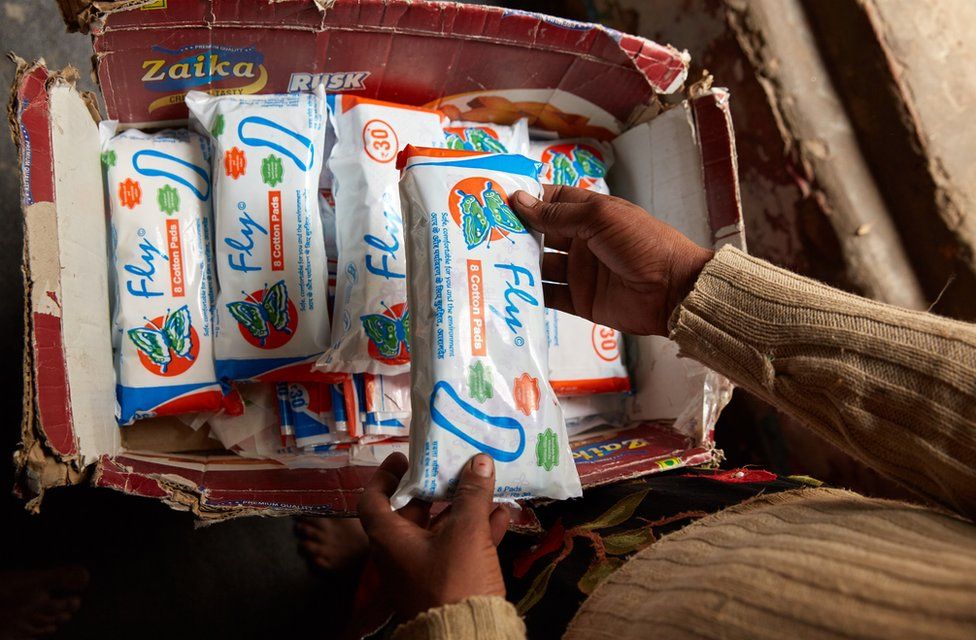
The final product
Image captionA pack is priced at 30 rupees ($0.40; £0.30)
Presentational white space

In January 2017, Sneh was asked by Suman, a neighbour who works with Action India, if she wanted to work in the factory.

A college graduate who dreams of working for the Delhi police one day, Sneh says she was excited. After all, there were “no other job opportunities” in the village.

“When I sought my mum’s permission, she said, ‘ask your father’. In our families, all important decisions are taken by men.”

She was too embarrassed to tell her father that she was going to be making pads so she told him that she would be making children’s diapers.

“It was two months into the job that mum told him that I was making pads,” she laughs. Much to her relief, he said, “That’s alright, work is work.”

Today, the unit employs seven women, between 18 and 31 years of age. They work from 9-5, six days a week and are paid a monthly salary of 2,500 rupees ($35; £27). The centre produces 600 pads a day and they are sold under the brand name Fly.

Presentational white space
Women making sanitary pads
Image captionThe centre produces 600 pads a day
Presentational white space
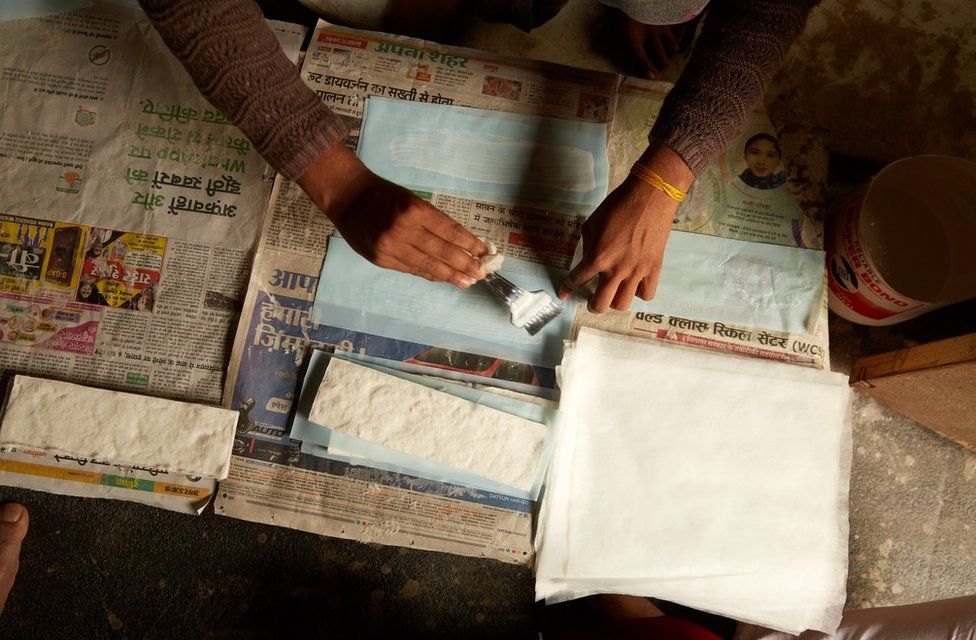
Women making sanitary pads
Image captionMost women in the village used to use old clothes when they got their periods, now 70% use pads
“The biggest problem we face is power cuts. Sometimes we have to come back at night to work when the power is back to meet the targets,” Sneh says.

This little business, run from two rooms in a village home, has helped improve feminine hygiene. Until it was set up most women in the village were using pieces of cloth cut out from old saris or bedsheets when they had their period, now 70% use pads.

It’s also de-stigmatised menstruation and changed attitudes in a conservative society in ways that were unimaginable just a couple of years ago.

Sneh says menstruation is now discussed openly among women. But, she says, it’s not been an easy ride.

“It was difficult at the start. I had to help my mother with housework, I had to study and do this job. Sometimes during my exams, when the pressure became too much, my mother went to work instead of me,” she says.

Her father, Rajendra Singh Tanwar, says he is “very proud” of his daughter. “If her work benefits the society, especially women, then I feel happy about it.”

Presentational white space
Sneh with her father
Image captionRajendra Singh Tanwar says he’s proud of what Sneh (left) has done
Presentational white space
Sushma Devi
Image captionSushma Devi’s husband does not want her to work there – but she won’t give it up
Presentational white space

Initially, the women faced objections from some villagers who were suspicious about what was happening at the factory. And once the film crew arrived, there were questions about what they were doing.

And some, like 31-year-old Sushma Devi, still have to fight daily battles at home.

The mother-of-two says her husband agreed to let her work only after Sneh’s mother spoke to him. He also insisted that she finish all the housework before going to the factory.

“So I wake up at 05:00, clean the house, do the laundry, feed the buffaloes, make dung cakes which we use as cooking fuel, bathe, and make breakfast and lunch before I step out. In the evening, I cook dinner once I get back.”

But her husband is still unhappy with the arrangement. “He often gets angry with me. He says there’s enough work at home, why do you have to go out to work? My neighbours too say it’s not a good job, they also say the salary is low.”

Two of Sushma’s neighbours had worked at the factory too, but left after a few months. Sushma has no intention of doing the same: “Even if my husband beats me up, I will not give up my job. I enjoy working here.”

Presentational white space
Members of Action India and some of the factory workers
Image captionAction India, a charity that works on reproductive health issues, set up the manufacturing unit two years ago
Presentational white space

In the documentary, Sushma is heard saying she’d spent some of her earnings to buy clothes for her younger brother. “If I’d known this was going to go to Oscars, I would have said something more intelligent,” she says, laughing.

For Sushma, Sneh and their fellow workers, the Oscar nomination has come as a big boost. The film, which is available on Netflix, is nominated in the Best Short Documentary category.

As Sneh prepares to leave for Los Angeles, her neighbours are appreciative of the “prestige and fame” she has brought the village.

“No-one from Kathikhera has ever travelled abroad so I’ll be the first one to do so,” she says. “I’m now recognised and respected in the village, people say they are proud of me.”

Sneh says she had heard of Oscars and knew they were the biggest cinema awards in the world. But she had never watched a ceremony, and certainly didn’t think that one day she would be on the red carpet.

“I never thought I would go to America. Even now I can’t fully process what’s happening. For me, the nomination itself is an award. It’s a dream that I’m dreaming with my eyes open.”

Source: The BBC

Law of Unintended Consequences

continuously updated blog about China & India

ChiaHou's Book Reviews

continuously updated blog about China & India

What's wrong with the world; and its economy

continuously updated blog about China & India