Archive for ‘Industrial park’

09/07/2019

Wuhan protests: Incinerator plan sparks mass unrest

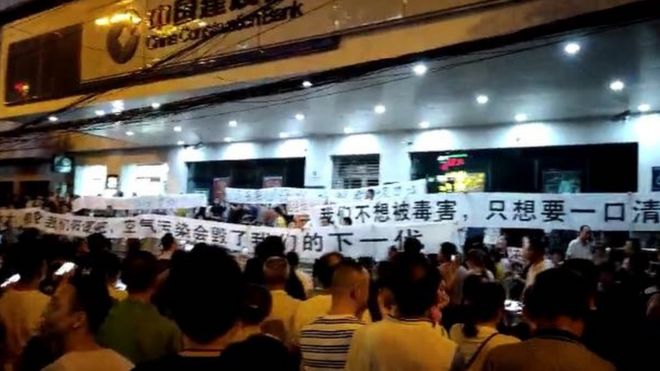
Protest in Wuhan
Image caption Local people say having an incinerator near their homes will be dangerous

While the world’s attention has been focused on the protests in Hong Kong, another Chinese city has been witnessing unrest on a scale rarely seen on the mainland.

Thousands of citizens in Wuhan, the capital city of central Hubei province, took to the streets last week for several days.

They were angry about a planned waste incineration plant they say will bring dangerous levels of pollution to their town.

But as the protests steadily grew over the week, a censorship and public security operation kicked in to try to keep a lid on the unrest.

Why are they so angry?

Wuhan desperately needs to find ways to handle the waste generated by its 10 million residents. So it has drawn up plans for a huge incinerator, to be based in the Yangluo zone of Xinzhou district, where about 300,000 people live.

According to a city government document published in February, the incinerator would possess a daily capacity of 2,000 tonnes of rubbish.

Xinzhou district also already hosts a waste landfill, the strong smells of which, according to some locals, can be caught even when one passes the area on a bus.

But there has been public concern that badly-made incinerators can emit dioxins that are highly toxic and can damage the immune system, interfere with hormones and cause cancer. In 2013, five such plants in Wuhan city were found to be sub-standard and emitting dangerous pollutants, according to China’s state broadcaster CCTV.

Social media footage of police in WuhanImage copyright OTHER
Image caption Grainy social media footage showed huge numbers of police moving into the town

In late June, rumours began spreading that work had already started on the new plant, on a patch of land in Yangluo designated as an industrial park, close to residences and two schools.

Local people took to the streets for several days, demanding that the location be re-thought. They held banners with slogans like “air pollution will damage the next generation” and “we don’t want to be poisoned, we just need a breath of fresh air”. They weren’t demanding it be scrapped completely, just that it be moved further away.

The protests grew over several days and, according to some locals, the night with the biggest crowds saw up to 10,000 people taking part.

How has the government responded?

At first the Xinzhou district government attempted to calm the unrest. It issued a statement last Wednesday denying that work had started on the incinerator. It said the project hadn’t even been registered, nor had it gone through any environmental assessment.

They said the local government would attach “great importance to the voices of the people” in its decision-making, but warned that public security authorities would crack down on any “illegal criminal acts such as malicious incitement and provocation”.

Several locals said people were detained but the exact number couldn’t be confirmed.

Over the weekend, the authorities appear to have successfully quashed the protests. Some locals said riot police were on the streets and shops around the protest sites had been ordered to shut by 6pm.

Meanwhile, China’s censors have been at work. Local voices on social media have been vanishing fast. Videos and photos of the crowded streets and clashes between the protesters and the police can be censored within hours. While there were a few reports in domestic media about the incinerator, none of them covered the protests.

Local people have said they’re not satisfied with the district government’s reassurances, because it’s the municipal authorities who have the final say.

But the municipality has kept quiet so far.

How unusual is this for China?

China often sees public protests like this, but mostly on a much smaller scale.

While the Chinese public have largely avoided protests about political reforms since the Tiananmen movement was crushed in 1989, “not in my back yard” protests related to environmental problems have become more common.

Civil movements against high-polluting projects date back to at least 2007 when a significant protest broke out in Xiamen city of Fujian province against an industrial chemical plant.

The incident became well-known at a time of lighter censorship, and the local government ended up moving the location of the project out of the city.
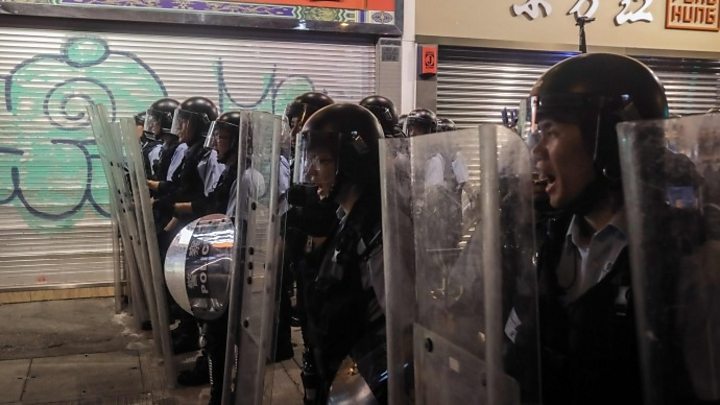
Media caption Hong Kong police and protesters clash

In 2015 there were protests in both Shanghai and northern Tianjin over planned manufacturing plants which locals felt put them in danger.

And in 2017, Qingyuan city in Guangdong province also saw protests over an incinerator.

During the Qingyuan protests nearly 10,000 locals took to the streets and police reportedly fired tear gas at the height of the unrest. Three days later the government cancelled the planned incinerator.

Might the Wuhan authorities learn from Qingyuan?

So far there’s no sign of that.

Even after a week of protests the city government seems deaf to public opinion.

Source: The BBC

15/02/2019

Beijing unveils plan to transform vacated “Steel City”

BEIJING, Feb. 14 (Xinhua) — The Beijing municipal government has published a plan to transform a vacated industrial site in its western suburb into a city landmark by 2035, as part of the preparation for the Beijing 2022 Winter Olympics.

The new area, on the basis of the Shougang Park, a former steel plant relocated to neighboring Hebei Province in 2010, covers an area of 22.3 square km, according to the plan released Wednesday by the city’s development and reform commission.

“Building on the existing facilities, we will create a distinct community composed of museums, industrial incubators and leisure facilities,” said Hong Jiyuan, deputy director of the commission.

Sports facilities including a ski site and a training center are under construction in the park for the Winter Olympics. The facilities will be used after the Games to host international events and exhibitions, according to the plan.

Beijing is also building more lakes, forest parks and waterscapes in the area to create an eco-friendly demonstration space.

Shougang Group will cooperate with enterprises both at home and abroad to rejuvenate the old industrial area, said Wang Shizhong, deputy general manager of the company, adding that Beijing’s first 5G network and an artificial intelligence industrial park will be established there.

Source: Xinhua

06/02/2019

Ethiopia to commission Chinese built industrial park by end of February

ADDIS ABABA, Feb. 5 (Xinhua) — Ethiopia is to commission the Chinese built Debre Birhan industrial park by the end of February, state media outlet Amhara Mass Media Agency (AMMA) reported on Tuesday.

Debre Birhan industrial park constructed by China Communications Construction Company (CCCC) at a cost of 71 million U.S. dollars is expected to create job opportunities for about 1,000 Ethiopians once it starts operations, reported AMMA.

Stretched on 75 hectares of land, Debre Birhan industrial park will have eight industrial sheds ready to accommodate prospective investors once it’s fully commissioned.

Speaking to Xinhua recently, Lelise Neme, CEO of Ethiopia Industrial Park Development Corporation (IPDC), said Ethiopia aims to commission six industrial parks, including Debre Birhan industrial park, before the end of the current fiscal year 2018/19, in July.

“Ethiopia has invested around 1.3 billion U.S. dollars in the construction of around a dozen industrial parks, which it sees as a key strategy of achieving Ethiopia’s industrial ambitions,” said Neme.

“Ethiopia has so far built and commissioned five industrial parks and with the anticipated commissioning of six more industrial parks in 2018/19, Ethiopia’s industrialization ambitions will receive a massive boost,” Neme told Xinhua.

With Ethiopia attracting large-scale investment in the export-import-oriented manufacturing sector, especially from Chinese firms, the country sees improving the efficiency and speed of the logistics sector as key to meet national manufacturing revenue goals.

Ethiopia plans to increase the number of operational industrial parks from the current five to around 30 by 2025, as part of its efforts to make the country a light manufacturing hub and lower-middle-income economy in the same period.

Source: Xinhua

17/01/2019

Beijing builds cybersecurity industrial park

BEIJING, Jan. 16 (Xinhua) — Beijing is building a national-level cybersecurity industrial park to boost the industry and tap into the potential of domestic tech companies.

Over 10 companies specialized in internet security have signed a contract to move into the park, which has two branches respectively in Haidian district and Tongzhou district, according to the Beijing Municipal Bureau of Economy and Information Technology.

Construction on the park started at the end of 2017. By 2020, the industrial output is expected to reach 100 billion yuan (about 14.5 billion U.S. dollars).

“We are actively advancing the project. Leading firms in cybersecurity from home and abroad will establish their headquarters in the park,” said Jiang Guangzhi, an official with the bureau.

As smart cities’ initiatives using information technology are rolling out in many cities in China, the demand for internet security infrastructure is high.

“The fact that many agencies and organizations are exploring digitization and information technology without sufficient security creates a lot of risks,” said Qi Xiangdong, a member of the Beijing municipal committee of the Chinese People’s Political Consultative Conference. The committee is currently holding its annual session.

“Beijing is the center for political activity, culture, international exchange and technological innovation, but it is also a big target for cyber attacks,” said Qi.

The 360 Enterprise Security Group said it found security loopholes in over half of the one million websites in Beijing. On a daily basis, over 9.55 million malware are detected and blocked from PC users.

The global average of security spending in IT is about 3.7 percent of the total IT spending, but the Chinese average is only 1.1 percent, Qi said.

Insufficient investment in cybersecurity may lead to serious consequences, said Tong Liqiang, also a member of the committee and former director of the Beijing cyber information office.

“A full-fledged internet security shield is still not yet in place, but it is needed to service the development of the IT industry, tackle the security challenges and meet the public demand,” said Tong.

Source: Xinhua

Law of Unintended Consequences

continuously updated blog about China & India

ChiaHou's Book Reviews

continuously updated blog about China & India

What's wrong with the world; and its economy

continuously updated blog about China & India