Archive for ‘industrial parks’

22/06/2019

What China must do to clean up its act on waste water

  • Inadequate infrastructure and industry standards are holding the country back in the battle to save the environment, new study finds
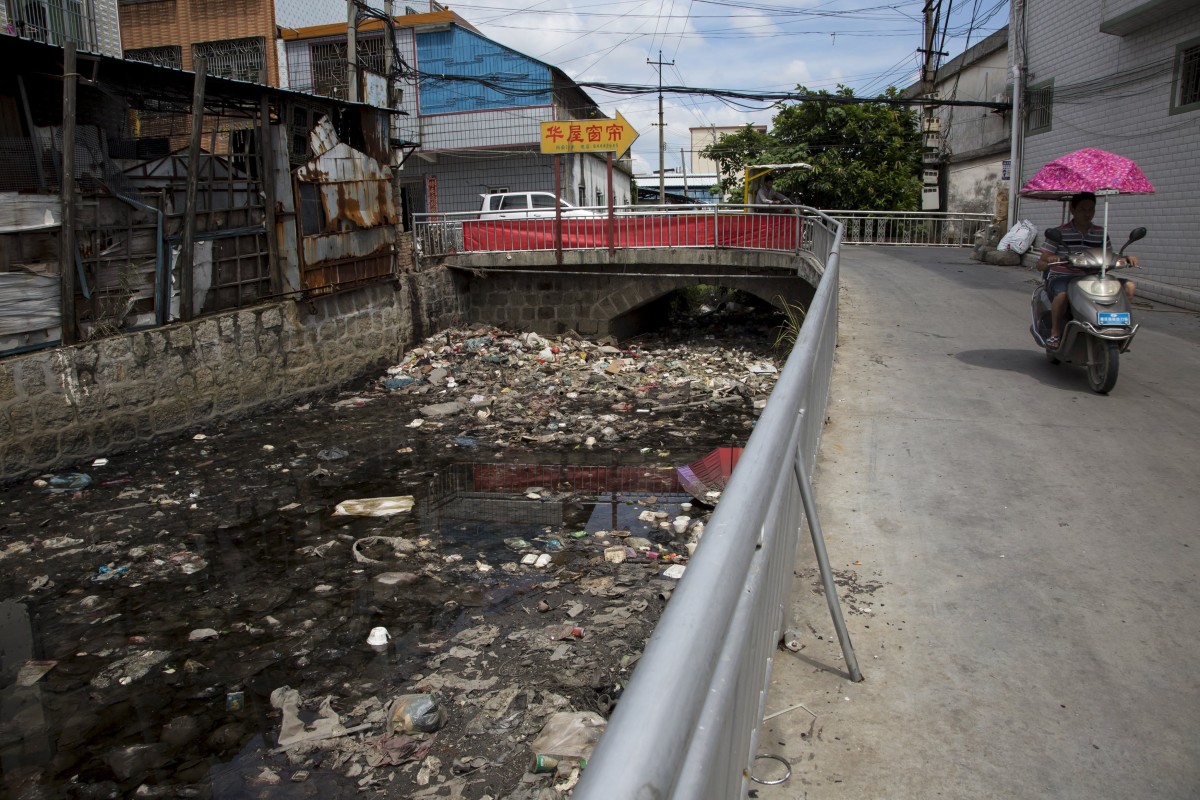
In some extreme cases, incomplete pipework meant factories in industrial parks discharged directly into waterways. Photo: Reuters
A shortage of waste water pipelines, lax local government oversight and a lack of industry standards are holding back efforts to cut industrial water pollution in China, according to a new joint study.
The research by Greenpeace and Nanjing University also found that many of the country’s waste water treatment plants were among its biggest polluters singled out by authorities.
Researchers made the assessment by examining data and reports released by the Ministry of Ecology and Environment last year. According to the reports, 243 – or 56 per cent – of the 436 major polluters fined in 2018 for excessive discharges were waste water treatment plants.
That is despite Beijing claiming to be one of the biggest processors of industrial and household waste water by volume in the world.
Fighting water pollution is part of Beijing’s pledge to fix the country’s depleted environment by 2020, one of the priorities President Xi Jinping identified at the start of his second five-year term in late 2017.
Dong Zhanfeng, deputy director of the Environmental Policy Department at the Chinese Academy for Environmental Planning, said waste water treatment was an important part of the fight against pollution.
“It’s called a ‘critical battle’ because the work is really tough,” Dong said.
China says progress made on water pollution, but battle remains

To try to curb contamination from industry, the central government has urged provincial authorities to concentrate factories in industrial parks, where infrastructure must be built to treat waste water.

The Greenpeace-Nanjing University researchers found that by the end of the third quarter last year, 97 per cent of 2,411 industrial waste water treatment plants needed for industrial parks around the country had been constructed. But not all of the completed plants were in full use because of insufficient pipes connecting factories and the treatment plants.

In extreme examples cited by the report, incomplete pipework meant two treatment plants in Hubei laid dormant for two years, forcing factories in the industrial parks to discharge directly into waterways.

In other cases, factories not linked to industrial waste water treatment plants discharged into the general sewage system, with the effluent ending up at household waste water treatment plants that could only filter part of the industrial waste.

This was the case in the southwest province of Guizhou, where a lack of pipework meant 89 of the 128 industrial parks relied on city sewage systems to treat polluted water.

Deng Tingting, a Beijing-based campaigner with Greenpeace East Asia, said conditions were a mess.

“Brand new waste water treatment plants sit unused while waste pumps into streams and rivers.

The current state of affairs is a mess, and it keeps companies from entering the growing market for waste water treatment. The decision not to shepherd this growing industry is a risky one,” Deng said.

China admits patchy progress tackling soil, water pollution, with some rivers worsening

The Ministry of Ecology and Environment estimated last year that in all China needed 400,000km (248,550 miles) of waste water pipework, costing around 1 trillion yuan (US$145 billion). The ministry did not say how much remained to be built.

Another major problem identified by the study was the lack of treatment standards for industrial waste water plants, with many plants relying on quality standards for household waste water treatment.

In addition, the researchers highlighted the problem of local governments and industrial park administrators shirking their responsibility to enforce standards.

The study called for clear demarcation of regulatory and oversight responsibilities among local environmental watchdogs, industry, industrial parks and water treatment plants.

Source: SCMP

10/03/2019

Wuhan to invest 40 bln yuan in high-tech infrastructure

WUHAN, March 9 (Xinhua) — The city of Wuhan, capital of central China’s Hubei Province, will invest 40 billion yuan (about 6 billion U.S. dollars) to provide key support to the development of high-tech infrastructure by 2022, local authorities said.

The province and its capital will forge ahead with high-tech industries by raising a 10-billion-yuan fund per year for major projects, platforms, industrial parks, equipment and talent teams, from 2019 to 2022.

So far, a research facility of precise gravity measurement, a national major science and technology infrastructure, is under construction in the Huazhong University of Science and Technology in Wuhan.

In the past few years, the city has completed a pulsed high magnetic field facility and opened China’s first national bio-safety level four lab, which requires the highest level of biological safety.

Wuhan will work with universities, institutes and enterprises to achieve great breakthroughs in various fields including integrated electromagnetic energy, optoelectronics, microelectronics, geomatics, and new materials, as well as build national laboratories.

Data released at the city’s science and technology conference for 2019 on Friday showed that the value added of the hi-tech industries in Wuhan exceeded 300 billion yuan last year, accounting for 20.56 percent of the city’s gross domestic product.

With 3,536 high-tech enterprises in total, the city is making efforts to build itself into a tech hub of the country.

Source: Xinhua

Law of Unintended Consequences

continuously updated blog about China & India

ChiaHou's Book Reviews

continuously updated blog about China & India

What's wrong with the world; and its economy

continuously updated blog about China & India