Archive for ‘infections’

30/03/2020

Drop in China’s new coronavirus cases; none in Wuhan for sixth day

WUHAN, China (Reuters) – China reported a drop in new coronavirus infections for a fourth day as drastic curbs on international travellers reined in the number of imported cases, while policymakers turned their efforts to healing the world’s second-largest economy.

The city of Wuhan, at the centre of the outbreak, reported no new cases for a sixth day, as businesses reopened and residents set about reclaiming a more normal life after a lockdown for almost two months.

Smartly turned out staff waited in masks and gloves to greet customers at entrances to the newly-reopened Wuhan International Plaza, home to boutiques of luxury brands such as Cartier and Louis Vuitton.

“The Wuhan International Plaza is very representative (of the city),” said Zhang Yu, 29. “So its reopening really makes me feel this city is coming back to life.”

Sunday’s figure of 31 new cases, including one locally transmitted infection, was down from 45 the previous day, the National Health Commission said.

As infections fall, policymakers are scrambling to revitalise an economy nearly paralysed by months-long curbs to control the spread of the flu-like disease.

On Monday, the central bank unexpectedly cut the interest rate on reverse repurchase agreements by 20 basis points, the largest in nearly five years.

The government is pushing businesses and factories to reopen, as it rolls out fiscal and monetary stimulus to spur recovery from what is feared to be an outright economic contraction in the quarter to March.

China’s exports and imports could worsen as the pandemic spreads, depressing demand both at home and abroad, Xin Guobin, the vice minister of industry and information technology, said on Monday.

The country has extended loans of 200 billion yuan (22.75 billion pounds) to 5,000 businesses, from 300 billion allocated to help companies as they resume work, Xin said.

Authorities in Ningbo said they would encourage national banks to offer preferential credit of up to 100 billion yuan to the eastern port city’s larger export firms. The city government will subsidize such loans, it said in a notice.

VIRUS CONCERNS

While new infections have fallen sharply from February’s peak, authorities worry about a second wave triggered by returning Chinese, many of them students.

China cut international flights massively from Sunday for an indefinite period, after it began denying entry to almost all foreigners a day earlier.

Average daily arrivals at airports this week are expected to be about 4,000, down from 25,000 last week, an official of the Civil Aviation Administration of China told a news conference in Beijing on Monday.

The return to work has also prompted concern about potential domestic infections, especially over carriers who exhibit no, or very mild, symptoms of the highly contagious virus.

Northwestern Gansu province reported a new case of a traveller from the central province of Hubei, who drove back with a virus-free health code, national health authorities said.

Hubei authorities say 4.6 million people in the province returned to work by Saturday, with 2.8 million of them heading for other parts of China.

Most of the departing migrant workers went to the southern provinces of Guangdong and Fujian, the eastern provinces of Zhejiang and Jiangsu, and northeast China.

In Hubei’s capital of Wuhan, more retail complexes and shopping streets reopened.

Electric carmaker Tesla Inc has also reopened a showroom in Wuhan, a company executive said on Weibo.

Shoppers queued 1-1/2 metres (5 ft) apart for temperature checks at Wuhan International Plaza, while flashing “green” mobile telephone codes attesting to a clean bill of health.

To be cleared to resume work, Wuhan residents have been asked to take nucleic acid tests twice.

“Being able to be healthy and leave the house, and meet other colleagues who are also healthy is a very happy thing,” said Wang Xueman, a cosmetics sales representative.

Source: Reuters
08/03/2020

Shanghai tightens airport checks as imported virus infections in China jump

BEIJING (Reuters) – Shanghai increased airport screening on Saturday as imported coronavirus infections from countries such as Italy and Iran emerge as the biggest source of new cases in China outside Hubei, the province where the outbreak originated.

Mainland China had 99 new confirmed cases on Friday, according to official data. Of the 25 that were outside Hubei, 24 came from outside China.

Shanghai, which had three new cases that originated from abroad on Friday, said it would step up control measures at the border, which had become “the main battlefield”.

At a news conference, Shanghai Customs officials said they city would check all passengers from seriously affected countries for the virus, among other airport measures.

Shanghai already requires passengers flying in from such countries, regardless of nationality, to be quarantined for 14 days. They will now be escorted home in vehicles provided by the government.

Tighter screening has greatly lengthened waiting times at Shanghai’s Pudong International Airport – some passengers say they have had to wait as long as seven hours.

The Shanghai government vowed on Saturday to severely punish passengers who concealed infections.

Beijing police said on Saturday they would work with other departments to prevent imported infections. They said some members of a Chinese family flying in from Italy on March 4 had failed to fill in health declarations accurately, and later tested positive for the virus.

MIGRANT WORKERS

In addition to the growing risk of imported infections, China faces a challenge in trying to get migrant workers back to work by early April.

So far, 78 million migrant workers, or 60% of those who left for the Lunar New Year holiday in January, have returned to work.

Yang Wenzhuang of the National Health Commission (NHC) said that the “risk of contagion from increased population flows and gathering is increasing … We must not relax or lower the bar for virus control”.

But new cases in mainland China continued to decline, with just 99 new cases on Friday, the lowest number the NHC started publishing nationwide figures on Jan. 20, against 143 on Thursday.

Most of these cases, which include infections of Chinese nationals who caught the virus abroad, were in the northwesterly Gansu province, among quarantined passengers who flew into the provincial capital Lanzhou from Iran between March 2 and 5.

For the second day in a row, there were no new infections in Hubei outside the provincial capital Wuhan, where new cases fell to the lowest level since Jan. 25.

The total number of confirmed cases in mainland China so far is 80,651, with 3,070 deaths, up by 28 from Thursday.

Hubei reported 28 deaths, 21 of them in Wuhan.

Source: reuters

04/03/2020

Sanitisers get priority over South Korea’s soju drink in virus crisis

SEOUL (Reuters) – Makers of soju, South Korea’s national drink and one of the world’s best selling spirits, are jumping into the fight on the largest outbreak of coronavirus outside China by sharing their stockpiles of alcohol with makers of sanitisers.

Disinfectants, such as hand sanitisers, are flying off the shelves, along with medical-grade masks, as infections in South Korea have surged past 5,000 in just over a month since its first patient was diagnosed.

South Korean soju makers have responded to soaring ethanol demand for sanitisers by donating the alcohol that goes into the drink, a distilled spirit with 17% to 20% alcohol by volume traditionally based on rice, but now often wheat or potatoes.

“Ethanol demand for disinfection has grown while supply is limited…we have decided to provide it,” an official of Daesun Distilling, based in the southeastern city of Busan, told Reuters.

To banish the virus, the company has pledged to donate 32 tonnes of ethanol for use in disinfecting buildings and public places in Busan and southeastern Daegu, the city at the centre of South Korea’s outbreak.

“We plan to keep donating until the coronavirus outbreak is stabilised and to donate 50 tonnes more,” added the official, who sought anonymity as he was not authorised to speak to media.

South Koreans drink an average of about 12 shots of soju each week, media say, citing industry figures. Ethanol for alcoholic drinks can be produced by fermentation or distillation, typically from grains and plants.

The chemical can also be made from petrochemical feedstock.

Whether used for liquor or disinfection, both have the same chemical structure and can break apart the virus particle, said Lee Duckhwan, a chemistry professor at Sogang University in Seoul, the capital.

“If there’s any difference, that is the liquor tax imposed on ethanol produced by liquor makers,” Lee said.

The virus fears boosted February sales of soaps and hand sanitisers, including those with an alcohol base, to four times the level a year ago, data from a major retailer Lotte Mart shows. Shares of ethanol producers also jumped.

Following Daesun Distilling, Hallasan Soju, based on the resort island of Jeju, also provided 5 tonnes of ethanol to authorities on Tuesday, a company official said.

Source: Reuters

23/02/2020

Daily necessity supplies stable in Hubei, rest of China: official

BEIJING, Feb. 22 (Xinhua) — Supply of daily necessities has been stable in China, including the epidemic-hit Hubei Province, despite the ongoing novel coronavirus outbreak that heavily impacted daily life and factory activities, an official with the Ministry of Commerce said Saturday.

With more Chinese returning to work, more than 95 percent of the chain supermarkets and about 90 percent of the large fast-food chains have opened to customers, Wang Bin with the commerce ministry told a press conference.

Meanwhile, around 80 percent of the chain convenience stores and 80 percent of the large wholesale farm produce markets nationwide have resumed operation, along with many farmers’ markets and grocery stores.

In China’s 50 key wholesale farm produce markets, vegetable transaction volume on Friday jumped 26.4 percent from the beginning of the month, he said.

In contrast, other retailers are getting back to service at a slower pace. For instance, only 50 percent of the department stores and shopping malls have so far opened for business, according to Wang.

For Hubei, especially the provincial capital Wuhan where the epidemic first broke out with the largest number of infections, Wang said while the epidemic did cause some difficulties, the local market is generally stable with stocks of grain, meat and vegetables on the rise.

Local authorities in Wuhan have ordered online purchase, group buying and direct delivery services to provide daily necessities to residents kept indoors by the epidemic.

Up to 80 percent of communities in the city’s central districts are covered by group buying services from shops and supermarkets, he said.

To ensure food price stability in the epidemic-hit Hubei, Wang said the commerce ministry has ordered 150 key food producers, including state-owned food group COFCO and major pork producer Shuanghui, to provide over 600,000 tonnes of food to the region.

For the next stage, Wang said the authorities will work on product circulation, farm product sales and further resumption of wholesale markets to both help farmers sell their produce while ensuring daily supplies for residents amid the epidemic.

Source: Xinhua

20/02/2020

Coronavirus: how Diamond Princess cruise ship became a ‘super spreading’ site

  • It started with a cough by a passenger who had visited China, leading to the two-week quarantine of some 3,700 passengers and crew
  • At least 218 cases have been detected on board the Diamond Princess, which has been described as ill-equipped to prevent the spread of infections
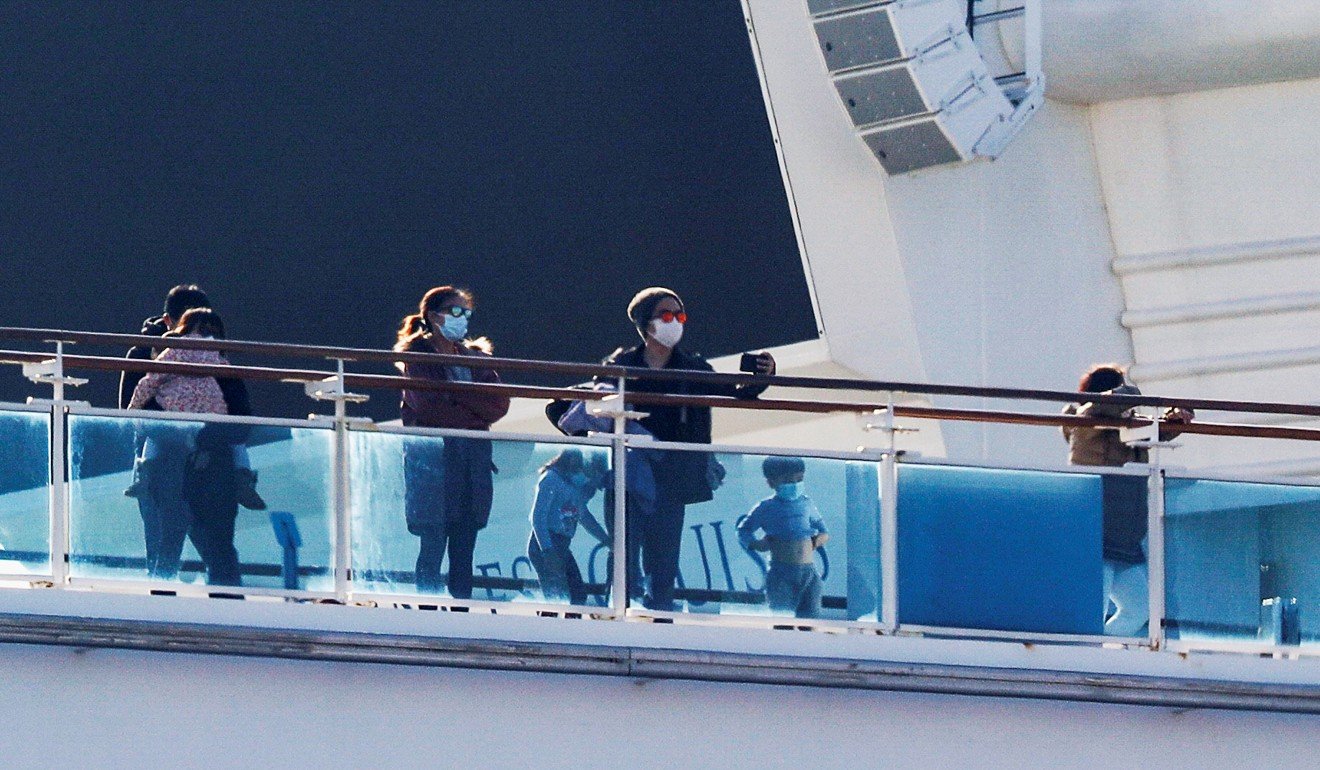
Passengers and crew on the Diamond Princess cruise liner are under quarantine until February 19, 2020. Photo: Reuters
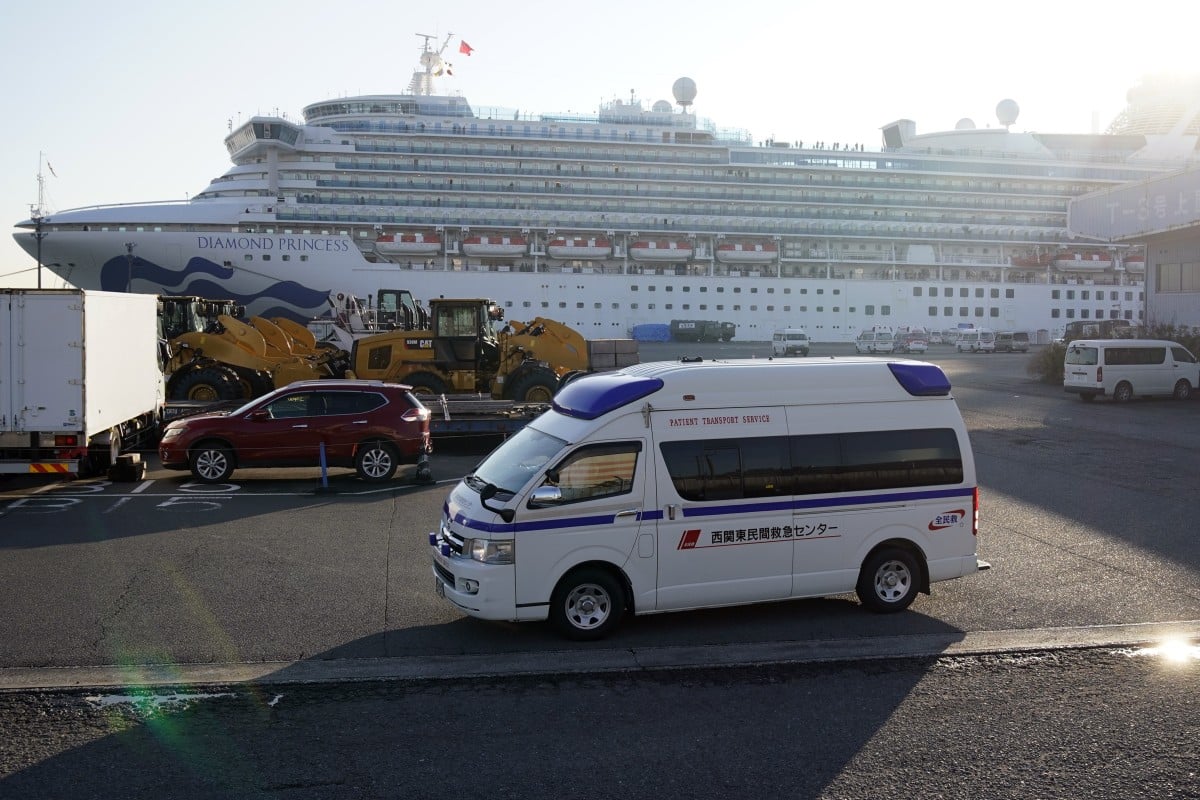
For almost a fortnight and counting, the Diamond Princess has resembled a floating hospital more than a luxury cruise liner, as 3,711 passengers and crew have remained under quarantine in Japan due to an outbreak of the deadly coronavirus on board.
The UK-flagged vessel, which set out on a 29-day voyage from Singapore to Yokohama on January 6, has been in lock-down since arriving at the Japanese city on February 3, after an elderly passenger who disembarked in Hong Kong tested positive for the virus, which causes the respiratory disease officially known as Covid-19.
Along the way, the ship had stopped at 14 ports, including Ho Chi Minh City in 
Vietnam, 

Kobe and Osaka in Japan, and Taipei in Taiwan, with repeat visits to a number of destinations, including Hong Kong.

How did the outbreak start?

While the exact source of the outbreak on the Diamond Princess is yet to be determined, it is suspected to be linked to a 80-year-old man from Hong Kong who had recently made a brief visit to mainland China.

The man boarded the ship on January 20 in Yokohama before disembarking five days later in Hong Kong, where he tested positive for the virus after seeking medical attention for symptoms including a cough.
Coronavirus: 44 more cases on Diamond Princess cruise ship
13 Feb 2020

How many people have tested positive for the coronavirus on board?

Japanese Health Minister Katsunobu Kato announced on Thursday that 44 new cases
of the virus had been detected on the Diamond Princess, including a quarantine officer who tested positive, bringing the total number of infections on board to at least 218.
The hike in infections came after officials announced 40 fresh cases on Wednesday. Authorities have so far tested 713 people on board, fewer than one-fifth of the total, but the outbreak already ranks as the largest single cluster of infections outside mainland

China.

Japan has confirmed 247 cases overall since the virus was first detected in the Chinese city of Wuhan in late December.

Passengers are allowed short visits above deck for fresh air. Photo: Reuters

What has it been like for passengers on board?

Passengers who have not been diagnosed with the coronavirus have been asked to stay in their cabins, except for short visits above deck for fresh air, until the quarantine period ends on February 19.

Those who have tested positive have been evacuated to onshore medical facilities. Health officials announced on Thursday that they intended to move elderly people and those with pre-existing conditions off the ship in the coming days even if they tested negative.

Many of those on board have described the tedium of being confined to their cabins and anxiety about the virus spreading further, or expressed frustration at the lack of timely information about the outbreak coming from Japanese authorities.

“It’s getting tougher by the day, and certainly for passengers with the inside cabins, it’s not easy,” said British passenger David Abel in a Facebook live-stream on Thursday.

The sorry state of Hongkongers stuck aboard quarantined cruise ship in Japan

11 Feb 2020

Some passengers have praised the efforts of the crew to keep up people’s spirits, including putting together videos featuring magic tricks and dance and stretching routines.

Matthew Smith, a passenger from the United States, has racked up thousands of followers on Twitter with his regular upbeat appraisals of the ship’s food.

“Don’t believe the honeymooners who would rather be in an American hospital,” he wrote in one post last week. “You might have to drag me off the ship when the quarantine ends.”

The event on the Diamond Princess cruise would fit the description of a super spreading event. David Hui, infectious diseases expert

Why has Japan’s handling of the outbreak been so controversial?

Some medical experts have questioned the wisdom of placing the passengers and crew in quarantine in the close confines of a ship, rather than removing them to dedicated facilities on the shore.

“Ideally, the crew members and the passengers should be quarantined at holiday camps,” said David Shu-Cheong Hui, the director of the Stanley Ho Centre for Emerging Infections Diseases in Hong Kong. “The event on the Diamond Princess cruise would fit the description of a super spreading event.”

Panic buying, mistrust and economic woes as Japan reels from coronavirus

12 Feb 2020

Kumar Visvanathan, an infectious diseases expert at the University of Melbourne, said a cruise liner such as the Diamond Princess would be ill-equipped to prevent the spread of infections.

“It seems that though isolation in individual cabins is somewhat effective, the increasing numbers of symptomatic infections seems to suggest active infections even with the best precautions are occurring,” Visvanathan said.

“It is clear that cruise ships and their individual cabins are not made for isolation purposes and depend heavily on individual participation in the isolation procedures, including respiratory hygiene, cough etiquette and hand hygiene,” he said.

Japanese city encourages travellers in coronavirus quarantine after return from China

Visvanathan said, however, that gauging the correct response was difficult as authorities had to consider the welfare of both the general public and those on the ship.

“I think the way to look at it is there are two disparate concerns that need to be balanced,” he said. “The first is the protection of the outside community which I think the Japanese government is taking as most important, and in this case isolation on board is the most efficient way to prevent infection of the Japanese population.”

Criticism has also been levelled at authorities for not testing all of those on board from the start. After initially insisting that they did not have the resources to test everyone on board, health officials said on Thursday that they were now aiming to test 1,000 people a day.

The World Health Organisation, however, has defended Japan’s handling of the situation, saying the country was ensuring those who were ill received proper treatment, the most important consideration during such an outbreak.

Source: SCMP

Law of Unintended Consequences

continuously updated blog about China & India

ChiaHou's Book Reviews

continuously updated blog about China & India

What's wrong with the world; and its economy

continuously updated blog about China & India