Chindia Alert: You’ll be Living in their World Very Soon
aims to alert you to the threats and opportunities that China and India present. China and India require serious attention; case of ‘hidden dragon and crouching tiger’.
Without this attention, governments, businesses and, indeed, individuals may find themselves at a great disadvantage sooner rather than later.
The POSTs (front webpages) are mainly 'cuttings' from reliable sources, updated continuously.
The PAGEs (see Tabs, above) attempt to make the information more meaningful by putting some structure to the information we have researched and assembled since 2006.
Links between company accused of receiving confidential information and Beijing, according to report
Investigation follows US court ruling against six Chinese employees of semiconductor maker ASML
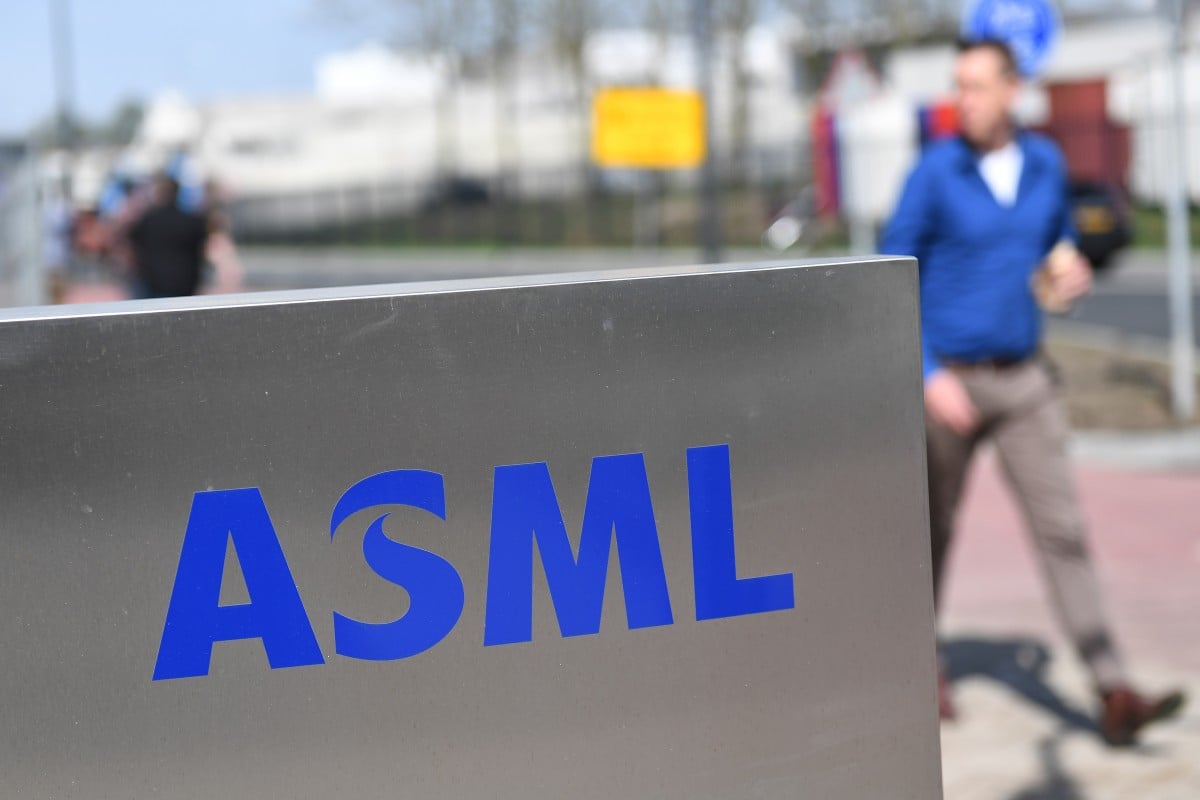
A newspaper in the Netherlands claims to have found evidence that six employees of Dutch semiconductor giant ASML passed corporate secrets to a company linked to the Chinese government. Photo: AFP
An investigation by a financial newspaper in the Netherlands has concluded that Chinese employees stole corporate secrets from Dutch semiconductor equipment giant ASML, resulting in hundreds of millions of dollars in losses.
The daily newspaper, Het Financieele Dagblad, reported on Thursday that ASML itself had “found no hard proof of involvement of the Chinese government” but that its own probe had determined that stolen technology had been ultimately leaked to a state-linked company.
According to the newspaper report, high-level Chinese employees in the research and development department of ASML’s US subsidiary were behind the breach.
An ASML spokeswoman said the company was aware of the report and was preparing a response.
The chip maker caught in US assault on China’s tech ambitions
ASML is the dominant maker of lithography systems, used to trace out the circuitry of semiconductor chips.
The newspaper based its report partly on company sources and partly on a November 2018 ruling by a California court in a suit between ASML’s US subsidiary and a subsidiary of a Chinese company, XTAL Inc.
The documents from the California Superior Court in Santa Clara show six former ASML employees, all with Chinese names, breached their employment contracts by sharing information on ASML software processes with XTAL, according to the report.
The Dutch intelligence agency has included warnings in its annual threat assessments for the past several years, saying that China is targeting tech companies in the Netherlands, as it does in other countries, for intellectual property theft.
In 2015, ASML disclosed a breach of its computer systems, but said at the time damage from the hack was limited and released few further details.
ASML’s sales to China doubled to 1.8 billion euros (US$2 billion) in 2018 from 919 million euros in 2017 as Beijing makes growth of its semiconductor industry a priority.
ASML CEO Peter Wennink said in January he saw no let-up in demand from China, despite an economic slowdown.
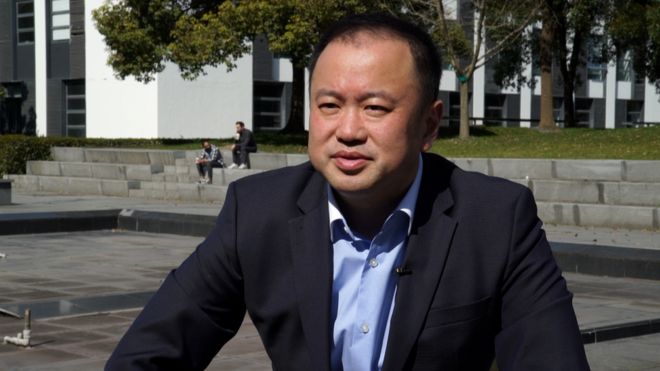
Image captionFrank Liu says his company Intco was the victim of intellectual property theft
There was no break in, no hold up. No glass was smashed. But the factory on the outskirts of Shanghai was the scene of a very modern crime. Someone stole a hoard of intellectual property.
“A couple of years ago one of my IT managers copied ten thousand pages of my entire company’s profile,” Frank Liu told me. His company Intco has been around for 25 years.
He told me the stolen download included “our technology information, our customer list, our purchasing and supply information. Everything.”
Intco is a business that makes medical devices, skirting boards and photo frames. I visited its offices at a business park in Shanghai, and a factory that sits either side of a tree-lined road south of the city.
The company recycles polystyrene waste sent to China from all over the world. Then, using heat moulding and imprinting techniques, it turns it into an array of products which end up on the floors of houses in Brazil or Russia, or hanging on walls displaying photos in the US and Britain.
“We actually have the record of how he stole it,” Mr Liu told me. “He just sold it to establish another company, as his investment.”
Mr Liu feels he has no recourse. He told me he went to the police but nothing happened. He said he still intends to pursue it.
His story is increasingly common here, for both local businesses and foreign firms.
Top officials from the US and China will hold their next round of trade talks this week and protecting intellectual property (IP) is a key demand for Washington. They argue American and other foreign companies in China have endured decades of theft and infringement.
China has taken some steps to address the problem. The country only established copyright laws in the 1980s, but things have progressed relatively quickly since then.
China now has specialist IP courts, albeit – like every aspect of the judicial system – subservient to the ruling Communist Party. They are supposed to settle cases within 12 to 18 months.
Their creation was not due solely to outside pressure from foreign firms.
Chinese business figures like Mr Liu have also called for the country’s legal system to better protect the innovators and entrepreneurs who have turned China into much more than the “copycat” economy it was once labelled.
Benjamin Qiu, an IP lawyer with US law firm Loeb & Loeb, told me that the Chinese are now just as litigious as foreign firms.
Foreign firms are just as likely to win a case – a good case, Mr Qiu added – as domestic plaintiffs. In the past few years Lego and New Balance have both won high-profile cases against copycat manufacturers.
There is no doubt that the trade war with the US has sped up the pace of reform in China.
The Foreign Investment Law states that the transfer of technology from foreign investors to any domestic partner must be voluntary. China has always defended this highly contentious practice by insisting it’s part of an agreed commercial arrangement.
The new law also bars government officials from passing on details of foreign investors IP.
A new era?
Now though comes the hard part – enforcement.
Mr Qiu told me the next step is “detailed regulation coming out after this law, and we want to see actual cases in local courts and also from enforcement agencies.”
If that follows, then he thinks “potentially the foreign IP owners will have more to protect [them] in China.”
Both the EU and American Chambers of Commerce welcomed the new law, but both also criticised what they said was ambiguity in the legislation. The Americans also had concerns that it was rushed through without proper consultation.
Many foreign companies have been stung over the years in China. Most have found the lure of the massive market, or what was once rock bottom labour costs, irresistible.
Some though feel the risk is too high.
A fruit industry executive recently told me his firm wanted to buy new conveyor belts for their farms in China, but the European manufacturers said no. They feared their systems would be copied here, and they’d be wiped out.
Mr Liu can’t do that. He is Chinese and wants to stay in China. But he has taken steps to try to prevent another IP theft.
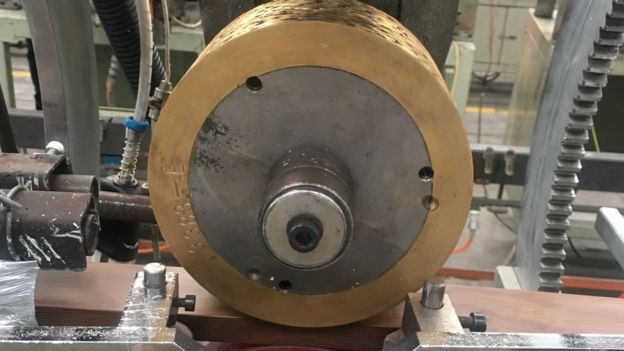
Image captionProduction line used to create photo frames at an Intco factory in Shanghai
He is chief executive of the company he founded, but this year he told me he’s changing his title to include head of research and development. Because he can’t trust anyone else with the firms’ commercial secrets.
Protecting original ideas, techniques and information in China – “it’s a human right” he told me.
(This Feb. 24 story corrects paragraph 12 to show Huawei was world’s third-largest smartphone vendor last year, not second largest)
BARCELONA (Reuters) – China’s Huawei welcomed comments from President Donald Trump about the future of U.S. mobile communications on Sunday and asserted its position as a world-leading smartphone producer as Washington and Beijing seek a trade war ceasefire.
U.S. and Chinese negotiators are set to meet for a sixth straight day of negotiations on Sunday as they work to strike a deal ahead of a March 1 deadline on a trade dispute which has disrupted global commerce and slowed the world economy.
At the center of the imbroglio is Huawei Technologies, accused by Washington of sanctions busting, intellectual property theft and facilitating Chinese state espionage operations.
Speaking ahead of the mobile industry’s biggest global event which begins in Barcelona on Monday, Huawei Chairman Guo Ping reiterated his company’s position that it has never and would never allow any country to spy through its equipment.
Guo, who holds Huawei’s rotating chairmanship, said Trump’s recent assertion that the United States needed to get ahead in mobile communications through competition rather than seeking to block technology was “clear and correct”.
Trump’s tweets on Thursday did not specifically mention Huawei, the world’s largest producer of mobile network equipment, but appeared to soften earlier U.S. statements that it should be barred from Western networks on security grounds.
“I have noticed the president’s Twitter, he said that the U.S. needs faster and smarter 5G, or even 6G in the future, and he has realized that the U.S. is lagging behind in this respect, and I think his message is clear and correct,” Guo said, speaking through an interpreter.
He said the United States did not represent the whole world and called for equipment makers, network operators and governments to work together to devise trustworthy standards to manage cyber security risks.
The Huawei logo is displayed ahead of the Mobile World Congress (MWC 19) in Barcelona, Spain, February 24, 2019. REUTERS/Sergio Perez
“We need to have unified standard that should be verifiable. It should not be based on politics,” Guo said.
FOLDING PHONE, RIGID PRICE TAG
Huawei also sought to reaffirm its position as one of the world’s leading technology companies, unveiling a folding 5G smartphone to an audience of media and analysts in Barcelona.
Huawei, the world’s third-largest smartphone vendor after Samsung and Apple, said it had taken the lead in developing phones for 5G – which promises super-fast internet speeds – because it was also involved in developing the networks.
The new Huawei Mate X will have two back-to-back screens which unfold to become an eight-inch tablet display, and goes on sale later this year priced at 2,299 euros ($2,607), setting a new upper limit for consumer smartphones.
Samsung had unveiled its own folding smartphone last week, priced at nearly $2,000, as part of a bid to top the technology of Chinese rivals and Apple Inc.
Thomas Husson, principal analyst at Forrester Research, said the Mate X showed Huawei was an innovative technology company and no longer trailing American and Korean competitors.
“The fact that Huawei is not just a network equipment provider but also a smartphone manufacturer … gives them a competitive advantage for 5G. It is also a double-edge sword as some argue the security risks are higher,” Husson said.
China’s Xiaomi, the world’s fourth-largest smartphone maker, also unveiled a 5G handset on Sunday, but without the folding screen or high price tags touted by the Huawei and Samsung devices. Xiaomi’s offering will start at 599 euros ($679) when it hits the market in May.



 CHINDIA ALERT: You'll be living in their world, very soon