Chindia Alert: You’ll be Living in their World Very Soon
aims to alert you to the threats and opportunities that China and India present. China and India require serious attention; case of ‘hidden dragon and crouching tiger’.
Without this attention, governments, businesses and, indeed, individuals may find themselves at a great disadvantage sooner rather than later.
The POSTs (front webpages) are mainly 'cuttings' from reliable sources, updated continuously.
The PAGEs (see Tabs, above) attempt to make the information more meaningful by putting some structure to the information we have researched and assembled since 2006.
BEIJING (Reuters) – Mainland China reported no coronavirus deaths for the first time since the pandemic began, and a drop in new cases, a day before the central city of Wuhan, where the virus emerged late in December, is set to lift its lockdown.
China had 32 new infections by Monday, down from 39 a day earlier, the National Health Commission said.
For the first time since the commission began publishing nationwide data in late January, Hubei’s provincial capital of Wuhan saw no new deaths, joining the rest of mainland China, which has recorded none since March 31.
Wuhan, a city of 11 million that reported only two new infections in the past fortnight is due to allow residents to leave the city on Wednesday, for the first time since it was locked down on Jan. 23 to curb the spread of the virus.
With mainland China well past February’s peak of infections, authorities have turned their attention to imported cases and asymptomatic patients, who show no symptoms but can still pass on the virus.
Total infections in mainland China stood at 81,740 on Monday with 3,331 deaths, the commission said. It reported 30 new asymptomatic cases, nine involving incoming travellers. Of the new asymptomatic cases, 18 were in Hubei.
By the end of Monday, 1,033 asymptomatic patients were under medical observation.
TIGHTER LAND BORDERS
Overseas arrivals made up all 32 of the new cases with symptoms, down from 38 a day earlier. Total imported infections stand at 983, the commission said.
China faces the “dual risks” of imported infections and domestic cluster outbreaks, a commission spokesman told a briefing on Tuesday.
The northeast province of Heilongjiang reported 20 new cases, all in Chinese citizens returning from neighbouring Russia. It had reported 20 new infections on Sunday, all also cases imported from Russia.
On Tuesday, the Chinese consulate in the Russian city of Vladivostok near the border with China said it strongly reminded Chinese nationals not to return home through the border port of Suifenhe, which is to be closed to all arrivals from Tuesday.
China has shut its borders to foreigners as the virus spread globally, though most imported cases have involved Chinese nationals returning from overseas.
The number of inbound travellers through airports is fewer than 3,000 a day, down from about 25,000 in late March, before China slashed the number of international flights.
It also started testing all international arrivals for the virus this month.
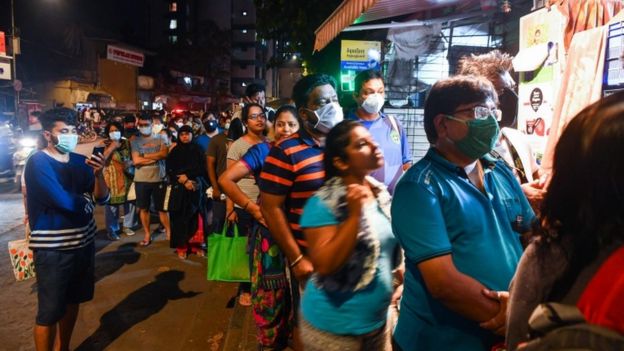
But in Delhi and the financial capital, Mumbai, people fearing shortages quickly thronged shops and pharmacies.
“I have never witnessed such a chaos in my life,” the owner of one store in the Shakarpur district of Delhi said, quoted by the Press Trust of India.
“All our stocks, including rice, flour, bread, biscuits, edible oils, have been sold out.”
Police in the busy city of Ghaziabad, in Uttar Pradesh state, patrolled the streets with megaphones to tell residents to stay indoors.
Image copyright AFPImage caption People in Mumbai rushed to stock up on essentials following Mr Modi’s address
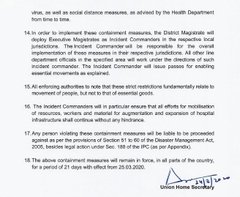
Under the new measures, all non-essential businesses will be closed but hospitals and other medical facilities will continue to function as normal. Schools and universities will remain shut and almost all public gatherings will be banned.
Anyone flouting the new rules faces up to two years in prison and heavy fines.
In his address, Prime Minister Modi also:
Stressed that the 21-day lockdown was “very necessary to break the chain of coronavirus”
Emphasised the seriousness of the situation and said that even developed countries had faced problems in combating it
Said that “social distancing was the only way to stop” the virus spreading
Announced that nearly $2bn (£1.8bn) would be made available to boost the country’s health infrastructure
Called on people not to “spread rumours” and to follow instructions
His announcement came after several Indian states introduced measures of their own, such as travel restrictions and the closure of non-essential services.
India has already issued a ban on international arrivals and grounded domestic flights. The country’s rail network has also suspended most passenger services.
Many parts of India, including cities such as Delhi and Mumbai, are already under tight restrictions. But this move extends those provisions to every corner of the country.
An earlier one-day curfew, which was seen as a trial, was flouted by many.
Mr Modi called on Indians to clap and cheer the emergency services from their balconies on Sunday. But many misunderstood the call and congregated in the streets as they danced and chanted.
“It’s impossible to fathom the cost that India may have to pay if such irresponsible behaviour continues,” Mr Modi warned at the time. “Social distancing is the only option to combat coronavirus.”
The implications of a total lockdown in India are huge, not just economically, but socially.
This is a nation where community is everything. Going to worship at a temple, mosque or church is an essential part of daily life for so many.
This is a seismic cultural shift but – like the rest of the world facing similar restrictions – a necessary one.
What’s the latest from around Asia?
Neighbouring Pakistan has almost twice as many confirmed cases – 878 as of Monday evening. Sweeping restrictions are in place although the government has stopped short of imposing a nationwide lockdown. However, several provinces have announced them independently. The army is being brought in to help enforce the restrictions
Bangladesh, which has reported 33 cases and three deaths, is also deploying its armed forces to help maintain social distancing and boost Covid-19 preventive measures. The soldiers will also monitor thousands of quarantined expatriate returnees. Across South Asia, there are concerns that the actual number of cases could be much higher than is being reported.
Indonesia, which has 49 confirmed Covid-19 deaths – the highest in South East Asia – has converted an athlete’s village built for the 2018 Asian Games into a makeshift hospital for coronavirus patients. A state of emergency was declared in Jakarta on Monday
In Thailand, a month-long state of emergency which will include curfews and checkpoints will begin on Thursday. The government has been criticised for failing to take strong action so far. Four people have died and nearly 900 tested positive
The most populous country that was without a case until now – Myanmar – has announced two cases
And what about the rest of the world?
Elsewhere, governments are continuing to work to stem the spread of the virus which has now affected more than 190 countries worldwide
More than 2.6 billion people are in lockdown now India has introduced its new measures, according to a tally by the AFP news agency
Media caption Reality Check tackles misleading health advice being shared online
Europe remains at the epicentre of the pandemic. On Tuesday, the death toll jumped by 514 in a single day in Spain and other European countries also reported sharp increases
Italy is the worst affected country in the world in terms of deaths. The virus has killed almost 7,000 people there over the past month
The World Health Organization (WHO) has warned that the US has the potential to become the new epicentre of the pandemic
In other developments, Japanese Prime Minister Shinzo Abe said the International Olympic Committee has agreed that the 2020 Tokyo Olympics should be postponed by a year










 CHINDIA ALERT: You'll be living in their world, very soon