26/09/2019
- Visually spectacular and with the latest technology, the Chinese capital’s second international airport is open for business
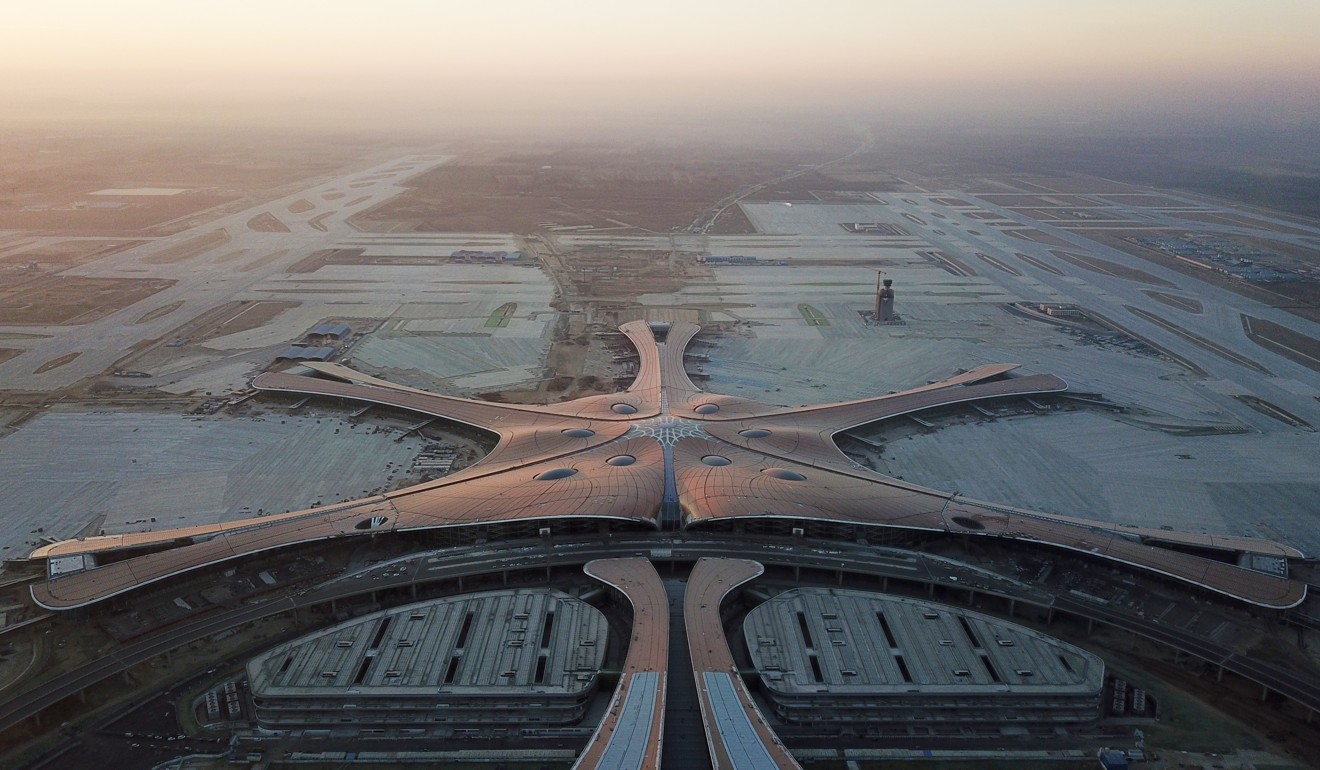
The terminal building at Beijing Daxing International Airport, which has officially opened. Photo: Xinhua
At 4.23pm on Wednesday a China Southern Airlines A380 left Beijing for Guangzhou – on the first commercial flight out of the world’s latest and largest airport terminal at Daxing, five years after construction began on the ambitious project.
The 80 billion yuan (US$11 billion) Beijing Daxing International Airport was officially opened by Chinese President Xi Jinping on Wednesday morning.
China Southern Airlines, the mainland’s largest carrier, has 40 per cent of the flight slots at the new airport. It is one of 16 airlines which will be operating out of Beijing Daxing International Airport, the visually spectacular new facility at the southern end of the Chinese capital.
Six other flights, including China Eastern Airlines for Shanghai and Air China for Chengdu, took off before 5pm in the afternoon. These domestic airlines will have part of their operations moving to Daxing for the upcoming winter-spring season, according to the mainland’s aviation authority. No Hong Kong airlines were listed.
British Airways has announced its whole operation will be moved to Daxing, while some foreign airlines, such as Ethiopian Airlines, Polish Airlines, Malaysia Airlines, Royal Air Maroc and Finnair, will operate at both airports.
Spanning 47 sq km (18 square miles) – almost 50 per cent larger than the city of Macau – Daxing, with its 700,000 square metre (7.5 million sq ft) terminal is a spectacular sight. Its futuristic shape, resembling a giant hexagonal starfish or – as some internet users have dubbed it – an alien base, not only handles more aircraft, it also keeps passengers’ walks
From the centre of the security check to the furthest end gate in each wing is about 600 metres (1,970 feet), or less than an eight-minute walk.
Beijing’s new 7-runway, star-shaped Daxing airport opened by Xi Jinping
According to Xinhua, more than 70 restaurants, tea shops and coffee houses will operate in the airport, along with 36 international brands, including Louis Vuitton, Gucci and Bottega Veneta.
Daxing is designed to take pressure off the overcrowded Beijing Capital International Airport (BCIA) and, by 2021, is expected to handle 45 million passengers a year, rising to 72 million by 2025.
Located at the south of the capital, 46km (28.5 miles) from the central Tiananmen Square, the airport was once frowned upon for its less than optimal location, with its southern end at the border with Hebei province. But it may not be as time-consuming for travellers as originally thought.
The design of the airport means passengers will walk a much shorter distance to the check-in and security check.Hu Haiqing, China Southern Airlines
Hu Haiqing, deputy general manager of China Southern Airlines’ operation control centre, told Global Times that “although Daxing is further away from downtown Beijing than the Capital airport, there are still some advantages, especially for our airline”.
With most of its bases in the south of the country, China Southern Airlines flights to Daxing will be 10 to 15 minutes shorter than to the Capital airport. A further 15 to 20 minutes taxiing time will also be saved, thanks to its position in the new airport.
“The design of the airport also means passengers, once they leave their car or train, will walk a much shorter distance to the check-in and security check,” Hu said.
According to Xinhua, Daxing’s design also makes transit much quicker, with transfers between international and domestic flights up to 90 minutes shorter than from the Capital airport.
The futuristic shape of Daxing airport not only handles more aircraft, it also keeps passengers’ walks to a minimum. Photo: Xinhua
Public transport will be the quickest way to reach the new airport from downtown Beijing – 20 minutes from West Beijing railway station once the Beijing-Xiongan high-speed rail officially opens. The airport express service will also take passengers from Caoqiao station to the airport in 19 minutes.
There is no underground rail service or airport express connecting the Capital airport in the north with Daxing, but passengers can change trains at Caoqiao for downtown Beijing or other stations which connect with BCIA’s airport express service.
Waiting times at the new airport will be greatly reduced by the use of facial recognition technology for self-service check-in and smart security checks, according to Wang Hui, manager of Daxing’s terminal management department.
The technology does away with the need for a paper boarding pass and passengers can check-in, with or without luggage, and go through the security check by themselves.
Beijing is the window for China to go global … Daxing airport makes it possible to open more global routes.China Eastern Airlines pilot
“The airport has more than 400 self-service check-in kiosks, which means more than 80 per cent of check-ins will be self-service. That shortens each passenger’s queuing time to no more than 10 minutes,” Wang told Global Times.
“The smart security check channels are able to handle 260 passengers per hour, 40 per cent faster than using traditional means,” he said.
The opening of Daxing Airport could be a great boost for the mainland – and even the global – aviation industry by easing pressure on the Capital airport and making new routes possible, said a veteran China Eastern Airlines pilot who declined to be named.
5 things we know about Beijing’s new Daxing International Airport
Opening new flight routes from BCIA was almost impossible, he pointed out, because the centre of Beijing was a no-fly zone for security reasons. Daxing airport’s location at the southern end of the city, however, avoided the problem of planes having to bypass the restricted space, leaving room to open more routes for domestic and international flights.
“Beijing is the window for China to go global but the Capital airport’s schedule is saturated and unable to open new routes. Daxing airport makes it possible to open more global routes,” the pilot said.
He said the runway design at Daxing also meant fewer delays, because the four runways of phase one – more than any other airport in China – included one which was perpendicular to the other three, allowing flights to land and take off regardless of wind direction.
Source: SCMP
Posted in Air China, Aircraft, airport express, airport express service, alien base, announced, aviation authority, aviation industry, Beijing, Beijing Capital International Airport (BCIA), Beijing-Xiongan high-speed rail, both airports, Bottega Veneta, British Airways, capital, car, Chengdu, China Eastern Airlines, China Eastern Airlines pilot, China Southern Airlines, Chinese capital, Chinese President Xi Jinping, coffee houses, Daxing airport, domestic flights, downtown, Finnair, giant hexagonal starfish, Global Times, Guangzhou, Gucci, Hebei province, international, kiosks, largest carrier, latest technology, Louis Vuitton, Macau, mainland, Malaysia Airlines, new airport, paper boarding pass, passenger’s queuing time, passengers’ walks, Polish Airlines, public transport, quickest way, restaurants, Royal Air Maroc, second international airport, self-service check-in, Shanghai, smart security checks, takes flight, tea shops, Tiananmen Square, Train, transfers, transit, Uncategorized, underground rail service, Visually spectacular, West Beijing railway station, whole operation, world’s largest terminal, Xinhua |
Leave a Comment »
17/08/2019
- Chinese government advisers say Beijing has not reached direct intervention point but that could change if the violence continues
- Military action would trigger international backlash, observers say, as US expresses concern over reported paramilitary movements and ‘erosion of Hong Kong’s autonomy’
Footage of trucks from the paramilitary People’s Armed Police in Shenzhen has circulated online. Photo: Handout
The unrest in Hong Kong does not yet warrant direct intervention by Beijing despite hardening public sentiment and calls for tougher action in mainland China, according to Chinese government advisers.
Shi Yinhong, an international relations expert at Renmin University and an adviser to the State Council – China’s cabinet – said China would risk damaging its ties with the United States and other major foreign powers, upsetting its own development and losing Hong Kong’s special status if it took the matter directly into its hands.
“I don’t think we need to use troops. Hong Kong police will gradually escalate their action and they haven’t exhausted their means,” Shi said, expressing a view shared by other mainland government advisers and academics.
But he warned that if the violence and chaos continued, it “won’t be too far away from reaching that point”.
A US State Department spokeswoman said the United States was “deeply concerned” about reports of paramilitary movements along the Hong Kong border and reiterated a US call for all sides to refrain from violence.
She said it was important for the Hong Kong government to respect “freedoms of speech and peaceful assembly” and for Beijing to adhere to its commitments to allow a high degree of autonomy for Hong Kong.
She said the protests reflected “broad and legitimate concerns about the erosion of Hong Kong’s autonomy”.
brought the city’s air traffic to a halt and triggered
a huge backlash on the mainland
, where the public feel they have been wrongly targeted by the increasingly violent protesters. Many demanded the central government take action to end the chaos.
The tension deepened after US President Donald Trump, citing intelligence sources,
to the border with Hong Kong. Trump described the situation in the city as “tricky” and called on all sides to remain “calm and safe”.
Footage of trucks from the paramilitary People’s Armed Police rolling into Shenzhen began circulating online on Saturday.
Beijing ‘unlikely to intervene’ in Hong Kong as pressure mounts on police
But Shi and others said direct intervention would be too costly to China and would only be used when all other methods had been exhausted.
“As the trade war with the US goes on, Hong Kong’s importance to our financial system is getting bigger,” Shi said. “If Beijing intervenes with too much assertiveness, the US might revoke the preferential status of Hong Kong.”
He was referring to the US’ 1992 Hong Kong Policy Act which gives the city a special status. In June, American lawmakers introduced a bipartisan bill requiring the US government to examine Hong Kong’s autonomy annually to decide whether to extend the arrangement.
Losing that status could cripple the operations of many businesses based in Hong Kong, said Shen Dingli, a Shanghai-based international affairs expert.
A satellite image appears to show a close-up of Chinese military vehicles at Shenzhen Bay Sports Centre in Shenzhen. Photo: Maxar Technologies
Wang Yong, another specialist on international political economy with Peking University, agreed.
“There would be a lot of opposition from interest groups in the US. Hong Kong is the bridgehead for many multinational corporations and investors from Wall Street to get into the Chinese market,” said Wang, who also teaches at an academy affiliated with China’s Ministry of Foreign Affairs.
“Hong Kong and the Chinese government will need to handle this with extra care, so as not to give any ammunition to hawks in the United States.
“If Hong Kong is not handled properly, it could add tensions to the bilateral ties and ruin any prospect of a trade deal.”
China rejects requests for US warships to visit Hong Kong amid protests Pang Zhongying, an international relations specialist at Ocean University of China in Qingdao, said direct intervention could also damage China’s ties with other countries.
“The whole world is watching. Beijing has exercised restraint for two months and still hasn’t taken any clear action because this is not an easy choice,” said Pang, who is also a member of the Beijing-based Pangoal Institution, a think tank that advises several ministerial offices.
While some observers said Beijing was under political pressure to end the protests in Hong Kong before October 1 – the 70th anniversary of the founding of the People’s Republic, Shi said the central government would not lose patience so easily.
“National Day [on October 1] is an important time, but the Chinese government is not naive to believe there has to be peace under all heaven then,” he said.
“It’s only a bit more than a month from now, we can almost say for sure the trade war will still be on by then and a major turning point in Hong Kong is not likely to happen. But the celebration must go on.”
Source: SCMP
Posted in 70th anniversary, American, autonomy, backlash, Beijing, bipartisan bill, celebration, China alert, China's cabinet, China-US trade war, China’s State Council, concern, direct intervention, financial system, foreign powers, Hong Kong, international, lawmakers, Mainland China, military action, Ministry of Foreign Affairs, Ministry of Foreign Affairs (MFA), National Day, Ocean University of China, Pangoal Institution, paramilitary, peace under all heaven, People's Armed Police, People’s Republic, preferential status, Qingdao, quell, Renmin University, Risks, Risks still too big, send in troops, Shenzhen, Shenzhen Bay Sports Centre, trade war, trigger, Uncategorized, United States, unrest, US, US President Donald Trump, US warships, US’ 1992 Hong Kong Policy Act |
Leave a Comment »
11/12/2018
Chinese Vice President Wang Qishan delivers a keynote speech during the opening ceremony of the 2018 Imperial Springs International Forum in Guangzhou, south China’s Guangdong Province, Dec. 10, 2018. (Xinhua/Zhang Ling)
GUANGZHOU, Dec.10 (Xinhua) — Chinese Vice President Wang Qishan on Monday said China will follow the trend of history, adapt to and lead economic globalization while eliminating its side effects, maintain the rules-based multilateral trading system, enhance equal consultation and cooperation, and jointly build an innovative, inclusive and open world economy.
The remarks came as Wang attended the opening ceremony of the 2018 Imperial Springs International Forum in China’s southern city of Guangzhou.
Some 200 former world leaders, renowned scholars and business elites gathered here to exchange their views on “Advancing Reform and Opening-up, Promoting Win-win cooperation”.
This year marks the 40th anniversary of China’s reform and opening-up, which, according to Wang, is a glorious chapter for the Chinese nation’s great rejuvenation history, and not only profoundly changed China, but also deeply influenced the world.
Reviewing China’s reform and opening-up, Wang stressed that the process is linked to the exploration and practices of socialism carried out 30 years before 1978, the history of Chinese people’s struggle for national rejuvenation since 1840, as well as the sufferings and glory of the Chinese nation over the past 5,000 years.
“The sufferings and glory of history are the source of the present,” said Wang, adding that socialism with Chinese characteristics has entered a new era and the Chinese nation is closer to the goal of great rejuvenation than any other time in history.
He said the door to China will never be closed and will only be opened wider and wider, and this is a strategic choice based on China’s development needs.
China will firmly adhere to its own path, work in a down-to-earth way on its own tasks, continue mutual learning and cooperation with other countries, build a peaceful world, contribute to global development and maintain international order, Wang said.
Noting that the interests of countries around the world are deeply intertwined nowadays, Wang said China will be committed to the path of peaceful development, uphold new forms of international relations featuring mutual respect, fairness, justice and win-win cooperation, and build a community with a shared future for humanity featuring lasting peace and common prosperity.
Posted in China alert, forum, Imperial Springs, international, Uncategorized, VP |
Leave a Comment »
07/12/2018
Yang Xiaodu, a member of the Political Bureau of the Communist Party of China (CPC) Central Committee, deputy secretary of the CPC Central Commission for Discipline Inspection and head of China’s National Supervisory Commission addresses a reception for the 15th International Anti-Corruption Day in Beijing, capital of China, Dec. 6, 2018. (Xinhua/Shen Hong)
BEIJING, Dec. 6 (Xinhua) — A senior discipline official Thursday called for upholding the authority of the United Nations and the principal role of the U.N. Convention against Corruption in global anti-corruption cooperation.
Yang Xiaodu, deputy secretary of the Communist Party of China Central Commission for Discipline Inspection (CCDI) and head of the National Supervisory Commission, made the remarks at a reception to observe the 15th International Anti-Corruption Day, which falls on Sunday.
Yang also called for advancing full and rigorous governance over the Party and combat against corruption in China.
U.N. Secretary-General Antonio Guterres sent a written congratulatory message to the event, reaffirming that the U.N. valued and supported international anti-corruption cause.
Representatives from 125 countries and international organizations in China attended the reception.
Posted in Anti-Corruption, China alert, hosts, international, reception, Uncategorized |
Leave a Comment »




 CHINDIA ALERT: You'll be living in their world, very soon